ve-BINAR Keeping IP Confidential with a Fractional and Interim Sales Leader
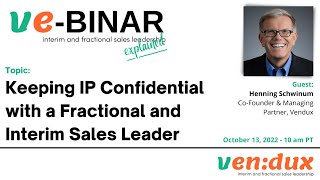
Webinar discussion (hosts: Andrew Miller and Henning Schwinum) about protecting intellectual property and confidential business information when using fractional/interim sales leaders (1099 contractors) versus W2 employees. Key points: NDAs are useful for both employees and contractors and should be tailored (specific carve-outs, mention critical IP explicitly); trade-secret litigation involving employees is common but data does not show employees are inherently more trustworthy than contractors; sales roles raise specific risks because of customer/contact data and CRM exports. The session closes with audience Q&A emphasizing mutual NDAs, explicit CRM/contact prohibitions, and protecting contractors’ own IP and reputation.
Chapters
Hi, folks. Good morning. Or good afternoon, depending on where you are. I'm based in the Bay Area. My name is Andrew Miller. I'm one of the partners within the Vendux Group, and I'm here with Henning Chavinham, the firm's co founder and managing partner. Great to have you. Great to see you. Just a quick housekeeping note. So we're going to keep everyone muted for the duration of the webinar and then we'll have a Q and A right at the end. So feel free to use the chat function in zoom to submit your questions. But we're also going to open up the floor at the end of the session so that you can ask your own questions if you prefer. So let's jump right in onto the topic of the webinar. Henning. In a recent conversation with a founder, as you know, she shared with us that it was important to her that certain positions, like her VP of sales, would be a W2 employee, given the confidential business information that they would have access to. For me, this was a first. So, Henning, from your perspective, have you heard this before and to what extent have you heard this among our clients and the people that we work with over the years?
Yeah, I mean, the straight answer is yes, I have unfortunately heard it before. It was brought up to me in a number of conversations, generally in the context when we talk about the fact that a fractional or interim sales leader comes in as a 1099 contractor. And the nature of this question got me thinking. And that's why we said we'll have a webinar, a webinar about it. You know, are W2 employees better at keeping proprietary information? Personally, my straight response is absolutely not, because I think it all depends on the person and not the type of employment. But I mean, at a deeper level, what prompts someone to think that and what factors come to play in answering it beyond personal feeling? And so that's why we decided to have this webinar. And our council has asked us to make sure that we include the following disclaimer, and I'm going to read it verbatim. The content of this webinar is not a substitute for professional legal advice. It does not create an attorney client relationship, nor is it solicitation to offer legal advice. So after this disclaimer, Andrew, let's get along here.
Yeah, for sure. So the stats that I've seen indicate that about 33% of the US workforce is bound to their company by an NDA. NDAs force employees to be silent about anything from trade secrets to sexual harassment, for example. And these have been growing in numbers as companies become increasingly worried about competition and reputation. So wouldn't NDAs address this issue once and for all for W2s and for 1099s?
Well, the number 33% or 1/3 applies to the W2s. And frankly, one third isn't a really high number, especially when most commonly an NDA is not just signed as a condition of employment when it begins, but also, and in some cases just after or just as a severance package is closed or a settlement agreement of some sort is reached. But for a business, it is definitely a good idea to sign an NDA with their employees. I mean, there are all these different risks involved. There is the loss of confidential information. Every time an employee leaves, they're undoubtedly taking information with them, even if it's just in their heads. And the NDA places a legal obligation on the employee to keep that information secret and not misuse it even after they leave the company. There's also the psychological deterrent of signing an agreement. An NDA often also clarifies IP ownership rights to avoid misunderstandings and vagueness. It is good to let an employee know right away that, you know, that the IP ownership out of their employment lies with the employee, with the employer. And of course, it's always good to clarify in more detail with the employee what needs to be kept confidential. I mean, we all know these very generic long lists of pieces of information that are part of a lot of different contracts. But if, if your business has something very particular, then it's a good idea to mention that. So I think yes, for a W2, an NDA does address all of those concerns from an employer perspective.
Yeah, so it does make good business sense to use an NDA as a condition of employment. But actually, hub for a 1099 contractor, over time, independent contractors work for a number of clients, and they might actually do work for a competitor of one of their clients at some point.
Yeah, I think most people here on the Vibinar can attest to that because they're in this space and they work in parallel or in sequence for different companies. Also, a Solopreneur 1099 contractor is engaged in his or her own business, and at times they begin, they start new business along the way. They often work remotely or at night, and there is confidential information lying around in their office. And it's in a lot of cases, not intentional, but the opportunity is there for an unintentional breach. So it does make just as much business sense to sign an NDA with a contractor. And we've had many clients who have asked our executives to do so. In addition, or even better, it couldn't. It can be made part of every service contract that a contractor signs and have the service contract include that confidentiality. And again, we probably all have seen this language that would read something like that a contractor is obligated to protect proprietary information treated strictly confidential and that this provision shall continue beyond the term or the termination of the contract. And then also that, and that sometimes is missed that you know, that a lot of that confidential information at some point tends to get shared. But the client should make sure that every time they allow the contractor to share confidential information that it is limited to a single occurrence and tied to a specific piece of information and disclose to a specific third party so that it avoids that carte blanche that otherwise would be given. I think those, those are, that those are, that's typical and good practice language to use.
Isn't that all a little bit too generic, though?
Well, yes, the answer is yes, it is generic, but it can be enhanced. Like I said earlier, if your business has some specific pieces of information, some specific pieces of IP that are critical to you, mention it by name in the document and that you can do the same with, you know, the pieces of work that the executive does and that that particular product ownership or IP ownership stays with the client and that binds the contractor to secrecy and has legal ramifications if should they intentionally or unintentionally disclose that privileged information. And knowing that strikes home, I think, for a contractor and creates awareness to maintain that discretion long after a contract has ended.
Yeah, got it. So let's pivot now back to the central question from your point of view, are W2 employees better at keeping proprietary business information confidential? More than 1099 contractors?
Well, I stick with my earlier answer, absolutely not. But like in prior webinars, we, you know, went out and tried to research that subject a little bit to get some more objectified statistics and you know, overall straight. And I think that's been, that's a very well known fact. Trade secret litigations in courts is growing exponentially. It doubled from 88 to 95, doubled again by 2004, doubled again by 2017. And the reasons are clear. There is the whole technology advances in the digitized information that makes it easier to share things, but also makes it easier to inadvertently share it. And of course, everything we've seen, especially since 2020, which is the workforce mobility, the work from Home movement. All of those things are trends that create more opportunity for that type of litigation. There are statistics out there. So I'm looking here at some numbers. When those types of misappropriations were brought to Federal courts, only 9% were third parties. 59%, on the other hand, were employees or former employees. Now, companies have a whole lot more employees, typically than they have contractors. So it's not a surprise that there are more significantly more litigations happening around employees or former employees. In 2020 of the cases that resulted ultimately in a verdict, plaintiffs, the companies received a favorable ruling 68% of the time, and the defendants, whether they were employees or third parties, contractors, a favorable ruling only in about 24% of the cases. That's obviously good news for companies because there is a recognition that in over two thirds of the cases, their rights are being recognized by the courts. The last statistics is the question, is there a higher or lower success rate? And in 2020, of all the cases alleged misappropriate. That's a difficult word. Misappropriators who were also employees had a slightly higher success rate to receive a favorable routing than misappropriators who were third parties. So you could argue that that puts a contractor in a more difficult position because their success rate was lower versus an employee. However, statistically speaking, that difference was so small that it wasn't statistically relevant. And so, to me, if I take all of these data points in, I really don't see any evidence that suggests that one form of human resource engagement is more or less trustworthy than another. And I do believe that with the right legal framework, the NDA we talked about earlier, if that is in place, together with all encompassing ground rules, that broad language we talk about, the company specifics, and continued reinforcement, there really is no difference between an employee or contractor.
So all of those data points, I think this is like a brush, a broad brush stroke across all companies and all types of employees or contractors. But what about in the world of sales? So this is our area. Is there anything more special or unique about sales and confidentiality?
Yeah, I mean, obviously many of those cases involve the departure or the termination or misappropriations of sales personnel. I mean, it's an area that you could call it ripe for the theft of data and ripe for the theft of, for the claims that data has been stolen, because these employees are, as we know, responsible for revenue generation, and they, historically at least, have spent years cultivating, maintaining, and growing customer relationships. I use the word historically for a reason, though. Because the tenure of a sales rep or a sales leader continuously decreases. And with more and more of the sales process happening online and without a sales touch, there's also less of a relationship that's actually driving sales success. Not in all areas, but in more and more areas. And therefore, should these employees depart for a competitor or be terminated, the potential to experience damages is, while higher than in other positions continues to decrease because the relevance of that salesperson and the relationship, the value of that relationship they have decreases. Now because it's a sensitive area and because companies are, are feeling that they are being damaged. There are more and more companies that are proactively pursuing claims to protect their position and what they see as their customer base. And thus companies are pursuing those trade secret claims as soon as they become apparent. And they also want to set a tone for their employed workforce, sending a very clear message that disregard for their employment agreements for their NDA that was signed will not be tolerated. Now, in all of that sales may be different from other company functions, but as far as I can see, there's really again, no difference between a sales employee and a sales contractor if all the things are in place that we discussed earlier.
Yeah, yeah, these are great points. I suppose it's also easier to bring suit against a contractor to make a statement to internal employees. So that's great. Really good content. So we're essentially towards the end of the webinar, but I want to open up the floor to questions. A couple are coming in through chat, but also we'll unmute everybody in case you want to ask your own questions and just engage in a conversation. But before I do, I just. It's maybe useful to just to repeat and reiterate your disclaimer at the top of the hour. Henning, that the content of this vibinar is not a substitute for professional legal advice. It does not create an attorney client relationship and it's not a solicitation to offer any legal advice. So I just want to reiterate that and then over to a couple of questions. So, Tim, this is a really interesting question that you've written. Do you mind if it's. It's probably a lot easier if you just come off of mute and ask this question in, in your own voice because I don't want to screw up the question. It's. There's a lot in here.
Yeah, it's. It's less of a question and more of a lesson learned observation. I have specifically run into the situation where I think it's really important with an NDA for either an existing salesperson, employee, or contractor to be. You know, I think contractors get it. They. They know their. Their reputation will follow them. But in the case of a employee, a specific salesperson, you want to be careful in that NDA to specifically call out leads and current contacts and accounts. And it's kind of a. Almost an accepted practice that, you know, has gone on where if a salesperson is leaving, they're allowed to take their book of business or not. But you have to be really careful. It takes like. It takes like 30 seconds to download an entire spreadsheet of everything that a company has sold. And in any CRM system, you can do that pretty easily. So my recommendation, because I've seen it happen in the past a few times, is specifically call out, hey, the database of contacts, accounts and leads shall not be something that they walk away with. And, you know, it could be potentially tough to enforce, but I would specifically call that out.
Yeah, I think, Tim, that that's a great point. Thank you. And sort of along the way, you said something about the reputation, and I think that's really important as well. And it's something that I tend to emphasize to potential clients as well. The fact that a contractor, somebody that's in this gig space and that is looking to take on new clients on an almost ongoing basis, is very acutely aware that his or her reputation is the key to winning the next. The next gig, the next assignment. And therefore they're a whole lot more aware and careful about not damaging their reputation by even creating the impression that they might have done something because even the impression is enough to damage their reputation.
Yeah, agreed. Thank you.
Thanks, Tim. Yeah, great. Great point from Dan here. This is also very pertinent. So in the. In the world of fractional sales leadership, where we're often arriving at a new client in a new client environment and an engagement, we're arriving with years of relationships and contacts. So we're bringing those to the table. So to what extent should these be carved out or outlined in an agreement, some kind of document ahead of the engagement? And then, you know, in a related way, what happens at the end of the engagement with those contacts that ip who, you know, the fractional sales leader still owns those that they've not been given or ported over in any way to the client environment?
Yeah, even more so, there are a number of clients who specifically ask for executives to bring a Rolodex to the table and connections to the table, and that can be spelled out in a contract. You can say, this is what the executive brings. It might be difficult to spell it out by name, company name or contact name, but it can definitely be included on a generic basis that any contact that the executive brings to the client is excluded from. From that confidentiality clause.
Yep. Yeah, good. Good point, Dan. Anything else for the moment? Anybody else want to chime in with a comment? Perspective? Question?
Yeah, I have a question. Henning, you didn't speak about mutual non disclosure mutual NDAs. I use mutual NDA more of a marketing. More in my marketing because I want to protect my IP as much as a client might want to protect theirs. Usually my clients don't have IP that would be so unique, so distinct from their competition that they would legitimately protect it. But I think it makes sense to have a mutual non disclosure, not just a one way unilateral non disclosure.
It's just.
It worked in my to do it that way.
Yeah, Dan, I think that's a great point. Especially when you know. And that goes to the other Dan's point. If you know you're bringing something to the table, that's your ip, you want that protected as well. Now if we, if we just go and compare, you know, an employee to a W2 to a 1099, those are typically unilateral because it's. The employee tends to not bring that kind of IP to the table.
Sure, but I'm not going to a W4.
Yeah, no, and you're right. As a seasoned contractor with anywhere between 20 and 40 years of experience and contacts and skills and methodologies, yes, there is IP that exists on the executive side as well.
At some point you become unemployable. So like me, who's gonna hire me?
You're, you're very humble, Dan Prosser. You, you and your.
I don't want to work for someone else. What are you talking about? They don't want me working for them. Reporting to them, that's for sure.
No, but they, they want your content. Sure.
I want my ip.
Of course.
Okay, I'm muting.
Very good. Great stuff. Good engagement here. All right, well, we are. We're half past the hour. Anybody else want to chime in before we wrap up? Yeah. Hey, Mitch, come on. Thank you. Mitch, we can't hear you.
How about now? Yes, I did unmute. I just didn't have an actor microphone on, so. Forgive me, Andrew.
No problem.
All the things that I said before were the important things, which I now forgot what they are. So for all the folks in the room that are much smarter than me and wiser, a Question for the group. So I have a new customer, been getting very busy quickly hunting by the way, and I'm training their team and one of the, one of the people that's ahead of this business unit said, oh, this is really awesome, super great. I'm really hoping that this one person on the team can learn all this so then she can go and teach everybody else later on. I'm thinking I don't want her to teach anybody else later on. I want her just to be smart, but not that smart. So my question for the group is, you know, I've developed 30 years plus years of how to really do well in large ticket complex selling, which is an art, but it's a developed art. You can teach somebody how to do well, but I don't necessarily want them to be able to repeat the process to somebody else right now. Want to keep them, you know, on the, on the drip, the morphine drip. So what are yalls thoughts on that? You know, I want to protect my ip, my skill set as in teach them how to be great salespeople. But I don't, you know, if you want to learn how to be a great trainer of others, you know, that add a zero to whatever I'm charging you.
Well, I mean that goes to the, to the issue of the mutual non disclosures. You have your, you have an ip, you have your own intellectual property. So impressing upon a client that you intend to, to protect that ip I think is, is an important step to take. You know, it also puts more value on your IP when you inform someone that you intend to protect that ip, you know, and that it's unique which sets you apart from other people. So next month we're gonna, I'm gonna talk about myself, I'm gonna talk about categorization of a business and how you, how you categorize a business to distinctly separate it from the competition. And I think, you know, I like this conversation because I think it's a, it's a way to separate yourself from other people in the eyes of the client. A mutual non disclosure. A non disclosure is a, it's not often thought of by clients. It's not, I'm not asked. I suggest it, you know, I'm saying let's, let's, before we talk, let's, let's have a mutual non disclosure. So that, and I always say it elevates for me. Yeah.
Of the relationship.
It does. And it also impresses upon them that I've got something of value that I'm going to share with them and not gonna just spill it to you. I'm not, you know, and if you don't want to do a non disclosure, then you're not serious about talking to me. You're not serious about learning from me. I, I've got something that you don't have and I'm gonna share it with you and I intend to that you don't go out and resell it, which they're not going to anyway. But yeah, thanks. Yeah, does that help?
Good, good. That was great. All right, well, I don't see any other question in the chat with 35 after the hour. We are, we are back at this same channel the first Thursday of every month. This month is a bit of an anomaly. Dan will be our guest panelist next month. Dan Prosser. Really looking forward to that, Dan, and great to see everybody. Thank you very much for being here, for your participation and engagement. If you want to follow up at all with one on one conversations about anything that might be going on in your world that's pertinent to this subject to fractional sales leadership, to what's going on in the market, please feel free to reach out at any time. But in the meantime, thanks again. Good to see you. Have a great rest of the week. Henning. Thanks very much. Be well everybody. Take care. Thank you.
More from Henning




ve-BINAR - The Revenue Tornado Methodology: How 3 Power Sources Create Exponential Growth


ve BINAR: Executive Cloning: How AI is Reimagining the Role of the Fractional Executives




veBINAR: Unlock Client Value: Why Compliance is Crucial for the Startups You Serve
