ve-BINAR :Launch Your Business and Sell by Starting a Podcast
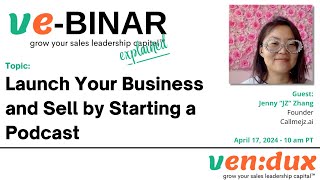
Henning Schwinum and Jay Z discuss how solopreneurs can use podcasts to engage prospects and grow their business. They cover AI ethics, leveraging AI in marketing, and strategies for product management. The webinar includes a Q&A with participants.
Chapters
Welcome, everybody. Welcome to this latest edition of our webinar. Happy to have everybody here and especially happy to have Jay Z as our guest. Welcome, Jay Z. Before we kick it off, a few housekeeping notes. We will be recording this session and make the link available afterwards. We tend to get a lot more engagement on the video than we have people actually participating live, but we still offer both versions and are very happy to do so. Please keep your microphones muted. In the first 25 or 30 minutes of the webinar, I will have the privilege of asking JZ questions. You can leave questions in the chat or wait for the Q and A that we'll have at the end and then you can unmute yourself and we'll have a Q and A session in total. We'll aim at being done after about 45 minutes. We don't want to overextend our welcome onto your screen and into your office. With that said, Jay Z, welcome again. I let you introduce yourself. Who are you and what makes you the perfect guest to talk about podcasting?
Thanks, Henning. Well, everyone, please call me Jay Z. Like the rapper, I am a expert in podcasting and AI. Not always together, but sometimes podcasting and I come together. And what makes me an expert is that as a solopreneur, I was able to start my podcast in less than one week, grown it to 50 episodes, and now help other people, other fractionals and solopreneurs like yourselves, launch their businesses and get more clients the same month via podcasting.
Well, we appreciate you sharing your experience. I'm sure in communities like Fractionals United or others, that sharing is greatly appreciated. Every solopreneur looks for peer to peer advice. Can you tell us a little bit about what brought you to this point, that you are now a founder and solopreneur yourself?
Yes. So I started as a designer and then became a product manager in sas, Tech, fintech, Social media Tech, and then became a founder. I think it's the moment when no code and AI became accessible, even with free trials, that I last year made the jump into working for myself.
Yeah. And tell us a little bit about what it is that you're selling. What's your service, your solopreneur service. So we can, we can put that into context with why you're using podcasts.
Sure. So in addition to podcasts, I sell AI. I can help you train and build a model. I can help you use other existing AI products that can help you answer the question, should I even use AI? That pesky question, like what are you doing with AI. And so the way that AI comes together with podcasting is that most people don't know who they're selling their AI to, like who their ideal customer profile is or who their target Persona is. So what I love to do is step, take a step back and do user research with who you think you're selling to. Ask them what their problems are, ask them, you know, how they want to be talked to, what the marketing language is, and then create a slide deck of patterns between your ICPs and then prioritization of who you should be going after. And then we'll do the AI, you know, build the AI to sell to them after and build the marketing to sell the AI to them after. But it's really understanding who you're helping that I thrive in.
Yeah.
So when you launched your business, you obviously were faced with the question, how do you engage with your icp and how do you get them to respond to your outreach, and how do you get them to buy into your services? What made you choose podcasts as the way to do this?
Yeah, so a lot of people have this still, like working in corporate mentality where they're gonna apply for a job. Right. But as a fractional, there is really no job listing. That's like, I want a fractional chief product officer. Every CPO I know does that through referrals and paths, really relationships. So how do you tap this hidden job market where there's no posting? And I didn't really do it intentionally, but every podcast guest I had was actually a leader, a prospect with the decision rights and the budget to hire someone like me. And then they would just tell me, I would ask them, like, what are your problems now? You know, because that's my superpower. What are your problems now? And then they would tell me after the podcast, and sometimes they'd want to hire me for product, sometimes they want want to hire me for marketing, and sometimes it was a combination. So they kind of led me to continue podcasting to my prospects.
In the invite to this podcast, we, we quote a 50 response rate. And I believe that number is comes from you. And I'd love to HEAR how that 50% is calculated. Is that literally people invited to your pod podcast versus attending or attending versus then having a follow up one on one with you? What does that rate 50% represent?
Attending. Okay, so think about all the people you're trying to get on to, calls to find out their problems. Tap that, you know, hidden job that they have. They haven't even created a listing or posting for, a lot of people will say, no, I don't want to talk to you now. I don't know you do. I have other priorities. But when you give them the gift of fame, and my students actually have a 80% attendance rate on their podcast, much higher. Right. Than me. And I love that. So they're getting weekly calls with clients, prospects, and leads on their podcast, and then they're filling their calendar the rest of the week with prospecting calls to get on the podcast. And so, long story short, it's the gift of fame. So if you're going to ask for advice or ask for a call with someone, what do they get out of it? They just lose 30 minutes of their time. But if you ask for advice from an investor or an influencer and report it, they don't have to answer that question again. It just plays over and over and over again. And then you make them extra famous, so you actually save them the time and you give them the additional fame. That's why people have this high response rate and they, they always say yes.
Yeah.
Now, now you, you blatantly disclosed why I'm on your podcast next week with that fame aspect.
Well, you know, honey, you are AI sales leader, so I know you're already famous, but I love making people famous and you're making me famous on your podcast. So it's a perfect win win.
It's a, it is a perfect win win. Now did, did you also try other channels, other ways to market at the beginning, just for comparison purposes?
Yeah. So there are a lot of people who are shy. They don't want to show their face on a live video podcast, which is what I usually do. And so for those people, I would say maybe just do an audio podcast. You don't show your face. Right. And then there are other people who are like, I just, I'm terrified of live. Like, I don't like, especially my AI friends and data science. They're like, I don't like being put on the spot and asking, being asked a question that I have to answer immediately. So they just write articles. And so whatever medium works for you. I would say keep it short. Like if you write a book, publish one page a day for 365 days. Right. That's your content calendar. But I wouldn't hide behind all this media and technology and have a calendar that's empty. Like, whatever gets you people booking your calendar, having a conversation with you is the medium that you need to choose. Because this business is all about referrals and and building trust through relationships.
And I can relate to that. I, I had great reservations about starting a webinar series or, or getting recording videos of myself when I started this business here five years ago. And I felt most comfortable writing. And so I started a blog immediately. So when you talk one on one with people who are, who are listening to you and who are saying, oh, I'd love to explore that, what's the number one hurdle you have to overcome? Is it the discomfort of being in front of the camera and being recorded or what else is it? What's the biggest hurdle that people have in your observation?
It's funny because it's about the fame. So they think of it as them being famous with a million followers. And I pivoted to making their guests famous. So my podcast service is called Give Take Giving the Gift of Fame and then getting five minutes to talk about problems and pitch your rational skills. So the number one hurdle is that people think that they have to be one to many famous, like one to a million famous, before they get that first client. They actually are scared of talking to prospects and leads and scared of closing that client that week. I think that's the weird hurdle. Like they want more business, but they're scared of actually going for it.
Yeah, I think I've seen that before as well. Even amongst people who spend 20 or 30 years in sales, it's one thing to sell a product or service from someone else as opposed to selling yourself. And when you sell yourself, you put yourself out there with, with all vulnerabilities that you have and, but you have to be, you have to really be firm on your strengths. And I love the word that you used earlier, your superpowers. Right. So that is the, that's the biggest hurdle that's interesting. The, the. So you're using, you're using a podcast to sell your AI services and your support of AI. Let's switch topics a little bit and talk about AI for a moment because that is something that everyone wants to do and I would assume very few people know how to do. So what do you encounter when you, when you sell your AI services to others?
So right now I start with the AI Brainstorm. That's my lead magnet. So I'm not selling AI, I'm just helping people understand if and should AI. Right. So the ethics is a barrier. You know, people don't want to.
Have.
AI do the wrong thing and they don't want to share their data, which they shouldn't, with like chat GPT. And so the first Thing I do is I help them understand what AI is, how to do it ethically, and then decide like, no, like, I don't want to do AI this year. It's not a part of my core business. It's not gonna monetize immediately. I'm gonna do it next year after I have 10 more partnerships. Right. So at least they get to answer that question for investors and all the trendy people out there. Like, no is a great answer. Because it's like, well, why not? Like, you must have a educated, informed thought process behind it. It, Right. And then for the people who are, yes, they're like, oh, okay, I can start in this easy way that helps me save time and money this week, like not next year. And so we pick, we prioritize, you know, using product frameworks, what the first place start is. But I think no is a great answer.
So when people say yes, what's a typical process for you to help them get started? What's, what's. Is there a prescribed step by step process or is it customized? And if it is, you know, what are the most common steps that business owners, CEOs, founders should take in order to apply the use of AI in their business?
Sure.
So the AI brainstorm I run goes through eight steps and the ones that are very specific to AI are one, understanding the history, like how do we get to this point of technology? Two is understanding the ethics. So how do you get a representative data set? How do you, you have a feedback loop. So if the AI is wrong, you can stop it from killing a person. You know, if you're in health, tech or self driving cars. And then the third is actually a list of all the AIs out there that might benefit your business. So it's like a menu. Oh, I didn't know you had this type of sales AI or this type of, you know, marketing AI. The menu really helps spark interest. And then the fourth is leadership alignment. So do we see value? Do we see value this year? This is more important than other strategic priorities because usually AI bumps out something else that you had promised your investors you were going to do this year. And then the fifth part is data. So when I worked in fintech and I controlled a machine learning team's resources, a lot of VPs would come to me and they'd be like, give it to me now, I want the model now. You know, they're like, I want the model before some other VP gets it. So is there data is the fifth step. You need to have a lot of data. To tell the model what to think. It's just a blank model. It's going to hallucinate whatever chatgpt told it to think unless you tell it what to think. But you need to have like a, not a terabyte, but you have to have enough structured and labeled data to get started to make a model. And then the sixth part will be, you know, what are the inputs? The seventh part is what are the outputs? And then the eighth part is how do we follow up and make sure it's doing what we wanted it to do. So I go through this very structured process and people really appreciate that because they didn't know they were these eight steps and it helps them align their leadership.
Yeah, I think. Do you find, or I would assume that you encounter quite a few people who start with the last point, the output. Right. What do they want AI to do and then forget the other seven steps prior?
Yeah, so I love generative video. That's where, you know, I do a lot of my own making videos and I'm starting to train a model. So, for example, like, of course you want a video, you want a AI to generate a video, but then that's not really the output. Right. The output is I want 5x more times views on my video. And to your question, like, I actually want 2x more calendars booked and I want more sales from that video. So it's not actually generating the video, it's just that it leads me to more qualified leads and to final sales. And people really have trouble with the output because they think it's like the model or what it generates, but they don't actually tie it back to the business metric.
Okay, now do you find that when you work with business owners through this process that they end up engaging you? Since we're talking about a lot of individuals here are solopreneurs. Right. Is that the end of it or do they then engage you further? I would look at this structured initial part as a kind of a discovery process, you know, but then it's all about ongoing engagement. Do you find that they continue to work with you on an ongoing basis or do they go out and just execute the steps that you help them get to themselves?
Well, both, like I would refer AI sales leaders like you to maybe do the sales part. Right, because I want to focus on the AI marketing and the AI product management part. But then for diving deep into, for example, AI product management, they love some of the AI wireframing tools. You could make a product every day instead of every quarter using These wireframing tools. So they really either get me to train their teams to use the wireframing tools, or I'll do it for them as like a first demo and then I'll continue to do it for them. But I think my goal is just to train other people to do it for themselves. Like, I don't, you know, it's fractional. Like, we want to position ourselves as leaders, not as the executor. So I love it when I can train a trainer.
Yeah.
Plus the, the tools are built in a way that you can, that they're easy to execute, easy to use as. As long as you know how to. And I guess that's the training that you provide.
Absolutely.
Yeah.
And I also tell people how to report bugs. Right. So a lot of these founders come onto my podcast. I'm like, oh, I have some bugs. Like, I don't tell them public. But like, if your AI is not doing what you want it to do, just tell the founder, like write a bug report. Like, get it prioritized in the roadmap. It's not just a one way street. Definitely improve the product.
Okay, we'll flip it around and go back to the podcast. Since you already sort of made the segue for us here, I want to alert the, the audience to the fact that in, in two or three questions, I'll turn it over and open the floor for. For Q and A. So we call what we do a webinar, or because we're vendocs, we call it a webinar. Just a little bit of a play of words. What's the difference between a webinar and a podcast?
I think it's the same thing. So it's just what you call it. And you're streaming live to LinkedIn, right? Because I saw you create an event for that.
Yeah.
So the, the thing that you said about how hard it is to sell yourself, I think that's the difference between what prospect focus podcasting is versus podcasting traditionally. So prospect focused podcasting is like talking to your prospects and leads, getting them to come to Something Live, RSVPing, asking questions, following up. Like selling yourself to get to the point where they actually attend versus podcasting traditionally is like, oh, I'm gonna put it out there and, you know, maybe I'll get famous. Right? You're so right. It's really hard to sell yourself because people reject me all the time. And all the successful professionals and solopreneurs get rejected like many times a day. You have to be doing that and not Take it personally and just be like, oh, you have a problem that I can't solve. Or you have a different idea of what your problem is. You haven't defined it, so you can't make its own decision. And so I think it's just about bringing people into the conversation and if they say no, like, finding out what their problem is and it's okay. Like, no is not always a no. No is not like no. To you personally, no is just like a door. Like, what's the problem?
Yeah, yeah. Well, it. Sales 101 to say you shouldn't take any rejection personally and you need to expect it's part of being in sales. How do you pick the guests for your podcast? I'm fortunate to be one of them next week. But how else do you pick your guests and what kind of criteria do you apply?
Yes, and my podcast is only about AI, only about generative Video, and sometimes about the creator. So you're coming on next week to talk about AI and sales. And so I qualify. You know, I see if they have a budget to perhaps hire me in the future. Right. So I'm looking for people who've already launched and don't have enough time, like, need help.
And.
The reason that I do that is because I don't want to be like a product generalist forever and I want to niche down and, you know, everyone wants to leave a legacy that's very unique. And so that's why I pick a focus from my podcast instead of talking about everything in product management or everything in AI.
Great.
Well, thank you, Jay Z. I really appreciated the. The fact that I had the privilege of speaking with you. Let's open the mics. Anyone who has a question, just unmute yourself, introduce yourself, and ask the question. I think, John, you were the first.
Yeah. Hi, Jay Z. My name is John Ford. I'm gonna actually go off as a courtesy, off video here. So my question to you is more. So how long. What is your current following for your blogs and are sorry for. For your. Your podcast? And, and how long did it take you where you felt you had a sufficient volume of followers to promote?
I probably only have a couple of hundred people on my email list and I have almost 5,000 followers on LinkedIn.
LinkedIn? Yeah.
I hunt down, like my ICP, which are, you know, product and marketing leaders and founders of generative AI companies. And so I don't need more than like 10 of them at a time because I'm figuring out what their problems are, and then I'm figuring out if they want to be on the podcast and if I can sell them something that they want to buy right now. So I'm not interested in the following. I'm interested in everything that happened in to get them into the podcast.
So just so I make sure I understand. So you typically for your folks that are invited on your, on your podcast, they are potential customer that you can pursue. So you do you get obviously inquiries from your followers since they view these podcasts. Like how, how frequently do you hear back from the audience beyond just the target candidate you had for the podcast?
It's, it's happened. But I would say then I would get them on a podcast to talk to them more deeply.
Okay. Okay, thank you.
Thank you, John.
Thanks for the question.
Any other questions, Andrew?
Yes. Hi, Jay Z. Andrew, hi there. Thank you very much. It's really, really interesting topic. I just want to go back to one strand of what, what you were talking about, I. E. The video work where the objective is to increase leads, increased numbers of calendar appointments, etc. Etc. Can you talk a little bit more about how that works from the context of or from the perspective of a, of a company or a solopreneur who wants more leads, more calendar appointments, more qualified conversations? And we expend energy and time and resources to do things ourselves, to write, to be on webinars. Sometimes we outsource lead generation to a third party and we do campaigns, email campaigns, LinkedIn campaigns, all kinds of activities. If I heard correctly, you're talking about replacing that effort, that work, and focusing on building one's own AI model to do that work. And you're implying that that work could be done a whole lot more efficiently and effectively, essentially, you know, just leveraging the AI. So you're cutting out your own efforts. You're cutting out marketing agencies and Legion companies, kind of these other tools and resources that one might use, and just focusing on developing and optimizing an AI model to do that for you. Right? Am I hearing that right?
Yes.
Very cool. So could you talk a little bit more about, let's say, your favorite case study where you helped somebody do that? You know, they went from, call it, you know, the 20th century to the 22nd century by implementing what you're talking about.
Yeah, so I'll talk about a client. I mean, just in general, they probably don't want to share their secret sauce. But for example, like on LinkedIn, half their followers are competitors, right? So building custom AI, if I see that their target audience, their ICP is responding, then the AI will warm up the lead, they'll like their posts. Then tomorrow comment, then the next day send a hi message, like, this is all AI. AI, right, not human. And then for the competitors, I'll put them. I'll use the AI to put them on a blacklist. Like, do not let them sign up for a webinar or demo that's going to show the secret sauce. And that's really important because, like, there's so much free stuff out there that anyone can sign up for and you really don't want to help your competitors go faster than you. So that's all the. The, like LinkedIn warm up AI that's built and then comes the human part. So the AI will suggest a message that you could use to reach out with this specific call to action. So it's the call to action. Booking a call is the call to action. Download, you know, a free summary of shortcuts is the call to action. Asking a question, yes, you're interested or not. So with training, the AI will draft these messages and then the human, probably the solopreneur or their virtual assistant would approve. Yes, send this message. No, don't send that message. And that will continue to train the model. So we'll know for your enterprise ICPs, like, you're not going to ask them to book on your calendar. Like, they're going to click on that link and then just get distracted. You're going to ask them to reply yes to the message. But then maybe for smaller middle tier, you know, you might ask them to book on your account. So the AI gets trained on how you approve and disapprove the messages. And then time comes for the call. So then the Playbook, which, you know, there are a lot of sales AI tools that I hook into and integrate with. Like, then the playbook is like, what do I say to this people? Like, which demo do I make? So then the AI asks you for approval. Like, do you want to do it this way? Do you want to do it this way with clients like this? Or just this one and continue to train the model and then you get on the call and the AI, I think a lot of you already have like note takers. So then the note taker afterwards would be like, well, you did great on this part of the conversation. They didn't really spend like 50% of time asking them what their problems are and empathizing with, you know, the things that they've already tried. You just tried to sell them a feature list. Right? So then taking that feedback yourself will change the Playbook for future conversations. Or you could have the AI even like remind you, like, hey, like you've talked, you know, 80% of the time, like, stop it. You know, and then follow ups, like how to get that next meeting or how to message them. I think my favorite one is like, they have a timeline. They know they're going to do this in six months, not tomorrow. So then, you know, backing out three months before the six months, how do you do the drip campaign? Be like, hey, you know, to reach your Q3 target, like, this is what you have to do this week and then next week I'm going to email you or call you about this other thing. So backing out from their timeline, I think is the favorite AI that I've built.
Okay, very, very interesting. And then at this moment in time, where, where we are in, in the tech landscape, are you using one foundational tool or you, you're using multiple tools depending on the application, whether it's the calendar, the video or writing, it's multiple tools.
So, for example, like the LinkedIn API is incredibly difficult, right? Just like the Meta API is incredibly difficult. So then I use other APIs that give me access to like, say the Meta API, but I don't have to directly hook up as a developer into the meta API. And so then I'll use a platform to hook up all the different accesses to the, the main platform. So it's a custom workflow.
Okay, great. Very, very interesting last question for the moment on this. What's the ballpark cost and time involved to go from, you know, zero to 100 miles an hour?
Oh, I start with the AI brainstorm at like 399, like $400. It's like you can invite everyone on your team or it can just be you. So the entry point is very, very low. And then it really depends, like if it's a core part of your business and you're making a model, it's very expensive. But a lot of investors recommend not training a model. In the beginning. I think the mantra is like no GPUs before product market fit. So if you don't know you're going to sell like a thousand units of this, you're not supposed to train a model that's very expensive. But then, so for not training model, then maybe we're using an existing model like ChatGPT, or we're using an existing tool like all the AI sales tools that Henning uses and we'll talk about on my podcast next week. So I'm not going to Give, like a cost. It's. It's like I start out with this meeting, and then it really depends on if it's part of your core business or it's just something there trying out.
Great. Andrew, thank you for the questions. Brian, you unmuted yourself earlier. I'll give you the floor for the final question before we close out.
Thank you. Thank you for your time. It was really interesting. So you're really doing fractional consulting to help people build their AI up in the specific ways that a company needs to in order to grow their business.
That's right.
Okay, so you're a fractional consultant or a solo entrepreneur, just like all of us. Solo. And let's say that. Do you ever work with brands in particular, and captivating an audience for a brand that's just launching so that that brand has a more specific, clear idea. But also it's a lot of work to post on a daily bas basis for a brand and hire people, have group people or different people, and even connect with influencers. Are you working in that area around as well? Because it's kind of an interesting aspect that might be a good referral pathway for, you know, people that I may know.
Yeah, yeah, absolutely. So I'm actually working on some leads and clients that are perfume brands. So think like luxury. And they have people who've already posted about their perfumes. They're not influencers yet, but they're, like, very engaged. So I'll do user interviews to find out. Is this our target market? You know, how would we find them in the future? For example, are they mom solopreneurs who want to be famous on Instagram, or are they, like, you know, tech entrepreneur CEOs who have a huge team that want to wear, like, a very exotic perfume? And so I'll create these two Personas, and then from those interviews, we'll actually ask them to become influencers of the brand. Right. Because they're already engaged. So what does it look like for them to kind of come out as a really smart, like, influencer or someone who, you know, could be a brand ambassador? Of course, you know, I also find other social media influencers who would help out, but I. I think recruiting from your existing customer base is cheaper and more engaged and more truthful and more fun.
And what if they don't have an existing customer base if they're just starting out?
Oh, yeah. So, you know, doing user interviews and even podcasting.
Yeah.
Sending them the product. What do you think of this? And would you tell your friends about it? And the unboxing experience if it's a physical product. And seeing all of that, either privately on a user interview or publicly on a podcast, is very enlightening to the founders. They'll be like, oh, we're not solving a problem, or someone else has this problem. We just didn't even know about that.
Yeah. Interesting. Okay, great. Thank you.
Yeah, great question.
Thank you, Brian. And above all, Jay Z. Thank you for being our guest. Thank you for sharing. How can people get in touch with you? You are so.
We tested the QR code. We tested it so good.
Wonderful. Thank you for being our guest. Everybody else, have a wonderful rest of your day. Bye. Bye.
Thank you.
More from Henning




ve-BINAR - The Revenue Tornado Methodology: How 3 Power Sources Create Exponential Growth


ve BINAR: Executive Cloning: How AI is Reimagining the Role of the Fractional Executives




veBINAR: Unlock Client Value: Why Compliance is Crucial for the Startups You Serve
