ve BINAR: Learning From Building a Fractional Executive Community
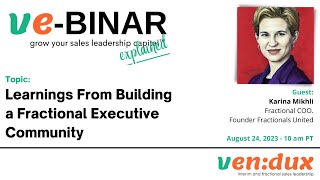
Karina Mickley built Fractionals United, a free Slack community for fractional executives that grew to 3,800 members in eight months. She shares how she runs it with a part-time manager and sponsorships, why fractional work has more supply than demand, and what fractional leaders should focus on: networking, time-blocking, and honest positioning.
Questions this video answers
January 7, 2023 (evening).
Almost 3,800 members (as of August 24, 2023).
About 400 members per month (average).
Based in Brooklyn, New York; has been a fractional COO for seven years.
Chapters
Hello. Welcome everybody, to this next Venocs webinar, or as we call it, the vbinar. I'm really excited to have Karina Mickley with us, the founder of Fractionals United. And we'll talk about the fractional executive community that shares she has built and continues to build and grow. To start a few housekeeping notes, we're recording this and make this available afterwards. So if you would stay muted until we open the mics up for Q and A, that would be terrific. That improves the sound quality. I will have the privilege of talking exclusively to Karina for the next 25 or so minutes, but then we will do a Q and A. If you have questions in the meantime, put them in the chat and we will monitor the chat and see if those questions fit in at that time or towards the end. And rather than me reading something off a sheet, Karina, why don't you introduce yourself to the audience?
Thank you. Thank you for having me. So, Karina Mickley. I'm in Brooklyn, New York. I've been a fractional COO for seven years. Well, before it was a thing where people knew what it was, so I had to explain it in a very long, convoluted way. As Henning mentioned, I'm also the founder of Fractionals United, which is a free slack community for all current and aspiring fractional leaders. And I'm really excited to be here.
Great, wonderful. Since Fractionals United is the core of our topic here, a couple of questions. When did you start it?
January 7th to 2023 in the evening. It was a Saturday night. I came to the release, the realization that I needed this community. I had come back to a very different fractional landscape because I had gone through time with one of my fractional clients and I started googling for it, you know, Saturday night, couldn't find what I was looking for, so decided to build it. I still remember looking up at my husband and being like, is this the thing I do? Is there interest? And the rest is history.
So we're looking at eight, eight and a half months at this point. And what's been the growth rate? How many members are in the community? As of this morning.
The last time I checked, we were almost at 3800. We will be at 3800, if not now, already by the end of today. And we've been growing. I think it's been an average of 400amonth. You know, some months more, some months less.
Okay, well, definitely congratulations here because that's an amazing feet. I think anybody who's grown. A community knows what that, what that growth rate means. What are the, the from a functional perspective, what are the top three functions that you see represented most in the membership?
So I'm actually looking at a chart now right now and it's, it's shifted a bit. Right now the two largest functions are marketing and operations with tech as the third. Which is interesting because at some, you know, the one time I look product was in third, one time I looked finance was in the third. So it shifts but right now it's marketing, operations and tech.
Okay. And I know from looking at some of the members it's an international community. So what, what's, what's the spread? How many countries, what are the top three top five countries that you see represented?
So the US is the top, no surprise with United Kingdom is actually second and Canada third. We do have Singapore, we have France, let's see, Germany, Spain, Mexico, Australia, Denmark, etc. Etc. And we actually do have now a global outreach committee because people actually self selected and they're like, you know, we need more here. Can I help? I'm like, sure. So now we have a global outreach committee because people want to just grow awareness of fractional in their area of the world and you know, this is an easy way for them to do it.
And when you have a local community like that in a non English speaking country, do you is that their content is their communication in their native language?
We don't, so far we haven't had to translate anything or deal with that yet. And the global outreach committee is so new, we don't have yet like standards. We'll figure it out, you know, but it's, they're welcome to use our content to help spread it and you know, we're gonna, we're gonna figure it out together. Like for me community is, my role is kind of like the supporter and enabler, you know, I'm there to. The community is there to help fractionals and any way that doesn't harm or spam others, I am for and try to enable and support.
You mentioned earlier that on January 7th or 8th when you started it, you had, you said you came back to a very different fractional landscape. So what, what was your own fractional journey like? When did you start the first time around and why did you come back?
So I, I spent two decades in the publishing industry climbing the content operations, production operations, whatever you want to call it, vertical or ladder, loved it. But if anyone knows, you know, Amazon Digital, I, there was a lot of reorgs and layoffs. And every time that happened, I would start dipping my toes and considering other industries, but always came back. Because this is going to sound silly, but I loved books so much and I did not want to leave that industry. So I kept trying to like wait and figure it out. But eventually I had to come to the realization that I can love books and not work in that industry. Like that is okay. I can do other things. So I started freelancing and consulting. It would now would be called fractional coo. Like it, I fell into this pattern where like I would help run small to mid sized businesses. And the way I used to explain it to people back then is like, no one goes into business to run a business. You know, people have a passion, a service, something they want to do. And as soon as founders have any modicum of success, they get overwhelmed and they need someone like me and hire someone like me to run the people and the systems in the day to day so they can focus on their passion. And that's what a fractional CEO does. But it didn't exist, which is why I, it's so much easier to just say I'm a fractional COO instead of have to say those, you know, three, four sentences. Um, so I fell into this seven years ago and it's funny, my son made me realize the pattern before I saw it. And that's how my brand right size COO came about. Because fractional wasn't a word back then. And I also do workflow consulting on the side which is, you know, project based. I had a workflow client that I happened to mention in passing that I was a fractional COO as a niche recruiter in California. And without any conversation, literally, she started referring to me as her coo. Like, okay, that happens, sure, fine. Like I enjoyed her working with her and the team, they kept needing more and more of my time. So I went less fractional everywhere else and more, you know, to the point where I went full time with her for a short time. But for all the CEOs listening, you can relate. Like SMBs don't necessarily need a full time COO once everything is running smoothly. So. And in 2023, in January 2023, we parted ways and I came back to a very different landscape than two plus years ago, which is the last time I was looking for fractional. On the one hand, it's more popular, right? People are talking about it, writing about it, it's, it's the thing now everybody wants to be it. On the other hand, it Felt harder and lonelier. Harder, I now understand, because there is way more supply than demand. Lonelier. I had gotten used to being part of a team. I had joined a bunch of great online communities the last two years. So I wanted my tribe. I didn't want to reinvent the wheel. I didn't want to have to figure this out all on my lonesome. So I started Googling. And that's why I remember exactly January 7th, a Saturday. I came to this realization that evening. I was Googling. I found platforms that supposedly help you find the work. Some, some communities on the other side of paid programs, but no, like community for the sake of community. So I was like, all right, let me see if there's interest. I put up a slack. I landing page messaged a bunch of the communities I belong to, put it up on LinkedIn. At the end of that weekend, I had 50 plus members and everybody was like, yes, please, yes, please, yes, please. And it's just grown since. And then I had to quickly learn how to run a community because I had never done that before.
So today, August 24, how do you split your time between being a fractional COO and being the founder and owner of the largest fractional executive community in the world?
I'm still figuring it out. Time blocking. I time block religiously. That's the only way I can do anything. And I have, I've gotten to the point where I have to learn to not apologize, that I can't necessarily meet with someone for a couple of weeks just because I, I, you know, I still meet with members. I want to always have time for members. We actually had our first all new welcome meetup. You know, I'm doing that once a month so that people have, can ask me questions directly. I, you know, I have someone who's now helping me with sponsorship and sales, so I need to be available to him and Tammy and just run the community. And then I have a fractional COO client and a workflow client. So I haven't quite figured it out. Like, I keep tweaking that, you know, like, I will admit that sometimes I work too many hours, but that's a good problem to have.
Yes. Since you already mentioned other contributors who are now part of the Fractionals United team. How do the financials work today? I mean, I know you were big on keeping it free for community members, but there is money coming in the door to pay for some of those people and some of those services or, or is everyone donating their time and their efforts.
So currently I'm Mostly funding. I am as a workflow consultant. I optimize and automate it a lot. So it's not quite as manual as you would think. There are systems and automations happening on the back end. For the first three months, I was doing this all myself and I quickly had to. I used to joke that I got into automation because I'm lazy and if I find myself doing the same thing over and over and it does not add value, I have to find a way to like, optimize and automate. So there are a lot of systems and tools on the back end. I, I was fortunate in that. Well, fortunate or unfortunate depends on how you look at it. Because I was rebuilding my fractional business and looking for clients. You know, having come back from being full time, I had the time that, you know, in the beginning to devote as much as I needed to build the community. Now that I have more client work, you know, I've increased Tammy's hours. You know, I do have more support and yes, the community will remain free because I strongly believe that I, I did this because I was looking for my people and I wanted help. And I know there are so many people in transition now and considering this and don't have clients or don't have enough clients and it's hard. It's really hard. So I don't want fees to be a deterrent. I don't want people, you know, to not be able to get the help because they can't afford to join. That said, you know, I do recognize that I have to monetize some ways. So that is why I brought on Will to help me with sponsorships and partnerships. He works on commission, so it's, it works out that way. And it's interesting. I, as a COO, the first thing I do is help CEOs recognize where they should focus their time and what they should like delegate, automate, outsource, etc, because you really the like, I've done business development, I've done other things. It's the difference between, you know, if you're playing to your strengths, it's, it's energizing and joyful and like, you would do it for fun. Like I automate for fun. Like I optimize for fun. I have a bracelet that says optimize. Like, that is who I am. Sales is not me. It's like I was on one call with Will and I, I came off the call and I told my husband, I told everyone, like, I should never sell again. The joy he brings to it. Like that is his strength, it's not mine. And I think it's really important to recognize that. And ironically like I do this for my CEOs and it was hard for me to do it for myself because my budget was zero. I was self funding it. So I had to get really creative to get the support I knew I needed so that everyone is, you know, playing to their strengths and it's more effective. So fortunately I was able to get, you know, Will who's working on commission. Tammy is part time but she's phenomenal. She's our part time community manager and you know, I was fortunate in that I had savings and my husband is supportive and was working even when I'm not. So I was able to do this. And it doesn't cost as much as you think because I have automations and systems and things on the back end. Going forward, Will is going to help get partnerships and sponsorships. We have some already, you know, paid events come or sponsored events coming up. I've made it hard for him because everything has to align with the mission of the community. I'm not just going to allow sponsors to come in and spam and not add value. And we also now have a perks program which is just a small way for members who find value to give back while getting extra value. And actually, you know, we're going to keep expanding that. So we're being creative or I'm being creative about monetizing without being at the expense of the community.
Yeah, you started it in January because you looked for answers for, you know, help from, from peers in this space. How does what you're seeing today in August the over 3,000 members do away. More than 3,000 members do. How does those two, how do those two things relate to each other? Are they the same? Have they changed just over course of those eight months?
I think what you're asking me is. Okay, I'm going to answer what I think you're asking me. If I was wrong, let me know. Yes, I started this looking for my people, my tribe and I think most of the people who join are as well. And nowadays because like, like I said earlier, I think I now know it's harder because there is more supply than demand. And I realized, and we've been on, you know, lots of conversations about this too that part of the problem is if we're lucky, 10% of the people who know, who need us know about us. Like you know, there is a big education piece that is needed and awareness spreading and because of the current situation, the People who succeed in finding work are the people with a network, are the people who know other people. David Fox did a really great lunch and learn for the community. And what he said is that he never networks with his potential clients. He networks with the people that are working with his potential clients because those are the people that need to know you exist in what you do and think of you and bring you in. And that's one of the reasons I wanted it to be a cross functional community. Like I'm in, I'm in countless operations, focused communities. I didn't need that. I wanted a cross functional fractional community because I cannot tell you how many times I've hired a fractional CMO or fractional cfo and I had to do research and like now it's so easy. Like, you know, all I do is post the need to the community and I will have many options to choose from. So I think I don't. I actually think that I realize now more than then how important something like this is to the current state of, of the fractional ecosystem.
Yeah, you, you said earlier you knew nothing about building a community. There are professional community builders out there. We will have one as a guest on one of our next webinars. Will you add this to your resume now that you can help others build communities?
Yeah. So fellow fractional CMOs, you know, taught me that I have to niche down. So I used to say that I can, you know, because I have worked across many industries. So now I, I on my LinkedIn I say professional services community and SaaS. And I added community because I'm like, I think I can, I think I can help other communities. Like, I know enough now.
Yeah. Was there, was there anything surprising in the journey over the last eight months? Things that you would have never expected to happen?
Yes. So one thing that I found interesting and surprising is, well, first off, I'm an introvert, borderline ambivert. I could not do this if it were in person. I still have to, you know, I. My social battery discharges faster than extroverts. So I still have to find balance and, and ways that I can do everything for everyone. Someone once, my husband once shared this like picture that it's, it's called intro virtuous where like you're an introvert but like you have to, you're a leader so you have to do all these things. It's a funny, it's a funny image. I have to find it the other. So the surprising thing I realized about community is it's not like any other business, in some ways you have more bosses than most because all the members, you know, it's, it's very, it's very important to onboard members correctly set expectations, protect the culture. I was, I was very lucky in the early days. I spoke to some really great community managers and I absorbed as much I could as I could as a sponge and I even joined a community for like community managers and just tried to like learn as much as I can. And you know, we are very, Tammy and I are very strict about what can be in what channel and we, we, you know, protect the vibe and, and then yes, there's, it's a very engaged community. So some feel it's too noisy. But you know, there are things we say yes to, there are things we say no to. It's always from the perspective of is this aligned with what I want? Is this the vibe, is the culture, how is it going to affect it? So like I said, I'm very particular about what sponsors can and cannot do. I realize in some ways that being a leader helped me prepare me to be a community founder because my attitude towards community is, like I said, it's, it's, I'm here to help and enable and support and as long as members are not spamming or, or doing inappropriate thing bothering other members, I welcome feedback. And often, you know, unless there is a reason not to do what, what was asked because I see it as I'm there to enable and support and if you think about it, that's what a good leader is, right? It's like you shouldn't be micromanaging, you shouldn't be directing. You tell your team the what, not the how. And in many ways being a community founder is the same thing. So that was very interesting and surprising and I think helped me do this better because I've been a leader for so long.
So I'm not sure if you had a long term business plan for Fractionals United back on January 7th. Do you have one now? What are your plans for the community in the next six months? 12 months, 5 years? Where do you think this will go?
My goal is to have us be the community for Fractionals. The way I see it is there is a larger fractional ecosystem. I'm not interested in being everything for fractionals. There are great, like, you know, Voyager U has a lovely boot camp. You know, there are other, I'm not interested in being a matchmaker, recruiter, you know, or platform or other things. I want to be the community for Refractionals current and aspiring and at the center of the ecosystem and then partner with all these other organizations that are trying to help fractionals in different ways. And so everything I do is aligned with that. Yes, I have to figure out monetization because I have a small growing team, but everything I do is from the perspective of community. So I've had other people suggest things. I've had other people who want to, you know, take over the community or join with the community or partner with the community. And it's always like community first.
Cool. Well, we'll be watching the journey and you already talked about some of the sort of macro observations that you had about supply, the supply and demand side on in the fractional world. Beyond that, what are you seeing out there in the larger fractional spectrum?
More and more people are interested in this, considering it. There have been obviously a lot of layoffs. I think Covid made people realize that they don't necessarily want to go back to what was. They may not have realized that there was no work life balance or there were other opportunities and once it was forced on them, they don't necessarily want to go back to what was normal. And fractional seems to be the best of all worlds. It's not consulting. You're, you're part of a team. There's more stability because you're long term. So I think we will see. I don't know when the inflection point will be, if it's three years or five years. But there will be an inflection point where fractional is the new norm for, for leaders and any SMB or startup or scale up will understand that this is a, this is a competitive advantage for them. Until then, it's still going to be hard for people that are not natural networkers to find the work. Yeah, that, that unfortunately is going to take time to, to change.
But what can organizations like Ven docs and what can individual fractional executives, of which we have some on a call here. What can they do to speed up the adoption? To not make it last five years until everyone sees it, but make it, make it faster, make it two years, make it three years.
Explain to everyone, you know, what fractional is and why it's an advantage? You know, I think all of us just needs to keep beating that drum. First of all, we only need to meet mean the same thing. Right? There is still confusion between fractional and consulting. And it's not that one is better than the other, it's just they're two different things. You know, a consultant isn't an Embedded part of the team. There is an end date, even if it's a long term end date. They don't represent the company, they don't have a team. Fractionals. It's meant to be ongoing or long term. You are embedded, you represent, you're on the org chart. You are a part of the team, just part time. And there's a fractional COO in the community who only does two engagements in any given time and his team isn't even aware that he's fractional, you know, so there really is no difference. So first, you know, it's important we all mean the same thing because if we mean different things, that's just going to slow down adoption and the, the spread of awareness and then just literally just talk about it, share, you know, especially if you do it and love it. Like let everyone know why this is a win win for both sides. Sides and share it. No, you know, we never know who's going to read it and who's the right person who knows it and etcetera, and etcetera. And how it spreads. But we just all have to do our own little bits, you know, our own little part to help spread.
Right, wonderful. I'll give up the exclusivity and hogging your time. Let's open up the mics here. I know, John, I see in the chat that you asked a question. John Williams. Do you want to go on mute and ask it or should I read it? Read it off the chat.
Hi team.
It's good to see everyone. No stranger to most of the folks on this call and I agree with Karina that each one of us who are in this marketplace are, whether we like it or not, are ambassadors of what is a fraction. Because you know, a lot of my human capital partners in HR understand it, but it's not a, it's not something that's in a normal process for them, a normal process for them as an FTE placement. So a lot of the systems that they have, honestly just the mentality is really around that bringing in, you know, that, that full time employee and, and, and so I've had to learn this year to temper my expectations when I'm working with this group of professionals, you know that I'm really in an education mode and by helping them to understand what's possible, it does create some awareness that's there and so totally agree on that. I think another thing that probably complicates things in particular this year, let's say is that we do have a large amount of supply right now and we lack, we lack a standards, if you will, across the, across the talent. So it feels like the CEOs and founders are really kind of having to go out and treat this in the same way of evaluating that talent, just like an fte. Right. So even though were fractionals and we've got CMO school and CRO school and, you know, a litany of experiences, that same attestation process is happening whether you're a fractional or an FTE from, from the CEO and founder. And I think probably longer term over the three to five years, we might land on a standardization so that someone could, you know, enter a few attributes and then be presented with, you know, okay, so here's, you know, here's the marketplace availability of what you need, whether that's a coo, CFO or CRO, in my case. And, and it would just be. Take a little more of the friction out of the process. I realized that was not much of a question, more of a ramble. But I hope that that may have sponsored some additional ideas from the rest of the team.
Just to address that quickly. Yes, there are, there have been conversations about standards and you know, that may happen, but sometimes when people join the community, they're like, oh, you know, when anything is posted, like, I'm competing with all these other people and my answer to them is like, yes. And how is that different than, you know, when you apply to another job? You know, I, I don't think there should ever be a time where the CEO founder is not doing that. Personally, I don't do proposals. I do interviews because I'm joining the team and I ask as many questions as I am asked because I'm determining whether this is a CEO who will enable me to be successful. You know, the worst thing you can do is, is join a team. You know, and I've had some of those where like, the CEO is their own worst enemy and can't get out of their way to save their life or their company's life. Right. So I am doing a lot of evaluating and interviewing as they interview me, and I don't think that should ever change.
Yes. Matt Kelton put a question in the chat here and I'm just going to read it for you. Karina, knowing what you know now, what would you have done differently to ramp up your fractional business?
That's a good question. So when I was doing before I went full time, I had three to five clients at any given time, and it was easy to see if I was coming to the end of one, you know, I do tend to go on maintenance level but you know, I'll, I'll become more fractional, but it's easy to see when I'm, you know, going to transition out and then fill in one ne, you know, one client or one hole rather than go from zero to one like I had to do. So maybe I wouldn't have gone full time. Maybe I would have kept like a fractional client or two on the side to just make it easy to ramp back up. That's I think and I, and given where things are now, you have to be constantly maintaining a network and just, you know, staying in touch with people. And I know that's one of the challenges we have, whether we're consultants or fractionals as solopreneurs is like juggling doing the work as well as, you know, like maintaining the, the business development and networking at the same time because you never know when you're going to need it. And that's, I think that's something we all have to just figure out until, until there comes a time where it's just a matter of applying to another fractional job, you know.
Yeah, Andrew, let me, let me call you out. I know you always have questions in mind and then to everybody else just unmute yourself to ask questions as well, but Andrew, the floor is yours.
Thanks Annie and Karina. Yeah, it's very interesting. Great comments. Congratulations on your progress and what you have built. Hannah, you asked a lot of questions that I had in the back of my mind. There's one in particular which I invite you to speak a little bit more about, which is the demand side and perhaps we can all contribute to that conversation. You say emphatically there's a lot more supply today than there is demand. But how do you know that? How do we know that? I have a sense of working on a day to day basis with clients or the demand side business owners and founders and CEOs of company startups to 20, 30, 40, 50 million in revenue who are not really aware of the paradigm of being able to tap into high levels of expertise and experience on a fractional basis. And when, when they, you know, light bulbs go off in their head, I, I can see the light bulbs going off in these conversations and it really, you know, the, the demand star, the demand side takes these conversations seriously as now a new option that they can think about going forward. So having said that, I, from my perspective, it's perhaps more a function of education and knowledge and awareness on the demand side than anything else at the moment. So what's your perspective on that and anybody else that wants to chime in?
I absolutely agree with that. It is. So a couple months ago, I was talking to a New York City nonprofit accelerator managing director about potentially joining. They actually needed, like, an interim fractional coo, which is bizarro. But anyhow, she. So I mentioned fractional COO and then the fractional community just in conversation, and she's like, oh, is that just a consultant? And I, you know that cartoon where, like, the exploding brain that was happening in my mind because I'm like, she lives in the startup world and she did not understand fractional. Oh, my gosh. You know, there are. So that's why I was like, we're lucky if 10% of the people who could use us know about us. And that is the number one problem. And, you know, Henning and I have been part of conversations. You know, we're like, other fractional community leaders are coming together collectively to think about ways that as a unit, we can help spread awareness faster than us individually. It definitely, yes, that is the problem. And I wish there was an easy solution. But that's why I say, like, all of us can, like, help spread awareness and educate just in our lives. Like, we can't. I actually. So at one point I asked. I have a voluntary advisory board as part of the. Com. The community. And I had the idea of sharing an explainer because I saw videos go viral and whatever. I'm not a marketer. I know enough to be dangerous. So one of my community members put one together and we put it out there and it had, like, I, the last time I checked, it had like, something crazy, like 16,000 views. But if you look at the analytics, most of the views are by us. And as somebody, as one of the CROs I talked in the community, pointed out most of the people we need to work with aren't on LinkedIn. They're too busy to be there. Like, they're struggling to just, like, keep afloat. So it's challenging. How do you figure out how to get in front of them and share the. You know, like, LinkedIn cannot be the only thing we do, whether it's going to, you know, the. As the small business Expo or other things, you know, so we just have to. We just have to figure out how to spread awareness.
Thank you. One more question for the moment on the supply side, you know, not every, not every executive is necessarily cut out for fractional work. So I'm curious as to if whether or not you've Got any filters or criteria at all in your, you know, nearly 4,000 people now in your community? You know, do you have any kind of a breakdown on those that are coming into the community with previous fractional experience and they know the game versus executives coming out of the corporate world and they've never been a fractional, but now all of a sudden, after 25 years of experience, they're, they're drinking the Kool Aid of the month. Fractional is. Oh, fractional is for me. I don't want to go back into the corporate world. I'm gonna, I'm gonna be a fractional. What's your perspective on, on that side of the equation?
So because my focus is community, I chose to make it inclusive rather than exclusive. And therefore any current fractional leader or leader considering fractional is welcome. I don't, we don't pre vet, you know, that is our only pre vetting. Right? Like you're either a current fractional leader or leader thinking about fractional. And we have resources for those that are new to fractional. I blogged about the challenges. We have questions about it in the community all the time. But yes, there are those that are going to try it, you know, and find that it's not for them or don't have the, the Runway to like stick it out and we'll have to take a full time job to pay the bills. There's all sorts of. I wrote a post yesterday about it depends. So today, every time I say it depends, like I'm, I'm, I can't help but smile. But it depends, right? It's like there will be people, like you said, who are used to. There was an interesting conversation the other day. Somebody asked if it's just them, but they find that fractional work is actually harder than full time work. And like a bunch of people chimed in and agreed. Because when you're, you know, when you're a W2, like you're not working 40 hours, you know, especially if you're good at your job and you've like, you know, done the thing, you know, I think that's why fractional is advantageous to the, you know, the, the demand side. But you will have downtime. You can take it easy. You know, some people coast on their W2s, you know, you can't do that as a fractional. Like, you have to get results and you have to do it a fraction of the time, you know, which is why like, recently I've been telling people, don't call yourself something you haven't been full time. Like, if you've never been a coo, there's no way you can succeed as a fractional coo. Start at the level you're at because you have to have the experience of doing something full time before you can then succeed at doing it part time. It's just common sense. But as people remind me, common sense isn't common. So there you have it.
And if you have multiple clients as a fractional, you are flipping back and forth between years and teams and language and product sets and definitions and yeah, it can be much tougher if you've got multiple clients.
Yeah. And it's task. So time management, I think is one of the biggest challenges. It's hard enough to do that when you're with one client, you know, or one employer. And then you have to, like you said, you have to do it for several and set expectations and be available yet, you know, like stay within like the bounds. And yes, it's, it's challenging and everybody, I think everybody has to figure out what works for them. But it is harder, you know, it is harder in some ways and better in other ways.
Anybody else want to chime in on any of these topics? Yeah, these are great, great perspectives, Karina. And you know, we're all, I think we're all aligned in terms of the mission and the big picture and the opportunities out there and the trends. The, the, the trends are going in a clear direction. It's just, it's a matter of how fast, how big.
Yeah, Should I be paying attention to the chat? Because I haven't at all.
There's just one more question and I'll use it as the final one and then we'll close it out after 45 minutes. What are you seeing in terms of the share between those fractionals who are asked to come into an office versus remote work?
Interesting. Surprisingly, that hasn't really come up in the community. I think most of us work remotely and prefer to do this remotely because it's, it's really hard to do this with a lot of travel or hybrid situation. The thing that has come up more is like if you have to travel, do you. How do you charge for that and you know, how does that work into your arrangements? But I think by default, like there are one or two fractions I know that actually prefer to be there, you know, or at least within like regional so that they can have FaceTime. But I think the majority just do this remotely. And that's just the default.
Yes. Great. Karina, not just congratulations, but a thank you to you for taking a need that you saw yourself just eight months ago and turning it into something that has become so big and so important for everyone in this fractional space. So thank you for building Fractionals United. I. I hope you stick with it for a really long time, because I like the mantra community for the sake of community. So that's. That's phenomenal. Thank you for taking 47 minutes out of your busy schedule today and joining us for this webinar or webinar. And have a wonderful rest of your day. And thank you, everyone, for joining us. Take care. Bye. Bye.
Thanks, Karina.
Thank you, Karina. Take care.
More from Henning




ve-BINAR - The Revenue Tornado Methodology: How 3 Power Sources Create Exponential Growth


ve BINAR: Executive Cloning: How AI is Reimagining the Role of the Fractional Executives




veBINAR: Unlock Client Value: Why Compliance is Crucial for the Startups You Serve
