ve BINAR Navigating the Future of Work
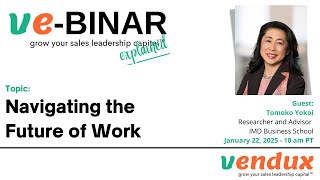
Tomoko Yokoi from IMD discusses how work is changing: fractional executives, hybrid entrepreneurship, and remote team leadership. She traces her own path from corporate to startup to academia, and explains why managers need to think carefully about AI adoption.
Chapters
Welcome. Welcome to this edition of our webinar series. We're very honored to have Tomoko Yokoi with us, who's calling in from Lausanne in Switzerland. We'll hear all about her in just a little bit. Let me quickly go through the housekeeping notes. As always, we'll have about 20, 25, 30 minutes of conversation with Tomoko and then we'll open up the microphones for a Q and A session. We're recording this webinar and we'll make it available on our website afterwards. And you all will be receiving a link so that you can share it as you see best fit. Please keep your microphones muted while you're on the call, so that improves the sound quality for all of us along the way. The topic today is the future of work. And Tomoko will share with us how she got involved into this topic and why that is something that she is a specialist in. We'll look at different aspects of the future of work, like the. Like the different modes of working that have developed that are new, the new leadership characteristics, AI and the role that AI plays, and other topics as they come on, come up along the way. So, Tomoko, again, welcome. Could I ask you to introduce yourself to our audience? Yes. Hi.
Thanks, everybody, and thanks for inviting me on to have a great discussion today. Henning. So I am a management research researcher in digital and AI transformations at IMD Business School, which Henning has mentioned, is based in Switzerland. And I'm really interested in researching how digital technologies impact how organizations and individuals and how it impacts their way of working. But more broadly, when I look at this phenomenon, I actually look at things around me through the lens of adaptive behavior. So what does that mean? Because when we look at all the things that are happening around us, such as these new, you know, new emerging technologies such as AI, we have climate change, you know, our values are changing about how we see the world and how we want to work. And I study how we, as individuals and organizations adapt to these exogenous changes. And I stress the word adapt rather than react, because when we think about just reacting, it's really impulsive. It's not very well thought out. And when you just react to things, the behaviors may not be sustained over time. What I actually try and look at is think about how we can actually adapt to things that are happening around us in the medium term. I think one of the reasons why I ended up in this field is actually because my transition or turn into management research is pretty recent. Like some of you who have, who may be fractionals or who have portfolio careers. I did a late career transition prior to being a management researcher. I worked for 18 years in the corporate world and I also worked another five years in the tech startup industry. So in terms of adaptive behaviors, I think my own experience has partially influenced what I ended up studying and what I'm interested in. And at the end of the day I study transitions in all different forms, so organizational transitions, individual transitions. And I think that's what we're here to talk about today. Henning.
Right, talk about it. I find it fascinating that you are not a, you're not a researcher by career, but you're someone who spent what, 20 years as a management in management in different companies. Can you tell us a little bit about that background, that part of your career?
Yeah, sure. So even within that I have a pretty unusual career because I studied foreign diplomacy way, way back and I thought I was actually going to be working on like diplomatic affairs, but I ended up first working for a large global educational company doing strategic business development. And then after that I went ahead and did the traditional going and getting your mba. And from the mba, after working for a medium global company, I was really interested in working for a large company. So I ended up working for industrial conglomerate, it's called DuPont. And I worked there for about 10 years. In terms of it was a beat. It's a B2B industry, working very much on textiles and also sustainability consulting. And then after that I had this itch after working in the corporate world for, for quite some time I had this itch of wanting to own something and to be an entrepreneur and, and to just be a business owner. And so while I didn't have any technology experience, I dec to come up with a technology startup idea and a friend of mine had told me about a digital health competition where the deadline was two weeks away and I decided to submit my idea there and I actually won the competition and got some seed money to develop a prototype. And so all of a sudden, while I knew I was getting a little bit antsy about my corporate career, I think just this transition to get a little bit of funding to develop my idea just really, really made me take action. And so I went into the startup world, the startup that I tried doing. I found that being a, an entrepreneur was really difficult. I felt that, you know, you had this idea, it was very fragile and you know, having come from the corporate world, I don't think that I was well equipped to understand what an entrepreneur was. I conceptually knew it because I Studied it in you business, but actually living through it was a completely different experience. And I think it really changed my mindset about a lot of different things. When you actually experience what it is to be an entrepreneur. I also went and while I was doing my own entre, trying to do my own startup, I also went ahead and worked for a another software startup which eventually became a unicorn. So that was a learning experience. And then I've always sort of had a tendency to work a little bit hybrid in the terms of I had my startup and then when the startup seemed to get a little bit of traction, I thought that I might do a little bit of research as well because I needed some income coming in. And so that's when I went to the school that I'm currently working at where they had, where they knew that I had some writing skills and I had this interesting corporate and digital experience. So we sort of agreed that while I was also doing my trying to do my startup on the side, that I could help them with some research and writing and with all things, I think we all know with transitions, that's how I transitioned from one industry to another. And then I was about in 2020, during the coronavirus, the pandemic, my co founder left to go to another country and we just decided maybe this was a good time to probably stop the startup. But then my management career became very interesting and so I sort of went into the management world. So a lot of navigation and I ended up here. But through this experience I was really glad that I've had this corporate entrepreneur and now taking a step back to using all of the experience I had to develop research projects that are hopefully that have real world applications. Because I think some people who, you know, some research scholars, they are sometimes accused of being too distant from what's actually happening in the management world. So I hope that I bring a little bit of the real world perspective. But that's been my own many transitions in my career as well.
I certainly think that you're bringing the two things together and I learned that quickly when you and I first met at the FRAC conference in Minneapolis. And that leads me to my next question. Because the FRAC conference was for fractional executives, it was about the fractional executive work concept. But when you study modes of working, I'm sure that's not the only mode and not the only future concept that you're looking at. What are some of the other things that you're looking into?
Right. So I think in the broad area of transition, I'm Looking at a couple of different things and at different levels of organization. So we talked. I think one of the first areas that we talk about is digital, right? The digital impact and that's coming and that's with emerging technologies. And so on one hand related to digital, I'm looking at how we can work with AI. And now on that particular front, there is a lot of management research out there right now, very much about how individuals and organizations are using AI, but mainly to enhance productivity. And so the research that I'm taking or the angle that I'm taking with some of my co authors is a little bit more different because we feel that some of the conversations that we're hearing between about AI is that they're always comparing humans to AI, thinking them as two same things, right? So they're thinking of the AI as some type of. It's just great for processing a lot of information. And so when compare a human to an AI, of course the human can't process as much information as a computer. But we always seem to compare ourselves and we're not doing ourselves any favors. So we're really looking into, well, you know, there are some unique human capabilities, there's a lot of tacit knowledge, a lot of lived experience. And the real question is how can you develop some type of collaboration where both of them could work mutually together and also in what areas or tasks where one or the other could compensate or benefit from the other. So that's one area of research that I do in terms of the new technologies. Now another area that I think is interesting from a managerial perspective is that if you're a leader or a manager, you can also be your own self manager. You're hearing a lot of, I would say advice about how leadership should be either top down or you take it another way. Leadership has to be bottom up. Is it a command and control type leadership you have in some conditions or do you need to be really flexible? The reality is that we think, especially in this age where everything is evolving so quickly, you really can't be an either or. Instead you really have to be very aware of your surroundings and have that flexibility to be able to toggle between different styles that you may have. And I think we're living in a really. When we talk about the future of work, it could be a time perspective of in the future, but it could also be the fact that the future of work is evolving, it's in flux and maybe that the future work is a state, not something in the future and that the state is something that's evolving a lot. So the question, it goes back into adaptation. How can you, as an individual, as a leader or manager and as an organization, you know, what are the skills and the competencies you need to be really adaptive and flexible in this constantly evolving environment, which could be the state of the future of work. So I think those are the things that really come into mind there. And the reason why I was really interested in fractionals is because we talked about emerging technologies as evolving. We talk about just climate, the pace of change. And what I was really drawn to about the fractional world was it's a story about changing value. So there are individuals who, who, who are, who are shifting their values on, in terms of how they want to work. And so that is that I also found fascinating because they're trying to self adapt in that case.
So in that what you're referring to is the fact that a lot of executives who enter the fractional world look for things like independent control over their calendar, flexibility to better balance work and life. Is that, is that what you're referring to as changing values?
Yes, for sure. So when I started, it's been about a year or so that I've been basically researching, looking into and also being welcomed by the fractional community and talking to a lot of executives as to the reason why, what are their motivations for going into a fractional? And it's exactly these values that you talk about, Henning, the autonomy and the independence that they want in their lives. What I find really interesting about fractional in this new mode of working is that I'm seeing these executives who want to take a stance to do something different. I feel that they have like two, you know, in order to do this transition, they're actually facing two hurdles. So one, doing a career transition in itself is super hard. I think we all know that. But in the fractionals, it's not only the career transition of yourself, but you're also trying to advocate for transitioning, a larger way of working. So you're trying to do double effort. And I think that's, it's just really interesting to see how a person who's trying to be a fractional, they're advocating for themselves, but they're also needing to advocate for, for a concept and an idea. And I'm hearing some interesting stories about how people are trying to do that.
When I talk about the fractional executive model, I always refer to it as organizational innovation in the Context of the 10 Types of Innovation that exist. For this idea to structure innovation that way Is that a right way to think about it or what other concepts would you, what other framework would you put around fractional executive work in the context of overall, the overall changes in innovation in the workplace?
So I like the word innovation because it's working innovation for sure. And I've been recently reading a lot about future studies. So what will the distant future look like? And one of the troubles. And so when we hear about, when you hear a discussion about future of work, is it really about the future of work? Because when we hear discuss, say about fractionals, you're not trying to. It's more like a innovation of how people work, but you're not speculating about something that could be completely radically different. Right. So in that respect, it's not a radical future, distant type of future, or discussions that are happening in the media today. It's more these innovations in working style. I think that that is what it is. So I think your conceptualization of using the word innovation, it's a working, it's a working mode. Innovation is correct.
Talk about leadership, leadership styles, adapting to new environments. What are the key highlights that you're seeing? What is different, what has to be different for a leader today versus maybe 10 or maybe 30 years?
Yeah. So I think there are a couple of things. So it goes again back to flexibility because you really don't know from one year to another how things will change. And so as a leader. So I think there are a couple of things in terms of managing yourself. It really, there's a lot of things about, you have to be. I mean, this sounds a little bit like a platitude, but you do have to have some self recognition of how you are. And there are some people who already know that they may be a little bit rigid on these things or their communication skills may not be correct. We spoke to, this is a couple of years ago, it's in a Harvard Business Review article that we published maybe two or three years ago. And it's about increasing your leadership range. And we came up with about seven different types of leadership skills. And they're on a spectrum. And for example, there are some people who have had technical backgrounds who we call a minor. Their leadership skill is to go very detailed. And the opposite spectrum of a person who minds is a person who has a little bit more of a broader perspective. And all of us along these seven competencies, we fall into some type of range. And now so you know, are you, do you have to stay in that range? No, but we would recommend you, especially in this type of in this era to just widen that sweet spot that you're used to so that you can just sort of move across the spectrum a little bit more based on the context that you're in. I think another area, and that's for yourself, I think another area that I'm really interested in is the fact that there are more and more people working remote or hybrid. And so when all of, when we talk about leadership and management, a lot of the theories have been based on the fact that you're going to be physically present and that you can be managing and facilitating and enabling your teams. You know, we're being, being physical and having these gestures and, and, and other communicative methods that help you bond, right, and help you inspire. But the question that I think a lot of people have right now is if many of your team members are remote, and I know Henning, I know many fractionals, they work, many people work remote. The question is, so what other types of methods can you use to enable that bond, to inspire? And I, during the pandemic, I was really curious because a lot of the communications I have with business executives before the pandemic or maybe even 10 years ago, you know, our communications were very formal and I started noticing around during the pandemic and maybe a year before, a lot of business executives starting to use things like emojis in their formal email communications. Frankly, I thought it was super strange. But now I think now with chats that we see with teams, everybody's using emojis right now. And I do. One of the other articles that I remember that I researched was so how are we using these new ways of expressing ourselves? And how can, and especially I was looking at emojis and I was looking at how you can use these new forms, expressions to better lead your teams in a virtual environment. So for example, one of the things that, one of the techniques that I learned from some executives was they would.
Use.
They would ask people every week at the end of the week to just send the manager just an emoji of what they felt like during that week. And it was just a bit of a temperature check. And it just helped them have a conversation with their team the week after. And I just thought it was interesting where you can, rather than just talk verbally about how you feel or what you need people to do, you can actually start as a manager, use these other different types of tactics to, to better enable and facilitate. So what I would say, not, I'm not a leadership scholar in, in any case, but I just find it fascinating that we just have a lot of different multimodal means to, to manage and to lead. And I think that's really interesting.
You already mentioned the aspect of technology, the influence technology has on, on work overall, on the workplace, on the individuals in the workspace. AI is a technology, but there are, there are others. You know what, what other big fact influencing factors do you see from a tech perspective into the workplace?
Yeah, well, you know, I think AI is dominating right now. It's, I think all the other technologies are a little bit being crowded out in terms of our everyday technology usage. I think to be honest, while there are other technologies, it may not be impactful for us. I mean I think there's a lot of deep tech industry which I really enjoy as well, which are going to be a little bit game changing. It does not. These types of more radical technologies will not impact our day to day working for most individuals. So what I like about AI is that it's a little bit more democratic that anybody can use right now. So I think that's it. What we're finding in our research today is that 2023, 2024 was years of. It was a pilot experiment, so everybody was using AI. But the verdict is that we still don't have conclusive evidence of business productivity or like a significant business performance change. And so the question that we have right now is so are we ever going to go past that piloting stage? I think everybody's bullish that it will happen, but it's about finding those right use cases and making sure that it's part of your business strategy. For me, one of the areas that I've been looking at, especially in the adoption of new technologies such as AI, more is just in the responsible use of it. And so I've been researching just a lot about what are the different guardrails that are being put into place so that if you use AI you're doing it responsibly because it does have impact on your brand. I know with these hallucinations, but it more than that, it's just about extending your brand reputation. One of the things, one of the insights that I had from talking to many companies when they were putting their AI policy or digital policy in place was they said that you're. Just because you work in a virtual world doesn't mean that you're a completely different organization in your digital identity. Your digital and your physical identity and your reputation should be exactly the same. So if you have like a corporate mission statement or if you have, if you're starting up your own company and you have, you know, your, your value statements, mission statements, you know, if you then go into digital, you know, your digital identity should be based on those, those, those values or the, the corporate mission that you, that you had put in place, regardless. And I think that's the most important, that there's a seamless effect. And I think that's, that's really important because I think a lot of companies or organizations who say they want to use AI or they want to use digital and they want to sort of transition themselves as a digital company or a digital savvy company, they always say, well, you know, how should we incorporate digital into our strategies or into our operations? And I think one guiding light that I always recommend is, well, go back to your, your values as your company and then build your digital values or your AI, you know, your AI usage or guidelines based on those values. So it's seamless.
We'll open up the microphones in just a little bit for some Q and A. But I'll have one more question, or at least I think it's my last one, unless more interesting things come up. But you brought your corporate and your entrepreneurial experience into the research space. Now how does the research that you're doing go back out there and help leaders, company owners, CEOs, today or tomorrow?
Yeah, that's a, that's a good question. So I do it mainly. So the first thing, what I have to say, Henning, about doing research for any of you thinking of ever doing a career transition to research, which I'm not quite sure if I recommend, but I will tell you that it has the benefits of being able to explore and also being able to talk to many different people. I would say that the research goes back or what I like to do is just through articles I like to give back. I think that's one way and another way is also be able to transform it, transform it into any types of other tips or teachings in that respect. And so I would have to say with my, because I do come from, from the industry, I'm, I'm very fortunate to have contacts and people reach out to me wanting to share their experience. And I would gladly interact with people. And then I always tell them, look, if I, if I find something, I'll definitely let you know how it works. And so it's, it's a very symbiotic relationship of how one can give back some of these insights.
Bruce, you were the first to raise your hand.
Hi, thank you. And I have a question. Tomkov. Because, you know, I've got varied experience and a lot of people do, and a lot of employees are looking for very specific. And if you don't fit 100% and you're only 98, usually get put aside. So what do you recommend? A good way to handle those situations, both in the search and in, you know, the description of that.
Yeah. So I resonate with you. And because especially when you do a lot of career transitions, it's. You have so much experience about and then how do you put yourself forward for the best one? I think the reality is it's. It goes both ways because a lot of organizations usually, as we know, they don't know perhaps who they want. And so it's a matter of also emphasizing the skills that you're going to give to them. What I have found, and I would say this goes from my own personal experience more than it is from research, is that I would say you talk to this perhaps the 80% of the criteria that you fill. And if you already have so much experience. Experience, there's probably more. Right. That you can give and then. But I do, in some of the conversations, what I do like to do is give a completely a curveball which makes them interested. So it may not be what they're looking for, but it's some insight that perhaps they hadn't thought about or just some experience that is a little bit out there, it's not in, it's. The purpose is not to fill that 20%, but it's actually to get them to think, wow, this person's a little bit younger, unique and different. So perhaps that's what I would do.
Yeah, that's good advice. I've done the unique part a couple times and thank you for that.
Yeah. But then I think one of the other things, when we come to transitions or it's, it's the whole framework of explore and exploit. Right. And so on one hand, especially when I've been speaking to fractional executives at the as you're just getting their business started, they're looking for exploit. But then I think when you're at a more mature stage of the career, it's also about a little bit of exploration as well. And whether you can get your client or whether it's an organization that's recruiting to think that maybe this person's also interesting on the exploration side.
Yeah. And one of the challenges I have is I've got a lot of varied experience and it culminates into who I am today.
Yes.
And that's hard to explain in. In this, you know, 100 versus 98 world. Because you never know what's going to hit with what with each one. Even though I put out a custom, you know, information each time, you can only get to your point to that 80%.
Yeah, yeah. It's difficult. But on one hand, you know, you have a lot of experience, so that is something that you can, that you can put your. Hang your hat on. Right, right. Good thing. Yeah.
Yeah. And that helps. It's all pretty much in line, so. Thank you. It's just a different way to look at the market and I appreciate that.
Yeah. And it's all about developing that narrative. Right. Because when you have myself as well, when I have so many vast different experiences, the question is, what is that red thread that would put everything together? And on one hand, it's been a little bit of opportunity. It's a little bit of, well, you sort of went with the flow at the same time. Time. But I think at the same time you would. Even within the different career transitions, it's not about the fact that whether you had a goal or not, but I think you want to show. Well, I like to show that I transitioned into such different industries, but I was able to show some success, so I wasn't just fleeting around. And I think that is also important to emphasize and. Which would emphasize adaptability.
Well, and it's interesting that in each, each transition I've had extreme success. But it's hard to. It's hard to even in a fractional to. To show that because they look at that and they say, great, this is what I'm looking for. That's nice. And it doesn't fit bill. Right. So.
Right. But this is something you can't have control over either.
Right? Yeah, I know. You try and get control over as much as you can and you can only go so far.
Yeah. What I do and what I do like about. In the academic literature, this. I'm not quite sure if this fits into fractional. I've been trying to think about it, but there's a new concept called hybrid entrepreneurship. And I know we can like come up with different labels.
Right.
And hybrid entrepreneurship is an area that, where you have a job currently, but you have a side gig that you're also putting together. And I've also seen a lot of people who transition by that, where the side gig becomes then your next job. So I feel that these are also different mechanisms for how people transition. But I'm also. I also, I haven't quite decided whether fractionals are hybrid entrepreneurs or not. I think the, the term is still very, we're still trying to conceptualize it, but I, it's just interesting that I think that the study, the management world is starting to understand that there's a lot of transitionings taking base and it's not just the linear career or a linear path anymore. So I think it's, it's a good thing.
Yeah. And to that point, a lot of what I did in the past is fractional and I put business development, so I went back and changed it to fractional because that's the new term. People look at the old term and say, that's a dime a dozen, I want the new terms on this. And they resonate more with those. So, you know, looking at your resume and updating the terms at times helps quite a bit too, both in fractional and, and others.
Yeah, that's a really, that's a really good point as well. Yeah. Thank you.
Good.
Thanks very much.
Others, the chance to ask some questions, but thank you, Bruce, for all the, all the input. Andrew, you unmuted yourself.
All right, thanks, Henning. Thanks, Tomoko. You, you live in an absolutely beautiful part of the world. You're so lucky. I'm jealous. So, greetings from San Francisco. Thank you for your comments and perspectives. Very, very interesting. I looked at your profile briefly. You go back, I see your work started in 1999. So I can say that you've seen a couple of iterations of tech development. PCs, Internet, mobile client services, server, etc. Etc. The big question is, is it different this time in terms of AI or is this simply another part of the tech evolution cycle? And in other words, is this the beginning of the end of human, human value to work? Is this the beginning of the end of where. Where Homo sapiens are at the top of the food chain? And it's the beginning of true AGI and the, the displacement of human beings at the top of the food chain, where at some point in 50 to 100 years we are more domesticated animals and AGI is at the top of the food chain, what is the big picture from your point of view?
Well, so I can see that in the management research world, that is the question. So when we say about, when we talk about doing research on AI in management, the first question everybody comes back with is, so how is the AI technology different from all the other industrial technologies we've seen in the past? And so there are some groups who say, yes, the technology itself is different because it is, it learns from itself. There's, it's, it's, it's generative. So in that respect, yes, it is different. And because of, of these characteristics, some of the other theories that we have about technology and how it's impacted will be different. So I think there's a group that says that there's still a group in the management research world saying, I'm still a bit skeptical. You still need to show me whether these characteristics you're telling me are really valid. So let's just say that there is no universal agreement on that yet. I personally lead to, I personally lean towards the fact that there are characteristics of AI that are different from previous technologies. I can't articulate it. I would need a little bit more evidence, but that's it. And I think primarily because of the cognitive aspect of it. And that I think differentiates it slightly just because how we may interact with it may differ. And so now I recently had seen something about, there's a lot of talk right now, of course, about large language models. I recently saw something about actually we're heading into large behavioral models and it's more in the area of robotics. And it's funny because if these large behavioral models become more mainstream, it is a little bit more where it's not about our tacit knowledge, us trying to translate our tacit knowledge so that the text model can effectively help us, but it is, it's going to be very, we might be heading into another area where it's, we can do tacit behavioral interchange. And I think that's sort of interesting. You know, do any of our theories that we have, does it help us speculate about the future and what it will be? Probably not. It could provide some guide, guide guidelines, but probably not. So I think that's where to your more philosophical question of so what does that mean for the end of the world? I'm not quite sure. But at the end of the day, I think we're all, you know, I think we're intelligent enough to try and figure it. I think we can put guardrails in place for more of the negative consequences. And at our institute at imd, we recently developed something called the AI safety clock. And it was really, it's like the Doomsday Clock that's, that's out there, but we just actually put in all these different factors just to see, well, how are we on AI safety? And so I, you know, I think there's different impacts and variables in that respect. And, you know. Yeah, let's see, let's see. We, we from A management perspective. We're a bit late on the game of then, you know, where the evidence comes in because we have to observe something and then we try and actually research it and then we come up with some type of understanding. But I think things are going faster than we can actually research. So of course that could be something that could be a little bit concerning. Yeah.
Thank you. Thanks. So maybe if I could ask one more question. What, what based on your, your knowledge and experience now in your work, what, what advice would you give to your 20 year old self coming out of college into the workplace today?
So for me I would. Well even for it, because I, I have children who are about 20 years old right now. So probably what I would get tell them is actually really develop your flexibility skills and your cognitive flexibility and your adaptation skills because the knowledge competencies and capabilities that you learn, I think they will change and evolve in terms of the function and the tasks that you may have to do. So the question more is what are the key core skills you need to be able to pick up and learn something. So I think it's an ongoing learning skill which means that you have to synthesize information very quickly, be able to then validate, but actually then understand by looking at the environment how might you use that information to be able to make some type of decision and then also to have this continuous learning sort of adaptability mindset. But in your 20s, I think you should, I would probably say that it's important to have some anchoring skill, you know, with, if you're a technical person, you know, just have some technical anchor. You know, I didn't have a technical, you know, I studied foreign relations. But what I do have is what I, that skill I did got was I was able to synthesize a lot of different information and I think that's helped me a lot. So just have a core skill but make sure that you have, you can also be very adaptable and I think it's a mindset as well. And that's what I would tell a 20 year old right now.
I think that's great advice for anybody at any age.
Very good, thank you.
We're at the 45 minute mark. We're don't want to really go much longer so that people who listen and watch this afterwards are not turning off. So final question. How can people get in touch with you and what kind of support can we as individuals out in the, in the industry, the private sector provide you for your research?
Oh well, you're so kind. Feel free to reach out to me via LinkedIn. I know I think my settings are on follow, but just feel free to contact me. And I'm always so one of the research that I do is very much there's individual in terms of fractionals that I'm working on right now, career transitions and at the same time I'm also I have a blog on Forbes.com where I also write about technology related events, entrepreneurship, etc. So if you also have some ideas that you want to run by me, please feel free to do so because you're out there, you're working and it's just always nice to understand what's going on out there in the world. So that'd be great.
Thank you again for being our guest and for sharing about your research. Very interesting topic. Thank you everyone for tuning in or listening to it later. Have a wonderful rest of your week. Take care. Bye bye.
Thanks.
More from Henning




ve-BINAR - The Revenue Tornado Methodology: How 3 Power Sources Create Exponential Growth


ve BINAR: Executive Cloning: How AI is Reimagining the Role of the Fractional Executives




veBINAR: Unlock Client Value: Why Compliance is Crucial for the Startups You Serve
