ve-BINAR Partnering with Business Owners to Build Wealth Versus Exit
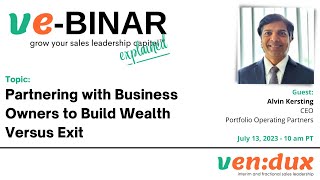
Alvin Kersting from Alliance Group explains how business owners can build wealth without selling. Instead of exiting, partner to take your company public, cover IPO costs with equity, and grow through acquisitions while you stay in control of operations.
Chapters
Welcome everybody. Thank you for joining us. Good morning. If you're on the West Coast. Good afternoon. If you're somewhere in the Eastern or central time time zones. Welcome to our webinar. A few housekeeping notes. We are recording this event and make it available on our website when you know, probably by the end of this day and then share it later on. Please keep your microphones muted so that we can focus on the conversation here with our guests and we will have a Q and A session at the end. We will monitor the chat so you can place questions there. But we'll also open up microphones when the Q and time for the Q and A comes around. Our topic for today is partnering with business owners to build wealth versus an exit. And our guest is Alvin Kersting from the Alliance Group, a senior partner at the Alliance Group. And Alvin, why don't you introduce yourself so that we know a little bit more about who you are and what your expertise is.
Well, thanks for having me here today, Henning and Andrew, it's real pleasure. A little bit about my background. I've turned around about 7 or 8 businesses now ranging from 3 million to 110 million in revenue. Got them turned around and grew them by mergers and acquisitions and then met the Alliance Group and continued that by helping companies go public and growing them by mergers and acquisition in order to scale valuation and build balance sheets that are that support valuation. They're not artificial. We build robust businesses.
You're based in Toronto?
Based in Toronto, yes.
And I understand you do business though worldwide, right?
Well, I'm based in Toronto. My partners are situated like for example the CEOs in Ireland, the managing director is in the Caribbean and another managing director is in the United States and Washington. So it's a global team. And we also have over 100 deal sourcing partners globally that help us find strong, good profit generating businesses.
One of the questions that I always find most interesting is how did you get to do what you're doing? So what was your journey to get there? Why are you doing what you're doing?
Well, first of all, I just absolutely love it, right. I enjoy, you know, building businesses, the engagement, the interaction, solving problems, solving problems at a high level, right from the plant floor up to the, you know, the major finance decisions, getting creative with businesses and understanding where opportunities intersect that you otherwise otherwise wouldn't have considered. And the creativity aspect of how two businesses can come together is really rewarding. At the end of the day, it's easy to see how two companies that are either viewed as competitors or viewed as opposing forces, whatever you want to call it can be reconfigured to be complementary. So we typically don't prefer to use the term competitive. We're always seeking complementary aspects.
The, the, the common wisdom amongst startup founders is that they build a business in order to exit it and that they, that that is their way of building wealth. Your approach is a little different. You talk about partnering to do that. Can you talk a little bit more what the typical startup founder is getting wrong and why your strategy and your approach is more successful?
Sure.
I mean it's, it's a big huge capitalist ecosystem we have, we're so blessed to have it. But there are time and phases in a business as they graduate from a pre seed or a seed or a startup. I don't even know what the term startup means anymore. And it's just a graduated business, if you can say that. And there comes a point there, you know, the ecosystem is such that there's a need for everybody. Venture capitalists really provide a huge value by helping companies overcome inertia. Right that initial funding and getting the companies going. But a lot of companies, when they get to a certain profit level, they can grow by mergers and acquisition and not be subjected to some of the equity dilution that they otherwise think they have to go through. And by having complementary companies, you now have the ability to come together and forge alliances to build a stronger balance sheet. And what takes seven years, five years to do organically can be solved in a matter of months with a partnership. And so we see that as value creating and we leverage that and the ability to accelerate that the capital markets by converting stock into capital.
The, when you, when you go and do your exploration, what, what's the process that you apply to find companies that are truly complementary, where you can put one and one together and it's not just two, it's three or more.
Good question, great questions, honey. That's sort of the source of what we do. We look for CEOs that aren't willing to exit, they want to continue growing their business. So many times folks that aren't aware that they have the option of going public because they always think that you have to be this big 50, 100 million dollar year company before you go public. And that couldn't be further from the truth. And in fact, when you go public as an early stage company, you can now start to leverage your stock and join forces with companies. So we look for companies and CEOs that want to continue growing. We also look for CEOs where they think they want to exit in order to achieve a liquidity event. But we say, why exit?
Why?
You can convert your business into what might be configured as a family office and generate cash, required cash generating businesses, grow your dividends, grow your valuation and your earnings per share. That creates wealth as opposed to exiting and getting rich. In our opinion, in our view.
When, when you talk, when you look at companies and, and evaluate whether they are complementary, can you share an example of not necessarily spilling the beans on your ip, but an example of things that were in place and that made companies complementary? Are we talking about products that are complementary markets that they're operating in where they can support each other? What are some of those complementary items that you look for?
Well, you know, it's in an illustrative manner I can articulate. You ever see the diagram that shows the evolution of man walking upright, for example?
Yes.
Right at the beginning all they were, all they cared about was finding food. And today we, we seek to find convenience. Right. So it's an evolution, it's a moving, targeted question. So take for example a company builds, let's just say they were in logistics. Okay? They started off, they acquired three, four, five companies in logistics, they grew their profit generating businesses and all of a sudden their balance sheet through to from say, let's just say 1, 1 for illustration purposes, 1 million in net equity to 50 million in net equity, got a powerful balance sheet. Now you can ask yourself, do I really need to acquire another logistics company or am I interested in trucking companies or, or you know, something else? So you now have leverage with a more powerful balance sheet. And you can ask yourself, you know, I got here by acquiring cash generating, cash positive businesses, right? What I didn't get here, acquiring quote unquote logistics companies. So it's a little bit of an adjustment in the mindset about what you can leverage with what you've built. You've built a bank with your balance sheet. Now what can I do with that creatively? And you know, conversely, a blue collar logistics company today may need artificial intelligence. So now you, you're not acquiring logistics company, you're now acquiring complementary businesses. And to summarize that in a very powerful way, I often ask folks, when was the last time Google bought a search engine? Right? They acquired complementary businesses. Walmart, world's number one retailer. Right. Well, in order to do so, they had to acquire companies that supported them becoming the powerhouse supply chain and logistics manager. So those are some of the creative, creative ways that we undertake an endeavor to build the businesses as part of our partnership with the companies we partner with.
How would you describe the space you're operating in from a company size perspective? Maybe also from a vertical perspective?
Well, when you say vertical perspective, can you elaborate a little bit on that?
I mean industries, for example, are there particular industries that you focus on, you know, labor intensive, investment intensive, or, you know, regulation intensive? Is there any, any particular focus that you have?
Well, one of the nice things and the luxuries we have is that we capture the eyes of institutional investors, the holy grail of what companies want. So that usually means that it's better to have bricks and mortar or asset based businesses. Now, that being said, those are conventional type strong businesses that get built, so we work with those. But we're listing a company that's a high end yacht rental company, for example. They have a wonderful app driven by artificial intelligence, supporting a very interesting space. How many folks really are aware that there's a high end yacht rental type business that can be scaled and we're going to help build that business. Now as for the size in terms of dollar value, I mean that. I hope that addressed the spectrum of industries and captured the essence of that question. In terms of size, we can take a company doing, you know, 500,000, a million dollars in net profit or greater or in terms of revenue, anywhere from four or five million dollars in revenue, right up to $80 million in revenue, for example. So we prefer to deal with companies in that accelerated growth space because we become working shareholders and partners. And so we're motivated to grow that company as much as the CEO is because we're working shareholders. And that's how part of our differentiation as we evolve this conversation.
Yeah. Can you talk a little bit more about the structure that you're striving for? You already mentioned that you become a shareholder. How does that work if you forge an alliance between or merger between two or more companies?
Well, it starts with one company. You usually. Or if there are two companies that want to merge prior to going public, or multiple companies that want to merge before going public, we can work with that as well. But let's just for simple mathematics, start with one company. Let's just say they're doing $2 million in net profit, 10 million sales, and they want to go public. And their valuation might be 6 million. And when we take them public, their valuation will increase to say 60 million. What we do is we cover the cost of going public and in exchange for doing that and increasing the valuation, we negotiate an equity stake. But the story doesn't end there with us. We continue because we've now become shareholders and we handle all the quarterly reporting of the publicly traded entity, a huge value creator. Because what is the bane of every public company, the quarterly reporting? What does every private company fear about going public, the reporting? Well, we address the number one fear. We take it on as working shareholders. And then to compound our value, we also handle all of their sourcing, structuring, due diligence and the final transaction of the acquisitions. So that what does the business owner want to do? They want to focus on building their business. Right. They own the business. We're like the general manager that puts the team together and they integrate it, they synergize it, they scale it. But one of the beautiful compounding effects now is that when this company comes into the hold code number two, for example, and the original company says, okay, you know what, I'm a little busy, I don't have time for M and A right now. We'll go to the second company or the third company or the fifth company and say, are there any interested parties that you'd like to acquire? They might say, yes, we undertake mergers and acquisition and perform the same services for all of the acquired companies in the whole code. So now where company one was too busy with something strategic in the company, operationally their net worth increased because we made acquisitions for the other companies. So it becomes a compounding effect for all parties. Again, what does that do? It drives the overall EBITDA earnings per share and the valuation. And to compound that, we are requiring profit generating businesses.
The, you, you spoke about the focus on, or mentioned the focus on regarding company size. So small and medium sized businesses or small and medium sized enterprises. And then the biggest challenge, quarterly reporting, with your expertise and taking over all of those reporting aspects, you're, you're, you said you're addressing the fear, but you also, I assume doing it with your expertise of having done this and continuing to do this not just for one company as a one off, but for a lot of different companies that you've taken public over the years. Correct? 50 plus, like your it says on the background.
Exactly, exactly. We've helped some amazing companies, you know, grow from, you know, having starting off with two companies in construction, growing to 32 companies in the hold code using no debt to make the acquisitions. And once the balance sheet became powerful and grew from 31 million to 81 million, we use institutional debt to achieve growth capital. Non dilutive, non dilutive growth capital. And we distributed that. And you have A perfect ecosystem. It's a compounding effect that results. Now I'd love to say that we're doing something absolutely unique and new, but really we're not. We're just modeling a little company called Berkshire Hathaway and Google and Facebook and Amazon, IBM, kkr. A lot of folks just don't realize we can start doing that very early. We don't have to wait until they're a hundred million come value company. And you know, going back to what you articulated Henning, depending on which country you live in, the size of the company may or may not be considered small, medium or large. Because for example, here in Canada a small company. Right. Is a micro company in the United States. You know, a small business in the States is a hundred million dollars. A small business that's a big business in Canada. And so you know, from varying from region to region. How we define a startup or a small company or a big company usually is a regional reference than a global one. So we work with companies really of all sizes. As long as the key thing, as long as the CEO wants to grow and have accretive value creation. Non dilutive is it.
Do I have to think about this as you finding that one CEO, the nucleus for your, the starting point for your process and then you go out and, and look for potential acquisition targets.
Correct.
So in the course of a year as a, as a business, how many companies do you look at in order to, to find those, those targets? I assume it's not a like 100% conversion rate. You do have to do due diligence on each one of those companies.
Well, I can answer that question that the conversion increases with greater awareness of our program. Why? Because we live in a very binary world of exit or acquisition, private equity or vc. There's somewhere in between to play.
And.
It'S, it's tied to the motivation of the business owner. A lot of times a business owner may want to exit for the simple purposes that they've lost the creativity because they've just built one type of company and what do they want to do? They want to exit and try a different company or a different industry or different segment. I often ask why do you have to sell your business in order to do so? Leverage the balance sheet that you've built in order to acquire a company that you've become more interested in. Install a CEO that you can have a report to you and now undertake what energizes you more than anything else? I, I, I have tremendous respect for a lot of folks that have Built, you know, multi exits, 1, 2, 5, 10 exits. But often say, look, maybe what could have happened was you would have had 10 acquisitions and then what would have happened to your net worth? And so this is where we adjust the articulation that we're not in the business of getting rich. We're in the business of building wealth.
You described earlier how, what all the areas are that you're getting involved in, the areas that you're taking over as a shareholder, what are things that you're staying out of? Is there anything that you're staying out of? You. You said, you mentioned earlier that business owners are interested in running their business, which I assume is what you let them continue to do.
I guess the best way to answer that question is that we Effectively become the CEO's chief capital markets and Chief Mergers and Acquisitions officers. We report to them in a roundabout way. We do not make determinations and decisions on the operations of the business. Now, my partnership team at Alliance Group have a wealth of expertise. As I articulate from floor right up to global finance. We are, we as shareholders now can become advisors so that the CEO doesn't have a transactional partner. They have a shareholder that will give them the best advice from the same frame of reference from people with actual skin in the game. That's tough to beat.
It's tough to beat.
And I, and I also think that and feel, and the, the results have definitely, definitely shown this to be true, that that's exactly who Most of the CEOs want to work with as well. So all of a sudden, now, if a CEO is listening to this, who said, I want to exit and try something different, or I don't know what to do, it might change his or her mindset to say, hey, maybe there's an opportunity here to expand my creativity and get my, you know, try something different instead of selling the business. Let's look at this balance sheet a little differently. Wait, did he say no debt? Well, I'm debt free. I don't want to take on more debt. Oh, how does this work? And all of a sudden, things start to shift because we didn't do an exit or an acquisition. We formed a partnership and created a conversation. And as I always said and learned from wonderful mentors, the purpose of conversation is never to win or to lose, but it's to make progress. Well, that's true in business as well. I often say that a successful business is a result of good conversations being had.
I love that quote, by the way. I think you have that on your LinkedIn profile.
Yes.
So that's a, that's a great place to start. Now I, our audience here is, you know, some, some of them are founders and CEOs, some of them are fractional executives because we're in the fractional executive business on behalf of the later group. How, how have you worked with fractional executives? Have you had fractional executives in some of those businesses that you've worked with? And what, what has your experience been?
Well, we believe that fractional executives provide a tremendous amount of value for companies for the simple purposes of matching supply and demand. Right. If a company requires, you know, if it's an early stage company that requires one tenth of the time for a fractional service. Right. Versus a full time service, then they're not, they're not building their business efficiently. Now this is where fractional CEOs come in, especially in the earlier stages or depending on the type of business. You know, nowadays with everyone working remotely and more service oriented type applications, it's a broad spectrum of what supply and demand might entail in terms of the services. So I think they provide a huge gap to fill in order to bring efficiency and more, greater effect to our beautiful capital ecosystem. Capitalist ecosystem, Matching supply and demand. It's wonderful. And they, we, we count on them because many of them enable us to see companies that we otherwise wouldn't have considered. They in fact will turn into some of our referral partners, which I might add is rather lucrative. And you know, we, we want everyone to be successful that partner and work with us. So we see fractional executives as being a fantastic, fantastic complement to the overall structure of our business. It's very important. Heck, Henning, this is why we connected.
Yes, that's exactly why we connected. Now before we go to a Q and A here for that first group, those CEOs, those founders that might be listening in, that might be intrigued. How can they get in touch with you?
The best place is usually through LinkedIn. Why? It gives them an opportunity to gain some insight into the individual and from there they can work backward to the company. So LinkedIn is perhaps the best. My name is Alvin kersting, I'm on LinkedIn company. I'm partnered with the Alliance Acquisitions Group. You can find us there as well. That's, that's a primary way. I can put my cell phone in the chat room as well. But LinkedIn offers the greatest insight into the individual and as we all know, we do business with the individual.
Absolutely correct. Thank you for, for sharing that. I think LinkedIn is the place to go. Andrew, let me, let me call upon you either for questions in the chat or for questions that you might have.
Thanks, Henning. Thanks, Alvin. I don't. Let me see. Yeah. Before we get any questions in the chat, I mean I always have lots of questions. One of the most important ones, Alvin, for everybody listening into this call with you, I assume we get a discount for the yacht rental business that you have when we want to rent our yachts, is that right? What's the name of that business?
Naughty360 and Andrew, it's a high end yacht rental. They do not offer discount.
If you, yeah. If you have to ask for a discount then it's not for you. Right.
I think that's usually how it works.
What's the name of the business?
Naughty 360.
Naughty.
Yeah.
As a nautical.
Okay. Or naughty and nice. Nice. Okay. And what.
It's a fantastic company.
I'm going to look it up. So another question in terms of your role, if you're working, you know, you start working with a, the CEO of a business and you now have become their partner and vice versa in the truest essence.
Yes. Shareholders. Working shareholders.
So now you're going out to, to develop a growth strategy. What, however that might look like now you've got other parties involved and so you are the go between a buyer and a seller. How do you manage any potential conflicts representing both sides of an equation if that ever actually comes into play?
Help me understand this question a little bit better, Andrew, please. Are you speaking of for example, a portfolio company in our Holdco and a potential acquisition, a company that wants to get acquired and how that activity interrelates with the existing companies in the hold cup?
It's sort of. But you know, a buyer wants to get the, I mean everybody wants to get the best deal. So the buyer wants to get the lowest price, the seller wants to get the highest price possible. Are you, are you representing both sides in a transaction?
Yes. Okay, so if it makes sense, we'll bring the, the, the summary. Okay. Of the program of the, of the potential deal to the board of the whole co. That means one CEO or all of the CEOs and we make a decision, they make a decision, not us. We're doing all of the work for the CEOs so that they can make the best decisions.
Yeah. Okay.
We will provide advisory of course and input but we will have hard facts to, to work with and we're not. And again we're, we're obviously going to be strategic in the acquisitions and by That, I mean there's give and take, a negotiation, but fundamentally we will not negotiate on the cash flowing aspect.
Right. You, I'm assuming that most of the deals that you've done, if not all of them involve hard assets and, and you know, physical product. Is that correct? And then the other question is, do you also work with services companies, professional services, consulting, other other types of services that are more heavily dependent on human capital?
Well, typically in terms of the professional services, I presume you mean accountants and lawyers. Sometimes that may not work out as a good space to take public just because of legal, non like or conflicting conflict of interest type of scenarios. Paralegals, it may not be legal for them to in fact go public. But we work with hard assets and services. Take for example the company I mentioned, the high end yacht rental company. It's primarily a services businesses right now. But what, what's nice is they will want to eventually turn some of that balance sheet that we build for them into hard assets. And hard assets will want to acquire tech. They're not to us there's no distinction.
Right.
Value creating, it's complimentary.
Yeah.
Leveraged.
Some point in the, in the future Vendu might want to go public. So you know, if through, through some kind of a roll up an M and a strategy on a global basis so that you never will help you.
To achieve in one year or they'll take you seven years to do. Interesting. With less dilution. Interesting. And with each acquisition, right, because we're acquiring profitable companies, your earnings per share is going to increase. It's like what did they say? Bill Gates was the wealthiest man in the world when he owned the least percent amount of Microsoft.
Right. Okay. Very, very interesting. I suppose. Last question for the moment, Alvin. From a, from an expertise point of view, now you're working with a CEO. They've built up a 10, 20 million dollar business, decent EBITDA and margins. And they know their business, their space in the business of acquisitions, mergers, working with adjunct kinds of businesses. So for example, you reference a logistics business, for example.
Yes.
They go into complementary businesses. So this CEO and their team, they don't know those businesses, they don't know those industries. To what extent are you involved in, you know, on the people side of the equation, helping these companies find the right people to execute properly on their strategies?
That's a good question. It's one that's best answered by saying we don't get involved in the management of the business. The owners, the experts do that. Now take for example our partner alliance Group's team. What we can contribute to that is that we've had all, you know, Florida finance expertise. We can advise them on what to look and how to configure as shareholders. We can advise them 100%. That will be the extent usually to which we'll provide feedback. After all, we are in a roundabout way reporting to the CEO because we are their chief capital markets and chief mergers and acquisitions officers. And so we don't get involved in the management of the company. We're focused on what we do best. But we know a thing or two, we can, we can provide some guidance on, on those topics. 100%.
Now, you know what I'd be interested in just, I'm sure Henning as well, because we've got hundreds of, you know, over the last four, four and a half years in business, hundreds of clients that might somehow be, be an interesting ecosystem to, for, for matchmaking purposes. So the more that, that I can know about that we can know about the Alliance Group and your criteria and what lens, what industries, what factors, what criteria, you know, the, the top scoring on, on a due diligence checklist. What would you look for for, you know, the high level screening to say yes or no. This would make sense at least for an exploratory conversation. It would be good to know about your, your perspectives more than, than you've shared today.
So many wise men, Andrew, have said if a 6 year old can understand what your thesis is, then you have a value proposition worthy of consideration. And for that reason we've distilled what you're asking there very simply. $500,000 in net profit or greater USD is the baseline to initiate a conversation. And we love conversation and we love reviewing companies and we offer a fantastic referral program whereby folks that are creating value to their clients, whether they're fractional, CFOs, CEOs, what have you. We offer a fantastic referral program whereby they're now creating an extension of value creation for their client by introducing them to knowledge, expertise, right. And creativity such as the Alliance Group. Everybody wins. And so the baseline to keep the communications effective and clear, 500,000 net profit or greater. Alvin Kirsten on LinkedIn. Let's have a conversation.
Great, great.
That is a wonderful closing comment, Alvin. I will add to it the quote that you have on your LinkedIn profile. The purpose of conversation is to make progress. You're inviting our listeners in to have that conversation with you if they fit the, the mold that you described. And then it's all about making progress. So thank you so much for being our guest. Thank you for sharing your approach and the support that you provide to companies in the space that you, you outlined. But first, first and foremost, thank you for taking the time to be our guest today.
Well, thank you, Andrew and Henning. I'd also like to compliment Vendux for what you do. I love the nature by which you guys interact in the ecosystem. You don't view yourself as just fractional providers. You're actually helping your peers. And in many industries, what they call competitors, you view as complementary partners. That's absolutely advanced thinking. And I'm, I'm very happy that we can partner and work together with Vendex here at Alliance. It's a real value creator and I appreciate that. As for that reason, I definitely accepted the offer to participate in today's program.
Thank you. Thank you, Alvin, for making the comment and sharing that positive view and positive impression. We are honored to be a partner of the alliance group and look, look forward to having you back on a, on a webinar at a later time. And for right now, thank you and have a great rest of your day.
Thank you very much, gentlemen, and I'll accept your offers in advance. Thank you for having me.
Thanks, Alvin.
Cheers. Bye for now.
Bye.
More from Henning




ve-BINAR - The Revenue Tornado Methodology: How 3 Power Sources Create Exponential Growth


ve BINAR: Executive Cloning: How AI is Reimagining the Role of the Fractional Executives




veBINAR: Unlock Client Value: Why Compliance is Crucial for the Startups You Serve
