ve BINAR Partnering with Business Owners to Build Wealth Versus Exit 1
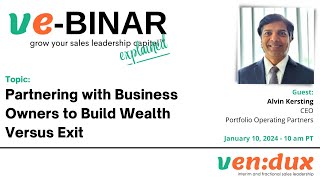
Alvin Kirsting of Alliance Group explains how they partner with CEOs as working shareholders, building company value through acquisitions and eventually listing on public exchanges. They screen for cultural fit, prepare companies for public markets, and use listed equity and bonds to fund further deals.
Questions this video answers
January 11, 2024.
Toronto, Ontario, Canada.
Over 100 deal sourcing partners globally.
Ranges from about 20% to 30%, depending on valuation and structure.
He stated public companies experience a 10–12× multiple as a minimum (quoted claim).
Chapters
Foreign.
Welcome, everybody. Welcome to the first webinar of the year. And we have a guest that those who've been part of this series have seen before. Alvin Kirsting. He's been, he was with us last year and we, we will not have a repeat. We might have a little recap and then move on to new topics with him. But first, some housekeeping notes. We're recording this as always and make it available on our website. Send out an email to those who have registered. We will have a Q and A at the end, so save your questions or put them in the chat, whichever way you prefer. But at the end we ask you to unmute yourself if you want to ask live questions. So without further ado, Alvin, welcome back. And why don't you to start us off, introduce yourself so those who haven't had the pleasure know who they're dealing with.
Okay. Hey, thank you very much for having me here. Tim, Tom, Chad, Andrew, real pleasure to be here again. I love what you guys do and how we can contribute to the well being of businesses. That's a primary goal of me being here as well. My background is I've turned companies around in all different industries. Regulation, configuration, family owned private equity divisions of publicly traded companies in all sorts of industries. And today I work with Alliance Group and we build businesses the old fashioned way through accretive and profitable acquisitions and, you know, with supported valuations.
Wonderful. Where are you based, Alan?
I'm based in Toronto, Canada.
Okay.
And Toronto, Ontario, Canada.
Toronto, Ontario, Canada. And you do business though globally, right?
Yes, we're industry agnostic and regionally agnostic, with exception to a few regions, but they're not overly applicable to mention predominantly western hemisphere Europe, some parts of Asia. So we cast a rather wide net.
Good, wonderful. I mentioned that we're going to kick us off with a recap the things we discussed in the first webinar. When was that? Like five months ago or so. Why don't you, Alvin, give us a quick rundown of what we covered back last year?
Well, Henning, you did a good job in asking very concise and clear questions and we covered a lot of base, so I appreciate that very much. Gets us to work zone in a little bit today on some, some granular aspects. But effectively we, we discussed, you know, why an M and A strategy is important, how to go about doing it. You know, to summarize the last program, we effectively highlighted that a lot of CEOs and business owners like to focus on their business, that is their core competency and capability. And alliance. We address perhaps the best time value utilization right to grow companies, and that's obviously by mergers and acquisition. But our goal isn't to drown the company in debt and have someone else collect future cash flows. And you hope like heck you can weather the storm. We do it as working shareholders alongside the business owners where our core expertise is capital markets and mergers and acquisition, coupled with our global network of deal sourcing partners spread across the globe. That's a wealth of words I just expressed there from the CEO's standpoint because it means that we effectively present them with merger capability, merger possibilities that are accretive and profitable, that bolt on to their company so effectively what will take them two years to raise capital, and perhaps in today's environment it might be much longer, if at all, and then three to five years to deploy the work that you raise the capital for with the hope that things haven't changed, which they're changing at a much rapid, much more rapid pace. So effectively, what I was trying to articulate there is that what will take the business owner five to seven years in many cases we can achieve in days with merger, acquisition coming together of like minded CEOs. And in most cases what we're looking at are CEOs with like minds that want to be a part of a bigger balance sheet for a multitude of reasons. Whether it's to access growth capital using the lowest cost of capital format, whether it is to compete for larger projects and acquiring your supply chain. These are all considerations to be had in order to grow by M and A. Now one of the things we touched upon as well is the evolution of a company that undertakes merger and acquisition. And the expression I always like to use is when was the last time Google acquired a search engine? They haven't. Is Google a search engine company? No, they're not. They're a mergers and acquisition business that's acquiring companies that are accretive, profitable and complementary to their core search engine. And it's evolving. Think of IBM, think of all of these different companies that are household names, they are merger and acquisition companies. So initially they started to roll up their industry and over the course of time, as their balance sheet strengthened, their profitability increased. They issued publicly listed bonds to drive earnings per share growth and paying down bonds through the profitability of the companies and lending against or issuing bonds against their balance sheet. So when undertaking the consideration of M and A, we need to think in phases as opposed to binary. I think that pretty much encapsulates our first program at a very High level.
Remind us again, I know we talked about that in the first. Even our. What, what type of companies do you work with? What size of companies, what verticals, if any, do you work in? How would you define that?
Great, good question. Effectively we are industry agnostic and we have over 100 deal sourcing partners globally. And so as working shareholders, right. In the context of taking a company public. Public. Well, prior to taking them public, we'll incubate them and do some merging of companies prior to taking them public if they need that breadth and scale to get to a certain valuation. Once public. Right. And in both cases, private and public, what we'll do is we'll sit down with the CEO and the decision makers of the company. CEO, cfo, coo, scientists, what have you and configure a strategy. We don't look at things as industry specific because I, I've, I've run over eight manufacturing companies. I can tell you that they weren't manufacturing companies because we had to acquire erp, we had to acquire logistics, we had to acquire, you know, non destructive testing, welding, fabrication, all these different things. So from the context of industry I'll say we're agnostic. But what I can, how I can answer that question differently is by saying we deploy our resources to acquire assets that are accretive and profitable to the companies that we are working with and partnered with. We don't have clients, we have partners.
What's your secret sauce? To determine that you Indeed bring together two like minded CEOs as you phrased it earlier.
Now that is a million dollar question. Hannah, I love it. Thank you. It just prompts what I like to boast about the Alliance Group. Every single one of us has built, turned around, grown, sold or acquired a business. We are not professional services practitioners that never built a business. It's the other way around. So we view every activity through the lens of the CEO because we were all there there. That is in fact the secret sauce.
Right.
And we don't allow familiarity to breed contempt. We take nothing for granted. Yeah.
Then let's talk about the. Tim, Sorry, I have a question. You raised your hand. So Tim, you want to chime in with a question?
Yeah, Alvin, if it's, if it's okay. I really liked what Henning started asking on the like minded, do you do any sort of. Yeah, I get that they need a minimum experience of having built or turned around a company, but do you, do you have any sort of profiling that you do, strengths finder or anything like that to say you Know, this comp, this person, the CEO at company A and this person, CEO at company B or C, they, you know, have the same sort of, you know, mission in life or, or they're strategically aligned because they both want this specific thing in the century industry or they, or they have some compatibility. Is there anything like that that goes in to say that, you know, this person could be a good partner and knowing that birds of a feather flock together, maybe not a great term, but do you use any of that sort of mentality?
Oh, absolutely. Absolutely, Tim. No matter how good a company is, say, for example, there have been deals where they were a perfect fit financially and operationally, but culturally, absolutely not. We've ripped up contracts on signed deals where, you know, very quickly the colors started to come out. And we, we take preventative measures for that. Right. And that's on the negative side of the equation of what you asked because we want to cover both sides. Now, on the more optimistic side and relevant side, Alliance Group will bring the company to a certain level of due diligence. Ultimately, the CEO or CEOs of the companies of the holding company that we're bringing the companies into will have the final decision. And if you don't mind, I'd like to share my screen so that you have an illustration of what a structure looks like. Sure.
Thank you.
So for illustration purposes, you're able to see my screen now, right?
Yes.
You see an example, exchange listed group Holdco. Okay, you're not seeing my Looney Tunes cartoons here, are you?
Nope. We're seeing the right screen.
All right, good. So effectively going back like. So, Tim, you've asked a very good question that somewhat brings a lot of things together at the same time. I loving the evolution of this. So Alliance Group addresses the gap that the CEOs have. We are capital markets and business builders experts. Right. And I use the term loosely, by the way, because we're always learning. So we're handling all the capital markets work, for example, reporting, listing fees, structuring, raising capital, administration of the capital, raise. We do not raise capital. We're not licensed to do so. Okay. And the mergers and acquisitions. So anything in that realm we bring to the table for the CEO. We'll have a discussion with the company and the CEO of the potential merged company. We will do the financial due diligence, look at formulating the financial structuring of bringing the company in, whether it's a combination of shares, solely share acquisition shares and some bonds, debt, what have you, and we will put together return on investment Calculations, net equity position, cash flow position, all those key metrics to look at to demonstrate what this merger will look like. Now, obviously that CEO is going to have skin in the game, right? But at that point in time, we've covered as much as we could possibly cover humanly possible. Obviously, if the CEOs, if we present six companies with that to the CEO or CEOs of the whole company, they might pick one or two. And at that point in time we're going to have a conversation. It might entail a site visit, those types of things to gauge the, you know, those tangible things that we need to verify. But it's a stage process, Tim. It's not one that we overlook and do through a zoom call solely.
Yeah, that, that makes sense. And I like your construction industry roll up example here because I, I imagine if, if you're looking to roll up your. You're finding companies that have a specific niche they're going after in their market and they're saying, you know what, we could grow in our market or our markets if we had electrical, mechanical. And we don't have that skill set. So they're really hiring people and acquiring people that can help them grow. So that's, that's interesting that, that. Thanks for this example.
It's good. I'm glad you find it useful, Tim. It took a long time to put together and view it from the opposite side. As easy as it looks now.
And I'm sure you have to do a lot of work with not only the CEO, founder of, you know, of your, I'll just call it your client, but the partner, you know, if there's four that are potential matches, you have to do some pretty good handholding and convince them why, why it makes sense from their side also.
Right.
So you gotta, you're really the broker in the middle of, of multiple entities.
I'd like to adjust that a little bit. Right. We, we, we are shareholders, so we don't view ourselves as brokers.
Sure.
Okay. Because we are looking at this solely from the eyes of the CEOs in these companies here. So if we feel it is accretive and profitable, only then will we present it. We are not going spaghetti against the wall here.
Yeah, yeah, no, I get it.
Yeah. I'd like to punctuate that because it's at the source of our DNA.
Yeah. So like, what percentage, what percentage of share would you take in? Let's just call it, you know, the average, you know, the average company. What percentage of share would you participate in in the new Co that comes out of the two out of the match.
That's a function of valuation and that can range from 20 to 30% simply because the only cost the company has to incur in the journey of going public is completion of their financial. Audited. Audited financial statements. Otherwise we handle every aspect and cost associated with going public. Okay. And the liquidity premium of going public more than offsets the difference. For example, on average a public company will experience a 10-12x multiple as a minimum simply because of the transparency and available liquidity. And we'll get back to liquidity because it can be a false sense of security. Yeah, and, but you still have a public market where your shares mean something. Furthermore, your shares are converted into a currency, something you can in fact use which you can't really do privately. And three, obviously the transparency with the open reporting which facilitates the previous two activities, notwithstanding the prestige that you get from being a public company and greater likelihood of suppliers and clients working together with you. So you take a that liquidity premium and if the company's at 1 to 3x multiple and we take a 20 to 30% stake, they come out still with, you know, let's just say it was 10, 10 million 10x and we took 3, they're still up 7. Right. Furthermore, it doesn't stop there. It now starts to compound because we're going to use all of those shares to acquire companies. Right. And use the arbitrage to compound the valuation of the company, all while acquiring profitable companies.
Yeah, let's stay there a little bit. The steps that you take before taking a company public, I imagine there is a period of incubation where you help them, you make changes or adjustments, you fix things that might not be right for an optimal listing of the company. What are some of the things that you look at during that incubation period?
Well, we run a closed loop circuit Simply because the CEOs have, the CEOs are focused on their business and you have a complimentary shareholder that's looking at the closed loop, the feedback loop of the business from a different perspective, albeit the same as the CEO. So during the incubation process we'll continually assess where the industry's shifting, where it's moving new technologies. We'll get feedback from our deal sourcing partners about what and how and what's changing. So that for example, you don't keep acquiring construction companies just because you're a construction roll up company. You start acquiring engineering services and all of these other complementary things. Now let's just Say drone technology is becoming more prevalent. We'll be on the leading edge of that knowledge and its implementation. So we might even recommend during the incubation period to consider drones as part of a construction roll up because you might have more efficiency in land surveying, in global navigation of the equipment, laying the cement or laying the asphalt, or you know, to conserve the utilization and reduce waste. These are all different types of things having built businesses that we would look at and consider. So that happens and that takes place during the incubation period. We're looking at the market, we're looking at all of the things that are going to impact the valuation of the business. Right Tom? And at which point in time have we perhaps exhausted the private space and we're now ready to catapult on the public market. We might be up at a 30 million valuation with 5 million in, 5 to 6 million in net profit. Okay, great. We've got a good balance sheet, we've got a good profitability situation. We might be able to access bonds going forward. Everyone has a different currency in the process of growing their business. We are just there to advise and make sound recommendations from the capital markets, from the M and A side which are now vital once a company's past that threshold towards accelerating growth. I hope that answers your question, Henny.
It does, it does. I also like how you appear to have always two different stakeholders. Right there is the company, but you also highlight the CEO as an, as an individual and as a leader in everything that you're doing, starting with bringing like minded CEOs together. So what are some of the things that you do to help specifically the CEO of the, of the then or now public company after you've listed them.
Well, for you to, for anyone to achieve in months what takes years to do, you need to take a lot of work off of their plate. So handling the M and A sourcing, structuring, having these conversations before we get to the final decision, looking at the capital markets, looking at bond structuring, whether it's private, public bonds, doing all of that work really takes a huge load off of the C level suite. Right. You know, whether it's a chief technology, chief executive, chief Financial officer, the cumulative effect of taking the workload, you know, I'll put it to you this way. Let's look at things a little differently. Let's just say you have two laptops, each have, you know, you know, 12 gigs of RAM and one terabyte, two terabytes, whatever's common nowadays of memory, right. They're, they're functioning, they're processing all the time. We load one computer at 80% load and we have another computer at 20% load. Which computer works more effectively and efficiently? Tim, you're on mute.
The 20% one is way more efficient.
Yeah, exactly. And that's, that's sort of an analogy I'd like to present in terms of holistically what we bring to the table. The difference.
Yeah, you're, you're fractionally, you're available and out there and you're fractionally doing all the things that the CEO can't do. And because one, they don't have the experience, they don't have the time and they have their own business to run to keep it going so that it is saleable at the end. How many different engagements do you, do you typically run? Because I, I think you said it's a two to three year kind of process that you're engaged with a CEO.
You know what, it depends on the, the magnitude of the deal. Yeah, right. So we can take on 10, you can take on 5, you can take on 15. It all depends on the size. Right now we have available capacity, right, to take on at least another three to five companies. But then what also happens in that configuration that would lessen or increase the capacity would be how many, how fast the other companies are growing. And as you see here, you know, if we bring in two, four, six, eight companies, that's eight other mouths to feed. Right. Pound value. So it's, it's something we monitor. Right. And we're perfectly upfront and straight in terms of our available capacity. So it's a good question, Tim. One that's absolutely relevant. And we're, we're really good because we, we understand our bandwidth very well based on that close interaction with all the CEOs that we work with. So we can time this and analyze the capacity very well. Now, you know, and where I'm going with it is if a company wants to get to 100 million valuation, or like a company we're working with right now that wants to get to a billion dollar valuation, you know, that gets taken into consideration the capacity and the magnitude of the, of the work as well. But one of the things I, I, we, we expressly do not use at alliance is that we're fractional, we are perfectly committed. Right, because again, we are shareholders, we're working shareholders and we have the, you know, like a 100 deal sourcing partners globally. And in a lot of cases you only need 7 to 10 per deal in a lot of Cases depending on again the magnitude. So we are, we are fully committed. We are not waiting for the CEOs to give us guidance either because we're shareholders, we're motivated as heck get to build the valuation as well. Right? Yeah. And so that would summarize our incubation process. Right. Whereby now we would look to take the company to the exchange so we can now experience the world of low cost capital. Now let's pause at that intersection because right away I imagine the next, the top of the five next potential questions will be where do you list? Right. And so not in North America, preferably in a lot of cases we are able to list in North America, but what we prefer are smaller exchanges internationally. One, if you're a publicly listed company anywhere in the world, you can access the lowest cost of capital, which is publicly listed bonds. So why would I go on a more expensive exchange to the goal isn't to exit, it's to build the company, build its valuation. So we are not a near term exit strategy or a 100, 200, $300 million valuation exit strategy. Right. If you want to do a full exit at all. And so when we take the companies, we, we like to take them on a smaller exchange.
Okay.
Raise minimal capital. Because most of the capital you want to raise usually is to make acquisitions or for growth. Well, we're, we're do. One company that we're working with said we need to raise $6 million. I said do you really? I said yeah. And we said this is how our M A program works. He said oh well, I think I only need to raise 1 million. Then I said how does that work for your dilution? Where Said, it works great. I said, but you do get diluted with the merger of other companies. He said yeah, but I'm acquiring profit. Said, bingo. We can work together. You get it?
Yeah.
And so can I ask a question.
About the, the minor exchanges or non. What I think you said was non U S exchanges. So the cost of capital you're saying is less in a smaller or foreign exchange, Is that what you were saying?
No, the operating costs and the management costs of listing on a smaller exchange is going to be considerably less than New York, NASDAQ, Canada, tsx initially, it's like matching supply and demand. I often ask folks, you know, would you give your 16 year old, your brand new Porsche to drive? And I'm batting a thousand on that question. Right, right. So why would we take inexperienced reporting, inexperienced issuers to top of the food chain listings? It's a disservice 12 in North America, institutional investors, which is the holy grail for Companies exist beyond 100 million valuation in most cases, we're not taking, we're taking companies that are less than that or haven't been proven at that valuation. And especially when capital is the way it is today, that, that's even more profound. So this is for this reason we are going to handle all the listing, all the, all of the reporting, all the building. We're going to educate the CEOs on the reporting how to handle themselves in the capital market. This is all part of the incubation process. People forget that there are two companies when you go public in order to access these low cost of capital. I'll come back to that low cost of capital, Tim. There are two companies. There are the operating companies and there's a publicly listed company. And by us handling the publicly listed company, it's also going to educate the business owners as they're building their business. Can't do both at the same time. Now at 100 million valuation, there will be more available resources to actually support a listing in North America. Often found it kind of interesting that people raise money in order to list just my personal opinion, but this is how we're looking at these businesses in a very fundamental way. We want them to be profitable. We want them to be able to support and match supply and demand with the listing because it is a part of the business. Now when I reference low cost of capital is just simply trying to identify that publicly listed bonds. Right. If we can issue publicly listed bonds against our balance sheet and pay the coupons with the profitability of the company. That's really all I was trying to illustrate. And that can be done whether you're listed in Austria, Luxembourg, Jamaica, Bermuda. That can happen anywhere.
Right. And there's enough, there's enough buyers in the Luxembourg or Jamaican market that would buy XYZ company bond at 4% or something.
8, 13. Yes. Yeah. And a lot of folks haven't realized as of yet that Jamaica is the top exchange for IPOs when it comes to over subscription. It's a powerful market. And when you, when you look at North America, we forget that. Also, it's not promoted that there are 25,000 companies listed in North America. That's New York, NASDAQ, OTC, CSC, CBO, TSX, TSXV, a lot of companies. And when you hear statistics like Vanguard, State street and Blackrock owning 78% of the S P 500, one has to beg the question how much liquidate liquidity really exists for small companies unless money is worth zero. Interesting.
Okay, Tim, I don't want to take the mic away from you, but I want to be cognizant of the fact that we're coming up against time here. One final question from my end, Alvin, before we open the mics to other questioners. How do you what happens host the listing. You talked about the fact that there are now two companies, the Holdco and the operating company. You talked about the, the journey to the long game to build the valuation. What else is important? Post listing from your vantage point to maximize the value of the Holdco and the operating companies.
Well, as I mentioned, we're handling many aspects of the publicly listed entity. So we are engaging with investors, right? We're creating awareness for the stock or administering the process of creating liquidity or driving awareness of the stock. We are handling the quarterly reporting. But the compounding effect that's most material to the question you asked is this right here. When we took the company public, we might have had one or two that exceed the minimum threshold of a half million USD to go public. Right? And what we, you know, there's, there's so much that is involved in this process of creating wealth versus getting rich. I can't show it all in one slide, right? So I'll go to the next slide. And this is an illustration of effectively what we aspire to build and ties into the phasing of the one year, two year, three year or two year, four year, six year plan. Right. When we started with this company, it couldn't be two more different companies. An online education and a construction company. In four years we averaged eight acquisitions. We made about 32 acquisitions into this Holdco and now they span seven different industry segments, all of which, or some of which are synergistic in nature and complementary. Now, some CEOs might only want the construction and transport and we could build that. Some might want just leisure or food and beverage and we can build that. This particular CEO saw an opportunity in an all encompassing Holdco because when they started with one education and one construction company, two companies doing 50, about 8 million in sales with 15 million in net equity over the course of year two, year three and year four, they said, hey, we can just be an acquirer of profitable companies. We're now effectively a family office structure. We're just holders of profitable companies. Yes, we started off with education and construction, but if my balance sheet says I'm sitting at $81 million in net equity on 167 million in sales and I've issued $25 million in bonds against it. Right. I can, I can have a little fun. I don't need to exit or wait a second, my valuation has increased that. You know, when I wanted to take 10 million out and give up 100 my business. Well, the valuation today is such that I only need to liquidate 10% and I still keep a good portion of it. That sounds like Bill Gates. Right. And so this is where I'd like to answer your question, Hanning, in a encapsulated format that this is somewhat of the story of the end game and the evolution now going back to this slide really quickly. We are doing mergers for all of these companies. So this CEO, let's just say they're pretty presently integrating a company. They don't have the bandwidth to integrate another company. Right. Well, his wealth will continue or her wealth will continue to expand because we're doing acquisitions for the other companies. So each time we make an acquisition of a profitable and accretive company, the earnings per share is going to increase and potentially the dividends will increase as well.
Great.
So that's how we continue to create value.
Yeah, that's great. I appreciate, I think the visualization here helps a lot to bring that, that point across. Let me just see if there are any other questions from the audience here before we wrap it up. Please unmute your mic and ask the question directly since we're a small group.
I don't have a question, Henning, but Alvin, it was very interesting and intriguing. So thanks for presenting that today. I appreciate the feedback. Chad, thank you.
If there's room for one quick question, Alvin, just very, very high level. Can we, can you zoom out for a moment? Macro environment last year, this year, trends. You know, what are you seeing particularly looking forward in terms of global exchanges, geopolitics, the increasing importance of AI and the prevalence of AI in technology, the interest rate environment, any, any major macro factors that are high on your list as, as key factors to consider going forward at least for the next year.
Great question, Andrew. I think all of those factors are relevant and I don't know if one outweighs the other to depending upon the business. But what I can say is 2023 was a year of adjustment for a lot of businesses. We've experienced close to 20 years of low interest rates. It created a lot of disruption in the marketplace. Some good, mostly in my opinion, not so good. And with the return of some value to money, it's really separated, you know, the, the strong from the not so strong because now we're going to see. I, I think we're going to see a lot of mergers and acquisitions. I read a report that summed up that 3,200 companies in 2023 went bankrupt, costing investors $27 billion. Well, in the M and A world, we don't view, we don't take a hierarchical approach to that language. We see it as opportunity. It's, it's coming together. So there might be some opportunity for real good discounts of good companies ready to merge and take place irrespective of interest rates. Okay. If the coupon rate on a bond is higher, great. No big deal to us because nobody can raise capital. It's too expensive. Right. So you're going to have these two. To us, they're just, you know, moving the water from one side of the teeter totter to the other. Right. To, to cause an effect. But at the end of the day, the entrepreneurs primarily focus on building his business or her business, such that they're going to eventually have to take a risk one way or the other to make it happen, irrespective of the geopoliticals. You know, for some folks, the geopolitical events are a boon. Right. For some, not so much. So there's a lot of crosswinds. But the fundamentally sound businesses are, will continue to grow. You know, look at the leader in the type of structure that we create. We create miniature, what we like to say are miniature. Berkshire Hathaways, well, he's licking his chops right now, ready to make some discounted acquisitions. So should they, should all the points you mentioned, Andrew, be considered 100%, but within that, they shouldn't be viewed as restrictive. They should be viewed as how do we navigate them. Great, thank you.
Thanks very much, Alvin. Appreciate the perspective.
I think that's a great closing comment, Alvin. I appreciate you taking the time to join us for a second time. Maybe we'll have you back for a third time later in the year. We'll see about that.
Absolutely.
So much for, for taking the time. And we hope you, hope you and everyone else has a wonderful rest of the day and a wonderful rest of the week.
Likewise. Thank you all for contributing. I appreciate it. Tim, thank you for the fantastic questions. You really helped to synchronize. You know, it's even on you. It's on everything that I have. You know, the objective isn't the purpose of conversation isn't to be right or to be wrong. It's to make progress.
Right.
And it's so nice when we have an engaging audience like you all. So thank you very much for that. That really helped to compound the hopefully benefit, hopeful benefit out of this exercise today. So thank you.
More from Henning




ve-BINAR - The Revenue Tornado Methodology: How 3 Power Sources Create Exponential Growth


ve BINAR: Executive Cloning: How AI is Reimagining the Role of the Fractional Executives




veBINAR: Unlock Client Value: Why Compliance is Crucial for the Startups You Serve
