ve-BINAR: Partnering with Private Equity
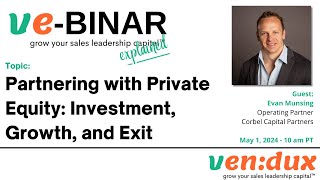
Andrew Miller and Evan Munsing explain how lower-middle-market private equity works with small and mid-size businesses. PE deals typically close in 3 to 6 months, faster for rescue financing. Investors focus on clean financials, strong management teams, and customer validation, then implement 100-day plans to support portfolio companies.
Chapters
Hey everybody. Good morning greeting. Good morning from the west coast, good afternoon from the East. It's great to see you. Great to have you. I'm Andrew Miller, one of the partners at the Vendex Group where we focus on helping clients to grow their sales leadership capital. I am thrilled to have Evan Munsing as our guest today. I'm going to let him introduce himself in a second. Today's webinar topic is Partnering with Private Equity, Investment Growth and Exit. I don't know if anybody has lived in or worked in socialist and communist countries in the world. I have spent many years in Asia, China. Today's one of those days in that part of the world. It's Mayday International Workers of the World Day. So it's funny and, and ironic that we're having this conversation about private equity and the business of capital and people. So happy Mayday. I don't know how we got to May so fast. It seems like it was just, just New Year's. Anyway, we're going to dive into understanding how private equity funds partner with small and medium sized businesses, how they can create options for you for us to grow, to professionalize and exit, you know, with a, with a financial transformation and what they look for when they partner with businesses. As an operating partner for Corbell Capital, Evan works with owners, CEOs, managers and he helps them accomplish their business goals and achieve the next phase of their financial journey. Evan joined Corbell in 2022 and he's, he runs portfolio operations. So yes, he's in the business of the capital side of the equation but also portfolio ops which means he works directly with business owners to, to help them transform his, to transform their companies. Evan, I hope I didn't steal any of your thunder. I'm going to pass the line to you in a minute for, for your intro. A couple of quick housekeeping notes before we jump in. So we're going to keep everyone muted for the duration of the webinar that be a Q and A at the end. You can either use the chat function in zoom to submit questions or then or feel free to open up your mics later and engage with Evan directly. The V R is being recorded and it'll be available later today or tomorrow at the latest on our site and on YouTube. Evan, again thanks very much for being here. Appreciate your time. So before we dive into today's var, could you please share a little bit about your journey, what's going on, what you do at Corbel and and even a little bit about Corbell at a high level.
Sure. Thanks Andrew. Glad to be here. Appreciate you and Henning bringing me on. So I'm Evan Munsing. I work with Corbel Capital Partners, which is a Los Angeles based lower middle market private equity fund. And when we say lower middle market, we're really talking about small and medium businesses, anywhere from 10 to 100 million in revenue. And I realize that the, the upper end of that, that seems like a large business to some folks, but in the private equity world that's still medium sized. So we provide both equity investments and credit. So we have a debt facility as well. We have a number of different funds, a couple of which are SBA backed and some of which are entirely private. So we have a range of options and a range of ways that we like to partner with folks like yourselves to provide growth capital. We do rescue financing as well. And what we really look for is we look for good management teams and good managers who we can back and who we can help professionalize their organization and take them to the next level of, of their business journey. My background has been almost entirely in private equity. I did spend a few years at the beginning of my, my adult life, I guess in the Marine Corps and Department of Defense, but then after that went into consulting for private equity organizations and then became a, an executive in a number of different private equity owned businesses. So I joined Corbell Capital about two years ago with the intention that I could take the lessons that I'd learned in my experiences and help other business executives, be they sales leaders or CEOs or whoever, to, to make their journey easier so they don't have to learn the hard way some of the lessons that I did. So I like working with people like yourselves. I'm, I'm much less on the capital side of the business and much more on people and the transformational side of the business.
Excellent. Wonderful. Good. Let's, let's dive in. So right at the, at the highest level, Evan, what, what is private equity and how does it differ from other kinds of traditional financing options like loans, for example?
Sure. So what private equity is, is, it's, it's a way of taking money from individuals and institutional investors. So maybe they're high net worth individuals. They could be institutions like a pension or a large bank that has capital that they need to deploy and we collect that money and we invest it into businesses without having to take them public and go through an IPO process and have all scrutiny that goes along with that. So it's a way for, for us to help transform businesses without a lot of the red tape that comes along when you're in a public market space and you have a lot of reporting requirements and you have to kind of hit a monthly or quarterly cadence. So this is a way for, for people to, on our side of the business, to transform businesses over long term. It's also a way for folks like yourself or business owners to really have a tight partnership with a professional organization as opposed to a lot of individual investors. And it's also an easier way for people to liquidate or to, to get value out of their business than if you had to go and, you know, try to IPO or do a SPAC or anything like that, where you might be locked up and prevented from selling your equity for a very long time. You know, if you compare and contrast it to a bank loan, which is a traditional way of small businesses to get financing, banks have a lot of restrictions on who they can loan to, what types of loans they do. It tends to be very formulaic. Right. Like a business loan is not that much different from getting a mortgage on your house. Banks have specific things they want to see. They don't want to take a lot of risk. They're in a lot of cases banned or blocked from taking risk by the regulators. And they also don't want to put work into it. They don't want to come over and mow your house. They don't want to, they don't want to come in and check on your household budgets. They just want to collect money every month. Whereas people in our game are looking to actually partner with you. We're not looking just for money every month. We're looking for the equity bump as well. So we want to help you grow your business. We, you know, a lot of funds have people like me who want to come in and, and be hands on partners and help teach you things that maybe you don't know and really be a source for you to drive your business higher. Not just a pool of capital. We're really partners as opposed to just a source of money.
Yeah. Yep. So you, there's a couple of subjects in here. One of them, you know, you use the word liquidation. And then the other revolves around what, what PE looks for in deals to invest in. So from a liquidation point of view, so I'm a business owner, I sell to, I sell out or sell or bring in pe. Does that mean I can walk away and, and head to the beach as, as the business owner or to what extent am I staying in the business and working with you for a particular period of time until there's a, a mutual exit.
Yeah, it's a great question when it comes up all the time. So broadly speaking, you're probably coming to us for one of three reasons. Either you've decided you want to cash out and you want to go spend some time on the beach or go enjoy your family. You might be coming to us because you're looking for growth capital. So you have a business that, and you think there's a great opportunity, but you need 20 or 30 million dollars to launch new product or to build new facilities or to go acquire another company. Or you could be coming to us because you've entered some financial distress and you need some rescue financing. Obviously in, in points two and three, we're, we're probably gonna be looking for you to be there for a while because if you're coming to us for growth capital, presumably you also see the value of staying. So we might give you some money to cash out so you can enjoy a higher quality of life. But both us and hopefully you would expect that your real bump is going to come in three to seven years when we all take this company to the next level. But if you were in the position of wanting to just exit the business and try to, you know, take, take, take your money out and go, go move to some nice beachy location, oftentimes you can't exit immediately. It's not like the deal closes and then suddenly millions of dollars appear in your bank account and you get to shut off your computer and shred all your documents. There will always be a period of transition time and it really depends on the maturity of your business as well as the needs of the new managers who are coming in. So if you, for example, have a really great chief operating officer, chief sales officer, who you groomed to become the next CEO and the private equity fund feels very confident about them. There might be a short timeline of say six months or a year where we're just making sure that, that this person is getting handed over the new responsibilities that your new board members feel comfortable with where the business is, and then you can go out and, and live your life. If you don't have that kind of either professional backing in terms of a management team around you, or there aren't the systems and processes in place to make it a really professional organization. And a lot of the day to day activity still revolves around you as an owner or CEO being involved in the business, then there might be a two to three year period where we come in and help you professionalize your team. We might partner with people like Vendux to find sales leaders or to implement processes to kind of back up the CEO and make a firmer transition period. So as you think about that journey, something that you'll want to be thoughtful of for yourself, but also candidate about when you talk to your new partners is what, what are the capabilities of your team, what systems and processes do you have in place and what are your expectations for an exit? Now there are sometimes advantages to prolonging your exit a little bit longer. If your company's healthy and growing, you can roll over your equity or you can get an earn out that will give you even more favorable terms. And if you took it all in cash, but, and all those things can kind of be traded back and forth as you negotiate and as you, you and your part new partners go through the process of getting to know each other and figuring out what you like and don't like about, about the business.
Yeah. So to what extent are the terms and conditions different for different kinds of capital needs? Rescue capital, growth capital, you know, these very, very different needs.
Yeah.
So from the P.E. from your point of view, you know how different are the terms and conditions in making these different kinds of investments?
Yeah. So maybe let me start by talking a little bit about that process. So. And they're very different. So if you come, you know, if Andrew has, or I guess in this case Henning has a great business that he wants to sell and Henning's found that nice little house in Tahiti he wants to retire to. But he's still a young buck. He's got, he's got time. He might start shopping his business around without really an intent to sell it. And in three or five years he might find the perfect partner who's giving him a great valuation and the economy is doing well. And so that person might be willing to give him 100% equity payout all in cash at a great multiple and Henning can just walk away from it all and suddenly Andrew Miller is a CEO.
No, I'm going to t also.
There you go. So that's a very different scenario than if, if we went to another company and, or another company came to us probably and they said, you know, roll back to 2020 June time frame. Companies in the, you know, one of our companies, T3 Expo is which is doing phenomenally right now, they've had tremendous growth, but in 2020 their business got crushed because they do expositions. So like they do the salesforce Expo, the Amazon Expo. And if people aren't going to expos, you don't really have a business. So they came to us with a very different set of needs where they needed capital to keep people employed, to bridge to the, the, the exit out of the pandemic. And when you're in a situation like that, everybody's obviously much more cautious. And so we're gonna, you know, we invested some, some debt, some equity as well to give them funding. But there were a lot more conditions on that. We had, you know, board representatives who were put in place, we had covenants in terms of how much cash they had to keep in the bank account at any one time to ensure proper liquidity. There were really extensive reporting requirements so that we could see where the business was at any one time. And so those are very different scenarios. And so the covenants and the restrictions on how you might take your cash out or what type of cash you get are also very different. Some other things that come into play also is, you know, if going back to Henning's example, if he didn't want to actually fully retire, he saw that there's a great growth for venn ducks in the next 10 years, he might say, hey Corbel, give me, you know, I want you guys to be a minority partner. I don't want to sell the business, so why don't you buy 30% of the equity, put some money on the balance sheet, give me some cash now. But the rest of it I actually want to roll over into equity or to more equity or I want an earn out because I believe in five years this is going to be four or five times the size of the business it is today. And I think the economy is going to get better. And so rather than taking all cash, he might decide that he's actually going to kind of sell part of the business to us. But he really wants to, to stay involved and run the business. And so most of his benefit is going to come from the next horizon of growth and whatever transaction happens on the, the tail end of that.
There's a lot of variables there. Yeah, what, what was the size of that exposition business?
I don't remember. So that was before I entered Corbell. So I don't remember what they were at that time, but now they're doing about 100 million in revenue. So they're quite large and they, you know, they had kind of one of those dips where they were a growing company and then the rug got pulled out from under them and suddenly they shranked and then we gave them the money to grow. And I think since then they probably doubled in size or since pre 2020. So they not only got back to their previous growth, but then they doubled. So a very successful business for us.
So you talk about this split or the potential mix of going into a company with both equity and debt.
Sure.
Do you ever do 100% debt financing or.
Yeah, yeah, so we do that. So we're technically a private equity and a private credit fund. And we're also backed by the SBA for some of our funds, which means we get to take money from the sba, which the SBA wants to go out and loan money to small businesses and to grow American entrepreneurs. So we have capital from private investors, we have capital from the sba, and depending on the different structures, we can deploy that either as credit or as equity. And we have specific funds set up for each of those. And there are rules and restrictions around each of those funds about how we can deploy capital or what the use of those funds can go to. We do do some 100% credit deals where someone might basically want a variation of a bank loan. We prefer to stay away from that because we believe we create a lot of value for our business partners and we want to create value. So we like to do some combination of both credit and equity investments because we want some of the juice at the end too. Just like you're growing your business and you're gonna get a lot of money out of it, we want, you know, we want to feel like we're being rewarded as well and not just treated as a bank or a capital provider.
Yeah, yeah, that makes sense. So then from a, from a timing or a process point of view, from the time that the first conversation begins between you and a prospective Investee for a 20, 30, 40 million dollar business revenue, how long does it take from first conversation to writing the check?
Yeah, so even before that, you probably have to find us. So there might be a personal connection. And, you know, in this case, we, we know each other and we could talk about business stuff. But if you were a business owner or a business leader who's going out to market their company for the first time, it's kind of like dating. You need to go out and find a lot of people, and that, that can take X number of months. But once you meet someone, timing can really vary and it depends on the pressures on the business or the lack thereof, as well as how much you and the other party like each other. So again, going back to A rescue financing deal where your business in distressed. There's going to be a lot of time pressure on that and both sides want to close as soon as possible to protect the business and to make sure that operations can carry on and that you're not losing customers or losing market share because it's taking too long to close the deal. So those deals can happen in, in literally days, so maybe a week or two weeks. And they tend to be very high pressure situations. You know, working 247 to get information to get the deal done. And because of that time pressure, because you don't have the, because we don't have the opportunity to really look at your business or really get to know you, we're going to expect more in terms of more restrictive covenants, probably, you know, a better value for us economically because we're taking a lot more risk. Now on the other hand, you could be run into businesses where the businesses are doing great. They don't really need capital, but they see value in it. And you end up playing kind of the hard to get game with people. And those can take two or three years until everyone kind of comes and comes into alignment. I would say a more typical process timeline is from the introduction all the way to the transaction closing is three to six months, which when you think about how long it takes to sell a house, three to six months really isn't too bad, especially if you're, you're trying to sell a $50 million business.
Yeah. To, to your point about the, the dating process or just even finding a date in order to date. So I'm the business owner and I have certain objectives with my business. You know, growth objectives for the business. How do I even begin the process of looking for 3, 4, 5 prospective PE companies that I could conceivably be aligned with and vice versa, to even start those conversations.
Yeah, I mean, so I think it starts with you and you have to, you know, it helps to come to the table with a very firm idea of. Great. Not a very firm, but a pretty good idea of what you want out of a partnership. Is it, is it just capital? Is it, you know, operational expertise? Is it discovering a new product or building out a new product? Is it getting the right people in place around you so that you can build a team. And then based on that, you, you can see that different private equity funds have different ideas about how they approach businesses. Some of them are just in a certain industry. So it might be tech or industrials or healthcare. Some like Corbel, are very generalist Focused, reinvesting kind of any company as long as we can find good managers. And then alongside that, that vertical focus, they'll have a, they might have a horizontal focus where some, some funds are very focused on product and go to market, some are very focused on cost cutting, some are very focused on re engineering, operational design. And so those, that kind of helps you build out a matrix of your potential dates might be, and all this can be found on the Internet. Or you might go to an investment banker or a business broker and say, hey, this is a type of, this is my business, this is the type of person I'm looking for. Can you start setting up introductions? And those people have a Rolodex and they'll go and find people like myself or you know, similar folks and other private equity funds to start arranging the conversations. And then as you go through this dating process, then you really kind of feel like what, what people are and what they actually want out of the relationship, if you will. Are they just there to, to make money? Are they there to build your business and what are their kind of strategies and the way they approach it? And, and really it's important to find people you like to work with because, you know, we all know that if you can take a lot of money from someone and end up really hating the job, if you just don't get along with them and they're, maybe they have a different value system or they're just not the type of person you want to be in a relationship with.
Yes. So we have what we would call discovery conversations all day long, every day, whether it's with a prospective client. 30 minute get to know you. Are we aligned with a prospective executive for a specific role? Kind of a 30 minute alignment. Yes or no? Yeah. If I, a business owner calls you to try to, you know, ask for a, an exploratory conversation for 30, 40 minutes, is that something that you routinely engage in?
Yeah, absolutely. That's, I mean, just as you, you described it is very similar to what we do. You know, typically deals come to us through investment banks, but we also have people in our network. For example, my second cousin just introduced me to a CEO and I am having a 45 minute conversation with him on Friday to discuss his business. And we'll do a similar thing to what you do, which is we'll talk about their business, talk about what they're trying to get out of the next phase of their growth, introduce ourselves, talk about what we like and what we like to see in businesses where we think we really Excel, what our strengths are. And then usually the next step will be, you know, send us, send us a board deck or your, your SIM or whatever kind of formal presentation you have, and then your financial statements from the last couple of years, we can look at that and that. Then we'll, you know, we'll huddle internally and go to our investment committee and say we like this business because of whatever. And if we do, then we would go into a formal process where we would sign NDAs and we would have a data room set up. And that's when we really start collecting all the information from, from a potential business partner.
What's the sim? Something. Investment memorandum.
Confidential investment memorandum. Oh, it's basically a formal presentation.
Yes.
That you would put out to investors. Yeah.
Got it. Great. Let's pivot a little bit to the people side of the business. So we're in the people business. You're in both capital, the capital, the business of capital and people.
Right?
Right.
Yeah.
You're writing a check, but you're writing a check to people who you trust and want to back, who can execute and deliver on, on the objectives.
Yeah.
Tell us a little bit about how you work with, you know, in your role, portfolio operations. You are diving in at some level, to some degree with your portfolio companies, right? Sure. So how does that work? Is it the, the folks on the investment team, they're, they write the check, they may, they do the deal, then they bring you in. Are you being brought in in the due diligence process, when in the due diligence process and then once the deal is done, what is your involvement from. From a portfolio management point of view?
Yeah. So I guess the first thing I would say is the people side of business is always the hardest part to get. Right. It's, it's easy to look at financial statements, it's easy to build a model. It's really hard to know if someone you're talking to is trustworthy. Are they telling you bullshit? Are they going to be someone you want to partner with for the next five to 10 years? Are they good because they've been lucky or are they good because they're good? So that's where I spend a lot of my time, is thinking about those, those issues and interviewing management teams and working with management teams to try to identify are they good because they're good or are they good because they're lucky? I can, you know, if you were to look at sort of how a private equity process might, might work. You know, you go from discovery or introduction and Business development to due diligence to when you close the deal, you usually come up with 100 day and a one year plan where you're saying these are the five or six things we want to partner with management to execute. And then there's the ongoing process of board meetings, strategy and operational implementation. I can come in at any part in that flow. So I do some business development work. I talk to folks like, who are on the webinar right now, get to meet people, find folks who might be good folks to work with. I come in during due diligence as well, either to evaluate management teams or my background is really in services and technology. So I get pulled in by the bankers and by the investment team, specifically in those types of companies. And then after a deal closes, so I might help out with due diligence, I might look at technical architecture, I might help write the 100 day plan. And then sometimes after a deal closes, if I'm not already involved, if stuff starts to get weird. So it could be that we, you know, we believe that we can't trust someone or just a business is not turning out the way we expected. Then I might also get pulled in to, you know, dig deeper to partner with management teams and to figure out what's really going on. And the difference there is that, you know, a lot of the other folks at Corbel are, they come from a banking background, they come from a finance background. So they're really used to thinking about spreadsheets and board meetings. Whereas because I've been an executive and because I've, you know, I've sold products, I've built products, I'm used to thinking about customers, I'm thinking about products and I'm thinking about leadership. And that's just a very different lens and a different sort of pattern recognition to have. And so I get brought down when, when those things are needed more than just the numbers are.
Maybe when you were with the Marines in the Department of Defense, you were an interrogator and you have special superpowers there. You could cut through bs.
I'm good at talking to people. I don't know that I have superpowers though.
Yeah, that, that's very useful. So let's say so you know, we've done the work, you've written me the check and we're, we're in our 100 day plan and you know, I, I want to pivot. I, you know, I don't want to stick, I'm not going to stick to the plan. There's something else going on in the business, the market. Things have changed. And you know, we, we may have agreed on, on path A, but it, you know, path B is right there in front of me and it's a better path to go down, you know, quote unquote, do I still control my business? Am I making those business decisions to pivot to path B or, you know, how does that dynamic work?
Yeah. So I mean, no plan survives first contact with the enemy. Going back to a marine aphorism. And we don't expect, you know, we know we've been in this business for a long time. We know that nothing that you underwrite ever turns out exactly as the deal model said it should be. No plan ever is executed exactly on time or exactly at the value you expected. So we're, we expect pivots to happen. Going back to the dating metaphor, this is just like you're now in a relationship so you wouldn't, you know, go buy a new car or go have the roof torn off your house without telling your partner. You would, you know, we wouldn't expect you to do that. We want to collaborate with you. We expect you're the business leader, you know, more than we do. If you see things changing in the market, we don't want you to commit to a plan that no longer makes sense. We just want to know why you're changing the plan. And we want to feel like we're brought along for the journey just like your partner probably expects to be brought along for those journeys as well.
Yeah, totally. Fair point. So in a minute I'm going to open up the floor to bring others in and see if anybody wants to ask you and engage directly.
Sure.
So in the VC world there's, every day there's examples of, you know, co investing VCS, bring other VCs in and it's, it's a pool deal. So a company would raise from multiple VCs. Does that ever happen in the PE world or just typically, you know, you, you're only going in as the, the one private equity investor and not others.
Yeah. So it certainly happens in the private equity world. We don't do it often. We, because we have both private equity and credit arms, we really view ourselves as a one stop shop. So we, we prefer to be your, your partner, your capital provider for everything. But certainly as you get into bigger deals, particularly you'll see, you know, what are called club deals where you have a couple of private equity funds coming in to do something. You might have private equity fund, a private equity fund, B Private credit group C all coming together to put together a multi billion dollar deal which involves some kind of equity and credit investment. So those things, they're not as common as in the VC world and they there tend to be fewer players than in the VC world but they certainly do happen. Gotcha.
Evan. So I'm a business owner and you know, my objective is growth capital or growth and growth capital is an ingredient to bring in. Sure. Before I would begin any conversations with, with prospective PE firms, any recommendations on what I need to be doing or should be doing to prepare to have effective intro conversations?
Yeah, certainly the most important thing, bar none, is make sure you have good books that you've had. You know, hopefully an external accounting system or company come in and look at, look at your finances, make sure stuff looks good because nothing is going to turn off a potential partner. Then something wrong with the books because even if it is honestly intended or there was no bad intentions behind something that is obviously very scary to people and you know, know it's hard to prove post hoc if there was good intentions or bad intentions. So getting clean financials is super important. It, it's also obviously important for you as a business owner to really be able to look at your books and look at your business from a clean outside perspective just to understand how the business is doing. So that would probably be number one. I think number two is trying to take a broader view of your business than you might be used to. So stepping back and you know, if you've been in the day to day and you build a company from nothing for 20 or 30 years, you probably know a lot of stuff kind of in your bones that might be hard to explain to someone outside the business. And there might be ways you do things that really don't make sense, but it's just how you do things. So taking a step back and thinking strategically about your business, coming up with a really clear explanation of where your business has been and where it is today and where it's going is incredibly important. Those will, you know, you can practice that obviously as you start going through these conversations, but having that narrative and having that strategic picture is really important. And then the third thing is, you know, if you need to get financing tomorrow, this is probably a little less applicable. But if you have time, really building a management team around you is incredibly important because what we're looking for is not just a good business and a good owner, but we're looking for good business leaders around that person because at some day Henning is going to go retire into Hedi. And we want to make sure that he has skilled leaders around him and they're professional, they're capable, they've been taught things and they know the business well. And so putting that in place over the next six to 18 months is really important for getting people comfortable and making a big investment in your business.
So that's probably a really great segue to having Henning ask you a question about making that pivot. Let me open up the floor.
I already booked my flight ticket here.
Oh, good, good. Excellent.
Since I have you on Andrew, I understood that I could just take the cash and walk away.
Yeah. Oh, yeah, that was, that was a key point that Heaven made. Yes.
Yeah.
No, Evan, if I may ask a question that you or, or emphasize a point or have you emphasize a point about the, the, the, the making sure that the business is not owner dependent but operates independently. In addition to the, to the notion of bringing in people that carry key responsibilities and basically can run the business without the owner, there's also this, especially in professional services, the notion of branding and naming of a company. So if our business was called Henning llc, it would be probably not as attractive or the name would be a liability. Is that how you look at it as well?
Yeah, I mean, I think people is always the hardest problem to solve. So. And you know, look, as a business owner, I'm sure you want to be able to take vacations and you don't want to be the person who gets up at 3am anytime the smallest thing goes wrong with the business, you want to have people to depend on. So it's good, good for you. But obviously us, like, I, I don't want to be flying to. Maybe I do want to fly to San Luis Obispo every, every week, but if you were in somewhere else like Houston, I probably wouldn't want to fly there every week to, to check in the business. So I want to make sure that you're good. I want to make sure your team's good. And the branding issue is interesting. That's something we don't come across very often. But I would tend to agree with you that like having even a name that seems very owner dependent can definitely be a liability. Doesn't necessarily have to be. But having, you know, it goes back to that image of professionalism and dependability and all of that that's so important. Making sure that your business looks good to customers as well as looking good to capital providers.
Thank you, Andrew. Now, now it's time for others to ask questions.
Yes, anybody Else here on our webinar. Want to chime in?
Well, hi, Evan, this is Chip LeBlanc.
How are you?
Hey, Chip, nice to meet you.
Nice presentation and great explanation of PE and what you guys are doing. Question for you is do you have any kind of best practice or insight into how, you know, I, I know a few of us here are fractional, you know, services folks on the sales side, on the go to market side. What's your, you know, thoughts or, or insights around how people like us can engage with PE firms? I know you do, you know, the operating component, which is obviously what you do. You know, your expertise, you said earlier is kind of in the services side and so forth. Curious on really what a best practice or insights would be around engaging with PE for folks like us who are senior leaders and looking to engage.
Yeah, I mean, so I think you've already taken the right first step, which is working with, with Vendu because we, you know, Vendu is a preferred partner for us for sales leadership. We have other partners for, for finance and, and other functions as well. And I guess it kind of depends on what you're really looking for. If you're looking to work for APE firm, so Corbel specifically or kkr, that's different than wanting to be a, a interim CFO who works for multiple different private equity funds. So I think in terms of being someone who gets called upon to do interim CFO work or to do fractional, sorry, chief sales officer, chief revenue officer type work or sales leadership type work, be it interim or fractional, partnering with someone like Vendux is probably your best bet because they are seen as experts in that field. The, the second kind of way to go down would be if you're looking for like a permanent placement in a private equity fund, either the portfolio level or as an operating partner. The, the two ways to go about it would be you can start off as, you know, and as an interim or a fractional sales leader or revenue leader. And then that office obviously if you do well, opens up tremendous doors to go and do other things for that same fun because again, people are the hardest thing to solve for and it always takes risk out of any decision if you get to work with someone that you know and, and trust. And then the second path is, is just through networking. Unlike other industries, private equity is still very small and very, and hiring is very episodic. So typically people get hired when a, when either a, a deal gets closed or when a fund gets closed. So unlike, for example, if you wanted to work for Google. There's no, there's no job application system for chief sales officers or chief revenue officers. It's when we have a need, we'll go out and look for it and we'll talk to people like Andrew about our sales leadership needs. But you just gotta, you gotta have your name out there. You gotta meet people like Andrew and Henning and meet people like myself. So you're on our radar. But there's no simple, simple, straightforward way to getting that job.
I don't know.
That's great. I appreciate that feedback. Thanks.
Great, great question, Chip. Who else, anybody else want to chime in with a comment or a question? Evan? And just in terms of the year, the due diligence process, so the books, the financials, absolutely key. Your management team, people, absolutely key. To what extent are, would you folks dive into due diligence on the products or services or market or competitive positioning or you know, other dynamics out there that are or could or would be impacting the business, you know, if it's growth capital, for example, are, you know, where's the line between looking at inside the four walls of the investee. Yeah. Versus outside the four walls and doing your own pressure testing?
Yeah, so we'll always look at stuff outside the four walls because we wouldn't, you know, if, if you're a great business but there's no demand for your products then, then it's no longer a great business. So we'll always do some, some level of research or validation on both the broader market, on the product and on the customers. Customers tend to be where we go to first. So we'll do customer calls. We'll, we basically want to get references that validate that you're a, you are who you say you are and the customers love what you do. Now because we do kind of small and medium businesses, we don't, you know, we can't spend the millions of dollars that big. Private equity funds do like a KKR or Apollo where they might hire Bain or McKinsey to go and do a really in depth hundred page deck on the market, on the product. We typically don't do that but we will partner with experts, you know, folks from your Rolodex, Andrew, who, you know, have done chemicals or who have done e commerce technology and hire them for a handful of hours to go, go help us pressure test and also contribute their own personal knowledge. But because we're a smaller company, we don't, you know, we don't do the extensive work that other folks do.
Yes, yeah.
Makes sense.
Great. Well, we are coming up to 10 minutes before the hour. I'm sensitive to time. Any other questions or comments otherwise Evan, I'm going to ask, you know, for any final words of wisdom and how do people get in touch with you and you know what, what would you like to see if anything as a result as people, you know, digest the substance of today's session either here live or down the line when people listen to the recording.
Yeah. So words of wisdom. I don't know that I have many of those but if any strike, I'll try to record them. I guess. You know, as you all guys and as everyone thinks about their own journey, we want to be in the conversation where we like to, we like to have a network. Even if you're not looking at selling now or not looking for your next job right now or whatever it might be, we're still always interested in meeting people, understanding new opportunities. So feel free to reach out to me directly. So I'm at emun s I n g@corbel cap.com or you can go to the Corbel Cap website which is corbelcat.com and there's a contact section and you can either email the the investor relations email address there or fill out our contact form and just mention that you heard about us on the Vendux webinar. We're always looking to, to meet talented folks to learn about new businesses, new industries. So please feel free to reach out and build that connection and obviously stay stay close to Andrew and Henning because they do great stuff and they're intimately tied into work that, that we do and that other folks like us do.
Excellent Evan, been such a pleasure. Really love working with, with you and the team there. Thank you very much. Really appreciate your time today and your perspectives. Good insights. We will keep this dialogue going. Lots of back and forth opportunities.
Yeah.
Crazy and interesting dynamic world that we're all operating in.
So it is.
We will see you soon. And everybody, thanks for joining us today. Have a great rest of the week and and month of May. All the best. Thanks for joining everyone. Take care.
Thank you.
More from Henning




ve-BINAR - The Revenue Tornado Methodology: How 3 Power Sources Create Exponential Growth


ve BINAR: Executive Cloning: How AI is Reimagining the Role of the Fractional Executives




veBINAR: Unlock Client Value: Why Compliance is Crucial for the Startups You Serve
