ve BINAR: Productivity and Focus for Leaders: Do More, Stress Less SD 480p
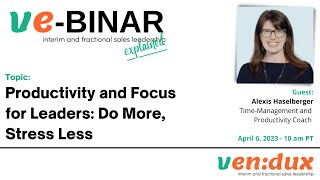
Alexis Hasselberger, a productivity consultant, shares strategies for leaders drowning in meetings and distractions. Use your calendar as a protective tool, maintain one task system like TickTick, and audit meetings with the five R's: review, remove, reduce, rearrange, repeat. Model good habits for your team and use AI to draft and brainstorm faster.
Questions this video answers
250% increase
About 23 minutes
TickTick (spelled out by speaker: T I C K T I C K)
About one third of the workday (≈33%)
Chapters
Foreign Good to see you. I'm Andrew Miller, one of the partners at the Vendux Group, where we focus on helping clients to grow their sales leadership capital. And I am thrilled to be here today with our friend Alexis Hasselberger on her favorite topic, spending our precious time on the most productive things and reducing stress. In the meantime, a couple of quick housekeeping notes so that we can be as productive as possible. We'll keep everyone muted for the duration of the webinar and there'll be Q and A at the end. So you can either use the chat function in zoom to submit your questions, or at the end, feel free to ask your questions directly, make comments, engage with Alexis however you want, and feel comfortable. This webinar is recorded on our site and on YouTube, and many of our interactions and views are in the recorded sessions. So, Alexis, let's jump in. Great to see you. Great to have you with us today. I've learned a lot from you and I have so many questions still, as always, as you know. So let's talk about sales leadership and productivity and time management. The Vendex ecosystem, as you know, is largely comprised of sales leaders and C suite professionals. These folks tend to be pretty good at keeping a lot of plates spinning in the air. So this is going to be a great topic, kind of high level. Alexis, tell us how it is that you've become such a guru around productivity. I know you've worked with many early stage companies, many large global enterprises, and executives at all levels. So what does your world look like and how did you get to where you are with productivity optimization?
Yeah, well, first, thanks for having me on, Andrew. It's always great to chat with you and you're right, this is my favorite topic. So really happy to be talking about this. So, in my world, like my background, I come from the startup ecosystem. I spent the first 15 years or so of my career running HR operations, like all the things that aren't sales and engineering in startups and some companies that got no bot. And then it became much larger companies and things like that. And I also spent about eight years of that time as an outsourced HR consultant for hundreds of companies at that time through another firm. And so I think one thing being in Silicon Valley in the area where people are always trying to do a lot with nothing, is that you start to see people burning out all around you. Right? Because people have a lot to do and they have a lot of balls in the air, just as you said. And if we don't have the right Strategies to keep all of those balls in the air, we burn out. And a lot of the people that I, that I work with today, I would categorize as people who have become very successful through brute force and they're looking for a different way to do it. And so, you know, throughout my career, people just kept coming to me for productivity advice, for time management advice, because I was able to get everything I needed to do done within a normal workday. And I had a life outside of that, and I had some kids along the way and I was still able to produce. And so people just kept coming to me for this sort of thing. And when the last startup that I worked at became no more, I decided that this was the area where I had a specific skill set that I could help people with and where I actually saw a lot of people needing that skill set. Because nobody teaches this stuff in school, nobody teaches it in college, nobody teaches it to you in your first job. And so you either sink or swim.
Yeah, yeah, for sure. So in, in all of the work that you've done, startups and the Googles and the Udemies, what, what, what do leaders struggle with the most when it comes to time management and productivity?
Yeah. So I think there's a huge one, and that is keeping track of all of the things without them slipping your mind. Right. So using our memory to, or relying on our memory as our task management system is one of the biggest see for folks, because as you progress up in an organization and as your life becomes more complex, memory is no longer a tool that works. And so it might have worked, you know, when you were straight out of college and you had no kids and you had no partner and you, you know, your job was relatively straightforward, you weren't managing anyone, you weren't managing lots of clients. Maybe you could use your memory or maybe when you're in school, that happened. But as things get more complex, it just doesn't work anymore. And so people still try to use that system or that lack of a system, but effectively they become more and more stressed out and more and more balls get dropped. So that's a big one. Meetings are another huge one. Meetings are up 250% since pre pandemic zoom has allowed us to be able to interact in this way, which is amazing. And also it means people are scheduled into back to back to back to back to back to back meetings with no time in between, and often scheduled into meetings that really don't need to be meetings. Right. Instead of being able to tap someone on the shoulder, ask a question, pick up the phone. Now we schedule time and what do we schedule? A minimum of a half an hour. Right. And so that's another big one. And then distractions are also a huge one. Studies show that anytime we are distracted, interrupted, every ding, every ping, every time our own mind goes down some rabbit hole, we remember we need to do something that, that actually takes us about 23 minutes to refocus on what we were doing. And so distractions are another huge one. I could keep going, but I'm going to stop there.
Yeah, no, it's such a great point about just even, you know, the back and forth on an email or Slack or all of the communication tools when, I mean, Henning and I were just doing this yesterday, we went back and forth a couple of times on an email regarding a subject and sorry, I'm gonna call.
Yeah.
And we literally had a two minute conversation which saved another 20 minutes.
Yes, exactly. Right. And I, I often call this, I call it the two exchange rule. It's like if I've emailed you and you've emailed me and I've emailed you and you've emailed me or slack or whatever and we are still not quite at it, like we're not quite understanding each other or we didn't get to a resolution, just pick up the phone. Because just like your experience yesterday, that is going to really speed things up. Because human conversation, like we get, we have tone, we have, you know, we can hear all this other stuff that it's, we're working to define or discern when it's over email or Slack.
What, what are some ways or the best ways that, that leaders can protect their time?
Yeah. So I always think about, I think your calendar is your, your best tool here. Right. I mean we are used to showing up for what's on our calendar. And calendar is open. People will just put time on your calendar. Right. And you will feel bad about saying no to those things. And so I think one of the things that I always, I mean, I hate that this is like a war metaphor, but I always think like, advance and protect, advance and protect. So it's like if you're looking at your calendar right now and it just looks like either a brick wall of meetings or Swiss cheese where it's like, you know, you're mostly meetings, but then you've got these holes of 30 minutes where you know you're not going to be able to get any real work done. You want to be saying, okay, well that's what My calendar looks like at this moment, but three weeks from now, if I look at my calendar, it's a little more open. So I'm going to now block time as do not schedule, so that other people do not take up that time without my permission. And so that's one of the best ways that we can do that. We can also look at the meetings and the things on our calendar that we already have and do a meeting audit to really make sure that the things, especially recurring meetings that we have, whether they're internal meetings, whether they're meetings with our key clients, et cetera, making sure that those are actually working for us and a good use of everybody's synchronous time. And so from a meeting audit perspective, I like to use what I call the five R's. And so it's first review, review your calendar to make sure that you know which things are worth your time and which things are not. Then reduce or, sorry, remove is the next one. So then we want to remove. Is there anything you can remove yourself from? Is there anything that doesn't need to be a meeting at all? Could be an email. Is there anything that you could delegate to somebody else on your team and they could just send you the notes? Then we want to reduce. For the remaining meetings that are on the calendar, we want to say, okay, could this be shorter? Right? Can we reduce it in length? Could we take it from 30 minutes to 20 minutes? Could we take it from an hour to 45? And then what about frequency? Maybe we do this every week, but we only need to do it every two weeks. We could try that and then rearrange. Right? So we want to say, okay, well, what's left on the calendar? How do I move these things into a place that looks less like Swiss cheese so that I have bigger open blocks for strategic work or deep work that I need to do? And then finally you got to rinse and repeat, so you have to do that every few months. Because we live in an additive world. We live in a world of entropy where things are going to keep getting a little more additive and chaotic. And so we can't expect that, oh, we did this once and now we never have to do it again. So that was a long winded answer.
No, no, it's great. I mean, this, this whole subject of calendar management, I mean, it, it can be huge. I mean, so many people actually say they are slaves to their calendar. I, I'm one of them. Do you use your calendar for, for everything, for personal time, exercise time and family Time.
So I use it for. So yes, the short answer is yes. And then I'm going to tell you like how that works. So I am not one of those people that has, you know, every single moment of every single day planned out in terms of my calendar. So for instance, my workday is 100% calendarized. So with my meetings and my time blocking of what I'm planning to do. And then I also put time blocks on there for things like exercise because you know, it's if you just wait and they're like, I hope I get to it today. We're never going to get to it. Right. We have to block out that time. I also block out time for things like cooking dinner because that's also something I need to do every day. And I want to have that on my calendar so that I'm aware of when that needs to happen and that I'm aware of how much time it's taking. But I tend to view all of the extra space then as my personal time. Right. And so I have, I don't block out, you know, I'm going to spend these two hours with one of my kids on Sunday and the other, etc. But I make sure that the default on my calendar is no essentially so that, you know, calendly is set up for me so that people, you know, even my clients can only schedule sessions with me between certain hours of the day and on certain days. So that when people are putting things on my calendar it is only at times that I have pre decided are okay with me.
Yeah. Do you use color coding? Do you use any other hacks, tips around the efficiency of a calendar?
Yeah, so I think that sometimes we can go overboard with like color coding every little thing. But I find that, you know, what tends to to work for me and for a lot of my clients is that I actually use layered calendars. So I have one calendar that is like my primary calendar. That's where meetings go on, that's where my calendly is attached to, etc, and then I have another calendar that just lays over that. So you know, on Outlook or on Google you can just create additional calendars that you can toggle on and off. And that one is my time blocking calendar. And so I will that just as a layer over and those are different colors. And so I like this because it's really easy for me to visually parse my calendar at a glance and say, ah, okay, these things are meetings where I have agreed to show up with someone else and these other things are meetings That I have agreed to show up for myself to do these things that. That I want to do. And that way my whole workday can be blocked without it looking like it's 100% blocked, that nobody could ever schedule time with me. Right. And then I also have a family calendar. We have a household calendar. That's another layer, and that's another color. And so I tend to think of it as how do I reduce the amount of time and effort that I'm spending organizing my calendar by having these different layers that are already each their own, their own color.
That's really interesting. I'm just thinking about so many of our fractional executives. They have different clients and all in different stakeholders, all kinds of things going on, deliverables and clients and people. So this layering concept is interesting, particularly when you have so many different clients and you, you know, do you ever show up to a meeting where you say, wait, I have no notes. How do I know this person? What. What meeting am I in? What is this about?
Well, I don't anymore because. So for me, a task management system is really important. And this is something that I work with on all of my clients with, so that they have really a single source of. Source of truth for all of the things that I need to do coming from. No matter what client, no matter what situation, there' one place where that all goes. And then my calendar is being used to essentially make sure that all of those different things can fit and that people have different. You know what? You know what? Actually, I've lost the train of my thought here. Like, sometimes we do. So can you repeat the question? Because I want to make sure I'm answering exactly what you asked.
Well, there were a couple of things. So many of the people that we work with, with our fractional executives, they have many different clients with different stakeholders and different issues going on. So they're constantly. They're jumping back and forth between handling one set of things for one client.
Yes.
And then a completely different set of things for another client.
Okay, back to my train of thought here. I got it. Caught the thread. Okay, thank you. So what I do is I have a task system, and for every meeting that is going to require prep on my part, I have a task related to that. So, in fact, I have a task for this webinar that we're on right now that had our notes from any previous conversations that we've had. Those are in there. It also had, you know, any prep work or any things I needed to ask you so that this is all in one place. So that when I show up to a meeting, if I have or if. When I'm doing planning, if I know I need to plan prep time, I'm actually going to block that out of my calendar. Like, hey, I need a half an hour to prep for this meeting. I'm going to block that out in advance. And if it's something where I don't need to block prep time, I just need to have my notes that they're ready. I am going to go into that meeting knowing that I can just pull up my task that's associated with this meeting or this project or whatever it is, and everything's going to be right there. I'm not using my memory for any of this. And that means that I can be really fully present in every single meeting because I know that my brain doesn't have to store all this stuff. It's being stored in kind of an external brain that I can access whenever I need.
I have a virtual assistant. I call her my second brain. What is your. What's the task management system?
So the one that I recommend most frequently to my clients and I have, I. Let's just say I have reviewed dozens of systems. The one I recommend most frequently is called Ticktick T I C K T I C K not Tick Tock. That is not for. At least not for my productivity as much as I love it. Not for productivity, but Tick Tick. I find that this is. This is my favorite for a number of reasons. It is really, really easy to use. Right. I think a lot of task system out there. It's like you got to take a whole class just to like figure out how to use it. There's so many fields you have to fill out. And I feel like Ticktick does a really good job of having extra features if you need them, but making it really simple for people to use. It also syncs across all platforms. So, you know, you could be like me and have an Android phone and a Mac computer and no matter what device you're on, it's all syncing, it's all seamless, it's all nice. Also, the free version is really great. So you're not the right system. The free version is great. So Ticktick is the one I recommend most frequently to people.
Great. So in a couple minutes, I just want to open up the floor to questions. So have your questions, put them into the chat bar or we'll open up the floor and you can ask Alexis directly. Just switching gears for a second. You know, the. To me being Busy is definitely not a badge of honor. But I think there's a perception out there among a lot of people that busy is somehow an honorable thing. What's up with busyness?
Well, first, I'm 100% with you. Like, I am not a member of the cult of busy. Like, I think that this is capitalism run rampant on us. And of course, like, we all want to do things and make money and support ourselves, et cetera. But I think that you're right. There's this. It's like some game people are playing about how few hours of sleep they've had and that like, you know, they can't meet with you for six months and they're like all of this stuff because they're so busy. And there's a real big difference between busy and productive. Busy to me is just kind of batting things away, doing all of the things. And productive is figuring out what the right things are, saying no to the things that aren't going to serve you, that aren't going to move things forward that you don't enjoy, and really being okay with not needing other people's approval for that stuff. It's one of those things where when I see someone who sends me, when I get an email from someone and I see that it's been sent at 2am or 3am, I don't think, wow, what a hard worker. I think, ah, this person does not quite have it together in terms of their time management yet. Right. And so I think that, I mean, it's also just like American culture, right? It's really ingrained that we are puritan ethic, work ethic, and we have to do all of the things all of the time. And we like to one up each other. But I also think we're in kind of a moment with quiet quitting and with people really focusing on work life balance, that we might be shifting a little bit and that we could be part of that change. Because I think that one of the things that I find a lot and I just actually had a sales call with somebody this morning and she said, you know, I am someone who just. My default is yes. I say yes to everything. I have an enthusiastic yes. And I'm just like busy, busy all the time. I don't know, I'm always feeling like I'm missing something because I probably am. I know I'm dropping balls. And I have this colleague and his default is no. Like you have to really convince him that something is worth his time for him to do it. And she was like at First I thought, wow, how arrogant. And now I think, wow, how smart. Right? And I think there is. This has come up just a number of times for me with my clients science of. We think that there's this sense, oh, that we're a better human if we're just busy all the time, but really, when we look around at the people we sort of admire, it's the people who are able to really focus on the things that matter and still have time for themselves and not feel frazzled and busy all the time.
Do more stress less.
Yeah.
Alexis, in the world, we're talking about tools a little bit. I'm going to check out Ticktick. But so in sales, we're inundated, and with many industries and functions, we're inundated with tools, with dashboards, with data alerts, bots, the bells and the whistles, the texts, the different forms of communication. All of these tools are or have were supposed to make us more efficient and productive. I am not so sure about that. What's, what's your perspective on the use of tech tools?
Yeah, well, I think that. I think like any kind of technology, it can be used for good or used for evil. And if we're not intentional, they're, sorry, intentional about our usage, then it is probably going to be a detractor from our success and feeling productive and getting the things done. And so I try to really limit the tools that I use in my world. Not that, you know, I can get away with not using anything, but, you know, we all are going to have email, we're all going to have some form of messaging, probably. We're all, you know, I think task. Having a task system is 100% essential. We all have a calendar, right? And then there's all sorts of other things like dashboards and things like that. And so my philosophy is try to have one place be your single source of truth, right? Have one place where all the things funnel into. And so for a task system, for instance, right, you have, you know, any task that you're getting from anywhere can go into that system. Lots of task systems and including Ticktick, have really easy integrations with other platforms. So, for instance, with email, say I can click a button in my email that says add to TikTok, and that pops up a little thing. It's going to give me a link back to that email and it also is going to let me just fill in. Yeah, what's the, you know, what's the data? I want to do this thing and any other information I need, right? So there's lots of easy ways to make this happen. And even if your tools don't have nice integrations, I'm going to suggest that it is always worth the time to just even like do a double entry and link to whatever the source of truth is so that you have one place where you can linearly prioritize. Because humans, we cannot prioritize. We can't multitask. Right? This is not a thing we can do. We like to believe that we can. We put it on our resumes, but science tells us otherwise, right? It's not something we can do. And so when we have things stored in all different places, it's like our email is a to do list and Slack is a to do list and our to do list is a to do list and we've got post it notes on all over our desk. Now our brain is just ping ponging between all the things without actually getting anything done. And so I say have like a single source of truth. Now if you're working at a company and like your truth is Salesforce, right? You can build a task system that will work for you into Salesforce. I've done it before for, you know, whole companies that I worked for. So you can, I would say like take the tool that you're using already that is the most useful and see how that can other things can become a funnel into that tool. Excellent.
I got one more question at the moment and I'm going to pass the floor to others. Generative AI, it's not a buzzword anymore. This is something that for anybody that has used it or begun to use it, there's a tremendous amount of power in this new technology. Are, are you using it? Have you used it from a productivity and efficiency point of view? Do you have any, any thoughts on people keeping their job and making good use of it and not being, you know, disruptive and disrupted and displaced in the marketplace?
I mean, I, so I use ChatGPT almost every day for a variety of things. One of the things that I use it for the most often is to just get started with writing things. So for instance, you know, I really like to write my blog post myself. Like I, you know, I enjoy that process. I don't use it for that, but then I have to repurpose that into a bunch of other locations, right? So I'm making a YouTube video about it. I will just pump that blog post into ChatGPT and say write me a YouTube video description based on this.
That's.
And then it pops something out and you know, it's not perfect, but it did that much faster than I would have done that. And then I can just edit it a little bit. I also use it for brainstorming things a lot. So for instance, with blog post titles, I used to spend 15 minutes like, you know, writing out 25 different titles and then figuring out like, which one I like the best. And now I just pump that same blog post into chat GPT and I say give me 25 titles, have them under seven words or like whatever the things that I need there, right? So I use it for a lot of those types of things. It's also really good, weirdly at rearranging content. So I, I'm working on a new online course right now and I put in, here's the outline that I'm planning on. Could you improve this to help the learner succeed? And it re, it said, you know what, I've combined these two lessons. I think that would be better. I've rearranged this, you know, I rearranged this module because I think that this will work better for the learner. And so there's a lot of things like that that it has, it just has a lot of, you know, has all the Internet up to 20, 21, right. And so there's a lot of things like that that I think it can be really helpful with job descriptions. That's another great one. You know, I just used that yesterday to put a job description on upwork and quite frankly, I think it did a better job than I could have because it knew more about, about those about like the job that I was asking for. It knew the right qualifications. Another way that I think is really helpful is to ask Chat GPT to explain something to you. Like you're a 10 year old, so if you take some really big concept and you're, it's like you, I could spend, you know, two hours researching this on YouTube or on, you know, on the Internet and instead you say, hey, there's like, I want us to understand how quantum mechanics works or something. You know, feed it to me as if I am 10. That'll do a really great job of helping you get really complex concepts into your brain in a way that works. So I think there's so many uses for it.
Wow, excellent. Any questions that have come in through chat or we can open up the floor? Anybody have any questions? I would say none in the chat. If you have a question, just unmute yourself and I'll kick us off. Alexis, when you coach leaders on time management, People who have, you know, a good number of direct and then also indirect reports. How, how much do you combine best practices and how do you combine best practices in time management with best practices of leadership? For example, availability to those who rely upon you and who need you to be there for them?
Yeah, this is a great question. And most of you know, not all, but most of the people that I'm working with are leaders in some capacity, do have reports and are, you know, in some form of leadership. And so what I, what I, what I always tell people, right, is that like we're going to work on time management and managing up, down and all around. Because you cannot, you're not managing your time in a vacuum, right? It's not like you're the only person that exists. And even if you don't have direct reports, you still have pressures, right? You have pressures from above, you have pressures from the side, you have clients, you have prospects, you have all sorts of people who demand your time. And so I actually, when I work with anyone, we follow a specific arc of con of essentially like content and practice. And so I start with everyone from a position of knowing yourself better, exactly, exactly as you are. Because when we want to build sustainable habits around the way that we do things, it works a lot better if we actually work with our own tendencies and personality traits and all of that so that we aren't, you know, like anyone can, we can bend ourselves into some shape for some amount of time, but eventually we're going to snap back, right? And so we want to build strategies around what that snapped back, that snapback shape is. Then we move into task management. And so, you know, whatever system they're using, we will, we will use that or we will build something new. If they're not using something, we move into prioritization. So what am I saying yes to, what am I saying no to? And really how do I decide when to do these things? I think the when is way more important than high, medium and low. Because if you are looking at a task list of 15 high priority things you need to do today, that doesn't really help you figure out how to do them right. We move into planning so that we can really think about our time, when we want to be available to people. When we, we don't, how do we make sure that our reports have time with us and that we're able to get back to them in a reasonable amount of time, but without, you know, being 100% open all of the time? We do need some boundaries and some guidelines. Around these things we move into our tools, our calendar, our, you know, our task system, document management, email, you know, I get everyone to inbox zero on all of their systems. We make sure to do a calendar audit just like we talked about, right? Then we say, oh, who do we need to be having one on ones with who? Where is it not happening? Where could we combine things? We move into habit building because habits do not get built on willpower or motivation alone. We need science backed strategies. Then we work on efficiencies. So things like batch processing, outsourcing, delegation is a huge one for most of the leaders that I work with because most people have some hesitancy around delegation, usually coming from either thinking we can do it better and faster ourselves or we don't want to overburden other people. Right? And so we really work on that. How can we, how can we learn to scale ourselves? One thing I'm always telling leaders is like you can't scale yourself if your team doesn't scale, right? Like if you keep doing all the work that you're like, you keep coming in like fixing things, doing that work, you're never going to scale yourself, right? Your team needs to scale as you scale. And then we move into focus. And so once we know what the right things are are once, then how do we continue to remove distractions? And also how do we create focus out of thin air when we need to? Because sometimes I don't know about you, but have you ever been like sitting in a room alone, all alone in a room, nobody's around, you've turned off all your notifications and you still have trouble focusing on the thing that you're trying to do. Does that answer your question?
Yes, it does.
Great.
Sounds like put on your own mask first before you help others, right?
I mean so much of leadership I really believe is about doing, you know, people do what you do, they don't do what you say, right? And so if you are a leader and you're telling your team, yeah, of course, like go on your vacation, don't check your email and then you go on your vacation and you're in your email every single day, well, what are people going to know is the real expectation there, right? I'm always telling people, leaders especially like, hey, if you are going to work late into the evening, use schedule send, right? Don't send your employees messages at 10pm because they are going to think that you want them to answer that right then, right. Use the features, use the technology that we have to create the kind of model that you want for other people too.
Wonderful. Any. Any other questions?
Comments?
If, if, then, if. No. Alexis, I'm gonna pass the floor over to you for any parting thoughts. Comments. How do we get in touch with you? And, and how can we move forward with you?
Great. And I think we have a slide if we want to pop that up there. Right. I think Henning is sharing that right now. Slowly it's happening. Started screen sharing. But what's going to be on here is just ways to get in touch with me. Right? Perfect. There we go. And so there are a few ways that you can get in touch with me. One, you can connect with me on LinkedIn. You can just scan that QR code. We talked a little bit about distractions and how much time they steal from us. So distractions take about. For most people, about a third of the workday is actually just recovering from distractions. So you can use that QR code to get a free distraction action plan that is going to help you to think through what are your individual biggest distractors and how are you going to build strategies to remove some of those so you can gain back time of your own. And then my contact information is there as well. And every single one of you, if you are listening and you want to mention Vendex when you come to me, please do. And I, I'm happy to give a free consultation just to see if working together might be something that makes sense to you, that would be helpful for you. But if that's not something that you're interested in, then you have access to all of these other ways to get in touch with me, connect with me. So I want to also just thank you, Andrew and Henning, for having me on. It's been such a, I mean, such a fun conversation because as you said, it is my favorite topic and I could talk about it all day long.
And every time we chat I always learn a lot from you. I really appreciate your time, your wisdom and insight and experience. It's so topical and helpful. Thank you very much for your time. We're very grateful.
Thank you.
More from Henning




ve-BINAR - The Revenue Tornado Methodology: How 3 Power Sources Create Exponential Growth


ve BINAR: Executive Cloning: How AI is Reimagining the Role of the Fractional Executives




veBINAR: Unlock Client Value: Why Compliance is Crucial for the Startups You Serve
