ve BINAR: Reality Check - Decoding the AI Hype
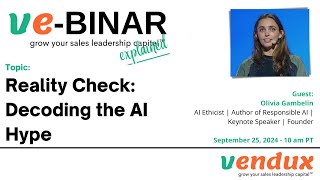
AI ethicist Olivia Gambelin discusses why companies should care about responsible AI. The EU AI Act mandates ethics work, while the US relies on non-binding guidance. Gartner data shows ethics practices reduce AI project failure rates, and Gambelin shares how healthcare, fintech, and HR are already implementing values-based design.
Questions this video answers
September 27, 2024
About seven to eight years
Responsible AI. Implement an ethical approach in your organization.
Ethical Intelligence (a global network of responsible AI practitioners)
EU AI Act (she advised/participated in feedback rounds and sandboxes)
Chapters
Hello, welcome to this edition of our webinar series. We're very happy to have Olivia Gambelin with us and she'll introduce herself in just a little bit. Let's go through a few housekeeping notes real quick. We're asking everyone to stay muted during the initial portion of the webinar. That just improves sound quality. And later on we'll open it up for everyone to take part in the Q and A. At the end, we are recording this as always and putting it out on our website on YouTube and we'll be sharing the link with everyone who signed up in just a little bit. So those are the short housekeeping notes. We are talking today about the topic of AI. AI is everywhere, as we know, and it's used in. I can't think of a place where it's not used today. And the pace just seems to increase and the development of new tools and platforms incorporating AI just seems to accelerate. And Olivia is an AI ethicist who is concerned about the topic of the human impact this technology has. We're excited to have her and share with us her experiences and her work in particular that she does in the private sector and in the government sector around this very topic. Olivia, if I may ask you to introduce yourself so that people get a little bit of a background of who you are and what brought you into the topic of AI and especially, especially AI ethics.
Absolutely. Thanks, Henning. So I'm Olivia Gamblin. I'm something of what you would call an AI ethicist. What that means is I'm essentially a strategist who works on ensuring that our technology is aligned with our intended outcomes. So understanding what impact are we actually causing when we're either adopting or developing AI and ensuring that that is aligned with the values and the impact that we actually do want to have. I have been in the space for quite a while now. It may seem like a niche topic, but we've been thriving for. For quite some time. We made. I was one of the first ethicists that made the jump out of academia and into industry. So I've been active as an ethicist for maybe about seven, eight years now, which is a while. It would make me a veteran of this space. I also have a company called Ethical Intelligence. We are a global network of responsibly practitioners and my first book just came out three months ago. It's called Responsible AI. Implement an ethical approach in your organization. So that should give a little bit of understanding of who I am. And I know we're Going to go more into depth of definitions and stuff. So that'll give you more to come on understanding what is responsible AI and AI ethics.
As a self declared veteran in this space, I'm always curious how people get into the roles that they have. I mean, is your background technology and, and then you grew concerned about the ethics, Is it more on the ethics side? And then you embraced technology as a, as a, as a sector to get involved in. How did you end up in that particular role?
So a little bit of both. So I, all of my research, my background is actually in philosophy and ethics. So I've always found ethics and morality fascinating to me. It's how I look at the world and understand how people interact with each other. But from the technology side, I grew up right outside of San Francisco and so I was speaking, we'll call it techie since I was born. So it was just always I'm going to work in tech. I didn't realize there was another industry until I went off to college and found out that there were other industries besides tech. So for me it was only a matter of time where I found the intersection between the tech industry and AI and ethics. So I worked for a while actually as a digital strategist before I found that that initial thread of, well, it was data ethics at the time, but starting to make its way into conversations. And for me it was more of this excitement of, well, finally this, this, this love and fascination I have of ethics does connect with, with AI and there's, there's work to be done there.
Yes. So I mentioned earlier that you do work in the private sector, all those tech companies in the Bay Area and elsewhere that you mentioned, but you also work in politics and for the government sector. Can you talk a little bit about the government work that you're doing?
Yeah, so I'm right now actually quite literally calling in from Brussels. Brussels, Belgium. And so I've been on the back, back end as much as I can talk about it. I've been on the back end of a lot of the policy development around the EU AI act, more as an advisor from a practitioner standpoint. So as someone in, as a responsible AI practitioner, we are the ones that are responsible for implementing and assisting companies at becoming compliant with something like the EU AI Act. And so there were a lot of different feedback rounds of is this feasible, Is this regulation feasible in the first place for companies to be able to comply with. And then also the sandboxing of different tools and solutions to help with that compliance. So that's More on, more on the public sector work and more regulation and policy, let's say.
Okay, since most of our audience is in North America and more specifically in the U.S. what type of regulations exist in the U.S. that regulate the AI sector?
To date, I would say none. Nothing as compared to the EU AI Act. Typically, if you're looking at the American market or North American market, a lot of companies are following the NIST framework, but that is not regulatory binding and so you don't necessarily have to follow it if you don't want to or choose not to. There are movements. So we saw California in this past month propose a set of different AI bills. We will see how those go forward. I think there are, there are bits and pieces of regulation that do exist on a state level. So you have for example the California CCPA which is focused on data privacy and data management and then you've got the State of New York's I can't, I always forget the, the full title of that regulation. But it's focused on eliminating bias in hiring. So specifically the use of automated systems and artificial intelligence in hiring and how to, and ensuring against bias in those systems. So when it comes to more the US market, a lot of companies are looking towards the EU for that guidance. And right now as we're, we're in an election year, we are as in the US it's a bit of a standstill of what will happen. We're not quite sure. We really won't know until after elections this year what kind of regulations will start to happen. I would be, I will say though, I would be highly surprised if we didn't make any move towards any type of more strict regulation in the states.
And without regulation then it's up to the companies and their standards to decide how to use AI. And your book, you know, talks about the human impact and do you have an example of maybe a company that you worked with that had to consider or had to strike a balance between what's possible from a technology point of view with what impact it would have on the human side and where they landed, I assume somewhere in the middle between the two in order to make the still have powerful technology but make it such that us humans can actually deal with the outcomes?
Yeah, so how I usually deal with that, Henning, actually is if it's not possible on the human side, I say it's not possible because at the end of the day it's not necessarily a company self regulating, it's actually the market that's going to regulate the company. If you are putting out technology for a user base that doesn't agree with how you're perhaps it's manipulating, perhaps that you are taking in too much data. Perhaps let's say we don't like the impact that it's causing. The market will self regulate and push back. We do have industry standards and we do have especially these younger generations, very opinionated generations that are voting, let's say quote unquote and it's a saturated market. You can choose other alternatives, even LLMs. It's not just OpenAI out there. There are, you have, for example anthropic is a, is a, let's say a counter example that people often will go towards anthropic because they identify or are more aligned with the values that that anthropic puts forward rather than OpenAI's values. So when I'm saying it that way it's sure you can make different technology, you can create all of these possibilities but truly that's not going to actually stick in the market. So it may be kind of fascinating and a little bit sci fi for a moment, but long term success, it doesn't work unless it's driving human impact. So when I'm working with clients I start from there. I said okay, if it's not working on the human level, it's not working. It doesn't matter how cool or shiny it is, it's not working. I, so I guess I don't necessarily have an example of a client where we've had to walk back any type of technology. Instead I, I've always gone in and said okay, how, how do we turn, you know, how do we, how do we incorporate it? How do we better align? So I worked with a client that was collecting a database basically on, on how to give advice specifically that they were, you could make a five minute phone call on it and just ask for advice. And so with speech to text you're able to collect these massive databases on what advice the kind of pattern and structure that it formed. And from there we started setting parameters of this is where that kind of data set can be used and this is where it can't be used. This is where the users are informed across the border. This is where there is concern and where we need to take a step back. So, and I know I'm speaking very high level here is that it was quite complex all of the different pieces moving here, but the whole point being was we were collecting this very valuable data set but we were very conscious of how, of the value of that Data set and the sensitivity. It was advice that people were giving to each other and then looking at that and instead of saying, hey, we can build a bot to create to give advice, we looked at, well, where's the actual value of that advice? The value of that advice was actually a human giving the advice. So instead of creating a bot to give advice, we worked on creating guides for the actual people so that you could access and see, oh, okay, this is kind of the structure, this works well for giving it advice. So I wouldn't say that that was scaling back the technology at all. It was just repositioning it so that it better aligned with the people and the people's needs where they were actually driving value out of the application.
You spoke about the, the self regulating aspect that the marketplace ultimately dictates what is accepted by humans and what is not. Now there are also things that are happening in the background and I feel these, these negative examples of not being ethical make the press weigh more than the positive decisions that you're describing. So when I think about the tech giants like Apple or Google who had to walk back certain features in their products or had to walk back data capture or usage of data that they're capturing based on lawsuits, based on public outcry, based on European regulations, those things I think make the press way more than the positive examples that you're citing. Is that something that you see as well?
Oh yeah, completely. We have not necessarily hero stories, but example stories of things gone really, really wrong. And it's harder to find the examples of things done well. A lot of the work that I'm doing now is actually trying to collect those stories and showcase them. The cases that it gone well and right. I think it's a lot creating and developing these, these what would be hero stories. So this is a company that did it really well and look at all the success they're having. That's far more inspiring and motivating than this company did it wrong again. So what, Like I said, one of the things I'm doing is I'm trying to collect those stories and make them, make them accessible so that there is an easy place to point to, to give an example, to give the counter example when someone says, oh, values don't matter. Well actually they, they do. And here's a direct example of how it drove the bottom line for this company.
And speaking of bottom line, your work and the work of other AI ethicists is, I'm sure part is under scrutiny for the ROI that you're delivering. So what does the ROI of your work look like and how can it be measured and what is a good example of a great ROI for your work?
Yeah, so the reason why it comes under scrutiny is because when ethicists first get set up to work or when you start to bring these projects in, it's not necessarily obvious to connect it to our, to any ROI or bottom line or any decision making. So that stunts the ability for an ethicist to quite literally do anything. Because if we're not connected to any aspect of the business case or any aspect of roi, then of course our work is the first to be cut. When truly the work of an ethicist actually drives return in so many different directions, makes it hard to measure. One of my favorite ways though that one of my favorite statistics though around the work of an ethicist or responsible AI. 82 to 93% of AI projects fail. That's across the board. That's out of a Gartner report. That's a huge failure rate and AI is expensive. So that's a lot of time and resources down the drain. That's a very high failure rate. Responsible AI and the practices and work of an ethicist has been proven by MIT and BCG to reduce that failure rate by 28%. Now to give you an understanding, most of the services solutions tools on the market that look at reducing the failure rate of AI are targeting reduction of 2 to 3, maybe 5% is a really good solution. So to have a solution that actually reduces that rate by 28% is unheard of. And that alone the amount of time, resources, time resources saved and then the increase of actual product quality that's then brought to market. You look at that and it makes you wonder why, why is no one actually, why is someone arguing against this? Why is this a no brainer? Of course we're going to do this.
Well, I think today we find someone who's arguing, you can find someone who's arguing against just anything out there. So that wouldn't surprise me. But the improvement that you cited is that largely tied to or the reduction of the failure rate, is that largely tied to better market acceptance and as such then success of the AI venture?
No, it's actually tied to better AI adoption and development. Because think of it this way, when we first started off with AI was kind of like the Wild West. No one really knew what best practices were. It was shooting in the dark, hoping that you were doing it right. Responsibility is just good business practice at the end of the day. So it's establishing clear paths to success for your AI projects. Instead of crossing your fingers and hoping, hoping the data scientists talk to the business analyst this time and they got it right instead of bringing something to market and being completely off kilter.
Okay, great. I mean that again, as you said, it's with those statistics, it's amazing that people are still questioning the investment. Maybe a more. I don't know if it's a more difficult question to answer, but when we speak about ethics or sort of alignment with human values, in a lot of cases between cultures, between individuals, you have different ethical standards and different values. So when you say I'm an AI ethicist, what's the ethical standard that you're using? How do you define that?
Yeah, that's actually a really great question because people can often be a little bit off put at first when they think about working with an ethicist. It's like, oh, here comes this morally superior person that's going to come in and tell us, oh, you're doing everything wrong. I actually as an ethicist have to detach myself from my own moral code. I'm very, very well aware of where my red lines are, where I won't cross, for example, but I actually have to be very self aware and understanding. This is these, this is my own moral code and my own ethical opinions and reasoning that's going to be separate from the project that I'm working on. Again, not compromising, just understanding objectively that that is where my bias and my preference comes into play. So instead when I'm working with clients, what I'm doing is basically creating this triangulation of values. So I'm pulling in any type of, of ethical values or principles from regulation, policy. There's a lot of global international institutions as well that have sets of values and values, meaning ethical principles. Then I'm looking at industry standards. So a great example of this is you've got the Hippocratic oath coming, medical ethics coming out of the medical ethics field and that's, that's been existent for ages. So there's a very strong industry set of ethical principles that, that, that anything in health care follows. Same across the other industry. All other industries that you run across there are industry standards that you're expected to follow. And then I'm also looking at company values and missions. So that's where it's where you start to have a bit of the customization towards the company itself. So you can say one company perhaps is prioritizing well being and another company is prioritizing privacy, again, not to detriment above their values, but just where the prioritization comes in. And so by taking those three different inputs, you can create this value set. That, that is your guiding North Star. That's what you're truly following. It's not anyone's opinion, it's, it's that objective distillation of these values matter across the board.
Is it fair to say that when you enter an assignment for a company that, that's the first thing you look at, sort of gathering all the, all those pieces that exist and putting them together in a, in a quasi guideline to be followed?
Yes, that and defining the values, which you would be surprised. The definition part is probably the stickiest part. I can't tell you how many times I've gone into a company and say you've got three different data science teams and they're all working on a different definition of fairness. So equal. One team's on equal outcome, another one's on equal opportunity. The third one's on like equal quality of service. So getting everyone aligned both on the values and the definitions of what these mean in practice, that creates incredible amount of clarity for teams to move forward and to actually get the right practices in place. But that's absolutely, you can't really do much without that to start.
Yeah. And I would think that the work following that, creating that definition is, it's not a no brainer, but all you have to do is always look back at the standards you defined at the beginning and everything comes.
Exactly. It makes it so much, it makes it so much clearer. Exactly.
Yeah. You also founded a network called Ethical Intelligence and to me that sounds like an industry association of AI ethicists where I'm sure you again work on creating standard approaches and standard definitions. Is that the case? And tell me a little bit about that association or that network. Yeah.
So that network is essentially the work of an AI ethicist or responsibly AI practitioner. We're not yet a very common job title, although I have to say there's a massive amount of people looking to move into this space, the true practitioners. We're still on the smaller side. There's still, still a smaller handful of us and it can be quite lonely and it's hard to improve your craft, let's say, if you don't have someone to talk to and say, hey, how did you, you know, how did you manage the NIST framework this time? Or any thoughts on, on this, this AI governance platform software, is it useful for, for, for your clients? Or like, does. Does. Does lunchbox training work or are there better solutions? Just being able to sit down with people that are in your same practicing field, it makes a whole lot of difference. So Ethical Intelligence was founded both to provide services, but also bring together that community where those best practices could be nurtured and exchanged in a space that is still growing and less and less spread out. But we all still know each other to some degree.
Good. And to your point of, it's still a rare title. You are quite literally the first AI ethicist that I came across. But then I ran a search and I found a whole lot more. Just a matter of awareness when you see something for the first time. We'll open the microphones for Q and A in just a little bit, but I have two or three more questions here. Real quick. Olivia, you mentioned the medical sector as an example of where you're pulling in existing standards and existing approaches to the question of ethics. What are other sectors where you see your work being focused on other sectors that are heavy, probably would assume heavy about regulations to begin with that you spend a lot of your time in?
Yeah. So I would say my three primary sectors, not the ones that I'm limited to, but the ones that seem to be the most common for me is obviously health healthcare or health tech, financial tech and then medium publishing. Right now, since the onset of generative AI, that's had a huge turnover. But I also work in urban city planning. I work in smart home and housing technology. I've worked in software development just for B2B software. So it's all over. It can quite literally be all over the place, which makes the job very interesting. You never know what challenge you're walking into. But I would say going forward, some of the biggest sectors that are having to deal with most challenging problems actually would be anything around marketing and media and publishing. And then HR and hiring have seen both heavy hits towards needing to get practices in place and quick.
Okay. And I'm fascinated by the fact that you also work in the government sector. And I am wondering if you can compare and contrast your work in the private versus the government sector.
Private moves a lot faster. Public is very slow. Public, I would say the hardest part of public is finding everyone you need to talk to to get on board and being able to manage the different, not agendas, but the different needs of all of these different people and organizations and so on. In public where private, it's more or less you're coming down to finding, let's say the top three decision Makers and once they're on board, you can move quite quickly. So I'd say that's probably some of the biggest difference right now. Public sector is playing a lot of catch up, trying to understand how to keep up with the pace of development of AI and keep up with. We see a new large language model released practically every week at this rate. So how to keep up with all of that development versus private sector is more on pushing that edge and releasing, trying to understand where to go next. And a little bit of self regulation, I would say there, not self regulation, but trying to keep the guardrails on.
Okay, wonderful. Well, let's open the mics here. Lisa, Nicole, Sharon, any questions that you might have for Olivia, topics that we haven't covered yet or that we were unclear on?
I just want to say I think it's fascinating what you do and I asked my question about other industries that, that you worked with, but I'm curious, like it sounds like the answer is going to be it really depends. But do you have sort of like a typical engagement that you do when you go in and you advise these companies? Can you describe if, if it, if, if typical even exists because your field is so constantly emerging or evolving. But I'm just curious, like what does it look like when you go in and actually, you know, roll up your sleeves to start that consulting?
Yeah, it depends in a certain way. So you did get that, that right? You did predict that. Right. But I would say over the past year or two, I've narrowed down on what kind of work that I, that I take on. And so I'm really focused on, I will work with companies on their AI strategy. So if a company has, say a chief AI officer or even sometimes it goes under informatics or technology and they're looking to become AI enabled. So adopting these AI solutions, I'm working with them hand in hand on that strategy to ensure that strategy is reflective of the company mission and objectives. So it's not going counterproductive and we're not wasting time and resources or I am in with the early stages of design of a new product and that's looking at essentially think of it as almost like product, product, market fit. So what does the, what values does the market want to see and what does, how does that actually get reflected into the, into the technology, the design of it itself. So. Oh, and I guess I do a lot of training still right now as well. It's still a new topic. So a lot, you know, very typical engagement is going and less so with tech Teams and more of the executive and management teams, training them on the terminology, what kind of questions to ask, what, what trigger points they're looking for and how to start to. To get their minds wrapped around both AI and responsible AI in a way that's not overwhelming.
Yeah. Sharon, you raise your hand.
I had more of a comment. I found it interesting that you said that the US was looking to the EU for regulations and I, you know, in the software industry it's usually the other way around, as you said. It's just, you know, I work with people. I don't work as a SAS person, but I work as a consultant with many people who are in the growth stage, SAs all over the world and generally the EU is a little behind. So is that just something that you feel or you see within your work that the US is waiting?
Yes. So Europe made the first move. So we have the European Union AI act that just came into effect. That's the first globally. And it's not even just the us, it's really globally. People are looking to the eu. The EU made a conscious step of, hey, we may not be leading in terms of innovation or development in AI, but we can lead in the regulation of it. And so that's the route that the EU took. So they're kind of like the guinea pigs, honestly, right now.
Good for them.
Yeah, yeah, hopefully. I don't know. We're going to see. We're going to see. It's a very interesting time where we're like, when the gdpr, the data privacy regulation that went in, caused all of everyone to click cookie consent constantly. It feels similar to, we're holding our breath to see, okay, what are going to be the odd outcomes that we weren't quite expecting from this regulation and how is it actually going to look for companies? Yes, hopefully good for them. Hopefully good for them.
Well, thank you. I just found it interesting. I also found the other statistic from the Gartner that 82 to 95% of AI projects fail. I was like, I didn't expect it to be that high, but I was. I'm still amazed at the number of people that haven't actually tried AI. And as, again, I work in the growth stage software as a service and you know, no, I haven't tried it yet. I'm like, so anyway, thanks.
Absolutely.
Nicole, Sometimes people are to follow on to what Sharon just said is people not using it. One, I think they're still scared. Two, they don't know how. I feel like we're doing a lot more Educating on how to use it in an effective way more so than responsibly because most people on the smaller side of business don't care if it's responsible just as they start out. I hate to say it that way, but they really don't, they don't care about the impact until it's a little further down the line. And I think that's, that's a little bit of an error, but a lot of it, it's just trial, trial and error. Right now they're just, they're just doing little tests. But I, I'm excited about the opportunities. And the other thing I was, I just glossed over was I think there's some people that are using it that don't realize they're using it because so many of the larger products have implemented AI in the background that it's become second nature and a lot of people are using it without even realizing it. And I, I myself did that in a couple of cases where I, it didn't just naturally occur to me. I'm not an engineer, I'm a revenue person. So I was like, wait a minute, I've been using it much longer than I realized after I, I went through there. So I think part of it is, it comes back to that educational piece. But I, I loved what you shared. It was, it was a great, a great.
Thank you, Nicole.
Sharon, I think. No, I was just going to say that I was drop. Adding on to Nicole. It's like, I think people don't realize. I mean, if you have, you know, a Siri, that's AI and Grammarly, you know, your vacuum, you have got a, you know, what do you call that? Robovac. That guy. I mean, that's a Roomba. That's it. I couldn't remember. I'm like, I know there's a name and it just wasn't popping up. Yeah, that's AI as well. So I don't, It's. My husband's a data scientist, so it's been around our house for a while.
Great. Olivia, then to, to close us out here, what does the future look like? Not the future of AI, because I, I mean, it seems that it's here to stay and here to be part of every single product we're using eventually. But what does the future of AI ethics look like?
So for me, in the direction that I am pushing both my research and my client work is I'm fascinated on how to drive something called values based product innovation. So using these ethical values actually as design guidance, both in the development and adoption of these tools. So saying, for example, well, being is a value that we want to embed into our technology, then what methodology is going to drive that so that it is that that is a core feature, not just something that you've added on, but that is actually a defining feature for this AI technology. And I really do see that as the future for AI. We get all these complaints of, hey, we got AI, we changed things, but we don't really know what we changed and we didn't really get the impact that we wanted. We don't have sunshine and rainbows like we were promised. We've got a lot of confusion and for me that means there is a disconnect between, there's a misalignment in terms of the outputs and uses of AI and the actual values that we wanted wanted to bring to life. So the future of AI ethics for me at least, at least what I'll be doing is looking at specifically design methodologies around that values based product innovation, not only because we want to have technology that reflects our values, but because it makes better technology at the end of the day.
For those, especially for those who later on listen to or watch the recording here. How can people get in touch with you if they like to find out more?
Well, you can Visit my website, oliviagamblin.com, pretty easy. You've got examples of talks I give. You've got my book linked. There you've got a link to something called the Values Canvas, which is a management template I use when it comes to designing AI strategies. It's free to download and has a whole plethora of use cases as well attached to it. You also have a couple different ways to get in contact with me on that website. Or you can go old fashioned and go to LinkedIn and I do eventually respond on LinkedIn. Sometimes it, sometimes my inbox is a little overwhelmed there, but you can reach out to me on LinkedIn as well.
Just Olivia Gamblin, Great, wonderful Olivia, thank you so much for taking the time to speak with us. It was very, very interesting. I love the work that you're doing and maybe we'll consider having you back in a year or two and hear how things have progressed in your field of work.
Hopefully an even more exciting conversation in a year.
Great, wonderful, Take care. All the best. Goodbye.
More from Henning




ve-BINAR - The Revenue Tornado Methodology: How 3 Power Sources Create Exponential Growth


ve BINAR: Executive Cloning: How AI is Reimagining the Role of the Fractional Executives




veBINAR: Unlock Client Value: Why Compliance is Crucial for the Startups You Serve
