ve BINAR Sales and Marketing Leadership Success In The Current Market
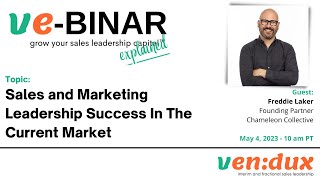
Webinar (May 4, 2023) hosted by Andrew Miller (Vendux Group) with guest Freddie Laker (serial entrepreneur; partner at Chameleon Collective). Freddie summarizes market shifts since the pandemic: acquisition costs have risen, growth-focused playbooks are under greater ROI scrutiny, and firms (especially PE-backed) are refocusing on optimization, retention, and "nailing the basics." He contrasts VC (earlier-stage, tactical growth focus) vs. PE (later-stage, transformation and systems focus) needs. Technology and AI are presented as force multipliers when applied to processes: CRM enrichment, personalized automated outreach, analytics/rev-ops, and AI-assisted brainstorming and content/voice generation. Freddie warns about automation done poorly and discusses ethical/economic disruption from AI (job displacement, quality improvements). On fractional leadership: demand remains strong as companies seek senior expertise without full-time cost; individuals must specialize, hone messaging, and position clearly. Practical takeaways: prioritize optimization and retention, use automation for personalized relevance, adopt AI as a productivity multiplier, and sharpen positioning if offering fractional services.
Chapters
Good morning everybody. Welcome. I'm Andrew Miller, one of the partners at the Vendux Group and we focus on helping clients to grow their sales leadership capital. I am thrilled to be here today with our friend and strategic partner, Freddie Laker. Despite Freddie's youthful good looks and energy, he has an extensive career in media marketing, digital consulting, agency work and driving transformation in his client companies. Fun fact, he's the son of Freddie Laker of the British airline Laker Airways. And I'm going to let Freddie introduce himself in a moment. But a couple of quick housekeeping notes. We're going to keep everyone muted for the duration of this webinar and there'll be a Q and A at the end. So you can either use the chat function in zoom to submit your questions or we're going to open up the floor. Feel free to ask your questions, engage and make comments directly at the end of the webinar. The webinar is being recorded on our site and on YouTube and many of our interactions and views are actually in the recorded sessions. So let's jump in. Freddie, hey. It's really awesome to have you here with us today.
Yeah, thanks for having me.
Absolutely. So I'm going to ask you to introduce yourself and then we'll jump in to talk sales, marketing leadership, the rise of the fractional executive, entrepreneurship, tech, venture investing and services to early stage companies and global enterprises. So with that, Freddie, over to you please.
I appreciate it. I think it's going to be an interesting chat. So I appreciate everyone who's attending today or whether they're listening later on. Just a quick personal introduction. I'm a lifelong serial entrepreneur. I've been starting Internet related companies since the mid-90s. I managed to build and sell a couple companies over the years which I'm quite proud of. I also managed to spectacularly employed my third company, which I'm not so proud of. But I learned some great lessons along the way. 2 out of 3 bad's been my long standing joke there. I've been a CMO many times. I've been ahead of sales multiple times and then in particular over the last seven years I've been operating as a partner in a company called Chameleon Collective. And we're really, really, really focused on supporting private equity and venture capital based businesses through three primary channels. We've got a very large bench of interim or fractional leaders similar to how Vendex operates. We've got a large bench of kind of like more specialized subject matter experts that are doing everything from brand Strategy to sales enablement. And we've also got a pretty significant bench of recruiters. We're placing a lot of full time roles there. And so what I'm hoping today is that I can bring a mix of kind of entrepreneurial experience, sales and or marketing leadership experience, but also pretty good visibility into what it means to be an interim or fractional leader, which obviously represents a lot of the people that work within for Bendocs. Awesome.
I know you could be talking for 20 minutes with your background and everything you've done, but that's great. So, Freddie, what are you, you know, this is a challenging environment. What are you seeing in the current environment in terms of how sales and marketing leaders are, you know, where are they now and our strategies changing going into the second half of this year? What are you seeing?
I love this question. Before I answer this, let's just kind of reflect a little bit on the last couple years. And I don't know if you guys feel this way, but I've certainly felt this way. I know a lot of my colleagues who are doing sales and marketing leadership roles have felt this way. It almost felt like you could throw a rock in any direction the last couple years and figure out how to make money. People were spending a lot of money, they were investing a lot of money, they were buying products. Everyone was very bullish in the market. And I don't want to say it was easy, but it was to drive growth. But everyone felt like they were growing or many, many industries and companies felt like they were growing. And I think all of us are now in this reality where that is not the case anymore. I also think when you take putting a little bit of a marketer's hat on here for a minute is that acquisition costs have been skyrocketing for the last couple of years. I think when you look at the beginning of the pandemic, a lot of people started adopting digital strategies. Customer behaviors were changing. People maybe remote or they were spending more time online. So. So whether you were trying to acquire leads as a sales leader through digital channels or maybe you're a marketer and driving E commerce type sales, so many people started to jump into that. People that were laggards could no longer afford to be laggards. Everyone jumped into the game. I would say a lot of people who didn't necessarily know what they were doing got into the game. And as they started to spend more and more money in these digital marketing channels, if they didn't, when their boss was asking for more leads, if they didn't know how to do it. Well, there was one other thing they could do, spend more money. And so what was happening is all these acquisition costs really started skyrocketing then. What we've noticed is in the last six months in particular that the P backed firms and venture backed firms that we're working for, whether a dealer with the board or the CEO, they're saying, look, I'm questioning these investments. I don't know if this is a good idea anymore. Where's the roi? We can't be spending money like Luna Politics anymore. It can't be about growth. Growth. Growth has to be about profitability. And so there's a really high level of scrutiny that is, is being put on these channels. And so the, the strategy going back to more directly answer your question, the, the big shift in strategy that we're seeing is one, it's about optimization. So you have to think about the levers that you can change as a sales and marketing leader. If you, if you can't change your acquisition costs, where can you change your levers? And one of those, as an example, might be like optimizing your touch points with the customer so that you're more efficient in converting the leads that you do acquire. You need to make sure that that's one way to lower your cost of acquisition. Another big thing that we're seeing people focus on and should have been something people were always focused on. But when you're going through intense periods of growth, it's easy to forget this one. Really, really getting focused on retention. If it's so expensive to acquire new customers, you can't afford to lose any customers. And so I think in this year and probably the next couple of years, people are going to get really, really, really serious about the retention game and just really understanding the customer, making sense of that. I think when you start thinking about what does this really mean? Like, how do people go out and make sure they're successful with that? Over the last couple of years, there was a expression that we used to use a lot with different firms that we were working with. And we'd say it was nailing the basics. And what this really means is when, when they're saying, hey, what growth strategy should we do, Freddie? Should we go this way, do we go that way? And they'd be talking about all these crazy things they'd read about and different technologies and opportunities. And I'd say, look, guys, if you're not nailing the basics, there's no point in, in, in thinking about what the next Big things are making sure that you have a super well optimized website, making sure you really thought through your acquisition channels, making sure that you've got a well developed CRM and, and you know, making sure you're using marketing and sales automations. And, and I think that my advice now is I don't think that's enough anymore. I think the last couple years there was basically a lot, as I mentioned, a lot of these laggards who weren't maybe as digitally savvy as they should have been. And the pandemic forced a bunch of people to get digitally savvy really fast because of customer behavior changes. And now that so many people have gotten to the nail the basic stage, or at least pretty good on the basic stage, actually it's going to force the people who want to get really competitive to start adopting more advanced strategies. What does that mean? I mean, does that mean more advanced automation work, leveraging AI? I think that's, you know, things that we hopefully will get into further in this conversation. I'd say it's just as a final thought, you know, if let's, I don't want to say we're in a recession, okay. But let's, let's assume that things are getting a little bit tighter out there. The amount of opportunity, doesn't matter what industry you're in is going to be smaller. The number of people fighting for that opportunity has not changed. So I think everyone, where maybe there was a bit of an abundance mindset the last couple of years, I think now there's a little bit of a scarcity mindset. And not to over dramatize it, but I think people have to prepare for war. I think they need to make the best versions of themselves. The best possible sales material, the tightest possible value proposition, you know, the, the best way of communicating yourself to customers being making sure you're staying engaged, like there's no room for error because again there's going to be the same amount of people fighting over less stuff and you cannot be in a disadvantage going into that.
Yeah, yeah. Words of wisdom earlier, you were saying that you, you work with both VC backed companies and PE backed companies. Are you seeing major trends or differences in the needs of these two different kinds of backers and stakeholders?
So if any of the people listening or watching or from, or work a lot in the VC and private equity world or worked with both of them, my answer may seem obvious to them, but I'm gonna, I think for a lot of people don't do that or they have aspirations that field. And, and this I think is a nice way to think about it. Let's keep it simple. So you've got, let's, you've got venture capital firms. They're typically earlier stage businesses depending on what stage they're at and they're, they're very, very focused on growth. But when you're an earlier stage business, how do I say this? You know, if you, if you're just developing a product or you're at early stage of the company and you're really just starting to go to market and then imagine this is where a lot of maybe fractional sales leaders are getting engaged by some of these earlier stage businesses. You don't need a really crazy strategy to maybe win some of your first business. So if you're an early stage company, there are some very tried and true methods that people know work that you don't have to reinvent the wheel on. If I was to use my marketing guy hat again, you know, paid search is a pretty tested tactic. You know, it works. You don't have to get crazy. Some crazy strategy. No, this is probably a place you should be investing your money. And so what I'm finding is that the VC bank firms are less focused typically in let's say an interim leader, maybe a fractional sales leader. But they don't need a CMO or something like that because what they need is some great tactically minded subject matter experts that can work on these very specific channels. They know work. They might be interested in fractional sales leaders because. But it's a different type of sales leader. They're going to want people that are again more tactical. I hate using the expression, but I'm going to say it anyway, kind of dialing for dollars, finding maybe their first couple of customers or helping them get that their early revenue. But they don't necessarily need to be these big strategic chief revenue officer types when you're dealing with private equity. These are later stage firms. Sometimes they could be firms that are 20, 30 years old or older and maybe the P firm is taking them through some period of transformation. And maybe at this point I would like to assume that all these kind of basic tried and true nail the basics type tactics, they've done them. So now what are they looking for? Maybe they even have those people employed full time that can manage those channels even so what are they looking for? They're looking for big thinkers, people that can challenge maybe the norm of how they've been doing things, looking for new innovative tactics. They have, they haven't thought of before. Or they're looking for more senior folks that can help them build process systems teams, you know, repeatable approaches, maybe help, you know, coach and mentor those more tactical people. And so depending on where, you know, a fractional, let's say a fractional sales leader might sit, I think it's important for them to kind of understand what kind of angle they should be talking to depending on if they know the company they're talking to is PE backed or VC backed. Leaning into one of those messages is going to help them close the deal, probably because they're just going to show those investors and those port co owners that they understand the needs of that company at that stage.
Yeah. Let's pivot to tech and to your theme about nailing the basics. This is a, another pivotal moment. People are saying in terms of AI, we're at a, at an AOL moment in time of where AI is now.
I'm using it almost every day.
You were, you, you're doing what.
I'm using AI technologies on a daily basis, basically.
Right. So when we, when we think about nailing the basics with companies going forward, to what extent is tech and AI going to be part of nailing the basics? I just read a Goldman Sachs report that came out in, in the last 10 days where they make a very, very good argument that over the coming years, not decade years, 300 million people, 300 million workers could be displaced by AI. The entire.
It's pretty staggering.
Yeah. What are your thoughts on where we are and where we're going in this?
Let me, let me separate. There's a lot to unpack there. So can we, I'm going to break it into two to two chunks. I think, I believe I heard you say that the first thing you wanted to get into is getting more around. Like how do basic sales and marketing leaders use tech as part of their thinking? I personally think the AI conversation is such a big one that I'd love to kind of give it some, give it some breathing room because I can riff on that for two hours without taking a breath. So I think. But let's kind of deal with the big picture first. So I think there's this thing, we're sales marketing leaders. What are the different chunks of where technology plays a role basically in your job? First one I think is just before you even jump into that, people need to think about the processes, the different tests that they're dealing with in their workflows every single day and where can they streamline those workflows. And it's kind of sad actually. And we're touching on AI a little bit that where there may be a lot of workers out in the market that are struggling right now or they're worried about job security. And on some level a downed market could feed into that because it might drive leaders to try and find even more ways to automate certain repetitive tests or to reduce manual labor. The trick to that, and I think speaking now to my kind of sales leader friends, you'll notice I keep swapping my hats on and off here, but I think when you, when you start thinking about sales, other sales leaders, I think all of us know relevance is a really big part of the game. But speed is a really big part of the game. And I think you're getting the right solution to the client before anyone else does and nailing it. So they go like, you know, no one wants to do six phone calls interviewing six different companies. If you can get the right solution to a client, most of the time like, hey, you did it first, you're fastest, you're responsive. So you know, trying to build out, you know, these kind of automations that get you to that place where you're building better relationship and closing deals is priority number one. The second one I mentioned a second ago is relevance. I think that when you start dealing with teams that are maybe doing more or need to do more with less, I think you, you start cutting quarters. So it's like, hey, I'm going to send the same sales deck out to everyone. I'm going to send this generic email template that I've got out to everyone. But I think, you know, again, for any of the sales leaders that might be tuning in today or maybe business owners that are responsible for their sales teams, everyone here knows that if you send out a note and instead of being generic, it says there's some insight about their industry, their company size, their, maybe some specific, maybe referencing yourself, clients that you've worked with that are relevant to their industry or their size of company, referencing specific bits of work from your experience that give them more reasons to believe that you're the right choice. All of that kind of stuff is, is takes time to do and it's hard to do at scale. But if you invest in technology, you can do all of this in an automated way. It just takes a little bit of effort. I do this every day with my own businesses and it's had a massive, massive impact in terms of number of responses. We get close rate shortening of sales cycles because you're just Showing them that you're the right fit really, really, really early into the process. You know, people especially right now, I'm also noticing a rise in automation done badly and that actually on some level helps those of us who do it well. So I think that, you know, there's a lot of people are just learning about sales automations as an example. And so I've seen an increase in these kind of automated emails I'm getting from people and because they're so bad, it actually lets me disqualify them so quickly because they're so generic. I actually even recognize people that use HubSpot because there's some templates that HubSpot provides in their outbound sales automations and people aren't customizing the templates. I'm like, you're using the generic HubSpot template, mate. What are you doing? Or you know, targeting people in not, you know, not understanding who the target audience is. Well, and people messaging me about things that maybe I'm already in the business of really strange things. But anyway, my point is this is that kind of moving person, you know, the basics. I think if people can do this really well and you personalize highly enough, people will never know these are automations. In fact, it really, really makes it look like you took the time to learn their business. And a final thought there real quick before we kind of jump into kind of AI stuff or any follow up questions you may have. The other one's analytics. This is something that I don't see a lot of sales leaders get into. In particular, I think marketing leaders have been into it for a really long time, you know, getting really passionate about whether it's web analytics or you know, e commerce analytics or you know, you and even now things like hot jar with user behavior analytics on websites. But not enough people are, you know, really embracing things like kind of like rev ops analytics. And so sometimes I see a lot of really great sales leaders that are maybe have been in the business for a long time. They're great sellers, they're incredible relationship people, they're incredible closers, they're incredible teams managers. But they, they, they didn't take the time to maybe kind of embrace some of these technologies. And I think this is, you know, this, you know, you should, people should see tech as a force multiplier. You know, it's like how do you take what you're doing and make everyone on your team? How do you make one person into five people? You know, that's what a force multiplier is. If you're not familiar with expression. And then, and it's like tech is, is this incredible thing that can superpower your team if you leverage it well and sorry Andrew, it looks like these are great. I didn't want to interrupt you.
No, these are great. So I just, I'm going to ask you, can you share any insights into how you are leveraging tech and AI? I mean you, you doing it every day. You see tons of bad examples. What are your.
I can give you a CRM tip and then I'd love to kind of jump over to some specific ways. I'm using AI now and I think it's pretty compelling. So data is obviously undeniably extremely powerful. And so being able to go out there and you know, knowing a company's name, you know, the job title, someone's name, their role and their company name and their website and their phone number is not enough. You know, being able to understand the industry that someone operates in, the size of their company, the number of their employees they've got, potentially who some of their customers are, you know, did they do certain kind of activities recently that might, you know, you can see if head counts going up or down. Maybe as an example, this is all publicly accessible data and there are a lot of companies that will provide that data to you. The tricky part is then to build systems that react to that data. But there's plenty of tech out there that will help you do that. So how do I personalize a message that says hey Mr. And Mrs. X, you know, I'd like to speak to you because I know that your insert your company name operates in insert this industry and then having different versions of outreach that says we have a lot of experience in insert industry. And then if you know that you have experience that industry, maybe you should mention companies that you know are related to that industry that you've worked with, which is another personalization level. So these types of things really, really make people go, you know, that's too personalized. I don't think that's an automation. And they respond, you know, and so you know, these or, and that on the outreach or you know, on follow up. A great one is we talked about retention earlier. You know, I've been talking about top of funnel biz dev. But this kind of exact same type of behaviors should be driven for ongoing relationships. You know, did someone stop invoicing with you recently? Why did they change the amount of invoicing? Automatically queue up a message from, you know, the account manager. And by the way, there are plenty of Serum tools, where you can automate a message to get queued up, but it doesn't actually send it until the person's reviewed it. So it cues up at like one of your inside sales reps as an example. And they see it, they can review it and then they can release it. So, you know, if people are worried about, oh, I can't automate everything. Yeah, great, don't automate everything. Automate a good chunk of it and then get humans involved and then they can edit it and you have to think about it all about an efficiency play, you know, that saves 40, 50% of their time off. Great. How much more strategic things could they do? How many more customers could they be contacting? How much more volume could they do? How much more time could they take to speak to people? What does that, what is that impact on the bottom line versus just doing everything the old school manual way? I mean, this stuff is just, it just firepower. It's gasoline on your growth. And so I can't. And this is just one of a hundred different examples, you know, that I could give, but I wanted to give one I think was relevant to potentially sales leaders tuning in right now. I love to geek out on AI a bit, if you're interested. So all of you who may be listening or watching now are familiar with AI, who've been all over the news. You'd have to absolutely live on a deserted island at this point to not be familiar with it. You're probably familiar with terms like ChatGPT and tools like that. And I can tell you it's the fastest adopted technology in history. Nothing has ever been close to this. Instagram, WhatsApp, Facebook, any of these other things. You look about adoption rates over the years and there's a reason why it is mind meltingly amazing. So you can go in there and think about any type of knowledge that you might possibly want and think about it like talking to a pretty damn knowledgeable employee. That's how I think about the interaction. And so I might come in there and I use it for brainstorming. I'm not saying it's going to be a replacement. So I have a new business that I'm working on right now as an example. This is literally this morning. And so for my main business, Chameleon Collective, we refer to the people that work at the company as Chameleons. It's catchy, it's great for culture and, you know, easy to think about. And so I was like, this new company is called Collective os. I was like, what can we call our people? And I literally wrote into Chat GPT, I am starting a new business. I want a catchy name for people, it's called Collective os, to consider things like related to collectives or operating systems. And I was even specific. I have another business called Chameleon Collective and we refer to the people as chameleons. You can see the analogy. Please give me 10 ideas for different team member names and explain why. And I'm not kidding, you know, within a second, two seconds you just start seeing, rattling up the typing, well thought out, succinct stuff. Stuff that if I had asked a human to do, I don't even know how long it would have taken a car. Oh, by the way, when it got to the end of 10 and Larry just wrote, can you give me 10 more please? Boom. And no joke. And when it got to that 10, I said, can you give me 10 more please? And then one of them was really interesting. And I said, and again, it's all conversational Chat GPT, I wrote, I like the one about the concept of nodes. Can you, can you expand that with 10 more variations on that? And then expanded 10 more. Now I'm not saying that I'm going to use these items verbatim, but it accomplished. I don't, I don't know how many days we would have taken to get to this place. And then I'm able to kind of go, oh, I like that nugget there. And then I might take that and go work on it with some more humans. Exceptionally good for brainstorming. Heck, it's good for writing interview questions for podcasts. Sometimes I might be working in industry that I haven't worked in before. Or you're going to interview someone. I'll go into it and say I'm interviewing someone in Biosciences who's got a startup based in Israel. Help me, give me 10 inspiring questions for a three time entrepreneur. And I can say, here's some information on the entrepreneur, help me come up with some ideas. I mean, you know, it's, I can. Sometimes I'll write an email and I feel like I've been working out too long, it's a little too rambling. I can paste that into Chat GPT and say, please write this email in a more succinct and professional manner. Instantaneous. Comes back to me. Or you know, maybe you're doing a pitch and you say, here's a, here's my, here's my pitch for my company. Paste it into ChatGPT and say, Please give me five versions of this pitch, not to exceed one paragraph. And then when you look at it, you're like, you know what, give me five more, but this time be funnier and insert a joke. And again instantly comes back. So it's like having an incredible brainstorming partner. And so I'm now in a place where I'm using it every day almost all day long as a, as a spark to get me to the place that I want quicker. You know, I'm writing a book right now about the collective business model. Yes, I have a lot of stuff on my plate and the side note, and I clearly need better hobbies worth noting. But, but you know, I. Some of these things are really specific and I could go out, do tons of research. I could go, you know, Google till the end of time to try and find information on it. But I was like, give me 10. I wrote specifically give me 10 examples of people using the collective business model. And I specifically wrote that most people would never know about. And then it just gave me these examples. I think I did that. I just kept going, give me 10 more. I think I did that like 20 times and it never ran out. So I ended up with hundreds of examples of people using the collective business model. And again, I'm not going to go use all of those in the book, but my ability to go back and say great cherry pick from these and again, speed. When I did that in five minutes, how long would it have taken me to extrapolate all that from Google? Going from blog post to blog post to blog post. This is a force multiplier. This is my point. Blog posts, anything. I don't think I've ever, I'm already a pretty known, well known for being a pretty efficient guy who likes to use technology to, to drive the way that I business even faster. And I've just never seen anything in my career just take that and just do that. I mean, not this that it's wild and it is going to create problems for, for some people, it's going to disrupt a lot of industries. I think that I want to call it like low end copywriting is in trouble. I still think there's a lot of room for high end, more insightful, creative type work, but really basic stuff. If I just need. Write me an email, write me an automated email to welcome a new user into my business. Great. You could really knock out some basic stuff there. I think that basic researchers, low level researchers is going to be really disruptive. But I'm going to Give you a really scary one. And I warned you I could talk about this subject at nauseam. So forgive me if I'm, if I'm talking too fast and going through too many things too quickly. But I put my own, my own sales guy hat on again for a minute here. So I'm going to take my marketer hat on back to sales guy mode. I thought, well, this could never disrupt my job, right? Or it's too hard to replace a seller. And then I started thinking about two technologies I played with recently. So let's put AI on a show for a second. And there's another technology out there, Text to speech or voice to text. So interpreting people talking, converting it to text as an input, or outputting text and making it sound like human speech. And most of us can identify text to speech. It sounds kind of clunky. It's the series, whatever the world. I ran into a text to speech engine the other day. I'm embarrassed. I can't remember the name of it. So apologies to those guys because they're not about to get a plug. Then I was dumbfounded. Was text to speech to the point that I generated some audio and I sent it to four or five people that I know and said, hey, what do you think of this voiceover artist I'm using? I wanted to see if anyone would pick it up. And. And then I. They're like, oh, sounds great. I was like, so anything unusual about it, like testing people? Not one person picked up that it was a text to speech engine. So imagine now combining that with Chat GPT. Now I'm going to give a very specific example. I have another business that I'm involved in that is an environmental parts company. Strange thing, very, very specific stuff dealing with like manhole covers and like piping stuff that's like really nuanced in like thread counts and measurements and inside the pipe and outside the pipe and the kind of stuff when people call us up, someone goes, hey, can my, you know, 816 or you know, 716 pipe or whatever, you know, you know, fit into this thing, into this thing. And our people go, let me check on that for you. They put them on hold. They literally have to go through it for that kind of stuff. Like, you know, you could get to a place where you spoke, you said, I need to know this ChatGPT, it turns to text chat GPT takes an input, instantly searches it against an E commerce database and instantly comes back and goes, yes sir or ma'. Am. You know, we can fit the a7754 pipe with the even like, wacky stuff that a human could never do, I think it could do that kind of work very, very quickly. And so this got pretty scary. It's not like, you know, this, this ability when you start combining these technologies to even impact some of us who might be listening to this call. In an area where someone goes, no one could ever do sales, right? I'm not so sure. I'm not so sure. And, and, and I'm not so sure a lot of people wouldn't want to take, wouldn't want to outsource a lot of those kind of things because a lot of companies only care about the bottom line and they don't care about people. And so there's some really profound implications to consider here. You know, how do you balance good old American capitalism, or capitalism anywhere, I should say, but how do you balance the desire to build incredible businesses and protecting all the people that are doing the work out there?
This is subject for a Fireside chat that we could be talking all day on this. Love this subject. And there, there are reasons why people like Elon Musk and even one of the heads of Google's AI initiative just left Google, saying that he's concerned now with the implication of his life's work.
Yeah, yeah, yeah. It's scary. It's fun right now. And there's this, really, there's parts of it that are fun, I think for.
Us now, I certainly get into this in a sec. I just want to begin to open up the floor for questions and engagement. If anybody ask questions, want to engage with, with Freddie, please put in either the chat or we'll open up the floor in a second here.
Well, we just making. So I was going to say that it's, it's really fun and I enjoy this as a, you know, a guy who's passionate about technology. But it's, it's kind of like an arms race. I feel like, you know, parts. A lot of us know that adopting this is actually just driving is gonna. The more we get excited about it, the more money is going to be spent on researching it. The smarter it's going to get. The more people that could potentially lose their jobs. But then at the same time, there's this fear that, like, well, if I don't adopt this stuff, I know my competitors are going to and they're going to crush me. I mean, that's how powerful this tech is. It's like if you're not using this AI tech over the next couple years, you're toast. I mean it did because it just again if everyone else their X their output of productivity does this and you're still on the old gradual track, what trends do you have? So then everyone starts adopting it which then drives even more money into the research and it's only going to get good old capitalism. It's only going to drive more people go everyone loves this even more money, more power, more speed, more features and, and what does that do? You know it's going to get. Then it starts coming from like oh this is pretty cool to like wow, it can do like anybody's job because if it starts to approach general intelligence levels, you know, could be a great cfo, could be a great chief revenue officer, you know, could be a great lot of big jobs. Yeah and that's, and that's pretty scary stuff to put a modeling Then we.
Get into what does it mean to be conscious and yeah exactly.
Right now we're getting really deep.
AI adopts feelings and judgment.
Yeah. Yes, true.
Let's Henning, we'll open up to the floor. Any questions, comments, perspectives on all of these subjects that we've discussed in the last 40 minutes?
I think I had no idea how much time had gone by. I guess I was myself there's nothing in the chat but. Larry, you unmuted yourself. Go ahead.
Yeah, I have a quick question. I've kind of tinkered around with it a little bit and just trying to get familiar with it and see what it can do, what it can't do. I'm kind of curious. You pointed out that people are doing automation and most people are doing it pretty poorly and it shows. Yeah, I've rewritten a couple of emails with chat GPT and they came out pretty much generic. You know, hey, I hope this email finds you well. You know and it was, it was kind of an interesting experiment but I ended up using my own versions to personalize.
I would, I would say that it's, it's all about the, the prompts. Right. So I may have oversimplified it a moment ago on a side note, full tangent but people are talking about new jobs being created. Apparently Ali prompt writers is going to be a job. But, but there, there is some merit in that. So for example, I think if, if the email is somewhat generic then then it, it, the output could be generic. I think that you have to give it really specific examples. So for example if you said I'm trying to give a good something good what do you industry you're in?
Larry, I'm Actually kind of a fractional BP myself. And, and I do sales training and leadership training.
Okay, interesting. So, so that's, I'm going to try and riff in real time to that. So I would say that a cool example of like you combining AI and personalization there is, if you knew that there was a whole bunch of different sales training roles, sorry for different levels of people depending on who you're reaching out to, you could combine. And you knew that you had the, the industry. And we're to go back to some of my earlier things. You knew the industry of the, the person you were reaching out to and they were in manufacturing and you knew their title was VP of Sales or could have been had to be called VP of E Commerce or something. Right. Let's say there's two different people you're reaching out. You could plug into something like Chat GPT and say generate a two sentence, two sentences that are about insert job title and insert this industry and explain some of the challenges that that person in that industry may endure in that role. And then that might generate this really like nuanced little two sentence step. Right? And then you've built a broader template. That's your outreach email. And there's one dynamic field that is in the middle of the email that you wrote, that's the personalization. And say insert this thing that says two sentence blurb about their industry and specifically name checking their title. So now the broader email is there, but then they've got this one bit that's like, oh, that's pretty thoughtful. You mean because you've made it super relevant. So it's not necessarily about writing the whole thing but about kind of generating these hyper personalized little chunks. Does that make sense?
Yeah, yeah it does.
So, and, and that, and that's that one little change takes your email. That was probably a great email because you've been doing a long time to like, oh, like when people get the email they're like, huh, I don't think you automated this, you know, because it's like, it feels really personalized. And you may even find that, you know, you, you could tell chat GPT, you know, you know, make five versions of this or 10 versions of this and you might find yourself rotating between them in different, in different emails. There's another perk to that. Less likely to get picked up by, you know, email sensors because the emails are different. They don't detect the repetition. Less likely to go into the promotions tab of Gmail as an example. So little things like that could go a Long way. So it doesn't always have to be about the big thing. As I'm saying, you can take these really nuanced little one or two sentences and use that to be the difference and then do it at scale.
Yeah, it's quite an interesting platform. I. Yeah, I was kind of using it brainstorming wise for marketing. I mean, my background is traditional. I'm the. I'm the tactical guy. Right?
Yeah.
So I wanted to. I wanted to use it like a gong, where you've got all the marketing stats and all that and just ask a question to chat GPT and picks out all the supporting data that you need.
I love that. And that's great. It's good. It's. You're. You're making choices by just, just playing with it. And the more you play with it, it's funny. In the beginning, I played with it like once a week. I was like, this is kind of neat. And then I found myself kind of like, I would, I would do something with it. And then I kind of be astounded by how well it worked. And now I'm like, could be anything. People like, I'm like, I'm gonna put it in Chat gbt. I just want to see what happens. What do you think of that movie? I was like, I'm gonna ask ChatGPT what I thought of that movie. Like, just because I just want to see. I just want to see what, you know, what happens because I find it so intriguing. But it's like the more you play with it, the more you start getting kind of astounded by, you know, what, what it can do. And I think the more inspiration that might give you to how to leverage it again. The only downside is I. I feel like, you know, are we. Are we every, Every. Every time I do that, am I rushing to our. Our own, you know, mutual doom? But at the same time, I don't know how else to not use it if. If I don't want to be competitive with all the other early adopters, so.
Right, right. Yeah. I, I made the mistake of watching Terminator Genesis over the weekend.
Sorry.
I was like, oh, no.
Yeah, I think we're pretty close to, like. I don't know if you ever watched Black Mirror, but we might be like another dystopian science fiction show. I think we might be approaching Black Mirror territory pretty soon too.
So my kids told me about that one.
One is a good one.
Humans 2.0.
Yeah.
Ready in the last 90 seconds or so. Couple of minutes. Just, you know, Switching over to the core of your work, our work in terms of leadership, fractional interm with organizations. What, what are parting thoughts on what you're seeing ahead with and for fractional executives on the one hand and the demand for fractional leadership on the other?
Yeah, great, great, great question. I think that right now I think the fractional plate is a good place to be, maybe even more so than the interim business, which is an area that I've historically like to play in. I think that people are, as I mentioned kind of early in this, in this interview, they're going to be trying to do less with more. They're going to be very strategic about where they spend their money and they might be trying to figure out how do we have our cake and eat it too. And I think fractionals are a great way of having your cake and eat it too. You can get some really, really top level thinking from some very experienced people, but maybe not have to commit to them on a full time salary basis. So I think that's, I think fractionals are still in a well positioned place. The downside to that is, or the inverse of that is depending on what industry you're in, like let's say you're a fractional leader maybe in software and SaaS you may find that it's a little harder right now because even though there's really low unemployment in that particular industry, there's been kind of a flood of new talent there or a flood of talent that's been unfortunately terminated from their jobs. And so I think the fractional game may get a little harder there unfortunately. So just something to watch out for. And I'd say the best advice is a kind of a closing thought that I could give. Any fractional or intro meter that's out there right now is you need to hone your message. If you are your own brand, you are your own business, you are your own product, so to speak. And like I mentioned earlier, just like a company and the companies that we operate for are going to be less opportunity and just as many people fighting for it. And those people should be nailing their value proposition and their marketing and their sales materials and making sure that when they get an opportunity that they're best position to win it every single time, individuals need to do the same. And I think that, you know, individual leaders, especially over the last couple years where they may have been really kicking ass, for lack of a better description of just, you know, going from one engagement to the another and maybe having some of the best professional years of their career. A lot of people told me that about the last couple years. You, you need to kind of go, you know what? Like I, I need to be ready for more competition. Everything is not going to be as easy and narrow your focus. You know, I'd say that great, great advice is if you, you don't, you don't don't want to, you don't want to be a generalist. If you're a consultant, you want to be a specialist and you might have multiple versions of telling your story. Maybe there's three things you're a specialist in. Really, really hone those three pitches down. So when people ask you are, you are absolutely the obvious and logical choice for whatever client it is. And, and, and I've heard that again. Thanks again for I guess taking the time to tune into me today. I hope this any of the advice I had was, was useful and valuable and hopefully I didn't terrify people too much with the AI stuff.
Wonderful. Such an array of nuggets of wisdom. Freddie, if people want to get in touch with you after this webinar, how do they do that?
You can email me at Freddy F R E D D I E Chameleon Co or hit me up at LinkedIn. LinkedIn in forward slash Freddy Laker. Or you know what, check out my podcast and go to oh shipshow.com Excellent, excellent.
Again, thank you very, very much for your time. Really such an inspiring and and thought provoking set of of topics here and we'll look forward to see you soon again everybody. Thanks for tuning in and we will see you again on our next Vendux webinar. Have a.
More from Henning




ve-BINAR - The Revenue Tornado Methodology: How 3 Power Sources Create Exponential Growth


ve BINAR: Executive Cloning: How AI is Reimagining the Role of the Fractional Executives




veBINAR: Unlock Client Value: Why Compliance is Crucial for the Startups You Serve
