ve BINAR Sales Leadership in the Realm of Private Equity
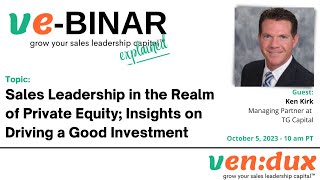
Webinar (Vendex Group) with Ken Kirk on sales leadership in private equity, focusing on the role of sales/ commercial leaders in deal sourcing, diligence, and post-acquisition value creation. Ken describes his career path (investment/wealth management, Med Solutions M&A experience, Longwater fund with 51% IRR and 8.3x MOIC, founding TG Capital in 2019), TG Capital's activities (raising a $50M Europe fund; focus sectors include business services, financial services, life sciences, and B2B enablement tech), and the search fund model (structure, investor dynamics, timelines, historical performance). He emphasizes leadership, talent and culture as primary value-creation levers, the growing use of outside operating partners (including CROs/CXOs) in PE due diligence and post-deal work, and practical advice for sales leaders marketing to PE/family offices.
Questions this video answers
Approximately 51% internal rate of return and 8.3x multiple on invested capital.
A $50 million fund (target).
Search funds began in 1984; over 700 search funds have been created (per the speaker).
About 35–36% IRR and roughly 5.6–5.7x multiple on invested capital (per the speaker).
About 70% transact within 15–18 months; about 25% of searches end without buying a company.
Chapters
Good to see everybody. Welcome to today's Vendux Webinar. I'm Andrew Miller, one of the partners at the Vendex Group where we focus on helping clients to grow their sales leadership capital. I am thrilled to have Ken Kirk as our guest today and I'll let him introduce himself in a second. At a high level. Ken has decades of investment experience and will share his insights on driving winning investments through human capital and a finely tuned due diligence process. He is a skilled PE practitioner across the spectrum. Buyouts, M and A deal sourcing, execution, strategy, operations, leadership and management. A couple of quick housekeeping notes before we jump in. We'll keep everyone muted for the duration of the webinar and then there'll be a Q and A session at the end. So you can either use the chat function in zoom to submit your questions or just feel free to open up your mics and engage with Ken directly at the end of the webinar. The webinar is being recorded and it will be available later today on our site and on YouTube. Ken, I'm really looking forward to chatting with you today about deal making, due diligence, and especially in the essence of the topic today, which is sales leadership in the realm of private equity. So, Ken, let me pass the line over to you. Can you just tell us a little bit about yourself, what you do at TG Capital. How did you get into this business? Just, just at a high level and then, then we'll dump, then we'll jump into the, the core of the topic today.
Certainly. It's great to be here with you all. And yeah, my background is I, I, I started actually in the, in the golf business. I was an assistant golf professional at Southern Hills Country Club in Tulsa, Oklahoma when I got out of college. And so that was going to be my, my, my, my path. But after a couple short years, my wife convinced me that, hey, 70 hours a week and only having off on Mondays was not a great lifestyle to raise children with. So I knew she was right. So I was looking. I had a finance degree from university and so I got into the investment business and, and the neat thing about, I guess what's different from my track, from the typical track in private equity is I have just over 20 years in the investment management and wealth management business. So I was in that for just over 20 years and then in 2014 decided to make a change and go to the private investment space. So I found a firm that was hiring. I mean, I had all this experience in investment management and had had worked for the Hartford, I worked for John Hancock, you know, they're out of Boston. And I worked for Goldman Sachs for a while. And it was quite a great time to be in the investment and wealth management business all through the 90s and in, through the 2000s. So going over to private equity, I had no experience other than when I left the investment space. I got the VP of investor relations position with a medical waste company here in Dallas called Med Solutions. And that was my first real exposure where the rubber meets the road in M and A. Because we were, we were acquiring companies in order to go public because there was only one publicly traded company in medical waste, and it was Stericycle. And their stock chart was amazing. And we had thought, geez, why wouldn't we go public? We have 300 shareholders. You know, we can, we, we can really position ourselves well to either go public or be bought out by Stericycle. So when I was there for a couple of years, we bought four companies in two years and I worked directly with the CFO and the CEO in sourcing some deals in the medical waste space. And then as we were planning to get our docs together to go public, Stericycle finally made their fourth offer, which our board couldn't refuse. So we sold out there. So that was my first experience in M and A. And I really got a flavor for it and I wanted to go into private equity. So I, I got a hold of a group called Long Water here in Dallas, and I was their first hire. Just a partner of two gentlemen and, and they were only 30 years old and 31 years old, so I felt like a, a very elder brother to them, but I had skill sets that, that, that they didn't have a background in. And, and so it was a great merge. And our first fund, we did terrific. It was a small fund, but we achieved 51% internal rate of return and 8.3 multiple invested capital. So if someone invested $100,000 five years later is when we, when we closed, when we sold the fund, you know, you received $830,000. So it was a great return. And that's when I decided I, I needed to pursue my vision of going out on my own. And so that's what I did. I, I started TG Capital in 2019. And I, I, I've tiptoed into the business in that I wanted to run my own process first. So I actually, we acquired a skincare company and that was my first foray into private equity. And we only had Two companies in the portfolio, but it allowed me to get my feet wet and execute and I was excited about that. So anyway, that's where I am now. TG is an acronym, stands for True Grit. So the reason why we name the company that is numerous reasons, but one of the main ones was that, that yes, we like to think of ourselves as being gritty and doing a lot of grit work when it comes to due diligence and sourcing and you know, kind of outlier analysis on companies. And we do that because yes, of course we do robust business analysis and we will do fundamental analysis which is, you know, know more qualitative about people and processes at a company, but we will also implement a lot of technical analysis. So the quantitative analysis that we bring from the investment management space, which adds some nice flavor to it and gives us some other additional metrics that maybe a lot of PE companies don't look at. So we've done some significant back testing with those metrics and stuff. So not that we have a better mousetrap, it's just that we're trying to do some outlier analysis and that's important to us. So those are some of the things that we do at TG Capital. Right now we're, we're in the process of raising a fund in Europe that's going to be a $50 million fund. So I have head of investor relations in London and we have relationships in Zurich, Switzerland as well as Luxembourg and Dubai. In fact, I'll be in Dubai in March and again in June speaking at two summits where we basically speak to about 40 high net worth or family office companies that are in either Abu Dhabi or Dubai. And it's a significant win to be invited to this because they only bring in 10 or 12 at the most 14 investment managers to ratio of upwards of 40 planet worth or family office people from the UAE. So we think that the UAE just by itself will probably fund 30, 35 million of the 50 million fund and I'll get the other 15 million from combination of the UK and Switzerland and some, some non EU countries that we focus on. So that's, that's the European fund and, and then we'll also have a, a fund here in the States that's a little bit different.
Excellent, great. Well you're keeping busy, that's for sure. So you have a lot of expertise and I know you have a passion as well in the blend of people, executive talent in the context of deal making, deal sourcing and due diligence. So I really want to get into this. One of the things I think about you and what you're doing is this, this concept of the search fund versus more of a traditional private equity kind of fund is, is that right in the world of TG Capital? And what does that mean? And what are the differences or the similarities?
Well, you know what's interesting is I don't know if we were the first people a PE fund to a firm to try this or attempt to execute it, but we are going to run a traditional fund in Europe, in the States though. My preference is to strategy with a search fund. And for those of you who don't know what a search fund is, I'll just give you the quick 60 seconds. A search fund is very similar to private equity fund. In fact, it's under the umbrella of private equity. You have traditional private equity, growth equity, venture capital, turnaround, recapitalizations. Search funds are in there. A search fund is. Instead of raising committed capital, this is number one, how it's different. Instead of raising committed capital right away, where you haven't, you have a goal line, you know of 20 million or 50 million or 100 million as your cap raise, you raise search capital first. And the search capital is, well, let's say I find 10 high net worth investors, accredited investors, and I want to raise 400,000 for two years to do a search. So that's the structure of the search fund and why it's appealing is that the entrepreneur and it's typically someone who's not even from the private equity industry, typically these, these searchers who's. Now since search funds started in 1984, it really took off in the 2000s and especially in the 2010s, but. So it took a while to get going. But since 84, there's over 700 search funds that have been created and the average rate of, the average internal rate of return has been 35, 36% over that time period for search funds as well as about 5.6, 5.7 multiple on invested capital. So the returns have been better than traditional pe, better than venture, better than growth equity. So it's an attractive space for a couple reasons. First is you get a, you get.
Sorry, before you get into the space. So just, just clarify what is a little bit more, you know, peeling back the, the onion. The, the what is the search fund? You start to allude about the, the entrepreneur.
That's what I'm going into. Yeah.
Okay.
Yeah. So, so what happens is an entrepreneur, he could be it from general line management at a company he could be an operator, he could be 52 years old, he could be 32 years old. I think the average age is around 34, 35, 36. For a search funder, the entrepreneur and what they do is they seek out either the cohort of search fund investors who traditionally are 80% of all search fund investments, 70 to 80% come from a core 30 or 40 types of investors, professional investors that are just high net worth, but the majority of them over 50% are actually private equity firms that yes, they've run a traditional strategy in the past, but they've found this, this lane, this offshoot that's very attractive and the returns have been great. So the big difference is the entrepreneur is only searching for a company that is, that is being sold. So you're not looking for people who are still going to be in charge. You're actually looking for only companies that are selling, which is a great idea because we have so many businesses that are going to transact course over the next 10 years. Right. So it's a good strategy in itself. And then the, the entrepreneur inserts himself as the CEO. So I go, I go, I find 10 people who can each put up 40,000 of search capital, which is a small amount for an investor. Okay, each puts in 40,000. So I raised 400 for my search, 200,000 per year to pay myself a salary to have some interns, maybe to have an analyst with me and then to travel to meet business owners and to also have money to pay for your deal portals and Q of these quality of earnings, things like that. So you use other people's money to fund your search. Now the reason why the investors do this is because they also get 150% step up on their investment when they, when, when the entrepreneur does buy a company, they get 150% of their original investment in, in, in the company stock so that you get a bump in that. And then also they also have first right of refusal, which 98 of them don't refuse once the searcher comes with a, a company. But the, the biggest benefit is a searcher has up to two years to buy a company and most of them are about 70% are transacting within 15 to 18 months. And then the other 30% will use the last half of the, the second year to acquire a company. But it allows a professional to actually spend more time searching for a company. And but about 25% of all searches end and wrap up and fold without even buying a company. So there's some risk there but then when you find a company to buy, you raise the acquisition capital and then you go back to your same 10 investors and say, okay, we're buying a company for $12 million. We're going to need 6 million in equity. So you raise that 6 million from your 10 investors, okay, and then your investor pool gets around 75% of profit when you sell five years later, or, and the entrepreneur gets around 25%. And he vests into that over four years. So immediately as you close the sale of the purchase of the company, he gets a quarter of his 25%. And then over the next three years, he vests into his 25%. And then there's performance, there's a little performance enhancement. So, so that's what a search fund is.
So it's very, very interesting in the, in the Vendex world and as we've been talking about. So let's. We've got now somewhere in the magnitude of 650, 700 senior executives on our roster, the supply side. So theoretically, each of these individuals with their own 20, 25 years of experience in their sectors and industries and practicing areas as the C suite, Chief revenue officers, heads of sales, commerce, chief commercial officers, they could be going to you and say, Ken, you know, I'm interested in starting a company and I've been CEO before and I've got a couple of possibilities in mind where I may know some companies to acquire. Would you be interested in participating or backing this initiative? Is that, is that completely relevant?
Yeah, that's, that's absolutely relevant. So we would, we would be interested in, you know, what, what. Most of the searchers will have a specific industry or two at the most. Three. They'll pick maybe three at the most. But most of them will pick one or two. Some of them are agnostic and will go anywhere as a generalist. But, but what's become more popular is, is, you know, deep knowledge in your lane. So choosing a sector and even choosing a geography are choices for the entrepreneur. But yeah, if they wanted to go talk to all the 30, 40 companies out there that invest in search funds and meet people and pitch their story, their entrepreneurial drive and where they'd like to invest in and what kind of company they want to be CEO of. So we would, we would definitely, you know, be interested in talking to anyone who wants to go down that route. Because what I'm trying to do is, is build a fund of funds of search funds. So rather than have a fund of funds of mutual funds or things like that, I want to do a fund of funds, of search funds. And the way I got this idea didn't make it up on my own is that the really kind of advanced and forward looking family offices out there in America today, they are already starting to do that. They've started that three, four or five years ago.
So.
You know, there's, there's family offices that will have a private equity division of their family offices. And then that private equity division will form kind of a, another lane with that just does search funds and they will make investments across a dozen or 15 search funds and that will be their fund of funds. Now, you know, where it comes in for sales leadership is, you know, I, I think private equity is a wonderful space to be in. You know, all the articles that, that you and I have talked about. It's so attractive to, to have that as a focus if you're, you know, if you're in this lane of being a sales leader, whether you're VP of sales or CRO or whatever, and you're looking to add value. You know, over 50% of private equity firms are hiring outside operating partners. It's a real growth area. And more than ever, they're not just hiring in CFO or CEO roles, they're hiring in all specialty roles that they can. So it's really important, I think, to get, you could get kind of aggressive in marketing yourselves and not just to traditional private equity. It would, it would be great for growth equity. You can, you can go on LinkedIn and, and start googling growth equity. Private equity and growth equity management firms will show up. I mean, what they're trying to do is help the company growth because the, the company they're engaging with is stagnant right now and they need growth equity. So a private equity firm, rather than buying majority position, will buy a minority position and really focus on a specific space like sales. Okay. Which is a great example of what we did at Longwater is that the company we bought, Circuitronics, was a 1977-OR 78 founded printed circuit board manufacturer and it hadn't gone anywhere in the ten years before. Their sales were flat and it was a small company, they only had 18 employees. But over five years we added, and most of this came in the first two, three years. We added 50 new employees over two or three years and most all of them were sales. But we had to restructure and reorg the entire sales marketing division because while Circuitronics was great at taking orders, they were good at taking orders, but that's all they did. They Never. They never executed orders, they never went out and got the business. So, so we were able to identify that right away. And, and they didn't have a head of sales because the owner was, he was the one making all the decisions across the board. And there was no input from middle management even. So, so they had a key man risk issue there. So we, you know, took some of the responsibilities away from him and hired sales leaders in two different divisions. Because what we did was, you know, their normal business at Circuitronics was just getting sales. But then what they, what we decided was we needed to buy a company kind of vertical in this area. So we bought a company called Assemblex, which was a prototype. So they would build the prototype. And then what was great was we could market that to new customers that were concerned about quality instead of price. So we were able to raise our prices, build prototypes, and then get the order right from the prototype construction. So it was, it was a wonderful strategy, but we needed, we needed salespeople. So it was. That's, that's a great story.
It's. You, you have. Sounds like you have an inside track into the Vendux business. Let's just pivot a little bit to the due diligence process. I, You've got a very sophisticated and well developed DD process. Just talk a little bit about due diligence on both sides of the equation. So you've got a searcher, you've got, you know, in that searcher fund, you've got entrepreneurs now coming to you. They're making a pitch. Ken, back me, this is what I'm interested in. This is where what I, you know, where I think I can make an impact on the one hand and then you have the deal itself on the other side of the table. Yeah, just talk a little bit about the due diligence process on both sides.
Yeah, so. So due diligence with the searcher is interesting in that most of them have never sourced companies to begin with. So the fact that they're getting into a chair where they're going to sit for 60 hours a week and source deals is a learning process for themselves. And then diligence on top of that is a whole other animal. And maybe they've done diligence in their background, which is great, but if they haven't, that's what, you know, those 10 investors or 12 or 14 investors that you have, half of those people become your board of advisors, you know, when you start to acquire a company. But they all help you with pointers on diligence. And pointers on sourcing and things like that. But, but for the, for the searcher, you know, we do we just tell them, look, there's the, the main diligence areas are financial due diligence, operational due diligence, sales and marketing due diligence, IT due diligence and personnel due diligence. So let's just start with those five and we'll have 15 or 20 lines of categories under each of those where we train them how to diligence the company properly. And the most important thing for the searcher is a lot of them come from an academic background. Many of them are, I think 65% of searchers have gotten their MBA within the last seven or eight years. So that doesn't mean if you don't have an MBA, still 45% don't have an MBA. But my point is, is that there's a lot of academics that come into being an entrepreneur for a search fund and maybe a lot of them don't have line management experience. So you can't approach due diligence really as an academic thing. It's an investigative thing, it's a discovery process. So we're trying to teach them. You have to investigate, well, what have you investigated? Your first thing you're doing is investigating the risks. What are, what are the, what are the 4, 5, 6 biggest risks to this company and the biggest risks to advancing on, on the value creation plan that, that we can see for it, which is, you know, in order to execute this, what are the risks that are going to stop us? So then we have to discover those, mitigate them and learn and then start the wheel over again. So that's kind of just the thing with the searchers that what we do to get them started as far as diligence of our own on portfolio companies, I really enjoy sourcing companies. It's a lot of fun for me. I think I'm pretty decent at it and I've done it long enough that I have a, I have a process and a routine due diligence is another animal. I haven't been doing it that long. So that's why I created a, an enormous process of 220 line items of, of things to look at. And you know there's, there's, along the horizontal line are, are the time timetable. So you got in week one and week two, what have you done with that one particular item? But, but they all go under. You know, when I mentioned financial due diligence, operational due diligence and, and sales and marketing Due diligence personnel, due diligence and I talked about, told you about the five that I go over with search funders. With our own, we have 16 of those categories, letter A through P. And under each one of the 16 we'll have at least a dozen 14, 15, maybe 20 line items to diligence on within financial or operational. But it's just kind of a report card as you go because there's so much diligence to do that. That's how we keep track of it. These are things that I can share with your people.
Sure. So to what extent are you bringing in outside? I mean that's a silly question. Of course you would bring outside resources to help in the due diligence process, whether it's the CPA and running the numbers and the audits. But actually it's more a question around sales and commercial leaders. Yeah. Who might know or who would know an industry, a sector really well. So if you're looking at, at a, at a medtech company and you know, you're, you're looking at their product, their market, their customers, the whole, you know, the tam.
Yeah.
Do you bring in, you know, Chief Commercial Officers, CROs.
Yes.
That, that know that industry very well to work alongside you in, in a due diligence role.
Our, our plan is to definitely do that. Absolutely. And, and, and kind of get away from the generalist which is, you know, that's kind of more like me. But, but to get the actual specialist in their lane to help us diligence the process, process of properly valuing the company which would then lead us to decision. Is this something we want to make an loi, a letter of intent on or not. But that's what's key about I think this whole thing with the rise of operating partners, of outside operating partners in private equity today is that there is a. I think it's more than a trend, but there is evidence that each year outside operating partners become more and more important to the overall and that you'll have traditional private equity teams now even they can run thin with specialization of labor in certain areas because a lot of them focus on four or five industries. And that's my whole point is that you may have a right then you have a Croat looking at. If you're the P.E. guy, you're like, wow, we're looking at, at these industries. I may need a CRO to help me with diligence in three of these industries. So that's how I look at it is that these things are becoming more and More popular. And you know, I have all, I have those, those articles that we can, you know, supply to your people. I think they, they really, it really kind of startle them. I think just, just how much private equity has focused on outside operating partners. You know, the inside, the inside operating partner is, is an employee of the firm.
Yeah.
Right. And, but, but the outside operating partner, all of their intentions are aligned because the compensation to the outside operating partner is, is always going to have some performance guarantee to it. You know, where hey, based on performance here of our diligence and you, you know, providing a scope for the sales team that we're inheriting. This is important stuff and you know, you get to get paid, but then you also paid on, on some bonus.
Yep. Great. So I'm going to open up the floor in a second for, for questions and you know, invite people to engage with you directly. Quick question about, you know, a case study. Can you, can you frame a deal now or in the past? You know, do you have a case study where you have engaged a sales leader before?
Yeah, well, I mean the one I mentioned with, with Longwater, that was key because, you know, and the three most, just one step back that the three most important things in, in finding value creation in a company, at least we think are leadership, culture and talent. So leadership, talent and culture are the three most important things. Now of course that supports our strategy of three other places to invest in, which are we're going to invest in people, we're going to invest in operations and we're going to invest in infrastructure. So, so we know that offhand is that we're looking for a company where we can make those three investments because those are three of the larger value creation levers. And that's one of the things when you're doing due diligence is you have to, while you're diligencing a company is fine where the levers are where we can pull on to execute growth. So their status quo is here. The business owner thinks they can get here, but we see it can be up here. And you know, between that is the delta that we're trying to grasp hold of. And of course we're not going to tell the owner, hey, that's great, you think you can get there? We're not going to tell them. We think we can get it here right away, but it comes to fruition as we get further down in negotiation because we will show our hand with our value creation plan. And the value creation playbook is key in private equity. Those who make private Equity investments and have a value creation plan have moderate to substantial returns 76% of the time. Those who don't have below moderate to negligible rates of return, I think it's 78% of the time if you don't have a value creation plan. So what's interesting is it's been proven, you got to have some ideas about where you're going and leadership, talent and culture is key because if you don't get that right, it's hard swimming upstream because you can make it really easy on yourself out of the gate or real hard. And you have to in order to do execute on value creation, the whole strategy should be to do it as quickly as possible. And if, and because you're wasting time, if you're going to analyze this the whole 12 months in your first year, you need to analyze it when you're doing due diligence on the company. And that's when you bring in a sales leader to help you diligence. Not just, not just sales and marketing specifically. I, I think that you could use their diligence in other spaces like for example in financials, you could use their space in pricing because they're going to know the industry better than you are about competitor pricing and things and about whether the companies are saying and their history of pricing strategy. So, so not just sales marketing in the raw terms, but pricing also in risk. Okay, that's huge. So I think a sales leader can position themselves with all different kinds of private equity. You know, private equity, traditional growth equity, search funds, turnarounds, even Evergreen Funds. Evergreen Funds is an interesting space too because you could create a list of PE funds in America that specialize in Evergreen. Well, what's great about those is they don't have the 10 year sales window where you have to execute a sale of your fund. They can do it indefinitely. So the neat thing about the Evergreen fund and why, why wealthy people are interested in that is because one, a lot of them have already have enough money and they know they're going to grow some money. But they're interested in Small Business America or American businesses and they like owning businesses for longer periods of time to make sure that they're the ones creating the value and it's not going to a competitor or whatever reasons they have, but there's a lot of of money out there going towards Evergreen Funds where you have a team of people probably maybe in a family office. Which is another reason why sales leaders should prospect every family you can find because they'll have a team focused on private equity itself. And they may even have a team focused on certain strategies of PE, like Evergreen or Search, you know what I'm saying? So. Yeah, yeah. So. So that's a. That's a specific area that I would focus on if I were a sales leader.
That's great. I want to. I've got a question. One more question, at least on actually just to this point, about sales leaders marketing themselves to pe, but we'll come back to that in a second. Does anybody have a question for the moment, directly for Ken? Any raised hands? Not yet. Ken. So to that question, what are your thoughts on sales and marketing and business leaders marketing themselves and their services to pe?
Yeah, I mean, one of my favorite things is networking and getting to know people and if, hey, can I value to you? And. And whether I get value back, you know, very soon or very down the road, it doesn't matter to me, as long as it's a, you know, kind of a negotiated or communal relationship where we like each other and we want to do business together at some point. So as far as marketing, that's. That's part of it. But. And I'm not. I'm not. I'm not great at the marketing side of. Of any business. I was. I was always pretty good at sales and had done real well on sales. But the marketing, you know, a lot of people think they go together. I'm probably in the school that think they should be separated more. I think, Mark, marketing people do great things that I can't do, and I'm not interested in doing so. But as far as marketing to pe, I think there's a lot of avenues people could go down the road with. You know, you could just. Just coming out with some mailing campaigns, some emailing campaigns, even. Even hard mail, you know, having so many things go out per week. And when you. When you're only targeting private equity and family offices, yeah, there's. There's a lot of them. I think there's 4,000 private equity firms now in the United States. I think there's about 77,000 across the world, 7,500 across the world. I don't know how many family offices. I know there's quite a few. But, you know, marketing those entities in your geography, if most people have a geography with Vendux, that seems very attractive to me. And I would. I would actually maybe hire a marketing person to get to your. To get quicker to the point what the strategy would be, I would think hire a marketing person. Maybe it's. It's Just part time, you know, four hours a day, four days a week or something. Start with that. Or maybe it's, maybe it's your wife. You know, I don't know how that would work but, but you pay these people to focus on marketing your value. Add to a bunch of different private equity types as well as family offices. That's where all the business is I think where you guys can excel. And that's what I would do is if I was a sales leader and I had to go get some business, that's those are the two places I would go. You know what's nice about it is especially if you market geographically, those people are all relationship based anyways. This is a people industry and you, you guys are in a people industry. So we're in parallel industries to begin with anyway. And, and they want to meet you. So there's nothing wrong with going and knocking on the door, you know, seriously and making an appointment to go in and see someone at the company and say hey, you know, can I take some of you guys out for lunch or can I come in and bring you know, cookies and coffee and, or something at the end of the day and do a 30 minute meeting. So I would almost treat it like you got wholesaling yourself, you know, where you're going in there and selling yourself and some kind of strategy where you have some marketing person constantly sending stuff out and feeding follow up to you and then even maybe setting meetings that would be fantastic because then you're, then you're pushing the envelope, you know, you're really making yourself noticed as far as hey, you know, I'm going to need to get to know this guy anyway if we're going to bring him in on due diligence before we even hire him to be a part of the operational team.
Right.
To scope the deal. So and what I mean scoping the deal is as soon as they do an they want, they know they want to buy the company then, then the sales leader in a consulting role, it he's past the due diligence stage and now he's into oh now I get to scope the sales team and I get to see where pricing's been. You know, he gets to access to the data room which now he can see everything and now he can, he can really get to work and add some value there. So I, I think it could just open up a kind of a field of dreams for a sales leader.
Yeah, great. No, and I thank you. Love your comments. Just a couple minutes ago also about you know, these These three core areas of focus for investing, leadership, leadership, talent, culture. It's all about people in one form or another.
It is.
I have a couple of very specific questions here for you that were chatted to me. One, does TG look for CROs, CMOs, COO roles for deals being sourced, or is it the responsibility of the sourcer?
Oh, that would be the responsibility of the sourcer. Like, if it's a search fund, for example, it'd be the responsibility of the entrepreneur. But if it's a, if it, if it's One of the dozen, 10 dozen, 10 or dozen or 15 search funds that we're investing in over calendar year 2024, I would have a lot of say or recommendations to the entrepreneur, the searcher, to say, hey, you know, in order to do some diligence properly, maybe we should get, you know, a CRO or VP of sales or, or, you know, whomever in to help diligence. Just, you know, just to get the ball started. Because, and the reason why is because you're inheriting a company where the owner is selling. And this is another kind of advantage for, for this, for, for this. The sales leader is the search fund space. They're all selling. So you're going into where employees, maybe they've been with the company a long time and they're a little bit worried about, hey, who's taking over the company and what's going on. You may have people leave, they may get courted by a competitor, but there's all kinds of situations where there's a, maybe even a more legit reason for a search fund entrepreneur to partner with a, a, a sales leader consultant to come in and do some diligence with him, because then he can insert him as, hey, let's, let's hire a team. We, you know, we have four of our people leave. We got to replace them and hire another eight. Okay, so we're looking at 12 people over the next six months we need to hire. Do you have relationships in, in this lane? I know you do, but geography wise, where we talk, you know, just, I can just see it kind of morphing into a great relationship. But yeah, leadership, talent and culture, that's just for, for PE guys if they want to make some improvements.
Another question for you. Does TG Capital play in the automation and robotics space, and does it have any companies that are currently targeting for acquisition or investing?
Okay, so we don't operate in that space specifically. It's. You can find, of course, private equity firms that do, and you can even find Private equity search funds that focus in that space. And it was just, it was just a month or two ago where I came across a search fund that, that had that as one of their four or five focuses. Typically they'll pick two or three. The more generalists will do four or five industries, they're more opportunistic. But yeah, I just came across one just probably six, eight weeks ago. And anyway, so it's funny that the question happened but I, we don't have any plans to invest in that space. It's just because I don't, we, we don't have any experience in this space. And so that's why we focus on just the, the few industries we do of business services, financial services, some healthcare and some technology. But the, the, the healthcare that we focus on is, is strictly life sciences and you know, kind of MSOs, management services, operational companies that you know, do back office servicing for the physicians and practices and whatnot. And then you know, in technology we're looking specifically for any kind of enablement of business processes and operations. So you know, it's a very specific lane in tech. It's just because we do that for, for sourcing reasons it's easier to source if we have a very more specific lane. And in healthcare I don't have a lot of expertise except for the medical waste space and some in life sciences. So that's why we're doing life sciences and I think it's a great space anyway. Financial services is my background so that's why we make sense there. And then business services is more of an opportunistic umbrella that we'll look at where we'll do a lot of diligence as far as more relative value of that company to other companies in, in its industry, things like that. So yeah, that's our, well.
I'm just looking at, I'm doing a double take on the clock.
Oh, sorry about that.
I can't believe how, how quickly this, this 48 minutes have gone by. We will have to have you back over the next few months by, by popular demand. There's a couple of more questions coming in Ken. People I think want to engage with you and communicate directly how best to follow up with you with anybody that's listening here.
Okay, so what makes things easy for me is if your group can contact me on my personal mail. My personal email is Kenneth D as in David Kirk K E N N E T H D as in David K I R K at Gmail. And that way I know when, I know when I'M getting mail there that it's coming from someone who's. Who's not an investor. And that's really what the TG Capital email is for. So at this point, that'd be a great way. And also my phone number is here in Dallas, which is area code 214-430-3774. So it's 214-430-3774. And you can call or text me there and I'll answer same day for sure.
And. And they should be mentioning Vendox.
Yes.
When they mention Vendux.
Yes.
You. You'll put them in the. In the. A line, not the C or the D line.
Exactly. And I'm on LinkedIn. If someone wants to message me on LinkedIn, I'm actually on there quite a bit. So I engage in messaging on LinkedIn quite a bit. So. And what I've used that for has been parallel industries that are, you know, intermediaries, where we work together. So it's a natural to communicate there as well if someone has a preference for that.
I, personally, I could go on with you for. For another few hours at least. We've got a lot of ground to cover. I got many more questions. We. We just don't have the time today, so we're gonna wrap up. I want to thank you very much for being here, for your participation, for sharing your wisdom and expertise. We will do this again soon. Yeah, can.
My parting comment. My parting comment is, is, is to maybe we steer some of your people towards these articles that you and I discussed just recently that have come to light. And I just think there's so much behind this, you know, the rise of operating partners, of outside operating partners in private equity. And I think you can easily add to that title. And family offices. This. Family offices are now, instead of just going to the large private equity firms to invest in, they're forming their own PE divisions. So. And above all, a family office professional is very keen on specialization. You know, typically these are people who will have a cfa, they'll have the. The Kaya. Right. The alternative investment designation. So I think it's even important, more important for the. For the gentlemen to also. And ladies to also attack the family offices as well as pe.
Okay, I'm getting a qu. You put the email in the chat. Hold on a second.
Oh, we'll include the email.
Did you say it's Kenneth?
I was going to say the email and the phone number when we send out the recording to the. To the vipino. So people on the call will get it within 24 hours.
Oh, okay. Excellent.
Excellent.
Ken, awesome. Thank you so much. Great to have you here. We'll do it again soon, as I said, and have a great rest of the week and month.
Great.
Talk to you soon. Thanks, everybody. Thank you. Thanks a lot, everybody. Take care.
More from Henning




ve-BINAR - The Revenue Tornado Methodology: How 3 Power Sources Create Exponential Growth


ve BINAR: Executive Cloning: How AI is Reimagining the Role of the Fractional Executives




veBINAR: Unlock Client Value: Why Compliance is Crucial for the Startups You Serve
