ve BINAR Spy Turned Executive Leadership Coach
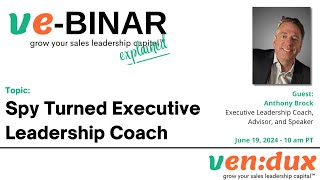
Recorded June 19, 2024, this Vendux webinar features Andrew Miller interviewing Tony Brock, a former U.S. Navy intelligence officer (submarine service, SEAL-support intelligence roles) who became an executive coach. Brock describes a 28+ year Navy career followed by eight years with the Department of Defense, then certification in executive coaching (Georgetown) and current roles including executive director at the Griffin Institute for the National Medal of Honor Museum (opening March 2025). Key themes: translating military intelligence practices into business (distinguishing data vs intelligence; acronym TRAP — timely, relevant, actionable, predictive), running a simple intelligence cycle for business (ask, get, think, share), mission-aligned leadership (Leading Mission Alignment / Big Five: vision, mission, business/market intelligence, strategy, plans), differences between strategy and planning, the role and benefits of executive coaching (confidential space, accountability, perspective), and managing information risks from AI/deepfakes by confirming across sources and assessing timelines/probabilities. Practical takeaways include tactical questions leaders should ask, the importance of shared situational understanding, and contact info for Brock (anthonybrockgroup.com, LinkedIn).
Questions this video answers
June 19, 2024.
More than 28 years.
Eight years.
March 2025.
anthonybrockgroup.com.
Chapters
Foreign.
Welcome everybody. Welcome to today's Vendux Viar. I'm Andrew Miller, one of the partners at the Vendux Group, where we focus on helping clients to grow their sales leadership capital. I am thrilled and totally humbled to have Tony Brock as our guest today and I'm going to let him introduce himself in a second. In a nutshell, Tony spent more than 28 years in the U.S. navy, most recently as a commander in the Pacific region. He then spent eight years with the Department of Defense. I first met Tony more than 10 years ago at a reception on the USS George Washington during one of their regular visits to Hong Kong where he and I were both daced. Tony, thank you for your service and thank you for being here today. Today's Vibinar topic is Spy turned Executive Leadership Coach. Love that title and really looking forward to this chat. So we're going to dive into this theme and topic shortly. First couple of quick housekeeping notes before we jump in. So we're going to keep everybody muted for the duration of the webinar. And then there's Q and A at the end. So you can either use the chat function in zoom to submit questions or just feel free to open up your mics and engage with Tony directly at the end of the webinar. Webinar is being recorded today and it will be available later today or first thing tomorrow morning on our site and on YouTube. Tony, before we dive into today's webinar, could you just share please, about your journey, what you do today, the. The things that you do today and what are the. The highlights of your journey getting here.
Yeah, thanks, Andrew. I appreciate it. First, gratitude. You know, just thank you for hosting me, you know, allowing me to be on the platform. It's a fantastic opportunity to reach out and connect, I think with a lot of like minded folks. I didn't realize we had met 10 years ago in Hong Kong. A decade somehow feels like a bigger chunk of time, but I know you're right. Yeah. In a city of 8 million people, you just popped out as one of those, one of those characters in the story that was, you know, both interesting and interested in others. And so I'm just really grateful that I had the opportunity to connect with you there and remain friends all these years sense. So that was on the. Just as background, you're right. Joined the Navy, served as a submarine sailor first and the time in Hong Kong is sort of those two things sort of serve as bookends. The piece in the middle was that I was fortunate Enough to be selected for a small group program as an intelligence officer at one of the Seal teams. Did a couple tours there with both SDB team 2, the mini sub guys out of Virginia beach and then working with Soxent forward out in the Middle east and had been pursuing my MBA online and was planning to make a transition out of the military when 911 occurred. And then of course, you know, you know, the, the people, their families, wives are friends, kids are friends. We've all worked together now for several years. And patriotism aside, this is a personal relationship at this point. It's not the time to walk away when, when it's. You have the opportunity to really do your mission. So. So I stayed in and continued. We did the deployments to Iraq and Afghanistan on repeated tours, and then finally at the tail end of that, took a break and headed to Hong Kong. So serving the embassy there in China, you can imagine if that's, that's the break, right. If you can leave Iraq and Afghanistan, then service as an intel guy in China was the downtime and correct. Yeah, the spy part probably sounds more, you know, cool guy marketing hook than it. Than it really is. I'm a career intelligence officer and I imagine if you were really a spy and you put that in your title and you told everybody, you wouldn't be a very good spy. So. But it got me into, as an intelligence officer, a position of working with executive leaders who were assessing risk, who were trying to understand human behavior, who were trying to lead organizations at scale. And I just became really fascinated with that whole process and became really fascinated with, with the concept and the role of executive leaders, the pressure and, and everything that's involved in that. And so after leaving the Navy, I went to Georgetown University for get certified in executive coaching and have pursued that since, both in my private practice and also my role as the executive director down at the National Medal of Honor Museums Leadership Institute, the Griffin Institute, which make a plug for them as well. The museum opens in March 2025 and that'll be a fantastic folks opportunity for folks to come check that out as well.
Tremendous humbling. In my next life, I want to be you. And.
We can switch. I want to be you. So that's good. Well.
Thank you. So, you know, transitioning from the military to business, you say, you know, the theme is spy turned executive leadership coach. So let's talk a little bit more about that. How. How has your experience as a former intelligence officer shape your to executive coaching and business leadership?
Right? Yeah, great, Great question. It probably first came to light. When I was in Hong Kong and we were dealing with so many US Executive leaders and firms that were overseas and we were talking about just market intelligence in general and the role of business intelligence in executive decision making. And that's where I started to feel more comfortable that there was a very easy application of those skills. You know, having some training in human behavior and psychology and having the other half of that job is really about understanding the executive leaders sense of vision and mission, what they want for the organization, and providing them a picture of what that operational landscape looks like. And so whether you're doing that in the military and it's, you know, a map in the battlefield and some satellite imagery, or you're doing it in the corporate marketplace and you're using more of like a Porter's five forces model or some of the other systems that are out there to examine what is the marketplace looking like right now, that the concept is really the same and then it's simply about, you know, identifying risk and adapting and mitigating that risk and then, and then making clear decisions and moving out. So I found that it was actually, you know, directly applicable to, to my former time working with executive leaders as an advisor.
Makes sense. So, you know, there's adapting military lessons to business. I mean, I'm, I'm a reader and follower of Lao Tzu, the Art of War. You know, I've been doing so many different versions of that over the years. With your experience and perspectives, what specific lessons from your time supporting U.S. navy SEALs, for example, have you found most applicable to leading sales teams in the corporate world or, or leading corporate leaders or helping?
Yeah, I mean, you bring up a great reference. I don't think you could, probably can't get a military guy on a podcast if you're going to talk Sun Tzu. You know, we can't get away from referencing that since, since the days of, of Wall Street. But yeah, you're right, a big part of that is foreshadowing, right? Foreknowledge. That's where you get paid sort of the big bucks. And so when I, when I talk to executive leaders about intel specifically, it's a recognition that, you know, we start off, hey, congratulations, you live in the information age. You have access to more information than any human has ever had before. And yet you would think therefore decision making is easy, but it's actually more difficult because we're just getting overwhelmed with data. In fact, that that information overload is about a $900 billion problem for, for corporations because it's not only impacts your productivity and your efficiency, but it also leads to like mental health stressors and physical stressors for people in the workplace. There's just a fire hose of information coming in. And so I think the application for, for sales leaders or, or leaders in general is a recognition that there's a difference between information, which we kind of just capture is everything, and intelligence, which you could imagine is that subset of information that matters to you. And so I like to give folks the acronym trap that intelligence is defined as that it's timely, it's relevant, it's actionable, you can do something with it. And then ideally it's predictive. And so, you know, you're, you're reading the paper, you're checking the wire, you're, you're pulling in all your sources and then you're spending a little bit of your own analysis thinking, okay, that's what everybody says, what do I think? And then trying to imagine if that's true, what do I think is going to happen next? And that's the big leap, right? Is the predictive part. That's where analysts get paid the big bucks. And so I think for sales leaders, the application is getting, spending some time doing your homework, getting into the head of the prospect and having a sense of what, what is their vision and mission, what are they trying to accomplish, what's the operating environment that they're working in and therefore what are their stressors and risks. And, and now how are you providing a product or service that's going to, you know, alleviate that risk and help them achieve their mission? And so, you know, if someone were a, a wine grower in, in California, then, you know, does the weather in Australia or the labor market in France matter to them? Probably yes, but it doesn't maybe if I'm in a different market. So what qualifies as information versus intelligence depends on the target that you're talking to. So I think, I think that as a general concept, understanding the difference between information and intelligence is a big part of it. And then from an organizational management, the, the real lesson of the SEAL team was all about mission, right? It's getting everybody's time and talent moving in the same direction to achieve the mission.
So I, I've heard you talk about, you know, the elite leading mission alignment framework. Is this what you're referring to? What, what is that and how, how is that?
Yeah, that was part of my, you know, transition from, in military and sort of stepping back and just saying, okay, that was an amazing experience to, to serve as A support officer, a SEAL team for so many years, what. And a lot of people would ask, you know, sort of what, what was the special sauce? You know, there are a lot of seals out there that talk about grit determination and mission focus. And. But as a support officer on the team, having the opportunity to really look at some of the diversity that was available there. And so like in any organization, you have HR and logistics and finance and the sales team. And there's a lot of different players that are involved. And the unifying factor, I think at SEAL Team, which I try to bring to corporate now with a leading mission alignment framework, is starting at the top and working our way down, making sure that we have a common vision. I call it the big five, basically, is a vision our mission, business intelligence or marketing intelligence picture. Do we have a shared situational understanding of what the heck is going on around us? What's our strategy? Given all that, how do we want to position ourselves in the market for success? And then what are our plans to get there? And I think a lot of times we jump into the org chart and who's working for who and where are people sitting and who's on remote work. We jump in real quickly on key performance indicators and what are we going to measure and why and what are, what's a bonus structure going to look like? And there's a lot of that stuff that's up at the top that's just so critically important about vision and mission and checking in on our assumptions of what's really going on in the market that are just absolutely fundamental to leading mission alignment, which gets you everyone's time and talent moving in the same direction. And so we sort of skipped that step, I think, with the idea that, well, everybody knows that. And the reality is the more senior you are in the organization, you're swimming in that stuff all the time. It doesn't mean everyone else in the organization is. And I saw that as a critical takeaway from the experience at the SEAL team, was that we always went back and checked in on here's a vision, here's a mission, here's a situation, and therefore, here's what we're going to do about it. We would walk ourselves back into the target every single time, not only to check our own planning assumptions, but to make sure everybody at the table understood this is why we're about to go do this next thing. And I just think that can be a feature that's missing too often. And it's really helpful for leaders to fall back in and check in on that.
Fascinating. So in terms of, let's say a business intelligence, how can leaders effectively harness business intelligence to, to gain better market insight, customer insight, product trends, to, to be more competitive, to stay ahead of the competition.
Yeah, yeah, you nailed it. That's, that's the key point is, you know, begin with the end in mind. And so you're ending it with how do I increase my competitive advantage ultimately? And if we back that up, then having a clearly communicated, even in your own mind, you know, your own head, heart and gut, what's my vision? It has to be purposeful, it has to be aspirational, it has to be inspirational. And those are sort of the three criteria that I would, I would unpack. What's the future, future state of the world that you imagine and how is your corporation helping to make that a reality? Next is sort of your mission, should you decide to accept it. You know, I throw a little mission impossible there on folks, and you want your mission to be present tense, clear direction and guidance to your people. Because we get these Hopi dreamy sort of statements sometimes and we do a leadership retreat and everybody's, you know, having a great time and we walked away with a vision statement, but we really didn't talk about specifically how are we going to get there. And so having a clear mission statement that says to do the following, you know, and it identifies your customer, it identifies the problem you're trying to solve, it identifies your product or service, you know, what's the value proposition? And it's identifying how the customer is going to feel afterwards. What's the benefit, you know, the internal, external, philosophical feeling that they're going to have at the end of this thing when, when we've set those two, now we're ready to look at the marketplace and business intelligence writ large. Because if, I don't know, back to the French wine grower example, if, if I don't know who I am and what I'm trying to achieve and what our mission is. The market's huge. It's. It's literally, you know, exponentially endless. So I, I don't know what you want me to look at, boss, and how I can help you make decisions if I don't know who I am and what I'm trying to achieve. So once we get those two knocked out and return to the market, I like personally Michael Porter's five forces model where we can look at those paths of the competition. In the middle, what are the substitutes where the barriers to entry, supplier power, buyer power, and you can run down as a starting point, you can kind of run down any of those paths. If, for example, we were looking at supplier Power. Now, before I open my laptop and I get overwhelmed by all the information that's out there in the universe, let me make up a list of questions, you know, and you can really take this complex business intelligence cycle we use in the military, and you kind of boil it down into four parts. It's ask, get, think, and share. And so you got to ask the right questions in the first place. Well, what are those? Well, what decisions are you trying to make and what do you wish you had the answers to? What's the data you need in order to move your company forward? If in the next step, in this case with regard to supplier, your supply chain situation, but you could apply it to any party of your organization, what are the questions that you want to ask? What are the most likely locations where that information resides? You might have to pay for it through a think tank or some sort of service provider, but you want it to be factual and as unbiased as possible, and you'd like to be timely and recent reliable information. And then when you get that on board, you're going to unpack it and think about it. You're going to say, here's what the different factors in this, in this part of the market are telling us. What do we think? You're not. You didn't just land on the planet. You've been doing this probably 20, 30 years. So what's your gut telling you? What's your head and heart telling you? And then the big one is sharing that information, whatever your analysis is sharing it with your team. And I see more often either we don't ask the right questions, we're just in sort of passive receive mode from the Internet. And then if you do some analysis and come up with your rationale for executive leaders to share that with the rest of the team so that everyone understands the planning assumptions and everyone understands sort of your commander's intent, your philosophy, so they can make decisions quickly at the lowest level possible that's aligned with your thinking as well. You don't turn around and then find out, you know, either everyone's waiting for you or they're unilaterally making decisions based on their own analysis or their own sort of hypothesis that's different than the CEO. And either way, you have, you know, misalignment across the organization. So I think, you know, the business intelligence concept is people can incorporate that in their own businesses by just recognizing the Difference between information and intel and then building out an intelligence cycle within your corporation. Hey, how do we, how do we ask questions? Where are we getting our information from? Are we sitting down then and having a meeting to crunch it and discuss it doesn't have to be everyone, but there should be some subset that does that. And then what's the mechanism by which we share that, our, our thoughts afterwards with the rest of the organization?
It's all in the questions. Yeah, you, you talk about a little bit about planning, you've talked about strategy. What I'm, I'm interested in your perspective on strategy versus planning. What, what's your perspective from, from a military perspective, strategy and planning and then overlay that in the business world and leaders.
Right? Yeah, that's like pet peeves.
Parallels, differences, lessons learned.
Yeah, yeah, plenty of parallels. And there's, you know, just endless books, books written on it. I think in the big picture, sort of philosophically, we use the words interchangeability. It's probably two of the most misused and intermediately exchange words between strategy and plans. Or we'll say, I'm working on a strategic plan, I'm working on the, we're working on the corporate strategy, we're doing the five year plan. And I'm like, well, is the five year plan a strategy? And who the heck can do a five year plan nowadays? You're doing a one year plan and you're lucky if anything close to that is what ends up being executed. So you know, if, if maybe you used a sort of a World War II example, the vision was to establish a free and open democratic society where nations could trade. And your mission therefore was to defeat the enemy and reestablish that condition. The intel laid out to include terrain and weather and who were the allies, what resources and means you have to do that. Your strategy, you know, can be forming allies, banding together to form allies for us to be able to go after this larger force or this more violent force together and then we're going to break it down from there. But individual plans, you know, the landing at the beach of Normandy, the invasion of Sicily, that, that's a plan. And then that breaks into goals and objectives and functions and KPI and somebody's in charge of it and all that stuff. So the, the difference between strategy and plans is just how do you intend to position yourself within the market? And then your plans are the, the way that you're going to implement that. You know, I always say that your, your, your strategic plan for your organization needs to zipper back up from the top. Here's our vision statement, here's our why, here's our Simon Sinek start with why. Purpose. Here's our mission of our customer and the product or service that we're going to provide. Here's what we think is going on in the market. And let's really take a second to lay out the map. If you were imagining the market as just a map, you know, could you imagine executing a strategy and a plan without looking at it? So lay the map out. What's going on? What are what. In the military we would call sort of the, the go, slow, go and no go areas on your map and then strategy statements. For me, the best always start with therefore based on these things and our analysis of it. My strategy, therefore, is this. It can be depending on the organization. You know, if it's, what sort of state are you in? Is this a startup, a turnaround, accelerated growth realignment? So it may be for the next six months. Our strategy is a tight realigning of our organization and getting our resources in place and these things. And then we will be moving into a growth strategy. And so there can be phases of a strategy and their subsequent plans and goals and objectives under each one of those phases, but they are really two different, like fundamental concepts. Your strategy is how you position yourself in the market for that phase and your plans are how you actually plan to execute them. One is sort of bigger, touchy feely, you know, subjective measures of effectiveness. And the plans are more deliberate, you know, objective measures of performance that we can put in, like your dashboard on your car.
That's a really useful perspective. Let's pivot to what you do now. Executive coaching. Leadership coaching. How does does partnering with an executive coach differ from any other kind of traditional leadership training? What, what benefits, what unique benefits are there with executive coaching and what. You know, your.
I know you've better know the answer to that. Right. That's a good. Yeah, if you're asking the executive coach, you better know the answer to that one. Yeah, I think, you know, in order to be best prepared for any role that we're stepping into, we want to make sure that we have the education, training and experiences we need to do the job. And some of the, and so those are not mutually exclusive. Right. You can have your MBA or your sales training, or in addition to some sales training, you can have some experiences. Those are, those are that side of the house. The, the, the difference in sort of leadership mentorship and coaching is that in my mind, leadership is all about providing clear direction and guidance to your team so that you can get everyone's time and talent moving in the same direction to achieve organizational goals. And so it can be collaborative, but at the end of the day, there's some positional directivity involved. You know, like in the military, we would say, you know, we're not here to. Or we're here to support democracy, not practice it. You know, everyone gets a voice. It doesn't mean you necessarily get the vote. So at some point the leader has to make a decision, somebody is in charge, and they have to make a clear decision and move out. You know, so, so that, that sort of leadership mentorship is sort of the transfer of knowledge. And so some of my mentors are older than I am, some of them are younger than I am, but they know more than I do in certain areas. And that's where you're drawing on creating sort of this unpaid board of directors that are around you, that are people that you can latch onto for mentorship and bounce ideas off of. So with those two set, coaching starts out with the idea that really as you become more senior, you have fewer and fewer opportunities to work in and among your peers. And so it can be really helpful for you to set some space aside where you're going to talk about you, because otherwise, everything you're doing, if you're in service to your team and to the board, everything is in service to others. It's to your family, it's to the board, it's to your shareholders, it's to your executive team and then to the larger organization. And the calendar can get filled up really fast where there's not time for you to just have some self awareness and self reflection and sort of check in as you're in the middle of the game. And so coaching allows you to block out, whether it's an hour a week or every two weeks, some time to have that experience with a peer. And you do that in a confidential setting because some, just like every other human, you want to be able to vent, you want to be able to tell the truth. You want to be able to talk about your vulnerabilities, you want to talk about things that you're uncertain about or frustrated by. And it's really not appropriate for you to have that discussion with the board or with, with your executive team who are your subordinates or direct reports or to let the whole organization know. Right. There's a difference between authenticity and being too, you know, too vulnerable with your team. You don't let the team know. I have no idea what I'm doing next. That's not helpful to the, to the confidence and morale of the whole team. But you might want to shut the door and have that conversation with a peer. And in this case, that peer can be an executive coach, somebody who's trained in providing sort of those open ended questions. The goal isn't to fix anyone. You know, you start out knowing that the executive is already smart and talented and capable and it's just holding the space for them with some open ended questions so that they can sort of explore it. You know, you don't get a light bulb moment every call, but, but pretty often people will say, you know, now that I hear myself say it out loud, I think this, this, this. And so it's starting with a challenge, getting really down into what's the issue at stake? What are the options you have available? What are some ways you've handled this in the past? What other resources do you have available besides yourself? It's not all on you. Who else do you have in your network that you can tap into or you could delegate this to and you know, ultimately providing them options so that they can pick a solution. So, and then in subsequent calls, it's really just about, you know, some general accountability. Hey, before you said these were the goals and these are the things you said you were going to do. How's that going? Checking in because you're the CEO and you're not challenged often by the people around you. And so if you don't have that soft accountability, you know, you're still a human too. And you may find that the week slip by and you're no closer to that goal you said was very important to you than you were, you know, eight weeks ago or so. So I think that for me it's, you know, having served as an intelligence officer to senior SEAL executives, I had the really good fortune of working for both General McChrystal and Admiral McRaven, two of our nation's greatest. And for me it just felt like that's, that's a career of service that I can be proud of, of, you know, recognizing that executive leadership comes with tremendous responsibility and serving as a confidant in that inner circle. For them to be able to sort of whiteboard and strategize or vent and then say, okay, got it. And then they step out and, you know, do what they got to do. So that's, that's sort of me, my philosophy on coaching. Yeah.
So I want to invite anybody else to chime in to comment, ask Questions to engage. I've got, I've got more questions, but if anybody would like to jump in, now would be a great time. Otherwise you can wait a minute.
And Andrew, you might have to read those to me. If they, yeah, if you call on them, great. If it's a chat question, you might read it to me. I can't see this on the screen, but you bet.
But you, you just touch on the subject of isolation at the top. And I think, you know, most CEOs and leaders would admit to, you know, the phrase it's lonely at the top. Would a commander of the Navy and would a general in the military say the same thing? Is that, you know, I'm sure.
Yeah, absolutely, absolutely. And you imagine that we have the opportunity to be better connected than we ever have before, right in, back in the day, you would be the captain of the ship and set sail and that was it. You know, there was maybe you get a letter, you know, months later. So this is a, this is part of the human condition I think of being a senior leader. The sense that you're at risk of isolation and that that's not a healthy place to be. It's not, it's not healthy or helpful. And so we, we have an opportunity now with modern telecommunication to be able to reach out and connect with others. And I, I see senior military leaders and senior corporate leaders making sure that they, you know, either they have an executive coach, they're part of a coaching group, they're part of some other network, they're reaching out to former NBA classmates or you know, some like minded peer group where they can get that connectivity because it's, it's incredibly important. So especially in light of, I think the other two big sort of frictional forces you have coming up are just the general sense of disruption and anxiety.
Right.
The market's more volatile than it's ever been before and post Covid, we're coming still back into an HR and legal environment that is, you know, full of more landmines than we ever had coming up. Certainly more than our, our, you know, mothers and fathers had when they were coming up through corporate to have to deal with. So a lot more stress on executive leaders and being on guard against isolation is, is really critically important.
Any questions out there? If I, if not, I'm going to ask one from, from left field regarding AI Tony, from an intelligence slash information point of view, are you facing you and, or your clients at this moment in, in the corporate world dealing with deep fakes or the, the, the increasing impact of false AI generated information, which for the, the average person at this moment would, is like, it's like indistinguishable from an action from, from reality. And, and this is, it's only going to get worse, this problem.
Right.
What's your perspective on this?
Yeah, that's a great question. It's. AI is a powerful tool and we've had these transformations, these revolutionary transformations of new tools entering the, the marketplace. And in each occasion, yes, it blows up a previous industry and people adapt and change and get on with the new technology. So I'm not, I'm in favor of AI as a knowledge management tool, but to your point about deepfakes and disinformation, we are also keenly aware that that's a reality as well. And I think the, the takeaway for senior executive leaders is having multiple sources of information and so that, you know, the kind of, within the military they'll say often that the first report is, is often inaccurate, grossly inaccurate and, and, and overdone. And I think the same is true for us to be mindful of all the market indicators that, that we have in our intel cycle. So whatever you're using as your sources, you know, if you get up in the morning and you're just checking financial times and Wall Street Journal and AP News and you know, some of these centrist sort of news sources and you're on feeds like that, or all the way down to something that's an operational or tactical, you know, a land acquisition decision. You're, you just want to, you want to check in with multiple sources of information. And so that if you are getting some positive or negative piece of data that says, man, you gotta act on this now. This is such an incredible opportunity. You know, we just got word that there's some regulatory change that is really gonna put things in our favor. And therefore we wanna make this decision for some type of acquisition. I'd step back, pause for just a second and check in with multiple sources of information. Play devil's advocate. How might that be true? How might we disprove it? And, and then you just go through that decision matrix. You know, often it's putting a time stamp on it. When do you need to make a decision on this new piece of data? What do you know? What do you don't know? This is, you know, from working with General McChrystal and within JSOC was, you know, what do you, the Powell Doctrine was sort of what do you know? What do you don't know? What do you think? And Always tell me which is which. A next level on that during the, the global war on terrorism in Afghanistan was really differentiating on of the things you don't know. What are you doing to find out? What's the likelihood that you'll ever find out for each one of these data points and if so, when so sort of the probability and the timeline for each one. And so when you come up with a piece of deep fake or, or some information, good or bad, that suddenly spikes your radar and you think we got to jump on this pause, check in on multiple sources of, of intel that might be able to either confirm or deny that that's true and what's your likelihood of finding it out and what's the timeline that you'll find it out? If you can delay the decision, then do so and, and then you know, at the end of the day you got to execute know that you're only going to get 70, 80% on a, on a good day anyway. And so you're, you're always going to be making decisions with less than perfect information. That's, you know, that's part of getting paid the big bucks.
Yeah, this I, we are probably all going to have to learn to be increasingly circumspect with information that's sure in, into the radar.
Yeah, yeah. It's scary because in the broader sense you're right. People are going to react to those market indicators, good or bad. You know, if we're saying a deep fake or something that pops up, they're going to react. So there's going to be a real reaction to a fake piece of data. And so then the perception itself becomes truth. So you're absolutely right. From a business perspective, it's just recognizing that that is now part of the course. And so you have to just check in on the veracity of any piece of information you get. You know, back, back in the day when you might, you know, the Germans went back to our World War II example, you know that the Germans might, Nazi Germany might fly over the Channel and look at the disposition of British forces and you know, it's a classic deception campaign where the British had blow up tanks and fake materials that they put on the battlefield to make it look like there was a, a piece of equipment from the army in that position on the English side, read it across the Channel. They even doubled down and released transmissions and communiques that they knew that specific code they were using was already decrypted by the Nazis. It was already, they'd already broken the code and so they had information going back and forth between these fake units, again, trying to deceive the enemy. And so you can take that one piece of data and think, aha, we got them, and move out. But you're really in your best position to pause for a second and look for multiple ways to confirm or deny this new piece of data, no matter how good or how bad it is. And so I think that's the answer to Deepak is recognize it's reality. And you're going to have to look for multiple sources so you can make a confident decision.
Very good. Anybody want, anybody have a question? Wants to chime in? Tony, I, I, I'm very, very grateful for your time, for your perspectives. So this, this is being recorded. It will be on our socials. I know we get a lot of interaction on the recordings. So if, if and when people want to reach out to you and perhaps have a, an offline conversation directly, how do people get in touch with you?
Yeah, best way is probably either connecting on LinkedIn or you can check out my website, which is anthonybrockgroup.com and so if they just go to anthonybrockgroup.com it'll kind of walk them through this philosophy of the leading mission alignment framework. It'll talk about some things you can do for yourself, some things you can do for leadership of your team, and then things that you can do for the mission achievement overall. And I got a bunch of free PDFs and materials and stuff on there, folks, that, that they're welcome to, to read up and incorporate all this stuff. If it helps businesses grow and you know, help the economy, then we're all winning. And if they want additional support past that, they're always welcome to reach out to me.
Excellent. Well, have a great rest of the week, month, year. We will. I look forward to our, our dinner either here on the west coast or, or where you are. Thank you again very, very much for your time. Thank you everybody for, for being here and have a great rest of the week. All the best.
Thank you.
Talk to you soon.
Yeah, thanks everybody out in the audience. Keep leading.
More from Henning




ve-BINAR - The Revenue Tornado Methodology: How 3 Power Sources Create Exponential Growth


ve BINAR: Executive Cloning: How AI is Reimagining the Role of the Fractional Executives




veBINAR: Unlock Client Value: Why Compliance is Crucial for the Startups You Serve
