ve-BINAR Tell Your Story With the Undeniable Impact It Deserves
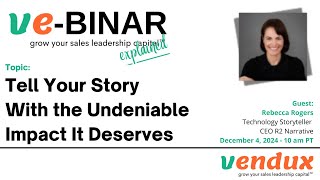
Webinar (Vendux) featuring Rebecca Rogers, a sales executive and "technology storyteller," on how tech companies should use human-centered storytelling to sell more effectively. Key messages: simplify messaging (remove jargon, cut words on slides), focus on human outcomes (credibility, likability, trust), use metaphors/analogies (e.g., iPhoto) to translate technical features into relatable value, interview internal teams and customers to find aligned messaging, segment by persona, and build referral-based growth. Practical tips and offers: have separate presentation vs. sendable decks, spend 2–3 minutes building rapport in calls, and Rebecca offers follow-up consultations (contact via R2 Narrative).
Chapters
Foreign.
Welcome to today's Vendux Webinar. I'm Andrew Miller, one of the partners at the Vendux Group where we focus on helping clients to grow their sales leadership capital. I'm really thrilled to have Rebecca Rogers as our guest today, and I'll let her introduce herself in a second. But in a nutshell, Rebecca is a tenured and accomplished sales executive and a leader with transformative experiences in both large enterprises as well as fast moving tech startups. She started her career as an engineer at the Coca Cola Company and Kraft Foods and then traveled the country developing new and iconic package designs for the CPG industry. She transitioned into a media sales leadership role at Business Week and Electronic Arts during times of massive digital growth. She then transferred her skills into the SAS realm where she worked as an individual contributor at Salesforce and then as SVP of Strategic Accounts at a mid sized analytics company. Good Data. I know Rebecca. She believes in radical candor when collaborating with executives with the goal of processing a business forward. Her leadership philosophy can be described as lead by example, connect profoundly and inspire others to see their greatness. She also believes that customers will never buy from you unless you build ultimate credibility, likability and trustworthiness. She's developed a winning formula to achieve all of these three. Rebecca has the unique skill set of managing the micro details coupled with the ability to visualize and articulate the long view. So today's vibinar topic is tell your story with the undeniable impact that it deserves. We'll dive into this topic shortly, but first a couple of quick housekeeping notes. We'll keep everyone muted for the duration of the webinar and then there'll be a Q and A at the end. You can either use the chat function in zoom or to submit your questions, or just feel free to open up your mics and engage with Rebecca directly at the end of the webinar. This webinar is being recorded and it'll be available later today on our site, our socials and on YouTube. Rebecca hi there. Welcome. Great you with the software and tech buyers purchasing journey has dramatically changed over the past years and there is clearly an immense opportunity for tech companies to optimize how they're engaging with prospective customers. I know you work with a lot of startups now to tell their story and help them craft their stories in a compelling, focused and value driven way. So and I know you help them determine who they should be telling that story to and how to ensure that those stories are memorable and effective. This is a It's a big topic. It's a great topic. We all, we all know the jargon out there. So at the high level, at the highest level, Rebecca, please just tell us a little bit about yourself. What led you down this path? And how does one become a tech storyteller?
Okay, great. Thank you for having me and thank you for such a warm welcome. So I live in Denver, and it is, I don't know if people know about Denver, but it was one of the most comfortable, beautiful cities in the US because it's like Southern California, except without the ocean. It is always sunny here, and it's beautiful. And I moved here 13 years ago and I have never looked back. But I live in Denver. I'm a mom. I have two teenage boys. I have two golden doodles that usually sit in my office all day, which is really fun. I'm a skier. I'm an avid reader of. I love nonfiction. I'm a baker, and I just love to be out in nature, and that's why I live in Denver. So how does one become a technology storyteller? As you can hear from my background, I've had a winding road of a career. I've been an engineer. I was a packaging engineer. Graduated from Michigan State, the premier packaging engineering school in the US and what that means is material science and physics and chemistry. And I did that for a few years, but I always felt like it was mismatched, right? I was always focused on the thing and so the people. And so when I was at Craft, a marketing director who I was doing a volunteer project with scooped me up and said, you need to be in marketing. You are too creative and too, like, ambitious to be, you know, focused, you know, on, on developing packages. You need to be with people. And so I said, you're right. So I followed him over to the marketing organization. And Craft Foods has a world class brand management function. And I learned, you know, I got an on the job mba. And from there I explored, you know, got into a marketing agency. Then I, I had seen all these media reps coming in and, and they had such a fun job, but I was like, they're doing it wrong, right? They're talking all about themselves and they're not talking about the problems that they could be solving for me. And so then that's when I was like, okay, this is, this is what I need to be doing. So I started my sales career in the media business and I worked for Business Week. And so all these things that I did, all these stops were just a part of the journey, technical marketing, media sales. Because all of these things, marketing and media sales especially were about telling stories and really engaging with your customers. And then when I got into software, you know, selling technology, it was still the days where sales was fun, right? Because there was only a couple of competitors in each field, right. So my first, one of my first big tech jobs was at a company called Data Zoo and they were bought by Roku. And Datasea was a demand side platform. So it helped. It was a software to deliver ads, media ads, digital ads. And you know that there was only like three or four other competitors in the space. So it was still fun, you could still get meetings, you were still engaging with customers and they were buying. But since that time, and I've been to, you know, I worked at Salesforce and a number of different startups, but since that time there's been a huge boom in technology, as everyone knows. And there's now roughly, I don't know, 70 to 80,000 software companies in the US. 80,000 software companies. So the world has changed for sellers and marketers and anyone running a business, right. It's not so easy anymore. You can't pick up the phone and get someone and say, hey, can I come and see you and sit down across the desk and build a relationship and let's see if this, something can work out between us. That doesn't happen anymore. That is long gone. What needs to happen today is we need to get back to some sort of element of that across the desk experience. You know, here we are on a digital screen and it's harder to create, you know, this, a bond, a relationship with everyone on the, in the group today. But one way to do that is being a little bit vulnerable and a little bit less jargony and a little bit less focused on our tech. We have to be focused on the human beings and creating more of a meaningful story so people can attach to that and actually want to learn more. Right? That's, that's the whole point about credibility, likability and trustworthiness, that all that stuff comes with technology, storytelling. So that's just kind of how I got to this point where I've just, I just. The world has changed and it's no fun anymore and I want to make it fun again. Telling stories is fun, right? Talking to people about their lived experiences is fun and interesting and that's what we're all here for, right? We're here to make connections with other human beings on this planet. We're not here to look at dropdown Menus and data and analytics charts all day long, seven days a week. We would all go insane if we did that every day. So that's how one becomes a technology storyteller.
I love the story. I'd love to introduce you to my son. He's an aerospace engineering student and he is a real human who loves to work with P.E. i mean, he likes to build stuff, but he's a very. He's a people person. He have a great conversation with you. Anyway, so let's go into technology storytelling. What is it and. And why is it important? I mean, that's probably an easy one for you, but let's dive further.
Well, I started my business R2 narrative because I wanted to talk about technology in a more human way. And I work with a creative partner. She's on the call, my colleague Kelly, who helps with, you know, developing visuals. I'm kind of the story strategist. And, you know, it's all about developing this human connection. And I want to. I want to see a raise of hands if the audience will participate here. Has anyone seen the new Apple ad? The new holiday ad with the earbuds? Okay. How many of you cried? Little tear. Yeah, that is what I am talking about. That is. That's amazing. There's an Amazon ad about a janitor singing while he was doing his job. And the workers around him. Has anyone seen that ad? Similar, right? It's similar. He's singing. He's. And. And all the colleagues around, the ushers in the. In the theater can hear it. Like they, they pick up on this fact that he's a really good singer. And then they go on Amazon, they buy him a fancy tuxedo coat, and then he's up on stage singing. And it's about. Amazon is able to make dreams come true. You know, it's not about the bells and whistles of flipping Amazon or Apple for that matter. It's not about the bells and whistles. Or look at this thing in the widget, or this app can do this, this and this. It's not about that. It's about how it changes lives and changes your work, changes the way you think, changes the way you feel. And believe it or not, everyone in the world, every technology can do that. Every technology, there is a way that it changes you, changes the way you work, changes a business. And that is the whole rationale behind this. You've got to be able to pull out metaphors and stories and analogies to make people, you know, think about it in a different way. How have they changed as a. As a result of your technology offering. I'll give you an example. Can I give you an example, please. So I was working with this client and she's a total spitfire CEO, founder, and she has this marketing technology that builds like campaign taxonomies. So now when you run like an. A social campaign or an email campaign, you've got to put all these words together in a long string and typically it's hundreds of lines of an Excel chart. And you've got all these different ads, and you've got all these different pieces to be able to track the ad wherever it's being distributed and then collect that data. So it's a marketing taxonomy piece of software. And she was going through all her slides and she's, you know, telling me all about it and this bell and whistle and this and that, and drop down this. You want to see a demo? No, I do not want to see a demo. I don't want to see your slides anymore because guess what? They're boring. They got too many words on the page and it's not interesting at all. It's not memorable. I don't know what you're saying. You're going too far. You're going in too deep. It's really yucky. I said, no offense, radical candor here. And, and I said, give me a day and I'll come back to you with an idea. And I slept on it and I came back and immediately I woke up in the morning and I said, iphoto. Her marketing taxonomy is like iphoto, Remember? Does everyone remember the whole the. The. The photos you have in the box in the, In a big box in the basement? Who's got that? I've got a big box of photos in my basement. There are a big fat mess. That how we collect our photos now? No, this. It's an analogy similar to, to how you used to do marketing taxonomy in Excel. Not updatable. It's a big hairy mess. It's exhausting to keep track of. There's no governance. But if you have something like an iphoto, as soon as you take the picture, you've got location, you've got a date, you can register the face, everything about it is organized. You can search it by favorites, etc. Etc. She has built marketing data and taxonomy like iphoto. And as soon as she. I laid out some new slides for her, created some new visuals, and as soon as she showed it to a customer, two slides, they were like, I totally get what you do, and I love Went from, oh my gosh, if you show me one more slide of this boring thing, I'm going to hang up on you to oh my gosh. I totally get it. I love it. Let me see who else I can introduce you to. I want to buy this. That is an example of how you take technology and turn it into something that we all know and get and understand and appreciate.
There's, there's a lot in there. The, the Apple ad.
Yeah.
I think we people, professionals, companies in our hearts, at least if not practically, we strive towards simplicity and.
That's right.
And, and, and having the quickest, most efficient line to where we are, from where we are to where we want to go. There's you. I think we can name one of the most, the most effective, powerful companies in the world.
Apple.
Apple.
In the world of simplicity, a child can pick up the product and, and know it. No instructions, nothing. So, so the Apple ad, I actually don't even remember hearing any of the words in that app in that ad. So. So can you just touch on storytelling in, in this multimedia, you know, words, images, music, emotion. What are the ingredients here to make storytelling effective?
Yeah, you have to be a good listener first. You have to know who you're telling the story to and what's important to those people, what's important, why it could possibly matter to them.
And.
You have to appeal to the humanity. So many. When you're, you know, so many people, when they're product marketers or marketing CMOs and product leaders, they want to show the bells and the whistles. But the bells and the whistles don't appeal to people because we are inundated with technology every day, all day long. It's jargon and features. There's just so much information our brains have to compute. And that is why, just like you said, Andrew, that we have to simplify. So by listening and understanding who our audience is and really understanding the value, the true value of what our product does. And I, I encapsulate that by saying, what are you best in the world at delivering? What is it? What's the one thing? If you can boil everything about your company or your product down to one thing, what is that one thing? You have to then take that one thing and turn it into how's it going to make my customers life better? How's it going to make their business better and focus on those outcomes? No one cares about the features and benefits. No one cares about the features. They only care about how it's going to help them. Don't talk to me about the widget and how you, you know, hook it up or what it's going to do, you know, in six months, once it finally gets optimized, it's got to be memorable, ownable, and meaningful.
So what about the other dynamic that's out there in the world that we're in, which is the. The pressure of time? Nobody has or is willing to invest time, their time really anymore. People in general have extremely limited attention spans. Everybody is trying to multitask. So you get on a call, you. You have an opportunity to engage with a prospect. One time, first time of all of this great stuff in my product and my tech that I think you're going to love. But to your point at the outset, the humanity, the human relationships, the connection, the credibility. I mean, we grew up in the world of sales and the importance of relationships and credibility and that human connection, there's not much of that going on out there today. Boom, boom, boom. Hi, Rebecca. I'll give you five minutes. I'll give you ten minutes. Tell me what you got. How can you help me?
First thing I would do is say, can I spend three minutes getting to know you? Because if I get to know you just a little bit, I can understand what's important to you, and I can make sure this conversation is well worth your time. And so taking two to three minutes, people have forgotten how to build rapport. People have forgotten how to ask questions and engage in a way that is professionally vulnerable. We don't want to hear about every illness you've ever had or, you know, your childhood trauma. That's not necessarily appropriate for your business call. But hearing about, oh, gosh, how's your day going? My dog got out of the house and ran around the neighborhood and had to run out my pajamas and try to get her right. You're opening yourself up and actually having a conversation where someone laughs and they say, oh, my gosh, I have a dog, too. Yeah, puppies are a pain in the neck. And you start to actually exchange and get. Get on a more personal level. Who does that anymore? No one. They jump right in. Let me. Let me bring up my slides. And guess what? Those slides are probably awful. If your slides let me. I'm going to go down this path of slides because it's one of my biggest pet peeves. I'm working with a customer or a client right now, and their slides have. It's like a book on every single slide. Go through your slides right now and take off 90% of the words I'm telling you, take off 90% of the words, put some visuals, hire a fantastic designer, and create something that is esthetically pleasing to look at. Because people see these slides and watch their eyes, right? You're recording like, you know, you use your AI to record the. I start recording the facial expressions of your customers because guess what? If you watch their eyes roll, start to glaze over, they start looking at your slides and they're like multitasking. They're like, okay, I'm gonna look at my phone, I'm gonna do this, I'm gonna look at my other screen. They're. Because your content is mind numbingly boring. And I'm sorry, but 99% of the sales decks I look at are filled with too many words, way too much jargon, and all about tactics instead of, hey, this is what we do and this is how we're going to change your life and this is how things are going to be better. We don't do enough of that. So those are like really simple things that you can do right away. Change your slides, eliminate the majority of the words, create some more visuals and tell a story, create an analogy. And that's what I do. I can come in and think about your business and help you figure out the story. And what can be really fun when you get really good at it. You start to develop your own personal stories. You pull things out from your personal life and you can tell the story about your product that isn't, you know, exactly the same, but it's on the same tangent. And it can really add to the flavor and the memorability of it. It is just, it's so much more fun, right? And people get to know you and they get to know the flavor of your business, they get to know the flavor of your, of your seller or, or just who you are because people want to buy from other good human beings. Again, we're on this earth to connect. We're not just here on this earth to buy technology. For sure, a lot of CROs would, would want you to think, want you to believe you're here to buy technology, but that's just not how it works.
I can't believe the stats. 70 to 80,000 tech and software companies. I want to open up the room here to questions and comments from the group. So please, folks, get ready with any questions or comments that you have for Rebecca. Rebecca, one more question from me for the moment. What happens? I mean, so you've got this perspective from the outside and you, you, you are preaching, but not necessarily to the converted, you're providing ideas and tips and observations. But on the inside you have engineers, you have product people, you have.
You.
Know, the founders of the company who have invested everything to, to build a better mousetrap and, and the, the chasm between that incredible technology perhaps and somebody on the other side of the table that want to, that might want to buy that technology and use it. How do you even be, you know, you, you touch on a couple of points about the obstacles, you know, yeah, the obstacles, you know, get rid of 90 of the words on, on your decks. But how do you, is a, it's a cultural thing. You have to change. Is it a perception, is it a, is it a self awareness thing? How do you even begin to, you know, start to create that connection between you and the engineers on the other side?
Okay, well, there's definitely a process. First of all, you have to talk to all the key engineer and data and product developers in the company. You have to, you know, you hire someone like me or do it yourself. Interview and ask them all the same exact questions. You know, what's our best feature? Why? What does it do for the customer? Why is it so important? Do other customer, can other, other tech companies do this, etc. You ask those questions and you get the answers like five or ten people inside you. You talk to all the salespeople, you talk to the CEO, you ask them all the same questions and you put it all on a piece of paper, right? You've got an Excel spreadsheet and you've got all the verbatims. You can use AI and start to call some of that down and you get some themes. But people need to see the verbatims. Cause what happens is you then you interview all the customers and you record that and you interview like your top five or ten very best customers that you've already gotten. Okay? You ask them, what's the value of this, of my company? What do you love about it? What makes you so thrilled about working with us? Those types of questions. And so you really understand why the hell are they doing business with us in the first place? And also if you, if we didn't exist, where would you go to get this? So you really start to get a feel for the competitive set and why they have purchased you. Okay? And then you really have to take a look at the competitive set too. What are they communicating, you know, what are they owning? And so you take all this information and you then can see the themes. Because guess what happens? The customers all say the same thing here's why I love you. Here's what's really important to me. Most of them all say the same sort of thing. When you talk internally, all the engineers and the sellers and the marketers and the CEO, they all say completely different things about what the company is meant to be doing and what they're best in the world at. There's very few companies that have total alignment around what they are best in the world at and what the value the customer sees in them. Very few. I've never really seen it. So you, you have all this data that you can then share with the leaders and you say, here's the disconnect. Here's the way you've been doing it. Here's the disconnect. Let me help you by kind of changing the way we're talking about this. There's a lot of research around. You know, how to present words on a page, how many visuals the human brain can consume, how many words on a page. There's tons of research on this, right? So you gotta pull in some of that and say, like, gosh, this isn't really working for us. Our sales are down. Let me try something totally different. You figure out your analogy or your metaphor, your personal story. You have all this data that says what you were doing is wrong. So you develop something different. You take, you develop those slides with less words and more beautiful visuals that looks like a cohesive story that talks about the problem you're going to solve. And later on you get into those details, right? Because once you. Once someone goes to actually buy, like, okay, does this fit in my technical requirements? Yes, but you got to get them to the point where they get it right. So many. There's been so many meetings I've been in when I've earlier in my career where you present, you're on the call for 30 or 40 minutes. You're, you're doing your pitch, you're a million slides in, and the customer goes, I don't really get what you do.
Right.
You know, you've lost. You lost five minutes in.
Yeah, yeah, right. Or you, you've repeated a particular message three or four different times in different ways. But then you're being asked, so what is it you do?
Yeah, what is it you do? So that's a sign, right? So you have to develop. You get the license to do something different because what you're doing now doesn't work. And here's all the data that shows it's not working. Let me try this. And so sometimes people will get behind it. But they're nervous. But you always can put more words on the page to send the follow up, right?
Yes.
You don't need to present the same deck. Right. You have two different decks, one that you send and one that you present. Stop trying to do it all up all in one fell swoop. You've got to have something different. So when you're engaging with someone, it's beautiful and it makes sense and there's cohesiveness and there's dialogue.
Yes, yes, yes, yes. Great. Wonderful. Few people have raised their hands. I want to go over. Thanks.
Raise.
Rebecca, I want to go over to Bruce. Please jump on in.
Hi.
Hi.
Hey. Great presentation. And the couple things that I want to mention from the world that I'm in. And one is, you mentioned, if you don't, you know, if you're talking after 20 minutes and then they say, what do you do? You know, that's, that's, that's like sales 101, and you're in trouble from the beginning. But if you're not. If you're not saying every few minutes, do you have any questions or calling on people to ask a question, engaging them, you're going to find out after 15 minutes that you lost them where you could have found out earlier. Right. By engaging them. And second on the slides, I love the fact that you got more pictorials and you've got some words and that you tell the story because that's engaging. That's where you connect with them. But what I do is I put the technical stuff after the presentation, so when the executives leave and the techies stay, you can go into the details with them and it's right back the presentation.
That's right. A hundred percent. Yep. I do find, though, I wanna. I wanna say that most of the time when you stop and say, do you get this? Is this making sense? Do you have any questions? They're quiet as a mouse because they don't get what you do and they're kind of like, sheepish. I don't. I don't really get it. I don't even know what to ask, quite frankly.
Well, I got to say that the.
Meeting wasn't even though very well. Yeah, yeah, yeah. But thank you for that. Absolutely. Have the tech stuff later on in the conversation or maybe save it for the next conversation. But, yeah, it's got to be there at some point.
Right. Thank you very much.
You're welcome.
Thanks, Bruce. That's a great hack. Yeah. It's like having scheduled schedules or, you know, the, the addendums to, to an agreement. It's all the details back. Yes. Who, who else raised their hands? Anybody else want to jump in here?
I think there's some questions in the chat.
Yeah, I asked a question in the chat. This is, this is William Leslie and, and thank you, Rebecca. I appreciate your, your storytelling. I'm in the food world and so, and I'm, I'm with a small chef founded company and, and we're doing a lot of what you're saying. I'm going to go back through our decks and, and see what else needs to be pared down. But you know, our, our messaging is, is mostly around we're your personal chef and we bring clean, nutritious, self, you know, mindfully sourced ingredients to you. I'm curious from your days at craft versus your tech days now, differences in storytelling, I think that the premise behind what you're saying crosses overall industries. I'm just curious about any of the specifics and storytelling you've seen.
Well, tech companies are egregious at talking jargon. So versus like a food company or a CPG company. They are good marketers and storytellers. Sometimes they focus on the product. Right. But a lot of times when you look at their ads or their messaging, it's around creating family time or like at craft, it's all about, you know, making your kids happy, being a better mom, bringing everyone together around the dinner table. What you just said about, you know, clean ingredients, mindfully sourced, I would encourage you to think about, what is that? How does that change someone's life? Instead of talking about the features, talk about what it does for somebody who can, you know, that's nice. I like good ingredients, but like, what's this going to do for me? You're going to live longer, you're going to have, you're going to feel better, you're going to have more energy because the stuff that you're consuming there that we're helping you put into your body is just the best quality you could imagine. So it's really about take the next step and think about how you're changing the hearts and minds and lives of your customer.
Thank you. Good insight.
I think I almost heard, Rebecca, you were going to ask the question, who cares?
I, I thought those words were going.
To come out of your mouth just now, but in the back of your mind or even with your clients, are you asking that question on a regular basis? Like you're doing this, you're saying that you're putting this out there? Cares. Who really cares?
Yeah.
And Then why?
Yeah, well, the one thing I talked, when I talk, when I work with customers, I say, no one cares about your technology. No one cares. No one wants to hear about it. You know, everyone, their goal is to get more customers, right? You're in sales to get more customers, to win deals, to create revenue. And right now in technology, it's like a death match to get to the next customer because there are so many technology companies out there fighting for every single dollar out there in revenue. I mean, there's a widget that will do just about anything you needed to do. So I don't believe in cold calling. I don't believe in cold emailing. I don't believe in any of it anymore. It's all gone. No one wants to hear from you. 90% of buyers hear about a new technology from someone in their peer group, in their industry, someone they've worked with. They don't buy technology from a cold call or a cold email. They may, once in a blue moon, take a meeting. This isn't tech. It might be different in other categories. They hear about it because someone had a great experience with a, with a tech, with a company, with a seller. Hey, talk to Rebecca. She's going to take care of you and she's going to tell you the truth. If it's not going to work for you, she's going to tell you, hey, this isn't the right thing for you. Again, it goes back to the story and the relationship. You tell a good story, people are going to sit up and listen, they're going to remember you, they're going to want to do business with you. You've got to. And it's got to be aligned, right? You get your story and it's got to be aligned with marketing and what you're talking about on social and in the media and in PR and all your ads, etc, your white papers. You've got to have total alignment so people will come to you. If you've got a good story, people will come to you. You've got to be able to be found. Stop hiring a bunch of salespeople to call your customers if they don't want to be called. Figure out how they buy, how they hear about new technology and develop your strategy around that. So if people, if technology companies hear about new technology from their peer group, well then why in the hell don't you have a referral program? Why aren't you like setting up a really comprehensive referral program and building that into your contracts? Like, hey, if you buy from us and you're successful, we would like, we will give you a discount on your renewal if you give us three introductions. And quite honestly, if someone's thrilled with you, they don't even need that incentive. They're going to tell their friends, hey, you should talk to these people. They're really good at what they do. And they, they've changed my life. That's what they're going to say.
Yeah, I see Lisa has raised her hand. Lisa, you've got a question for Rebecca.
Oh, I did. First, I have a comment. I think I've really enjoyed your, your storytelling today. And I think just to give you kudos, like, I noticed early on that you engaged us, you asked us questions, you know, show of hands, relating personally. And I feel like I've already bought into, like, what you're, what you're talking about. I'm like, oh, I would love to build upon that because I think I found it to be very effective. So thank you for that. So I come from a background in talent acquisition as well as customer success, and you were really like, hitting the nose on the head. We always talk about, and in the teams that I build and coach, we talk about the fact that you need to adapt your message depending on what Persona. Who are you talking to? Are you talking to, you know, decision maker? Are you talking to the end user and really understanding, you know, what it is they care about? Because the core of your message is the same, right? What you provide the specifically in tech, Right. Like your technology is your technology, but it's really about telling the story of how am I going to make your life easier or better or whatever goal it is they're trying to achieve. So I'm just curious if you have any, and this is going to be very broad but like general advice that you use when you're prepping or coaching people, how do you advise them to go about understanding what the diff. What they think the different people care about? Because I think it's like within different organizations, different people care about different things. So your strategy is there to adapt the message accordingly.
Yeah, great question. Well, I think about it in the way of, I think when you're developing products and messaging, you have to know, you know, kind of who the companies are and you kind of research the different Personas. Right. If it's tech person, here's what they might care about. If it's a financial person, here's what they're going to care about. If it's a leader, the economic buyer versus the champion, et cetera. But you got to really talk to your customers, and you got to find out as you're developing your story or as you're refining it. You know, you. You probably get your first five or 10 customers from your board relationships or someone in your network. And so then once they start using it, then you really start to ask those questions. Sit down the CFO of your customer and say, what has this done for your business? What do you guys care about? What do you measure? Like, why is this interesting? Same thing with the CTO or the product they use. You got to ask the questions, and you got to hear what they say, really hear it and take it to heart without any sort of varnish on it. Right. You've got to really take it. When they give you some constructive criticism, you smile and say, thank you. I needed to hear that. And so I really think it's just simple conversations. People don't want to have conversations anymore. They want to send emails or slack messages. Do you know how much gets lost in that translation? A lot. So if you pick up the phone and say, can I have 15 minutes to ask you, ask you some questions on why you love our product or why you hate our product, and then you really start to figure out, like, okay, in general, here's what I'm gathering. These groups of people need to hear. So I just. I think it's just learning as you go. You start kind of broad, and then you. Even when you get on a call with someone and it's read the room, who's on the call, and what do you guys care about? Okay, I've got the CFO here, I've got the tech person here. I've got the. The data entry person here. And they go around and say, like, oh, yeah, this is what I'm interested in. Oh, this is what I'm interested in. The CFO is like, yeah, I just want to. How much is going to cost and how much it's going to save me. Then, you know, even just top line. And then as you're telling your story, you can touch on those things. Don't be afraid to spend the first five or ten minutes just getting another group and what's meaningful to them, because it's going to be rich. If you. If you gather that information, you're going to have a much more effective call and you can position it as that. Like, hey, I need to know what you guys care about so I can make this well worth your time. That's what I do.
Thank you. Yes. Wonderful. Any other. Thanks, Lisa. Great question. Any Other quick questions. The time has just flown by. I personally, I could continue this another half a day at least.
Clearly I could talk about it for days and weeks.
I'm really enjoying this. Anybody else? Quick hand raise? No, not. Not for the moment. All right. We will have to do this again. Rebecca, in the first few months of the new year, I think. Any parting thoughts? Words of wisdom, one or two perhaps best practices. You've provided a lot already but words of wisdom to wrap up and then how do people get in touch with you and you know, kind of message for follow up either on this call today or people that are watching the recording like then what?
Some words of wisdom are best practices. Be professionally vulnerable. Think about how you're going to change the lives of your end users and your customers. Be meaningful, ownable, memorable. Those are really important in the sea of technology. What can you say you're best in the world at? And how do they remember you? They're going to remember you because you've told them a good story. Take the words off your slides. You can find me simply@rebecca2natively.com you can track me down on LinkedIn. I'm easy enough to find. Rebecca Rogers is a common name but R2 narrative is not. So I'm sure you'll find me there. I have an offer for people if you, if you mention ven docs I'm, I'm going to give you an hour of my time versus a 30 minute consultation. I am happy to walk through sales decks and help you create or get you at least some thinking around creating your story in a more memorable, honorable and meaningful way. So I'm happy to do that. And this has been just so fun for me. As you can tell, I'm really passionate about this topic. I love talking about stories and, and how to, you know, make the sales process lot more fun. Let's get back to having more fun at work. Right.
Make storytelling fun again.
Absolutely. I love it.
You, you, you're clearly a pro. I, I have so enjoyed this, this time with you. Great insights. It's a very generous offer. Get that one hour time and consultation. Thank you very very much on behalf of Vendox and our community.
Thank you.
Happy holidays and a wonderful new year. We will see you soon. Thanks for your time this morning and today.
More from Henning




ve-BINAR - The Revenue Tornado Methodology: How 3 Power Sources Create Exponential Growth


ve BINAR: Executive Cloning: How AI is Reimagining the Role of the Fractional Executives




veBINAR: Unlock Client Value: Why Compliance is Crucial for the Startups You Serve
