ve-BINAR: The Best Fee Models for Fractional and Interim Sales Leaders
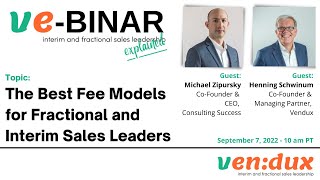
Michael Zipirsky explains fee models for fractional sales leaders: retainers, project fees, value-based pricing, and equity components. He shows how to move from hourly rates to six-figure engagements and how consultants can build firms instead of staying solo.
Chapters
Welcome everybody. Good morning, good afternoon across the country and to our northern neighbor, Michael Zypersky. Welcome to this month's webinar. Delighted to have you. Today's topic is fee based models, the best fee based models for fractional and interim sales leaders. My colleague, the co founder, managing partner of Ven Dux, Henning Schwimman is usually on these webinars. As you probably know, he had to make a quick and sudden trip to Germany where he is now for for a family matter. He sends his regards and he apologizes that he can't be here.
So.
Just a quick housekeeping item. Everybody's muted and as we start to get into the Q and A session and please feel free to send in questions, but questions should come in through the chat function here on Zoom and I will moderate those questions. Now, just to jump into the nuts and bolts of the webinar, I'm going to introduce Michael Michael Zipirsky. Thanks very much for being here Michael. Michael is one of the co founders of his company Consulting Success with he and his cousin Sam. They're known as the Zapersky cousins to their clients and friends. The Zaperskys started Consulting success more than 20 years ago to help consultants and strategy coaches to increase their impact and earn more money. Today he his cousin, the company is an international leader in coaching and training for entrepreneurial consultants. Michael has advised business leaders in consulting firms throughout the world in more than 75 industries, working with service providers, 2 billion dollar multinationals including Panasonic, Dow Jones, Sumitomo, Financial Times, Royal bank of Canada and many others. Michael's work has appeared in publications such as Forbes, Entrepreneur, Huffington Post, Financial Times and Fox Business. He's also the author of several best selling books on the topics of consulting and business growth including the Elite Consulting Mind act now and Consulting Success. Michael's been featured as a consulting expert on podcasts such as Conscious Millionaire, Unstoppable CEO, Daily Grind, Duct Tape Marketing and the how of Business. So let's just jump right in. Michael. Over 20 years you and your team have built quite an array of courses and coaching expertise for your clients. Could you, in your own words, please introduce your programs and your core framework to help consultants and fractional leaders to become the most effective business people that they can be?
Yeah, well first of all, thanks for having me Andrew and Henning. If you're checking the recording, it's a pleasure to be with you all. It's not often that I get to have a conversation with a small group like this. This is Actually a nice treat. And I think you've probably heard enough about me from Andrew and I'd love to really move as quickly as we can to open this up for questions to make it as valuable and relevant for all of you because it's a small group. So we, I think we'll have plenty of time to take questions and speak to whatever is most top of mind for you all and just how I can add value for you, but to add a little bit of backstory and answer your question, Andrew. About 23 years ago, we started our first consulting business. We've built multiple consulting businesses over the years. And the reason why we started Consulting Success was because we had gone through ourselves a lot of experiences of success, but certainly a lot of experiences where, where we felt like we were getting punched in the stomach and we learned firsthand what worked and what didn't and continues today to, to work in terms of best practices to really grow consulting businesses. And so about 13 years ago we decided to, to share our experiences with the world. And we did that through Consulting Success, where it started off just as a, a blog really. Resources, articles, core consultants from, from us in terms of what we had gone through. And that turned into people saying, hey, this is really great free information that you're putting out. Do you have a course that we could maybe dive deeper into this where we can have a lot more kind of step by step guidance? And that's led to what we now call Momentum, which is an online training program for early stage consultants. We have many people who are transitioning from executive or corporate world or working even in nonprofits, but typically as senior leaders who are very good at what they do, but they have no idea how to actually run a successful consulting business. And that led to people saying, I've taken your course. I'm seeing great results. I've grown my income. I feel much more confident about running a consulting business than what it takes. But I really feel like I need a specific detailed plan for my situation. I need something that's customized. Do you have a coaching program? And at that time we didn't. But several years back we created what we call the Clarity Coaching program. And to this day we have over 800 people that have gone through the Clarity Coaching program where they've come in, we work them very closely, we customize a plan and then we guide them step by step through that plan for their specific goals and situation. And that's led to hundreds of people adding six and seven figures in additional revenue to their consulting businesses. So that's really what we do. I have an amazing team. We're about 16 people right now. We work with clients all around the world in all different industries. You name an industry, we've probably worked in it, maybe multiple times in some cases. And so we help our clients from everything. And this is kind of to your question around the framework, but on how do you first of all decide who to focus on in terms of who is an ideal client? And then we help them to develop their messaging so they can create a message that gets the attention and interest of their ideal clients. Then we help them to figure out how do you take all of your years of experience and expertise and package that, position that, place value on that and ultimately price that in a way that will resonate and align with what your ideal clients want to invest in so that the sales process becomes much easier, but also allows you to capture significant compensation and fair compensation for the value that you're creating, which I know will we'll talk a lot more about. And then the fourth part of really what we do is help our clients to create a marketing engine. So this is all about how do you create and generate leads consistently of high quality. And even if you have absolutely no experience in marketing or sales, and in some cases many people have experience, but they're just not comfortable marketing and promoting themselves. They don't know what the best approach is to do that. Especially these days, given that there's so many different options in technology and social media. It's can become very overwhelming very quickly. And so what we do is we boil this down into a very specific system that we call the marketing engine. And it's 100% specifically for consultants or those that have expertise and want to monetize that expertise. Because the way that you market to an executive is very different than the way that you, for example, sell a computer or the way that you sell, you know, a cell phone or a pen online. Right. So it's not E commerce, it's not just the typical social media that you hear about. So we help our clients to really dial all that in.
That's cool. So let's dive for a second into the nuts and bolts of pricing. There's a range of pricing models for consultants and fractional executives, time and materials, project based fixed retainers, a combination of fixed and variable, including equity. So how do you actually approach this question? How can I optimize the pricing of my time, service experience, the impact I have made and can make beyond the basic measures of supply and demand? So for example, you Know, if we're completely booked out, it's. It's easier to increase pricing and to be less sensitive to pricing. If I have. On the other hand, I have plenty of bandwidth, so I'm going to be more flexible on pricing. So is there a science or best practice here, Michael?
Yeah, Andrew, Would it be okay if I just ask for some participation among everyone that's on the call right now?
Absolutely.
I'd love if you guys could go ahead, type in the chat box. What model do you typically use for your pricing and projects?
I think there's two things here. First off, I'll just jump in. As I was listening to Andrew, I'm not a fraction fractional tends to be more like a CFO and others. But I'm business development, I'm sales of marketing. And so I don't do fractional work. I'll do work based on a project specific. And so I look at it on an interim basis.
Yeah, so that, that's David and others. Could you all type in the chat box? Just let me know what, what pricing model you tend to focus on and use today. Just so we get a little poll going on. Is there a standard approach you typically use? All right, so Jeff's saying I'm a CRO currently and don't do fractional or consulting work, considering this is the next career step. Okay, got you. How about the rest of you? What, what approach do you use to pricing currently?
I'll save the typing. I'm also new to the fractional side of it, so something I'm looking at. So been talking a bit with, with several of the folks within this ecosystem on pricing models. So I'm probably not the best one to give value to that.
Yeah. All right. So it seems like there's a bit of a theme going on that many of you are maybe a little bit earlier stage in figuring out how to approach pricing or you're still working in a corporate role looking to make the transition to more fractional or consulting type of work? Is that, is that everyone here or is anyone actively working as a fractional kind of expert consultant currently, or is everybody still working in corporate and looking to make a transition just so we can make this as specific and valuable as possible for all of you. Christina, how about you? Nicole?
You want us to use the chat and you want us to answer? I'm confused.
Yeah, put in the chat. I think the chat will be easiest. That way we can manage it.
Michael, most of the executives that we work with, we've got about 450 or so senior sales leaders in our roster at this moment, the vast majority are pricing their time and service from a fixed monthly retainer point of view.
Yeah, got it. All right. So yeah, as we have more people typing in, Andrew, I mean, I'll, I'll speak to your question and the answer is that there's no one best answer, right? And I think this is what people tend to miss. They'll look at what others are doing and think this is somehow going to be, you know, what they should be doing, but it's, it's certainly not the case. So if you are currently charging a monthly retainer to work with clients and that works for you, then then great. I think the most important factor to consider when you're thinking about your pricing is what are your goals? Right. The pricing model that you use if you want to be a solo independent consultant is gonna be very different than if you want to build a firm and you have multiple consultants or associates working underneath you. And so there's no one size fits all. It's about understanding what model is the right one for you. How do you want to create your time? Do you, do you prefer to work with a fewer number of clients on higher value engagements? Are you interested in productizing your service offerings and therefore in most cases having a higher volume but lower value? And so these factors, when you consider them, will help you to arrive at what model should you actually use. I think the most important factor that goes kind of across, we can apply and kind of blanket over every pricing strategy out there and every kind of tactic or structure that you use is a focus on value. What I see far too often is that my guess, from what I've heard from Andrew and Henning, is that every single one of you here has many years of experience, right? If not decades of experience in different industries or in different organizations. And the most common mistake and error that I see on the part of executives who are transitioning into a consulting role or leveraging their expertise outside of, instead of just working with one organization, but working with multiple organizations is that they over deliver and undercharge.
Right?
And that, that is a common kind of human nature, right. Most of us tend to want to just really deliver great value for clients. So we do everything we can to provide them with an amazing result. And in many cases, that result adds a lot of commas right to their bottom line or just has a significant impact. But the consultant or the fractional executive doesn't charge a fair level of compensation for that. And so I think that's the key thing is that you want to focus on is whether you're using a project based fee, a retainer based fee, whether you are doing value based fees or kind of ROI focused fees, or you have some component of equity or performance in your deal structure. The key thing is to ensure that your client is going to be left off better than when you started with them and that they're going to look at whatever investment they make into working with you as a great investment. And even if their hand is shaking when they're writing that check, even it's more money than they ever paid anyone before, they should still be happy that they invested that money into work with you because again, they're better off than they were when they first started. And this is the big difference between somebody who might be charging, let's say, $25,000 an engagement, or somebody charging 5 to $8,000 a month, when they could potentially be charging 15,000 or $25,000 a month or $50,000 a month to work with an organization. Right. So every person's situation is a little bit different. I'm happy to open this up to, you know, we can do questions and kind of dive into your specific situations if you all would like to, but I can tell you that there's a vast range of what people charge, but it all comes down to the value impact that you're having and who your client is. If you're working with a much smaller organization, you're not going to be charging $50,000 a month. If you're working with a larger organization, $50,000 a month is a drop in the bucket. They don't even notice that in some cases because they're literally investing. If they hire, you know, an accenture or a McKinsey or a BCG, they're spending maybe a million dollars a month, if not more. Right. So it's all kind of perspective and it's about your specific situation.
Yeah, great, great points, and so true. Does anybody want to share their specific situation and, and get some insight from Michael here, real time? Because I mean, you, you're touching on these, on these points and I'm going to ask you, Michael, do you have any specific cases, you know, you work with so many clients. Do you have one or two particular examples where you've worked with very experienced executives and, and you've helped them raise their game even more?
Yeah, I mean, that's. Andrew, that's pretty much what we do every single day. We literally have hundreds of people that we've worked with who have that exact background. In many cases they are senior level executives, they're in the C suite. They're either working for a very large organization. In some cases it might be a nonprofit, but they're very good at what they do and they have many years of experience doing it. But the big thing is again, when you start consulting, you are the product, right? You're used to putting the focus on the organization that you've worked in. You know, as an executive, it's a whole different ballgame when now your knowledge, your expertise and the whole spotlight has to be on you. So, you know, I can give you an example of one person who transitioned from being in a senior executive role into consulting. And they were thinking that it would take them two years to get back to their six figure, you know, solid six figure income. And they were able to do it in six months just by being very, very focused on who their ideal clients were, understanding what to charge, how to structure things, and then just going to market and really focusing on having conversations. I can give you another example of a consultant who was working with a client, delivered a first great project. That client said, hey, you know, let's come back to need your help for a second phase of this engagement. And we sat down and we talked about what their situation was and uncovered that they, to that point they were charging based on an hourly fee. And so they were going to go into that second phase proposal with a $60,000 price tag for that phase two. And we talked about the impact that the work was going to have on their client and very quickly realized that they were leaving a significant money on the table and they were undercharging, they were undervaluing what they were actually creating because this was going to lead to millions and millions of dollars for their client. They went back, they changed up their, their pricing structure on that phase two and landed that for a very solid six figures. So they went from a sixty thousand or so dollar engagement to almost a $300,000 engagement and won that business without changing anything in terms of how much time, how much energy, you know, the resources required to deliver on that. It was all about the positioning and the conversation they had with the buyer. So if I was to speak to kind of one big opportunity that many people have is that they, they rush the conversation with the buyer. They focus too much on the deliverables and what they're going to do and what they're going to provide and not enough on what is the value and the impact that the engagement is going to have on the buyer and the organization. And when you really dig deep, not just a surface level conversation, but you go deep into what is the impact going to be, how are you going to be better off? Right. How will this have a trickle down effect across the organization? You start to uncover a whole different level of value and that's the level of value that you then want to confirm that the buyer also sees. And then you both have agreement around. And once you have that, then it becomes very easy to charge significantly more because both you and the buyer are aligned on, on what the value is. And so your fee seems quite insignificant in terms of the value that is going to be created for that buyer.
That's such a nugget of wisdom across the board, kind of this whole concept of value based pricing to get the client to see that in the end what they're spending is the equivalent of the price of a postage stamp relative to the value that they're getting.
Right.
Yes. There's a question here from Jeff Toms, your commentary about goal driven pricing. So you mentioned discerning whether the goal may be a solopreneur firm or one with consultants working for him. For us, with that question as a backdrop, what are some examples of, of how you would change the fee structure for one versus the other model?
Jeff, can you just unmute, maybe elaborate a little bit more on your question? I'd love to get a bit more kind of background and color on that.
Yeah. Your commentary was interesting because in other words, as you're, if you're thinking about the goal for the organization a little bit longer term. You mentioned that if the goal really is just to have a lucrative income for you as an individual versus one where you have, you build a team and you've got people out working for you, that you would structure the pricing differently. My presumption in that is that maybe what you're talking or sort of intimating is that you might need to run a little bit more lean on margin early on to build credibility in the market, establish brand notoriety, that kind of thing, so that you can ultimately attract other consultants and grow the business versus maybe trying to pursue high margin, fewer opportunities like we talked about a minute ago with the, you know, the difference between high margin, low margin and volume, but that. I was just curious sort of what your thinking was on that.
Yeah, I mean, so what's your situation right now, Jeff? Are you actively working as a. Yeah.
I'm a chief revenue officer for about a $45 million company. You know, I personally run sales and client retention, marketing and sales, operations and all that. So, you know, as I think about it, it's private equity backed, so looking for an exit probably in the next 12 months. And, you know, do I sign up and go do another one of these or do I maybe get into consulting? So I'm kind of kicking the tires and deciding, you know, what I may want to do and working for myself seems pretty interesting.
Yeah. I mean, so here's the most common path that people typically take when they transition from working in, let's say, a role that you have to, or potentially a much larger organization into, you know, being a solo consultant or into the world of kind of independent, you know, entrepreneurial activities. Most people tend to start off being a solo consultant, right? So you have this expertise, you put a plan together to figure out who else might benefit from that expertise and experience that you have and you go out. And by the by nature of it just being you, you're typically going to be doing a lot of things yourself. And so that, that will lend itself best to high value, low volume, so fewer number of clients. But those clients, each engagement is going to be of significant value because you don't have the infrastructure, the resources that will allow you to serve a higher volume of clients for lower dollars. It just wouldn't make sense. Right. You're going to drive yourself crazy. So what most consultants do is they're going to want to build up to having somewhere between, you know, four to six to eight clients per year. Any fewer than that is essentially you're a contractor and one client goes, right, a third or even half of your income disappears. Not a smart place to be in. So, and much more than that starts to cause all kinds of strain and overwhelm because you're, you're just managing administratively too much.
Right.
In terms of too many different clients. So what most consultants tend to find is they'll get their business to a point, in many cases it's, you know, a solid six figures in business. And then they start to think, is this really the path that I, that I want to go down? Because I'm starting to see more demand. I'm starting to kind of bump up against capacity. And if I want to be able to grow my income, if I want to be able to, to make a bigger impact, it means I need to be able to work with more people. Well, I can't work with more people if it's just me, right? And so this is now where people start to transition to thinking about how to build a team. And that team might start off with just being like a personal assistant, virtual assistant, somebody to help you on administrative types of stuff, or a designer or whatever it might be. But very often, I mean, we've seen this more times than I can even count or remember that the executive leaves the corporate world because they're tired of managing people, they're tired of politics, they don't want to have that like income ceiling and they want to be their own boss, have more freedom and more flexibility. So they start and they become an independent consultant and they think, I don't want to manage people. But that goes on for a period of, could be many months or many years. But then they'll start to realize, you know what if, if I want to be able to have a bigger impact, if I really want to be able to grow this thing and if I want to be able to have a business that doesn't rely on me. Meaning that if you want to be, you know, if you're sick or you want to go away for a month, you want to have a holiday, or maybe you want to build this business and you can actually sell it one day because if it's just you, there's nothing to sell, right? So people start shifting their thinking over time as they get more experience that maybe I should actually think about building something that is bigger than just me so I can have a bigger impact. I can create more enterprise value, right? And all the other benefits that come with that, that people actually start to enjoy and then they start to build a team. And so as that happens, back to kind of your initial question. What you tend to start to see is that your margin will change. And that just makes complete sense when you think about if it's just you. I mean, almost 100% of what you make is going into your pocket and that's fine. But as you start to scale and you start to think about growing the team and having more systems and technology and all that kind of stuff, then your margin will typically go down. But if you're doing it right, your margin percentage wise will go down. But your overall in terms of the, what you're taking home at one point will get back up to where it was and then exceed that. But you're also creating all this enterprise value. And the other big consideration is that which is a real benefit is that you're creating more free time for yourself, right? So oftentimes people think about, well, maybe I'm making a little bit less money. Yeah, maybe you're making a little bit less money margin wise right now. But, but you have all this time that you didn't have before, and you can reinvest that back into building the business, into hobbies, into being with your kids, elderly, parents, whatever it is. Right. Just enjoying life, traveling. So that's kind of the progression that we see most people go down.
Yeah, that's good. Very helpful. Thank you.
You're welcome.
Excellent. Mitch, you made a comment here in the chat bar. Is there a question that you want to ask associated with this comment about you're getting ready to start a three or four months. No, you.
You had, you had asked us to give, provide in chat some of the examples of some of the pricing structures we were doing or looking at. Or so I had added that in during the conversation.
Okay, thank you. Does. Does anybody else want to bring in their own personal situation to get a perspective from Michael? You can chat that in if you'd like. Michael, I've got a question about one of the books that you wrote. It's called Act How Successful Consultants Thrive during Chaos and Uncertainty. So very appropriate title for the time we're in. When did you write that book and under what circumstances? And can you share any pearls of wisdom in that book, given the chaotic and uncertain times that we're in now?
Yeah, no, it's interesting. So act now, that was written in April or May of 2020. So. Right. Let's go back to. In the U.S. march of 2020, people start think realizing this Covid thing, regardless of how you kind of think about it, is. Is going to be trouble. And what we saw with a lot of people is that they became like a deer frozen, you know, in. In like staring at headlights. They just. People didn't know what to do. And so I decided that it would be initially helpful for clients. And so I wrote a letter to all of our clients explaining what I saw going on in the world and what I thought was the opportunity for everybody and what I thought people would really benefit most by focusing on. And the response to that was, was pretty significant and positive. I had several clients say, this is really a great letter. Can I share this with my clients? Because I'd like to give. Give them this message. And, you know, part of it was some motivation, but it was also pointing to opportunities instead of just, you know, potential pitfalls or concerns that the people had and the importance of taking action, which is why I ended up calling the book Act Now. And so I, I decided to go beyond just writing that letter and sharing it in social media and with our clients, but actually to share what we were doing inside of our company during that period. And I decided to go out and ask other successful consultants and professional service providers that I've known and who I respect, what they were doing and how they were thinking about it. And the response that came back was very interesting because it was very aligned. Right. So almost every single person that I spoke to was doing the same thing in one form or another. And so I can share just a few of those ideas from the book, if you'd like. Sure. Okay. So I mean, one of the big ones was just really starting off and I think at that time it was maybe even more relevant to, to potentially today, but it's still very relevant. And it's this idea of relationships. Very often people forget that the business that we're in is a relationship based business. And so what you saw is that when kind of, you know, when things hit the wall or hit the fan or however you want to call it, people started thinking, well, maybe I need to strengthen my relationships with my clients so they don't leave me. Right. But if you're leaving it to that point, it's almost too late. So the wake up call was make sure that you're investing into your relationships with people right now. Because if you have a strong relationship with those around you, you're much less likely to be the one that's going to get cut. Right? You're like, they're going to cut somebody else's budget before they cut your budget because they truly view you as a, view you as a trusted advisor. If they feel that they can confide in you. If they feel that you have their back, then they're much less likely to cut you. They're more likely to actually refer you and come to you for counsel and come to you for advice. And so one of the recommendations that we put forward in that book is, hey, it's really important for you to pick up the phone right now and call all of your clients, your current clients, your past clients. Don't wait. This is not, this is not a time to sell anything. This is a time for you to reach out to people and to engage and just see how they are doing as people, as, as wives, husbands, as, you know, brothers, sisters, whatever it is, you know, whatever the situation is, you need to connect with them personally right now and let them know that you are there for them as, as a supporter and as an advisor. So that was one big kind of theme that came up. Another one was this idea of building community. And so when you look at people who generate a lot of their business from speaking when Covid started. So back at that time, right, Kind of March, April, May of 2020, literally, people's business just disappeared overnight. Right? It dried up.
The.
Well that was. That was feeding them and sustain them disappeared overnight. And they had no idea what to do if they weren't prepared. And so the idea of building a community is that you don't wait for something like that to happen. You need to be prepared in advance. And so the way that you kind of prepare for the unexpected is that you make sure that you have a direct line of contact to not only your existing ideal clients and past clients, but also prospective clients. And so building a community can come in many forms. It can be hosting a webinar, or you guys call it a webinar, right. It can be running a mastermind. It can be that people are on your email list and you send them valuable newsletters. But you need to have some community that allows you to communicate with people. Because if. If you have that and then something unexpected happens going back to that time, you know, to your question, Andrew, why did I write that book? Act now. When you have a community, you can literally say, well, okay, my business used to be speaking, and so on and so on, if that's what it was. Well, we can't do that in person anymore. But what I'm. What we're going to do is we're going to launch an online workshop series on this topic. You know, would you be interested in joining us? And that's what we saw across many people who were prepared and who already had a community in place, is that they were able to send out a couple of emails to their network, to their community, and instantly have people sign up and generate revenue and create all kinds of new opportunities from that. So that was one of the big lessons that I shared in the book, is this idea. It's never too late to build community. The sooner that you start creating a community, the more opportunities you're going to find. And a community is not necessarily just for generating revenue in the moment that you need it. It's about creating those relationships so that it may not serve you right now, it may not serve you next week or next month, but over time, over months and years, it's going to be one of the greatest assets that you have. So that was another one that I think really came up. And I still feel that's just as important today as it was back then.
Yeah, wonderful, wonderful insights.
I asked a question to Michael on that real quick, please.
Thanks.
Thanks, Michael. So I love what you're saying. What would you say is some are some of the challenges that you see people trying to break through, like the roadblocks or the mental roadblocks to creating community, to building relationships. Being that you're in the business, I'd love for you to just give us your $0.02. As you've been talking or coaching people, the main things that you see, they're getting in people's way of bridging that versus just transactional billing, invoicing, doing tasks to true sense of community and relationship.
Yeah, I mean, the biggest one is probably perfection, right? People want everything to be just right. They feel they need to have a real source of something incredible in order to, to put it, you know, to put a spotlight on it. And I think that's, that's, you want to go in the exact opposite direction. So the idea of community is you don't need to have a master plan of how you're going to create this fantastic community. Mitch, you could literally like reach out to a group of 10, 15, 20, 50, 100 people that, you know, you know, current clients, past clients, vendors, previous employers, whoever it is, right. That you have a relationship with and say, hey, let's jump on a call next week if you're available. Come, we're going to be talking about this topic and just choose a topic that is very relevant to them. Maybe it's very timely, you know, new regulations, whatever is. I don't know your exact area of work, but, you know, figure something out that would be relevant and helpful and valuable for your ideal clients in the market that you're serving and boom, you've created a community. Right. It doesn't need to take you a lot of time to like, you don't need to think through it. You don't need to write a book. You don't need to, you know, spend years researching. The idea of creating community is getting people together and you positioning yourself as the, the source of value, right? A source of truth. Because you are facilitating that that's great activity or that experience right away, people are going to be drawn to you and view, view you as an expert. So the biggest thing that I, that I see holding people back is they try and over plan, over prepare, try and get everything just right. And that holds them back from actually taking the action. That's why the book is called act now, because you just need to act now. You need to take a step. And when you take that step, all of a sudden you'll start seeing, hey, maybe I didn't create the actual result or the ultimate result that I desired or that I was hoping for. But I made more progress than just sitting and thinking about it.
Thanks, Mike. That's awesome.
Yeah, you're very welcome. Hi there, Wendy. So you just jumped on. I like the big tower behind you. Where are you in the world? I'm in South Market, San Francisco. There you go. And you're not too far from you.
Hey there, Wendy.
Hi there.
Great to see you. Perhaps last question from me, and if there's any others, please type them into the chat bar. Otherwise, we will wrap up over the next couple of minutes. Michael, we work with fractional sales leaders, and I'm, you know, in many of the conversations that I have, I'm both with our roster of sales leaders as well as our clients. This notion between jumping in as a sales leader into an organization, becoming the fractional CRO, Chief Commercial Officer, VP of Sales, and kind of doing the work that a client perceives they want done, building a team, restructuring a team, writing playbooks, getting tools and systems and resources into place, the outreach process, etc. That versus coaching sales coaching helping, you know, perhaps even coaching the CEO. From what you see with your client base, do you make any. Do you see or make any distinction between a fractional sales leader and a coach slash consultant?
Yes. So the first thing I'll just mention, which might be a little bit on the side, is that very rarely will you find that what the client actually tells you that they want or need is actually what they need. Right. And so that's about getting in and really having a deep, meaningful conversation and challenging them. Right. For the ultimate purpose of really creating the value that they want to your question. So I think that the big distinction that I have observed with people who label themselves as fractional executives or fractional sales leader, marketing leader, whatever you want to call it, is they operate more as contractors or more as a contractor mindset than what we would consider to be a consultant and even a consultant. So we, we actually have a term that we describe as, as an entrepreneurial consultant. Right. And an entrepreneurial consultant is a consultant that is not just thinking about doing the work and only serving the clients. Those are incredibly important. You can't have a business without those. But the big difference is that when somebody labels themselves as a fractional fill in the blank or just calls themselves a consultant, their focus is just delivering the work and doing a great job. And there's nothing wrong with that. But what we're focused more on is people that actually want to Build a business. Right. So back to Jeff's kind of earlier question and what we talked about there. It's not just about delivering the work and, you know, engaging with clients, that's a key part of it. But to have a really thriving business, a long term business, a business that is creating value, you can't forget about the business side of your business, which is your marketing, your sales, right. Your intellectual property development, everything else that comes with it. Client relationships, doing great client work are incredibly important. But a business also needs marketing, it needs branding, it needs a sales function. And so even if you're a solo consultant, those are things that you want to be thinking about if you want to be able to. If you want to be able to create a long term, thriving, successful consulting business or really any business for that matter. So that's the big distinction is I think the mindset that somebody who is more in a fractional space or they're more like a contractor that's thinking about working with a few clients at a time. But it's more about just doing the work and there's less attention paid to the marketing into the sales and all those other pieces which if you really want to build a business that is not reliant on just one source or you know, the feast and famine, the roller coaster of one client comes, you have great income and then all of a sudden disappears and you're trying to think like, where do I go for the next client? That's what building a business provides you with. There's a lot more opportunities and more inbound lead flow. So people actually coming to you and you have that client relationship directly with the client.
Yep. I have another hundred questions. I wish I had the time. I downloaded one of your books and I'm going to download a couple of others. I don't see any other questions for the moment. I really value your time. I appreciate your time and your input and your insights. The comment about managing people, I remember managing large teams across continents in different time zones. And then I thought, oh, I've got enough of managing people now. I've got a virtual assistant. And it's like this whole notion of amplifying yourself and doing more with less. Yes, I love that. So again, we're going to send out the link to this webinar. We also have an upcoming newsletter that goes out to our executive leadership roster and you'll be seeing a little bit more mention about Michael and his firm and some of the things that we're doing together. So stay tuned for that. And again Michael, again, thank you very, very much for your time. Great to see you here and everybody. Thank you for being here and your participation, your questions, your engagement. Look forward to next month together in the next session.
Great to be with you all. Feel free to get in touch if there's anything I can point you towards in terms of a resource or something that we might have. Andrew, enjoy the conversation. Great to see all of you and have a great rest of the day.
Thank you.
More from Henning




ve-BINAR - The Revenue Tornado Methodology: How 3 Power Sources Create Exponential Growth


ve BINAR: Executive Cloning: How AI is Reimagining the Role of the Fractional Executives




veBINAR: Unlock Client Value: Why Compliance is Crucial for the Startups You Serve
