ve BINAR: The Radical Disappearance of Leadership in the Executive Suite
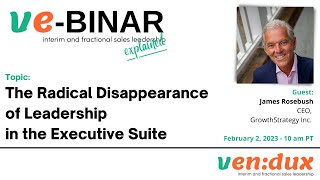
This is a Vendox-hosted webinar (Feb 2, 2023) in which James Rosebush diagnoses a "radical disappearance of leadership" in executive suites and public life. He argues that many elite educational programs produce technically skilled managers but not leaders because leadership requires beliefs, service-orientation, empathy and authentic communication. Rosebush illustrates his points with historical and contemporary examples (Ronald Reagan, Winston Churchill, Volodymyr Zelensky) and offers practical advice for sales and business leaders: focus on understanding what people want and lead by service rather than personality or self-promotion.
Chapters
Oh, good morning, Good afternoon. I am. I'm in the great state of Maine today where it's going to be 30 degrees below zero. Lots of fun here. Henning. I know you're in California, so enjoy it. Welcome everybody. I am Andrew Miller, one of the partners at the Vendox Group. I am thrilled to be here today with James Rosebush on the subject of leadership, specifically the radical disappearance of leadership in the executive suite. James's resume and biography is a mini novel in and of itself. I would love to sit by the fireplace all day chatting with him. So let me introduce him with an attempt at brevity. James is the founder and CEO of an international advisory firm called Growth Strategy. Focused on driving measurable growth for Fortune 500 companies as well as startups through the effective management of strategy, finance, marketing and communications. Prior to his 25 year career in the private sector, James was a Deputy Assistant to President Reagan, the Chief of Staff to First Lady Nancy Reagan, and a Senior Advisor at the White House. He's also a best selling author on leadership and communications. James is also a frequent public speaker in front of many different types of global audiences and the media on leadership, politics, philanthropy and the Reagan's. His weekly columns on leadership and and public speaking appear on Business Insider and Real Leaders magazine. He co created Deal Ring, a platform to train investment managers to make the perfect pitch and compete successfully for investment dollars. James also coaches business leaders to become impact speakers through impact speakercoach.com so that's my attempt at brevity. Just a quick housekeeping note and then we'll jump in. We'll keep everybody muted for the duration of the webinar and there'll be a Q and A at the end. You can either use the chat function in zoom to submit your questions or you can feel free to ask your questions directly to James at the end of the webinar. You might want to start thinking about subjects of leadership. Your favorite subjects. Leaders or leader or leadership. James, welcome. Great to have you. James, where are we with leadership in 2023? In the C suite. In politics, in. In the training of our young and emerging leaders out there. It would seem to me that we're sorely lacking in this quality on a global basis. Big picture.
Andrew, thank you so much and Henning for having me. I really appreciate this invitation to talk about this critical subject and it's not surprising to me that you've chosen this subject because you are a firm that supports the whole ideal of and practice of putting leaders into important executive assignments. So it's right, consistent with your thinking and your practice. And I certainly appreciate that and it's certainly needed. I also appreciate the fact that you said you would like to have a conversation with me in front of a fire, given the fact that it's 30 degrees below in Maine. So I'd be happy to sit in front of the fire with you, especially in a place like Maine. And I hope that you find a warm fireplace for yourself. No question about that. When I was writing my current book, Winning youg Audience, I did research into a number of maybe 40 top business schools, graduate schools of business, and I Learned that only 23% of them required courses and had curriculum in things such as public speaking, leadership qualities they were focused on. For example, I always like to say you can get an mba, and to get an MBA at most schools, you have to take several accounting courses. You have to take statistical courses, some of them engineering courses. So I like to think, and after I discovered this lack in my viewpoint in MBA programs and I have a lot of other things to say about MBA programs and their lack of contribution to creating real leaders out there, that wouldn't it be better perhaps to can the accounting courses and to focus on the qualities that an individual really needs to lead other people? Because of course, the whole term leadership begs the question of followership. And in order, especially if you're running a business, you need to have people that either you've hired or that you've inherited to follow what you are creating in terms of a strategic plan for growing your company. And this is. It's critical to learn how to develop a followership as much as it is learning how to be a leader. I would say that over the course force in maybe the past, maybe 50 years, the development and the attractiveness to so many people of highly ranked MBA programs, from Stanford to Harvard to Pennsylvania, all of these schools, mit, all of these schools have highly creditable programs for MBA students. But the question is, are they really creating leaders or are they creating people who are technically skilled in obviously critically critical departments of leadership, which include things like finance. But leadership takes much more than that, and it is really based on the development of and the acquisition of beliefs. And accounting and finance are not necessarily beliefs. They're. They are skill sets that are necessary. But in terms of leading humanity, you're really leading people more than anything else. Because if you can't get people in line to perform the way you think your company needs to be performing and managed, then you're really lost. You may have skills in all of These other areas, real estate, finance, all of this sort of thing, those are skills that can be acquired. But to acquire real leaders is a rare. A rare ability. Now, to go back to your initial question. We have witnessed and we have been perishing from. And we're in a state of utter turmoil throughout the globe, in many different walks of life, different, different categories of leadership. The. I call it the sudden evaporation of leadership. So suddenly, and this has been brewing for a long time, so the word suddenly is perhaps what we've woken up to and recognize, begun to recognize because of the effects of a lack of leadership. We have a global turmoil. We have global turmoil in 23 major geopolitical areas where countries and coalitions are in complete turmoil over public and private finance, over taxation, over military buildup, over geographical issues, over trade. There's a tremendous amount, a lack of agreement, there's a lack of even communication on these issues. And it's because we have a lack of leadership. That's the only answer that you can put to it. Why do we know that that's true? Because we're watching these people. They're not inspirational. They're not leading people in the right direction. They may be motivated by what I'm addressing in my fourth book, the Rise of Politics and the Decline of Leadership. They become politicians. And I mean that in the broadest sense of the definition of the term. They may not be elected officials, but they may be pursuing a political path to controlling their countries or their organizations or departments of their governments. And they're looking at. And why do I say that? Because being a politician and having been in politics, seen it at the highest level, at the best and worst, politics really involves creating a platform on which you're basically promoting yourself as a personality. Personality. This is what is worshiped today. And all the social platforms basically promote. What do they promote? They promote personalities, and they promote personalities as the engine of wealth creation. And personalities are the figures that are basically honored and worshiped today rather than true leaders. So we've replaced the kind of quality that we need because we have deeply. We have deep fractures in our belief systems and our way, in our ability to end practice of communication globally. Those are not necessarily things that personalities can solve. Personalities are busy building up their own egos. They're busy making sure that in the case of people who run companies, you see a tremendous fear as well as interest in and, and kind of attentiveness. No question about that. But their standing in the media, their public standing, in terms of what different how the Media judges their performance. You see tremendous problems with the lack of ability of corporate CEOs to communicate authentically and genuinely to their shareholders and to their customers. And we've seen this repeatedly in the case of the downing of the, the Boeing Max, two planes go down, the head of Boeing gets fired because he can't even communicate how tragic this is and how he feels. You know, the heartfelt loss of these people can't even communicate that. Maybe he's told by his lawyers not to, maybe he's told by his PR people not to. But I would say if he had it in his heart, it would have been felt by his. The constituents that need to hear that same thing has happened. It's happened over and over and over again with these so called leaders that don't have the ability to communicate. Well, what does that come from? What do they have in their, in their core in terms of their values and what they're trying to pursue? And this is no indictment of any of these people. They're, most of them are very good people and they're hardworking and they're creating value and new ideas and new technology that people of the world really need. So I don't mean to denigrate them, but what I'm trying to highlight is that we need to turn the corner on this and we need to immediately, urgently address how we develop leadership and how we respect leadership qualities and show examples of the, the types of leaders that we really need so that people can pattern these examples of sound, productive, effective public service, which is basically what a leader really is. And I just think I'm going to stop here for a second because I'm just blowing on here. But I think you can tell it's a subject that I'm very concerned about. And especially having worked for a president who today is. Even people who weren't born during Reagan's time, they'll tell you how old I am, but people will come up to me on the street and could you just, could you just take a few minutes and talk to me about Reagan? Could you just tell me, you know, I've read about him, or maybe if they, if they were alive during the time he was in the White House, being a great communicator, but also such a great public servant and a great leader. Could you just tell me more and more about him? And I, I think it's fascinating to me. I think it's logical because he was certainly the most remarkable human being that I've ever had the opportunity to work with and work For. So I understand that. But it says to me, it says a lot to me about where are these people? And people say this to me every day, where are these people? Where are the Ronald Reagan's, where are the Churchills of the world? Where are JP2, Pope John II? Where are people like that? I think we see it in Zelensky right now because why? Because he's willing to give his life for his people and for what he believes in. And you know it. Because he's so authentic and he has this conviction and he didn't have it. By the way, I have a number of friends who. The ambassador from Ukraine lives next door to me. We've had many, many conversations about when Zelensky came on. It was unexpected that he had no idea he wasn't preparing for war. And a lot of the other parties in Ukraine were not terribly happy about that. But okay, as his habit was to this lot that he's in now, he's risen with this conviction, authenticity, willingness to die for his people. And I really believe that. I don't think it's any act or otherwise you could tell. And this also strategic thinking that makes you want to follow him, it makes you want to trust him because you have the feeling that, number one, that he's not giving up. Just like. And what did Churchill say? We will fight. We'll fight on the farms, we'll fight on the beaches, and we'll fight in the hedges. We will never give up. Where do you hear, where do you hear people like that today? Where do you hear people talking like that? This is. And it wasn't. It wasn't for Churchill. It wasn't political. It was, it was survival. For Zelensky, it's not political, it's for survival. He has the full support of his parliament. But there are, you know, there are three or four different parties in Ukraine. They're all united behind him because he's not talking about his next term in office or whether he's going to run or not. He's talking about, this is an existential threat. Now you could say, well, that's interesting. Wartime creates leaders. Well, maybe not. I think we're in the war. We certainly are involved in a dozen war zones right now. So we're really in an extent existential war as well. Where are we going to support capitalism? Are we going to promote capitalism as the only system in the history of man known to lift people out of poverty? Are we going to really, you know, get the underpinnings of what's going on? And really lead people. Not because we're trying to make more money or be more. For appear in more media interviews or, or to become more famous ourselves. That's not really it. It's really asking the question, which I like to ask every day, what is really going on? What is really going on? What's really going on right now on, on energy? What's really going on with a transition to electric vehicles? What's really going on in terms of trade? What's really going on? Because what's really going on is rarely what you read in the media. You may get little snippets, but when you ask yourself what's underneath this? What is really going on now, that is what leadership is. That leadership is asking yourself what's really going on. Getting a little idea of what it is that's going on and then sharing it with people as if you're saving their life. And I believe that Reagan had that view that, you know, after the assassination attempt, they, they blow up this famous thing that, you know, Reagan said, whatever time I have left on earth, I'm devoting it to, to God and the American people. Well, I, I always smile when I hear that because Reagan always felt that way. That was who he is. And if you're interested, we could talk more about that in a few minutes. But I think that people are drawn to individuals who have an idea and are committed to it, and it's an idea that will help them. That's how, you know, remember the whole phrase, gather around. Let's talk about this. Well, what are we going to gather around today? It's going to be your fireplace, but let's gather around and try to figure this out together. We're just all in this together. But I've been thinking about this and I've got an idea. So let me stop there, Andrew, I've gone way on too long there.
There's so many questions I've got. You know, nature versus nurture. Can we. To what extent can we actually learn leadership? And if we want to learn leadership and practice and grow our abilities, our mental framework, our belief systems, our values, how do we learn? Who do we learn from? If there's such lack of leadership in the world and there are fewer and fewer examples of great leaders, that cascading effect is a snowball downhill. So big picture, where's this all? How is this going to change? So I've got that question, and then you're talking about Zelensky and Reagan. And then the thought crossed into my mind, what the similarities of Their backgrounds, which is fascinating that they come from entertainment and the media. Wow. What. What's that? Is there a common thread there? And then, you know, the subject of, you know, Churchill, for example, or wartime. Does the moment make the man or the woman the leader? The moment. And we could be. We're leading sales teams and organizations and P. Ls and corporate empires, and we think we are leading every week, every month, every quarter, hit the numbers, the miles. But then something happens and there are those that step up and. And are in. In the face of adversity. They. They come out of a. Of a. Of a rough ocean and a storm come out shining the other side. And then on the other hand, the ship sinks with others. So I guess the question is, if I were to summarize this into one question. Nature, nurture.
So do you have a couple days that we could talk about this? So one of my first days in the White House, I was responsible for creating the. I sort of call it the. It's not a great term to use right now. There's a lot of controversy about it. But it was the office on impact. It was called private sector initiatives. And my job was to bring in private industry and private philanthropy to improve. It was the first time the term public private partnerships was coined. It was to improve what government spending was doing ineptly, such as building public housing, affecting public transportation, public health and public education. That's when we started charter schools. That's when Section 9 and 11 housing came in that could be developed by private developers, and the quality of public housing increased substantially. So this was Reagan's favorite domestic policy program, although it was a very small program. But in any case, so early in 19, in. In 1981, I was in the back seat of the limit of the president's car in a motorcade. And it was the. It was early in. In his administration, and it was a time for me, it was just the two of us in the back seat. And I thought, well, I would brief him on the speech that he was going to give, which is where we were taking a motorcade a couple of miles up to a hotel. But for me, fortunately, what happened was that the motorcade was delayed because there was some kind of traffic problem. Although motorcades don't really care about traffic. Usually they go on through them, you know, and they're. There are 24 cars, I don't know if you know this, in a presidential motorcade, including the last car, which is called the. The death watch car. And it's. It's Kind of a scary term, but it's where the media, some of the media goes in case something happens while, while the motorcade's going. But any case. So I'm, I was approaching, we were walking out of the Oval Office and, and Reagan, who was taller than I, is 6:2. And he walked, he had a very graceful and powerful walk. So I had never gone alone in, I'd been in motorcades before, but I hadn't gone in his car with him. And I thought to myself, now which door do I get in on? And so I thought I better just let him go ahead of me a little bit and watch which door he gets in. Well, of course, the principal always sits behind the Secret Service who is not involved in driving the car. So I went around, got in. So I started briefing him on this speech that he was going to give. He said, jim, I read it, I've read it through, I don't want to talk about that. And I thought, oh, you know, what should I be doing? And instead we sat there for 20 minutes and he gave me a 20 minute education about who he was and why he was. And it was all about how having been the son of an alcoholic, having had to pick up his father out of the snow, drag him into his house, it was an enormous disappointment for him. But his mother made up for this and his mother, who was an itinerant preacher, gave him his values. And he was, he was both desperate to find a strong base for living and convicted that what his highest calling would be would be to serve in some way to serve mankind. That is how he found his only solace. And he would sit, you know, they never owned their own home. He would say to me, oh yeah, but the Reagan's, the richer Reagan's were not rich at all. They, he came from a family that the only home that his parents ever owned was the house he, he bought for them in la, in East LA after he went to Hollywood. So he never grew up in anything but rental housing. And he would go up in the attic and he would read just like Lincoln did, very, very much like Lincoln. Very, very kind of situation like that. And I one time I spoke at the college where he graduated from and I saw, and I was speaking in the room where he was speaking and he found his voice and he was student chairman of an effort to oust the president of the college. And I thought, well, that what an interesting story that Reagan was trying to oust this guy. His whole group was. And he says, as I heard the response to What I was saying grow bigger and bigger and louder and louder. I learned the power of oratory and that. So if you combine that with his conviction to serve, that's really what he was telling me in the back seat of that limousine ride that day, that his life was built on values that his mother gave him, that he was desperate to. To understand. He was a lifeguard for 17 years on. On the, you know, the major river there where they lived, and he saved any number of people from drowning. They reported in the newspapers. We. We still have all of that. And I always like to think that Reagan thought of himself as a lifesaver in the larger sense. When my first grandson was born, you know, I watch him growing up when basically he's, you know, we're talking, we're having conversations just as a little boy, he said, papa, I want to save the world. I want to save the world. And I. Sometimes I think I need to remind him of that now. But he. He. I thought I was cat. I was taken by that, really captivated by. Why is this little kid just barely speaking? How is it that he has this feeling like, what does it even mean, I want to save the world? And, you know, it's kind of faded as he's become becoming a teenager. We don't talk about it that much, but I'll never forget that, and I'll never forget that day with Reagan. He basically explained to me where leadership comes from. It doesn't. You know, it's an individual situation. But he grew up in a hardship situation. So did Winston Churchill. Even though Churchill was born in a palace, he didn't have a palace kind of life. He suffered. He made a lot of mistakes. He didn't. He wasn't confident in certain ways about himself. He had to learn. He had to suffer, and he came into his own. And his greatest leadership, obviously, very much like you said, like Zelensky put in the greatest trial, perhaps one of the greatest trials that history's ever had, saving Western civilization. And these are things that I think when you ask the question, you know, where does true leadership comes from? I think it's the same thing as saying, where does service come from? Where does service to mankind come from? And it has to come from. In a lot of cases, it comes from suffering. You see, in cases the, you know, ptsd, for example, one. One of the. My heroic people I met had the privilege of meeting so many people that I would call heroic to. To me is this gentleman who founded this organization to redeploy the. When they become Civilians when they leave the military officially. But he says, and he sees, you know, such high rates of suicide, so he takes them and he redeploys them in operations to save communities after they've suffered from hurricanes or fires. And, and these people love it. So what happens to them? Their, their pts, PTSD is solved because they're serving. And I consider those people to be great leaders because they're showing the rest of the community what, you know, how you can rebuild all this sort of thing. But they have a, they have this degree of humility that comes from having to make your own way and to suffer. So to, to go back to your question, is it nurture? Is it nature? Is it nurture? That's what really made me think about how people who have had to earn their way. And you read, you know, when you read about people who've been successful as CEOs of companies or other organizations, there are a lot of Horatio Alger stories about people who have, many of them have come from nothing. They wanted to lift themselves out of that. Now, a lot of those people aren't necessarily leaders, but I think there, there are people who, if they really discovered what, and had the opportunity or created the opportunity to really serve others, those are the people that are the genuine leaders, not the politicians. So basically what we've said there, just to summarize, I think, is that personality and personality cults are not the way to nurture and create leaders. The way to create leaders is to find and help people identify motivation inside of them or to adopt motivation to be of service to mankind and not to be so taken up. You know, Reagan, he had no interest in polls. And of course, we had a pollster in the White House, very, very competent person and be in the Oval Office. And he would be, he'd say, well, the President, you know, Mr. President, the public feels this way about you or that way about you, blah, blah. Reagan was a person. He was not available to other people to be manipulated for one reason. He didn't care what people thought of him. And that is, that is stunning. I mean, most of us care. Most of us care what people think of us. And he didn't care at all. He had no, he, he left the White House the same person he entered in which you can't say for a lot of people who, in political positions. Margaret Thatcher, she became obsessed with her power and her popularity, and look what happened to her. She left a really broken person in terms of her political standing.
James Most of the people that we work with on a Day to day basis are there's really two sides of the equation. One is the group of sales leaders that, who are in our roster today. That number is about 500. The number grows every month. These are typically very senior people, many years of experience in and around sales and business leadership. The other side of the table are CEOs, business owners, entrepreneurs who in one form or another they are trying to solve basic problems around sales in their organizations. Scaling new products, new divisions, team development, etc. Any, just to one or both of these kinds of audiences. All of these lessons and perspectives. If you had to boil it down into, into a mini 1 or 2 minute boot camp on leadership in and around the world of sales. Is there anything that you, you want to impart?
Yes, I'll tell you exactly. It's what my dad told me. To be successful in sales, you have to know what people want. More than knowing what you're selling. You have to know what people want. And if you have the capacity to understand what people want, that's basically saying understand markets, right? But if you, if you have the capacity to understand what other people want, what people want, then you have the ability to build a sales practice, sales strategy, sales team or start selling yourself. And this relates to something we've been sort of talking around a little bit and that is the ability to be authentically, to be able to connect authentically with other people, to be able to empathize. So for example, I've seen so many cases where I've lost opportunity for sales when someone is trying to, oh, well, we, we're all subjects of people who are trying to sell things to us, right? But are they, they're really, are they really trying to figure out what we need? I remember, you know, as a kid, just like so many, you know, millions and millions of other people. So I, I started in business, you know, when I was 13, mowing lawns, cleaning rugs, you know, all this kind of stuff because I wanted to be in business, right? And, and my dad, who was a General Motors executive and he was his, he was obsessed with finding new routes to manufacture cars, all that kind of stuff. And it was inspiring to me. But he was always saying to me in my little, you know, crazy little businesses, okay, are you providing a service that, you know, people need and want? And that means I had to be somewhat empathetic to my potential customer base. This is a big problem that I think we have today in culture and this isn't just an American problem, but the ability to empathize with other People to care enough about them to, well, is this a product that you can really use? And in a lot of cases of people who are creating new products and new solutions, particularly in technology and I. All kinds, all kinds of things. The ability to sell these concepts or products relates to, for example, let's say, let's take an iPhone when they're bringing out a new model. Well, they've been pretty successful so far, but they have to know that the market is going to absorb the number of new phones they manufacture. So what do they do? They, you know, they do market testing. Obviously they're constantly doing that. So that's a part of their great success. But I think in any sales initiative, I think that it is, you know, the all, all of the day to day tools that we have in sales have migrated to social media platforms, all different kinds of communication. And that's great. But the human side of sales is something that your success in is dependent, I feel, very much on your ability to relate to either individuals or groups of customers that otherwise you, you know, you really can't make it happen. That, that would be how. I would answer that, just based on my own life, you know, as a kid mowing lawns, you know, do, do these people really need their lawns mowed? You know, rather than wasting my time and people who had gravel for a front yard instead of grass.
Yes. Yeah, for sure. Great. Yes. Empathize. What do people want? I had a discovery call with a prospective client the other day, 30 minute call. And for 25 minutes I was asking questions, trying to understand the context and the environment of the situation there. And towards the end of the call, the CEO said, you haven't sold me at all on your business and what you can do. I said, well, that only takes two minutes. If I understand your situation and what you need and want, then I'm very quickly in a position to tell you, yes, I can help. And here's how. So she was pleasantly surprised.
Good way to put it. Good way to put it. Good example.
Again, I wish we were sitting by the fireplace all afternoon. Any words of wisdom, any parting thoughts, James, particularly to our roster and our community of CEOs and business owners and sales leaders. Maybe, I don't know, example of leader, whether it's Jack Welsh, Steve Jobs and Tim Cook, anything for the, for the last couple of minutes together and that if there's anybody that's got any questions, please put your question in the chat or I'm gonna pass the line. I'm gonna open up the line to you shortly to ask questions. Thank you.
I think that the. The world is. There's a lot of plurality. There are a lot of different ways to invent a product or solution, bring it to market and be successful. So it's impossible today, I think, because we were working in all of these different silos and with so many different outlooks and ways to manage that. It, it's rather difficult to say that an individual who perhaps if you look at Steve Jobs, I think he was possessed of this extraordinary skill in a very certain sort of way. And you could say, well, was Steve Jobs a leader? Well, he was a leader in the sense of creating something of massive value both in terms of what he manufactured, what he created and manufactured and its impact on global communication. Right. So there's no question that we desperately need people like that. But when you come to using the term of leader, I go back, I guess I go back to what something I hinted on in the beginning, and that is leadership requires fun, followership. And the implication of leading is that you are influencing people in hopefully in a direction that will improve their own lives. And teachers in school should be leaders. They should be examples for I know growing up, going to an elementary school with teachers that I basically, oh, I want to be like them or, you know, meeting people certainly in my life. I want to do another book on the great leaders that I've had an opportunity to meet and see what they embodied and what they gave and the way they live their life. You can say a lot about that as well. And I'm not. I don't want to go down, and I never want to go down the road of just judging people for necessarily the way they live their lives. But the, the term leader is a golden term. It's a golden term. And by that I mean that it's a special category and it has been abused, no question, by the fact that we call tyrannical murderers are called leaders of their country. There, There are no more leaders than they don't. They don't deserve that topic. They're. They're maybe controllers of people, but they're not leaders. And what we need, I think more than anything else is we need to discover what leadership is and, and the cost of lack of it. And we need to share this with young people, with our children, our grandchildren, teachers in schools, people that are influencing young people, getting the curriculum focused on. And you know, at one time I was asked to come on by, by the board of a school. I was advising them on financial issues and then they fired the head. And they said, well, you're going to have to become the head of the school. And I said, no, thank you very much, but I'm not going to become the head of your school. And they said, well, you have to at least hire the new head, so you're going to have to stay here and, you know, anyway be the interim head, which which was a really is a blessing, I think for 18 months I did that. And I tried to create a leadership center at this school. I tried to turn it into a center for leadership. And I think there was a hunger for it. And we did change the curriculum to a certain extent. I'm not sure that the board really bought into that entirely, but they could see that this is something that we really need to do. But the more at that time I researched leadership centers and they were growing, blossoming all over the country. I had to say, I felt that the more these leadership centers were popping up in schools, colleges, even elementary schools, leadership, it didn't really it wasn't really producing more leaders. And I wondered why that was really the case, because otherwise we would have an overabundance of leaders today in every field which we desperately need. I think probably the answer to that is people were to go back to what we talked about in the beginning. They were approaching development of leadership academies and leadership schools kind of based on the MBA model. They were giving them skills, but they weren't necessarily giving them heart. And in the bottom line, I would say that if you take Ronald Reagan as an example, which high percentage of people would say that Reagan was a great leader, he's in the top five now, Some people say he's more than that, but he's certainly in the top five of all presidents. Why was he a great leader? Because he loved.
That is a great way to wrap up, James. It has been a great honor. Thank you so much for your time for your insights. We will be following up with folks with links to your books and profile, and people might be reaching out to you directly as a result of this webinar mentioning they saw or heard you on this webinar. So again, thank you so much, James. And for all of you joining us today, very much appreciate your time and we look forward to see you again on our next webinar at Vendux. Thank you. Thank you, James. Thank you.
Thank you. Thank you. My honor, my honor to be with you. Thank you.
More from Henning




ve-BINAR - The Revenue Tornado Methodology: How 3 Power Sources Create Exponential Growth


ve BINAR: Executive Cloning: How AI is Reimagining the Role of the Fractional Executives




veBINAR: Unlock Client Value: Why Compliance is Crucial for the Startups You Serve
