ve-BINAR: The Team is the Issue - Driving Results Through Alignment
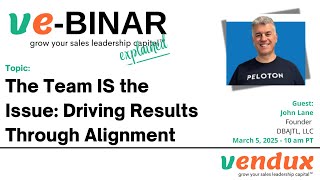
John Lane walks through how fractional executives use personality assessments to audit sales teams and surface alignment issues fast. A 110-adjective test takes 5-7 minutes and produces coaching reports and development plans, typically delivered in the first month. The cost runs about $1,200-$1,500 per person.
Chapters
Welcome. Welcome everybody to this week's webinar. We are very happy to have John Lane with us. Let's kick it off with just a few housekeeping notes. Let's keep your microphones muted while we are in the main section of the webinar. We will have a Q and A towards the end and then you can unmute yourself and ask questions. But you're also welcome to put questions into the chat. I'll monitor that and we'll, we'll have those questions be addressed as well. Our topic for today is around team teams and how teams are driving or hindering success with a particular focus on the fractional executive. And John Lane is our visitor and our guest. John, why don't you introduce yourself briefly and give us a little bit of background for why this topic is near and dear to your heart and how you got into this topic. You're muted, John.
I wasn't sure if I could unmute myself. Hi everybody. How are you? I am John Lane. Nice to meet you. I'm a leadership consultant. You can see that my logo. So it has to be true. And my focus with fractional leaders, especially fractional sales leaders, is working with them to make sure the team they now lead is properly aligned and engaged with the business. This is not a universal truth that I'm going to say, but I think it's pretty close that if a fractional leader is coming into a sales organization, there's challenges that have been identified by somebody who hired you. And sometimes those challenges are going to spill into the team. Maybe there was a sales leader before you who was rough on the team and didn't leave it in a good spot. Maybe people you hired a year ago were right at the time and now because of changing environments and whatnot, they're not necessarily the right people. There could be a number of different things. But my belief is that if you don't properly audit and understand the team you now lead, there's a good chance you are making it more difficult for your work to succeed and for you to earn that next contract. I don't know if it's universally true again, but I suspect fractional sales leaders tend to get hired for a trial period of some kind and then they show results and then they get another trial period or a longer period or a year long contract or something. So my belief is that if you can better understand what's going on with your team and solve any issues or at least mention that you have team issues to the person who hired you when you come on Board, you've at least identified that if three months in, the person who hired you, let's call that person, the champion, asks how things are going or says things like headache. I'm seeing a lot of activity but I'm not seeing a lot of results. If you then say, well, I have to tell you champion, your, your team's kind of rough and, and they're going to say to you that's an excuse, right, because you're three months in. So what I like to try to do is get all of that information out and in front of everybody in the first couple of weeks of the engagement. So I'll stop there.
So what brought you into this line of work? You know, what's your background? I assume you didn't grow up thinking that you'd be a consultant.
No, nobody does. Well, very few do. So my background is very broadly advertising, marketing, startups, etc. It is a non linear approach that got me here. A lot of the work that I do uses a personality assessment and we can get to that later. But what I think I've been in a situation is that I've learned a lot more from bad bosses and bad leaders than I have from the good ones, which is probably true for a lot of people. And so as I was a people manager, I always tried to be the best I could in my current work as a solo provider. I want to see teams succeed and I want their leaders to have the tools to help them get there. So that's my very non linear journey. I'll also say to anybody who's on here, I am not in sales. I mean I've dabbled in startups where everyone does sales and that sort of thing. But every one of you on this call has forgotten more about sales since the call started that I know. So I say that to you because I'm not in competition with you. I want to make your engagement better and more successful. So you win, your client wins. The client team, the client's team wins.
Do you feel that this topic should be approached with the universal assumption that there is an issue in every team or are there indicators that a fractional executive should be able to, should be looking for and should be able to make a, make a determination whether there could potentially be issues?
Yes and yes. So you take any size team, some percent is going to be less engaged.
Less.
And align with the business. It's just the law of large numbers. So you're going to have that. My belief is that there's two drivers of, of alignment issues One is people have lives outside of work. You got a sick kid, sick parent, something's going on, you're divorced. A million things, not a lot you can do at work with them, but give them grace and acknowledge that you understand that can't go on forever. Push those aside. There's typically something in the business that is creating an environment where the team is not as engaged or aligned as they should be. Sometimes it's things and this is like the classic one that I see. You'll be in a situation and you'll see that like there's three particular sellers who are off, you know. Yes, you're probably seeing this in their numbers too, but you're trying to figure out what's going on. Then you dig in and you go oh well that regional leader was just promoted from a seller to a manager and you say did, did you give her training? No, we were too busy. Is okay. Have you leaved her of some quota? No, no, no. She has to keep selling or let's talk this through. A first time manager has not lost quota and is still trying to manage the team with no training. So this is not stuff that the team didn't know. It's just like it hasn't been framed up in a way that you're seeing the cause and effect. I'll just say one other thing. You all are good at your jobs. You will figure all these things out in time. My job is to speed that up and to pull that information advantage forward so you're getting it in the first couple of weeks rather than slowly over time and in an unorganized or an organic way.
Yeah, I mean that you already pointed out how that why that is the reason this is so important for fractional executive. And from our data we know the, the average assignment length is seven months. If you're starting out with an assessment at the beginning or when you start out and things don't go in the right direction, then you know, after two or three months you're in the doghouse as a fractional and typically on the way out if things aren't working out. So knowing, knowing for a fact that there is something misaligned in the team is the value that you would bring to the table or more generally speaking an assessment would bring to the table early.
Yeah, can I talk a little bit about how that happens please? So maybe throw stuff in the comments if anybody has a different opinion. But in my research, when a fractional sales leader comes on board, their first call it month is figuring out the playbook, learning the product, seeing what kind of tools they have, how is the CRM, how are we using it, what's price, all of those very sales infrastructural things, if you call them that. It's hard to move the needle till you figure all that stuff out. So as you're focused on that, I come in and I do what I call a people alignment audit. It is a very light touch. I use a personality assessment. I won't talk about it now I understand, but it's very brief, it gives me lots of information and I take all of that and I put a report together for the fractional leader so that when they give their first month update on what's what they see in the business, sometimes we'll say, oh, we need a new CRM or we got to change the playbook or whatever those things are. You also can give an overview analysis of the team. And now you're putting that front and center. So that's what I do for the fractional leader. The second part of two things that I do is I put together what's called a personal growth plan. And the personal growth plan is a, is a set. It's a, it's a framework of understanding of how a person might be naturally good at their role and where they might have natural challenges. So here's an example. Let's say you have a full cycle seller. Say that three times fast on your team or that is the team they have to be good at. Let's say four things. Prospecting, customer success, giving product demos and presentations, and managing their pipeline. The financial side. Very few sellers are going to come in good at all of that. Right. They're going to bring their own strengths and challenges. So what I do is I show each one of them where they're naturally strong against those four and where they naturally have challenges. So let me give my, let me give me as an example. If I was a seller, my VP of sales, my fractional leader would like me because I'm a very good at client relations. I build trust fast. I build relationships fast. She'll also like me because I have an internal clock. I know when a deal is slipping and I'll ask for help. I feel the difference between the beginning of the month or quarter and the end of the month or quarter. I just have that natural timing. So that's going to jive well with my leader, which is not going to like me so much as I'm such a people person and I am so optimistic about my work. My, my forecast is junk Everything I put in is 85% chance of close and above average. Right. We all know that can't happen. Right? So my forecasts aren't great and I'm not super detail oriented. So my handoff notes in the CRM to the client success team aren't as good as they could be. My expense reports are late, those sorts of things. So if that fractional leader likes me for the things I do well, then the rest come along with it. And so it's, it's your job to be able to get the most out of my strengths and work around, limit my weaknesses as well as help me develop them. So then the last part of what I do is I create a, in the personal growth plan I create, I call them development suggestions. So these are things against your job that you may not be as strong at and you're, you're, your leader can work with you. And I give the leader something's called a sales coaching report so that they have a document that shows them how to motivate me versus Sally, Tom and Sue on the team so they can understand how to apply that leadership and that, and that mentoring and coaching to each individual person. That's, that's the program. Okay.
Now the, the idea of providing a sales leader with development suggestions for each of the team members, that sounds pretty standard. Have you seen the, have you seen the, the impact that this has had on a fractional sales leader when he's been on an assignment? Have you been part of a story or two or three where that really saved the day? Where the early detection of misalignment and the early implementation of development suggestions made a difference?
That's a great question. And it's one of these things where it's sort of hard to disprove a negative. So I tend to come in at the start and so any story of success I have is these bad things didn't happen. Right. And so I've been able to help my fractional sales leaders get off and get smooth and get into their, their work rather than. I've not ever come in to an existing relationship when there's already trouble and then had to put the fire out. So not a great answer to your question, I understand, but it's more, I tend to come in at the start and I'm built into, my work is built into the sow. We're doing one now with, with a fractional sales leader and we are helping the new leadership team. So it's, it's a, it's a company that was acquired by a much, a much bigger company like a half a million dollar. Half a billion dollars in sales to multiple billions. And so they're all going through a big change process and they're doing well, but they're not doing well in the way that the big company wants them to do. So our program is based on their assessment and against their specific responsibilities. And we are in phase one of that now. So I'm literally finishing up this week helping the leaders just understand themselves and understand how the thing, I mean, let's face it, sales drove revenue such that the company was acquired. That's a good thing. Right. And now we're, we're moving them through because how they do their job is almost becoming more important as is how well they do their job. Now that's not a fractional leader that's actually working with an established sales team. But the principles are the same will roll through the team as a next phase.
You may have mentioned that before, but could you specifically outline the ideal timeline? You come in at the beginning, but how long does your job take and when will the sales leader be able to put those developmental suggestions in place?
A month. Right. So that like, like give you a very quick brief answer. My belief is that I'm a resource for the fractional sales leaders. It's your client. You did all the hard work to land them. My job is to help what you do get off to a better start and a longer better start. So if a fractional sales leader wants to say at the beginning, oh, and I work with this guy, John Lane, here's what he does, it's very important. You know, let's have a meeting with him and he'll do a scope of work and you sign with him and we do it together. That's great. If I'm in the background behind that fractional leader, that's also great. I'm, I'm agnostic to that. But my process is designed to be mostly completed in the first month. I'm on call. I can be around, I can do follow ups, whatever is needed. But I want to get everybody off to a good start and then get out of the way. Right, that's my point. There might be a question in the chat.
Yeah, there is one from Lisa and I think you just addressed it because sometimes the fractional sales leader who brings you in and sometimes it's the client directly.
Yeah, I mean the client is paying. Ultimately, how it's papered is going to vary every time. Yeah. Okay.
Can you talk a little bit more about the analysis that you're doing. So your soft touch interaction and assessment of each team member and then how do you come to the conclusions that then lead into the development? Suggestions.
Great. Yeah. So everyone takes the assessment. It's a five or seven minute undertaking and I'll explain what it is. It's incredibly simple. There's a list of about 110 adjectives. The reason there's 110 adjectives is the human mind just can't remember what it picked. And so it enables the person to just be honest and select the words that describe themselves. The instructions are select all the words that describe yourself. Hit submit. Done. Same list is presented to you. The instructions change the instructions say select all the words that describe how you must behave at work. Submit, done, you're finished. I get a report. I'm a trained analyst in the software that I use. So some of what I do is outputs from the system. Nothing to do with me. The system produces it. And then other things I do are my interpretations of that against the specific job. So there's a bit of tech that supports me and then there's a bit of my analysis and reporting. That's the second point that creates the, the comparison of your traits to your. I call them the four key proficiencies. I also work with the fractional sales leader and the team to differentiate those for proficiencies. You might have account management, you might have a channel manager, you might have a bdr, BDR managers. They'll all have different key proficiencies. So we'll establish them at the start of the program or as. As we kick off. And then it's my analysis using what I learned from the assessment to create the that people audit report the personal growth plans inclusive of the. The development suggestions. Okay, Makes sense.
Yes. Now in, in cases where a fractional sales leader comes into an organization where the sales team is relatively small. Right. There are maybe two sales reps. Yeah. Maybe an additional insight support person. So a really small team. In my observation, a lot of the misalignment actually comes in through other parts of the company, be it the founder or owner, be it operations, be it manufacturing, be it distribution partners. How do you make sure that those factors get recognized as well so that the assessment really captured the source and the origin of the misalignment.
Yeah. Thank you for that. What you said is true in small companies. It's also true in large companies. Right. You just, you don't see it as directly because you have different departments and there may be different buildings or different locations, et cetera, but it's really the same idea. So my, my work has to start somewhere in a company. Ultimately, I'd like the whole company to use my assessment to create that common language, experience and framework for all the departments to communicate better. But you can't typically start there. So I would likely start with the fractional sales leader and the team, their team, and through the process of finding alignment and engagement issues, find out where they are and why. And then that might take the fractional sales leader, the champion who brought them in, to turn to another department or departments and say, hey, we're seeing this friction. Let's also go through a program so that we all have that common language, etc. To work things out, right? Rarely is any interdepartmental issue one way, right? Like what I've seen is sales is selling stuff that we don't do, right? Or we don't. Or they're off book, right? And the product team or the account management team is saying, you're making our work twice as hard because we have to take the natural reports that we get and then we have to tweak them for the other team making this up. But you get the idea. And now we have mistakes, we have errors, we're delayed doing what we need to do. Because you all sold something that is out of the box and the sale says, yeah, but the stuff, you put it in the box, no one wants and we have to sell something, right? You've all seen that, that give and take. So it's very rare that I come in and do work and someone goes, oh, I didn't know that about myself, right? We all have a general idea of it, but it's when we all understand each other's right. This, this is not psychiatry, right? We share everyone sees everyone's report, we're all aware of it. We have this thing we do with quadrants. It's kind of how we summarize it. And some of our clients, they put their quadrant on their cubicle or their door, right? Because they just want you to remember, hey, I'm a builder, I'm a, I'm an expert, I'm an architect, I'm a facilitator. As you come and talk to me, remember the lessons that we've learned, right? And so the more that stuff is surfaced, the more people can communicate with each other, right? And so the issues that, that I see a lot are quite common. It's that the teams don't have the skills or the learning to be able to communicate with each other. So you just Have I call it unproductive conflict. It produces heat but no light. Right. And so we want the type of conflict that comes up with, hey, our client, our potential customers are telling us they want X from us, we're not giving it to them. What, what's happening? Where's the market fit? How do we fix it rather than how do we blame each other?
So a lot of sales leaders, myself included, take pride in the fact that they have, that they have a sense for what's wrong and a sense for misalignment in a team. So what would you say to someone like me who would say, hey, all it takes me is a 20 minute conversation with a team member and I know exactly where things are misaligned.
I would say that's great for you. How are you going to explain that consistently across everyone on the team? And how are you going to find the problem or the issue and then solve that? As I said, you all are good at your jobs. You will figure out what I can show you. But will you have it in a report? Will you have it in a way that everyone who's been through the assessment can now understand? Right. So it's not just about, oh, you can figure it on your own, of course you can. Right, but how are you going to productize that process so that it's smooth and it's even? And let's be honest, we all have biases, right? So, Henning, I'm going to bet you that you prefer salespeople that operate in a certain way. Why? Because that feels smooth for you. That's the way you do it. That doesn't mean everyone can do that. Right? So you may sense conflict. Remember I told you with me, like, we haven't done your assessment. But, but I'm going to, I'm going to suspect you and I might be opposites. So the stuff that I'm doing that's making me successful has a tail on it. That's making you crazy, right? Because of how you are. You're. That's your bias, right. There's nothing wrong with it. I have, I bring my own biases, right. I'm like, hey, Henny, because you. Could you take your foot off my throat? I'm actually, I made president's club last year, right, so, so it gets out of all of that bias and just puts consistent, objective data on the table that everyone can understand. Yeah, that was a good answer.
Yeah. Well, it's recorded so you can use it later on. And we'll open microphones up shortly for, for a Q and A. But let me ask one more question. What type of investment would a company be looking at if they wanted you to be part of a fractional sales leadership engagement?
Great. So it sort of depends on the size of the team and it sort of depends on the composition of the team. So here's an example. A 10 person team of full cycle sellers where everyone has the same job. That's easier for me to produce, more straightforward that I typically. I call it a workshop. How it's presented to the client in the sow. We'll just push that to the side. That's going to be about 12 or 15k just. And that part of the sow. And I enumerate all the different things that, that, that they get. If it's three people, there's got to be a baseline floor. So, so your cost per person is going to feel like it's going up, but it will be three or four grand for the baseline and then a grand for each person in that. And then there's some nuance around. If it's a four person team and everyone is different, that's going to be a little bit different cost structure. But it's in that, it's in that range where you can almost say 1200-1500 per person.
Okay.
Give or take. Okay.
Well that's, I think that's what I was looking for. I know it's hard to generalize pricing in a service business like yours, but.
I've also learned, and I've been a buyer, I guess I'm sort of a seller now. Whatever. If you can't answer what does it cost, then you're just not trustworthy. So no one wants to get boxed in. Right. I don't want to then get 20 people all different jobs and somebody's holding me to the, you know, the estimate that I get. That's not fair either. But if you can't give a general size, I think you come across as untrustworthy. So I always try to put a few caveats on it, but also be clear. 1500 a person, give or take. That's how, you know, anyway. That's how I do it.
Good.
Great. Thank you. Let's open up the Q and A and let's see if we have questions from the audience. Just unmute yourself and, and, and ask the question when you're ready.
Also, if you're not on camera and you're going to ask a question, please come on camera. Lisa, we just met by happenstance this morning. That was fun.
We sure did. He Got pulled into my sales nav campaign.
He said it's great. What question would you have asked me if I engaged with you just straight up?
Well, I would have wanted to hear about how you work and I feel like I got a great sense of that from, from your presentation today. That was really helpful. I'm curious, do you do any follow up with the engagements that you have? Like to see how things have gone once they've, you know, once you've done your magic at the beginning. Do you, do you ever do any follow up to see how things are going down the road?
Sort of. I'm an upper right builder so I'm not so great at that. But here's how I know I did a good job. The somewhere in, in that this the fractional sales leader, the champion who brought that fractional in, whatever says hey you, we really like what you did. So let me give the example we're doing now. It's not fractional but we're starting to hear from the sales leaders we've put through. Boy, I'd like to do this for my team. Right. And so when we get that initial engagement and then we're asked can we do it for the larger team or can we do it for the other department, then I know we've done a good job. Even though I probably haven't been very good at like sending a survey and collecting data and comparing it to other engagements. That's not something I'm particularly good at. But Henning would do that. I bet he's data guy. Good.
Corey, you unmute yourself. Yes. So John, when you talk about the.
1200-1500 per person, is that just for.
The upfront assessment and tools and reporting.
And things that you're going to do in the very beginning? Yeah, it's the assessment itself. It's the analysis of the assessment with each of the team members. It's the writing of the report, the people audit report and then it's the development of the personal growth plans and it's the providing and initial usage of the sales coaching report. All of that is like in a box. Okay. And from the day I send the invitation like I usually start with the team but I've learned this the hard way. Don't let somebody else introduce you because then like people don't know. I got this email from this guy. What is it? So I will come on an early meeting with the fractional sales leader. I need 10 minutes. I explain why I'm here, I explain what's going to happen and then when I finish, I send the first assessment from that starting moment to the delivery of 95% of what I just described is about a month. And it can be faster or slower depending on access that I have to the team. But it will never be, it will never be slower than expected because of me. It'll just be access to the team because there's probably a lot going on. Do you ever do white label it at all or is it always have to be you in the background? I can white label everything except the actual assessment because that pops out of a, of a system and it's copyrighted. The name of my assessment is, it's not mine, it's, I'm a distributor of, it's called Organizational Analysis and Design oad. But I'm happy to be like a member of the fractionals team. I want to be as light of a touch or as heavy of a touch. Some fractional leaders do. They just want me to do my thing and get out. Others want me to appear to be part of their team. That's, that's totally fine with me. It's your client, however you roll. Right. But if they client signs with me, then I'm going to invoice the client. If I sign via you, I'm going to invoice you. Right? Doesn't matter to me. Okay, thank you for that question.
John. Thanks for your comments and insights. A couple of questions. One, presumably there will be clients that you have that, that pull you in to assessment situations more than once. They, they have different clients, they move on client to client. John, you, you did this for me in the past. I like your work here. I've got a new situation. Come on in and, and do an assessment. So ballpark, what percentage of your clients are, are those kinds of repeat clients where you're part of their bag of tricks?
So hard for me to pin that too much. But almost all of my work is through referrals or engagements like these. So I, I don't do LinkedIn ads, I don't do Facebook stuff. I, I, I write a little bit on LinkedIn and I talk and that tends to be how I drive my business. So I have one engagement now that came in because of some work we did with somebody in the past. So it's probably 50, 50 over time, right. Someone went to a different company or I get a call from the marketing team that heard about my work with the sales team and they asked me to come in and do something like that. So it does, I got to say about half, but that's that's a swag.
Thanks. And then. And my other question is, you know, if you flip the script and instead of a. A new fractional sales leader in his or her new client bringing you in, to what extent are you involved with CEOs of companies who bring you in first to do an assessment which then helps inform them on bringing in a new fractional sales leader and the type of fractional sales leader that they will need with the skills and the attributes and the experience based on the assessment.
That is a great question. I started talking to Hannig about something along those lines a couple of weeks ago. So it's not fully baked yet, but one of. So I don't have any examples of a CEO hiring me and then me hiring of me saying, oh, I think I'm noticing issues in the sales team. You might need a fractional sales leader. That's not happened for me before. For. So I don't have a. I don't have an example of that. I am in a community of mostly B2B professionals. I don't want to cross swords and talk about too many different things, but I have a mechanism that if I'm in a situation and I notice there's a preponderance of issues on functional team A BC I have a way to access sales trainers or fractional CMOs or whatever those things are that I can bring in. But that's not been a big use case for me as of yet. But I would. I'm not against that. And so knowing all you all is a. Is a great. Is a great benefit to me. It just has not happened. That flow has not happened yet for me, sorry to say.
Thanks.
Thank you.
John. I. I have one final question. It's one that Brad Cuttle asked me to ask you. Why do you always wear a peloton shirt?
Well, I don't always wear a peloton shirt, but obviously. Okay, let me be vain. In the pandemic, I was a peloton monster and I was probably in the best shape of my adult life. I've turned into a peloton after model. Sorry, I've turned back to a peloton before model when at that time. And so it was just a nice picture and the peloton was very meaningful to me in that pandemic moment where we had just moved to Raleigh where I live now, and we bought a condo, moved in and the pandemic hit. It's like it was my wife, myself, my dog and the peloton. So it was a very close knit team. And that's my. That's my picture. And it's sort of become my brand as my wife is like, God, darn it, get a new picture. Right. I'm like, no, I like that picture. But that's my vulnerable leader answer, Joe. Oh, can I do something?
Yes.
So you said I could do one slide and I made one. So that's my vulnerable leader answer. Oh, can I do something?
Yes.
So you said I could do one slide and I made one. So I'm going to find it.
Good.
And this will be recorded. Can you all see that? Oh, that's so funny. It's the super peloton shirt again. But that is my. I learned how to do LinkedIn. I learned how to do QR codes on ChatGPT, so I had to make them. So that's my LinkedIn. If you want to snap a pic, that's my email. I'm sure there's a more efficient way. Like, if anybody wants to contact me, I'll say this on my outro. If anyone thinks this is interesting and they could see us working together, my first step with you would be to give you the assessment and walk you through it so you understand it. I couldn't expect you to bring me into one of your clients if you haven't experienced what I'm talking about. So that's. That's something that I would just. I would just do naturally. And we'd give probably your champion the assessment too, because they're not going to want to turn that onto their team until they've seen it. So there's a couple of steps that we could do together to. To warm this thing up. So that's as much of a sales pitch as you'll ever get out of me.
Good. Thank you. John. Thank you for. I really appreciate it, being our guest. Thank you for sharing these insights that are extremely relevant for all the placements that we make and all the fractional sales leaders that we work with. I think there is a very natural intersection between our two businesses. So thank you for coming onto the show. Thank you, everybody else for joining and have a wonderful rest of your Wednesday or whenever you're listening to it.
Lisa.
More from Henning




ve-BINAR - The Revenue Tornado Methodology: How 3 Power Sources Create Exponential Growth


ve BINAR: Executive Cloning: How AI is Reimagining the Role of the Fractional Executives




veBINAR: Unlock Client Value: Why Compliance is Crucial for the Startups You Serve
