ve BINAR: THIRTEENERS - Why Only 13 Percent of Companies Successfully Execute Their Strategy
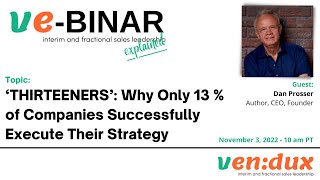
Dan Prosser explains why 13 percent of companies execute their strategy: leadership blocks employee contribution. His method replaces managing people with managing promises, using team accountability and software to track what's promised and what's missing.
Chapters
Well, as I say, nice to see some familiar names and, and faces. And to all of you, welcome. Welcome to this month's Vendux webinar. I'm Andrew Miller, one of the partners within the Vendux Group and I'm here with Henning, our founder and managing partner, and Dan Prosser, very special guest. I'll introduce Dan in a second, but just a quick housekeeping note. We'll keep everybody muted for the duration of the webinar. Then we'll have a Q and A at the end. So feel free to use the chat function in zoom to submit your questions. But we'll also open up the virtual floor at the end of the session and you can ask your own questions and engage with Dan as you wish. So Dan, really great to have you. Let me know a couple of, you know, words about you as an intro. For more than 45 years, Dan has been a successful entrepreneur, a CEO, a, a mentor, a coach, a team educator, a software developer, speaker and an author. His work with clients has created Fortune 500 and Inc. 5000, fastest growing and best place to work companies. Dan has been a chief strategist and he sits on the boards, sits on the boards of a number of organizations. His independent research into best place to work companies has uncovered a unique understanding of the distinctions within these exceptional workplaces. Distinctions that make them achieve two to three times the growth rate of non best companies. When Dan's not on the road with clients, he lives part of the year on a lake in Minnesota and the other part of the year in the great state of Texas. So Dan, with that, welcome, great to have you.
Thank you.
We're very grateful.
Great to be here. Thank you very much.
Absolutely. I love the concept of promise based management. You have opened up my eyes to this. I've learned a lot from you over the past few weeks and couple of months that we've been talking and I love your book 13ers, why only 13% of companies successfully execute their strategy. Great title. It's interesting. It begs a lot of questions. So Dan, right out of the gate, can you please introduce this concept and the substance of your book and your experience in this area?
Yeah. Thank you. And I'm, I'm glad to see people on this call. I, I appreciate everybody being here. Can you hear me?
Okay.
All right. All right. So I sold my last two companies back in 2001 and I was really struggling with what am I going to do? And I was working companies that I sold to, but I wasn't being, I wasn't Very happy doing that as most or many anyway, you know, entrepreneurs who sell their business. So one day I was, and this is where California by the way, plays a part in my, in my future. Back then I met a guy from Temecula, California and he had been doing the research or the surveys for, for best places to work for the Houston Business Journal, where I am. And he, long story short, he gave me two years worth of surveys and with the conversation that I was interested in finding out why the companies that didn't make it on the list didn't make it on the list. And so he went in the back room, came out with a big stack of green bar paper and threw it on the desk and he said there's this two years worth of surveys, go find out. So I spent two years looking at that and interviewing people and trying to understand by looking at the comments exactly what was going on in these companies. And it was through that that I decided that well, I think this is a thing, this is enough research to get started on a book. And so I began to write 13ers. Why only 13% of companies successfully execute their strategy? Well, you know, the reverse of that is 87%. And, and that's what I was discovering is that so many companies fail to execute strategy. And, and it's every year, it's not like one time, it's that every 87% of companies are not hitting their numbers. So it's not everybody, but it's a pretty big number. And the thing that I discovered about this was really eye opening to me was that the number one reason that companies were struggling with themselves was that leadership did not allow employees to contribute to the future, determining the future of that company. And I call that distinction contribution, of course, but it's not being willing to contribute, being contributable, not being willing to be contributable by employees. And the reverse of that is that companies are run by a lot of times by people who think they already have the answers they know. And so they don't allow other people to bring other knowing. And that's, that kills possibility, that kills people's energy. And when you already know the answer, that's the end of possibility. So it was out of that and understanding alignment and accountability and you know what, how responsibility plays a role and got down to accountability in terms of promise based management. And that's what you and I have talked about quite a bit actually, which is an exciting concept to me. It's something I discovered again California, I discovered it in the writings of a guy by the name of Fernando Flores, which anybody can look up. He was the Minister of finance for Chile. And in the overthrow of that government he went into prison for three years. But when he came out, he came to Stanford and he began writing about context in business and context in terms of computers. And he wrote the book Conversation for Action. And he wrote about commitment based management. Well, okay, that's one way of looking at it. And then other people have talked about it. There's other people who've talked about this concept. It's not something I invented, it's something that I've, that I've taken and applied to business and to help people to execute the strategy that they're failing to execute. So it's been a very effective process, it's been a very effective system. And then I developed some software to support that.
So a couple things, it's fascinating. How do you come up with these numbers? For example, the 13%, was that just based on your, your, your discovery, Digging into the two years of research that you were alluding to or is there something else? This. Well, 1387. And then, then I want to get into the, the guts of promise based management.
Okay, well again, you know, Picasso said, you know, copy everything. So I did, I went out and I did my research and you know, it's all research, it's all what other people have said, you know, pulling it together. You know, it's, you know, Harvard Business has studied this quite extensively and I got that number from them. You know, I, you know, it wasn't just oh, I saw the number but it was actually understanding, you know, what is it that's going on in these companies. And with so many failing to execute their trade, that doesn't mean that they don't, they're not profitable obviously. It just means that they're failing to fully, they make a strategy but they don't fulfill on it entirely and it costs some money and they're capable of it and we can show them how to do that, but still doesn't happen.
What, what is promised based management? And, and how does this actually form like the backbone of your system to help companies?
Okay, well promise based management is just like it sounds, it's promise management. It's a way of managing where you literally stop managing people and start managing promises. So what I discovered in this, in this research was that there was just a lot of conversation in these best placed and non best place to work companies about micromanagement and how, I mean I just looking yesterday at a company that you know, they, employees get very upset and about the way they get treated and dismissed. And so the key to promise based management, number one, is that everybody who is executing strategy and in an organization contributes to the creation of that strategy. It's critical because if you're not contributing to it, you don't own it. And so when that, I mean I've worked in corporations and I see how they pass down, you know, they, they start with, this is, this is years ago, they, they would do zero based budgeting but they would tell you, here's what we're doing. So you make your budget fit that. Well, I didn't have anything to say about that. So it really wasn't my, wasn't my vision, it wasn't my mission. It was just I was there to get the job done. And that, that does not create best place to work companies because it didn't allow me to contribute in any way that was meaningful to me as a, as a, as an employee. So that's where it starts then understanding what it is that's running the show. Now I talk in 13ers about a hidden context. And this hidden context is, I call it a meme. It's a viral concept. It's a conversation that's limiting, it's negative and it undermines and sabotages performance in companies and people aren't aware of it. So when we dig into that, we find that there's a conversation hidden in the background, hidden where people are actually in this conversation and it is actually affecting their behavior. So when we discover that and we can replace it, we can then move on to creating a future based strategy that actually where people literally, figuratively, I guess really is stand in the future in a possibility that they declare which is which we prefer to be seemingly impossible. We don't want them to see that they, they could achieve something. We want them out there playing a much bigger game. And so standing in that future, we ask a different question. We ask what's missing. That if it's not missing, you'd be in that future. That future would be reality. Another way of asking the question would be how did we get here? Okay, so once we have that strategy now what we want to do is we want to actualize that strategy. We want people to champion the strategy and take it on and make promises, to execute, to take action and report back. And so promise based management is simply managing promises instead of managing people. You know, yes, you're going to evaluate people's performance, that's no question. But what we want to do is we want to take the individual out of the equation and we want to create the relational. So with the individual it becomes transactional. And then with the relational, you're creating a relational value system. People feel a part of something, they feel valuable and now we're asking them to take action. People are making promises to take action. Now the team becomes the primary force instead of a manager driving people's performance, telling people how to do things. Now we bring the team together in a way that people who are more experienced on the team can contribute. Again, we're back to contribution. And so promise based is managing promises. We use a strategy execution system. We use software to manage it all that we developed.
I see. So we'll get that into that in a second. In the world of sales management, right. The, the vast majority of are the executives within the Vendux roster. These are sales management, sales leadership professionals managing large numbers organizations, remote multi regional, multi continent organizations and workflows and processes and numbers. In sales management. How would you, you know, draw the line between managing a set of numbers and quotas and quantitative objectives versus promises? You know what, you know, how does that work? What's, how do you distinguish or is, can you distinguish from a sales management perspective?
Yes. That's a really great question.
It really is hard objectives.
Yes. So, so when you're managing numbers, it'd be like, it'd be like an NBA coach aging against the scoreboard. You know, NBA coach and, and I live next door to one and a best friend of mine who just died as an NBA coach. They did not manage the scoreboard. They manage the action on the, on the, with the team on the floor and the team self managed. We want that. But if you look at the numbers in business, and I was in the business of providing those numbers at one time, those are not future based numbers. Those are lagging indicators. They're the past, they're historical. You can't manage a business on that. Some people try. I mean many people do. Most people do. But a promise is a leading indicator. It will tell you what's going to happen. If you're managing them, it's an asset to the organization. It becomes, it's like an asset on the balance sheet. But it's not a balance sheet item. But you're managing it like you would a balance sheet item. So we're looking at leading indicators. Now when you're managing a sales team and you know, when we manage sales teams, we know what it takes to get the number, the one sale. We know how many Prospects, we know how many contacts, prospects, proposals, presentations, we know how many it takes to get that one. It's a, that's a numbers game. But it's, but we're not playing a numbers game here. We're playing a relational game where everybody contributes. So at each layer, at each level of that funnel, we're asking people to promise to take those actions. And when we take, when they take those actions, they get the results. I mean, they know what the results are going to be. So the promise based management system, the promise management system is actually managing the promises. So people say, I'm going to do this many and this many and this many. And then they come back the following week and they say, well, here's how well I did. And so we're, but we're not measuring, we're not overall measuring on the individual. We're overall measuring on the team. We want team performance. We want to focus on the team, not the individual. Because the team has the relationship now. The team gets interested, you get peer pressure happening. It's like we're keeping the tension in an organization, which I think is very critical. Something I learned from an orchestra conductor, that's his job, is to keep the tension. So the system is designed to keep the tension. We're going to measure that. And what we've noticed is in using this, this kind, this system, this accountability scorecard system is that the P L, the score tracks with the promise, promises kept. So it's just an, it's been a real eye opener and anybody who's used it has had extraordinary results.
Can you cite one or two examples of the work that you've done where you know, you, you went into a situation, this is what it looked like, and you brought this system in and the results went to some other level of growth or impact?
Yeah, the first time we used this process, the system was with a group inside of a CPA firm. They were the consultants and as it was explained to me, their performance was little more than lackluster. They were about to get bounced from the company if they didn't improve performance. So they gave me that as my, as a challenge and I sat down with them and took them through the process. And then every month, in this case, every month, and with a sales team, it would be every week, but every month we would review promises. Kept me in fifth month. In the fifth month. This is a 12 month process. They came to me in the fifth month and they said, we have an article that we're going to put in our tabloid news. You Know our tabloid publishing that they sent to clients and they said we want you to review this. Well, I read it and what they said was they had, they had grown revenue by 60% in that five months which was unheard of in that organization. And they dropped write offs from 30%. This has had them in real trouble to 5% and it was going down from there. So they were pretty excited. So that's a CPA firm where numbers are very important. Obviously that's their business. One of the next companies was a company that they told me that they were a art consultants to the hotel industry. That's what they told me. And that they were in fear of losing their, their lease because they were underwater. And they asked me if they'd come, if I'd come in and help them. And, and so we went through the process with them and took them into what I call the connection points that are in the book that you know, the, the contribution and the different connection points that I outline in the book. And the end result was they, they landed at number 2245 on the Inc. 5000. So we did a good job there as well. Others have had similar results, just a variety of different kinds of companies. It doesn't really matter what it is, but it's had some spectacular results. Promise based management is a very powerful tool.
So if I take that and I, you know, I put it into a different context or you know, in this, in the notion of let's say bottom up budgeting or planning where, so I'm managing teams and the divisions, you know, and to your point about leadership and ownership. So if I, if I'm working with my team and you know, I'm providing the, the big picture objectives, this is where we are today, this is where we want to be 12 months from now. So what are you folks going to be doing in your parts of the organization to take, you know, to hit a 22% growth rate if that's the, the big picture target. And then I leave it all to them to come back with their, you know, their zero based or bottom based budgeting and planning to come back where they've, they've done the planning, the budgeting, now they own it, now they come back and present it. Is that, is that a version of promise based management?
Well, it could be, it could be. I think the most important aspect of the strategy process is the process of identifying where you are currently. I call it the map in the mall. You know, you are here. So marketing, finance, sales, you know, every single one of the the aspects of the company that need to be managed. Where are you, you know, on an objective basis? Between 1 and 10, between 0 and 10. Where are you currently? Where would you say you are on this? And they will give you a number and then, then you're going to ask them, well, if we're going to achieve this massive, seemingly impossible goal, where do we need to perform? Well, it's usually a 10. Okay, fine. Now let's just say we've got sales and they're performing at what they say is a four or a six. Well, here's the thing about that. That is really exciting is that that creates a gap. So there's a gap that becomes visible. Okay. Now, most people that I have met in business kind of have a resistance to having a gap because they see it as being a weakness, and that weakness is actually where the opportunities are. So let's just say we have a four in sales and we need to be at 10. We got a gap of six. Well, what's it going to take to close that gap? Now we have a different conversation going. So that becomes a strategy. And so it's everybody's response to identify what's missing, because everybody has a different perspective. And in this program, perspective is everything where you're standing, you know what your perspective of the past is, because the past perspective is going to impact your future perspective. A lot of people create the past again because they're looking at it from a standpoint of we got to climb the ladder to get to this future as opposed to standing in the future and asking what's missing here and then making a promise to produce it. Not complex. It's not complicated. It's just, you know, I'm sure that the people on this call are very familiar with this. It's not. Yeah, it's just, how do you, you know, how do you teach somebody to do that? You got. It takes some rigor. Takes. It takes a bit of rigor to bring people along. You've got to. First you got to enroll them in the concept, and then you've got to get their buy in. They got to register. You know, I'm. I'm in when they are. When they're in, they're in. Yeah, but you got to enroll them first, you know, and that's a.
That's a good segue to, to start opening up the floor to questions. I, I saw one through chat Henning, if you want to ask that question or if you want to open up and. And unmute. If anybody wants to chime in and, and ask questions. I do have a couple of more if there's no if I got a cough.
Yeah, there's one just clarification question that came in from Evans, which is the one about the size of companies that were involved in your research. Dan, what size companies were part of that analysis that you did?
Well, of the best places to work, they range. I'm sorry, I'm gonna, gonna lose my voice here. I think I explained to you guys, I had a little Covid episode here and it just seems to have hung on for a month with a cough. Okay, so the size of companies were, they're all over the board. I mean in best places to work, they, they categorize it in different size of company. I had the results from all different size companies and I was particularly interested in the larger companies because when I visited them it was unbelievable the things I heard. It was just how can people actually treat other people this way in a business? And I didn't do that. But then there were small companies like even the. I apologize. You guys.
Have some water. So I've got a question about, you know, the execution of promise based management with the focus on the promises as opposed to the individuals, which is one of your, you know, the key premises of promise based management. So I've got the promises, the budgeting, the planning has done, has been done kind of bottom up. Individuals are taking ownership. They're making promises to execute to goals and processes. We do quarterly reviews, half yearly. Things are not happening, execution is not happening to the plan and to the promise. What do you do? Do you focus on the promise or do you go back to. But wait, you promised, I had your commitment, you said you were going to do this. So then when, when the tables are turned, what do you focus on?
Yeah, that is such a good question. So in promise based management, people don't keep promises all the way. Okay. They don't always keep 100% of their promises. And so what do you do? You know, you're managing. So they said they would do X and they did, you know, they said they would do 10 and they only did six. So you know, what is the old patriarchy approach to things? You know, we get on their case about it, we try to micromanage them, you know, tell them what to do. Well, in promise based management, we're asking that same question we asked when we're doing the strategic planning. We ask, well, you know, John or Andrew, let's say Andrew, you said you'd do 10 and did six and okay, and so there's a gap. There's a gap there. Right. So we're managing gaps because that's where the opportunities are. So we're asking them what's missing? Like if, if it wasn't missing, there would be a 10. Like, like. So that's the feedback. So what we want is feedback. We want to find out where's the weakness, where are the weaknesses, where are the gaps? And now we can address that. We don't have to address the individual. We want to find out where is our strategy, where are the weaknesses in our strategy, that if we didn't have those weaknesses we would have performed better. So you're always working at it. You're never done with your strategy because you may have it wrong. You may thought it was one way, but then from experience reality tells you it's a different way. So how do we manage that? We don't tell people they need to do their job better. We ask them what do you think is missing? What would improve performance here? And then they get to contribute that again. Now you end up with a team that's actually engaged in producing results.
Yeah, that, that, that's a good point. It reminds me of my managing consulting days where, you know, so much of, of the work revolves around gap analysis and filling in those gaps. You know, you go into a situation and it looks like this and the organization wants to get to this, okay, what are the gaps? What needs to be done to, to, to achieve those goals? And it's, it's very much those filling in the gaps. I understand.
Yeah, but with a different question. Not how we're going to get to that, that new number. But hey, what's missing? What's missing in our organization, in sales, marketing, finance and going back to the budget, that might be, you know, an appropriate thing to do. Because what we're asking is what's missing in this finance area? That if it wasn't missing again, if it wasn't missing, we'd be there. So then we're not there. What are we. So we're going to go back and we're not going to go back and do a new strategy because that's where most people go. They say it's not working, so they go back and they do the strategy all over again. Yeah, you know, it's not the strategy that's the problem. That is not the problem.
Dan, Dan, another Dan put in a question. If there is a limit to the number of promises that you should focus on.
I've never actually encountered a problem of having too Many promises. Because there's a, I mean it's, it, there's a reasonable number and people when being requested to make a promise, requested something and a promise as a result have the opportunity to negotiate. So if somebody feels like that's not, that's too many promises that you're asking me to make, they can negotiate that. There's, there's room for that. And everybody gets an opportunity to make promises. So let's take the CPA firm. Everybody championed a piece of those missings, so we focused on 10 of those missings with, with that team. And there were 10 people on the team and everybody took an aspect of the strategy and then made promises to take action on them. And it was, it was me. I don't see it as a, a necessary thing to limit the number of promises. I think it's necessary to look and see what's reasonable to take on now and then add later once we achieve once, once we keep the promise and it produces the result that we want.
And then there's a. I tell you.
It'S a lot of fun. It's really a lot of fun to manage promises than, more fun than managing people, you know, because that's hierarchical and, you know, patriot, you know, paternalistic and, or maternalistic in some cases. And nobody wants to work for that.
Evans, you unmuted yourself. I, yeah. Another question.
Henning.
I have a lot of questions. Hey, Dan, I've been around for a long time. I've never heard of this concept. This is really fascinating to me, so maybe I'm behind the eight ball here, but a couple of questions for you.
At a high level.
How are you managing the outcomes of the promises? So we've set up these promises for this quarter or this month or this half year. How are they measured?
Okay, that, that's awesome. And I'm glad you're asking it because I probably didn't cover it very, very well. So that was a concern we had in the very beginning. And so what we did was we developed a piece of software. I've got developers over in the Ukraine who are now in London, of course, but I went to them with the problem and I asked them to the engineers to work with me on promise management. Now I had done a beta site with some, with Indian developers and it was very difficult, but it got proof of concept. And so then we develop the system so that when you make a promise, the promise goes into the system. Okay. The promise is made, the number is assigned. I'm going to do this. Then when we, so it's in the system, and we're asking the system to manage it as a team. So then we come back a week later or a month later and we say, okay, you said 10. How many did we get? Well, we did six. Okay. So now we put six in there. So we're measuring the gap. So we're measuring performance on a team basis, not on an individual basis. And the software manages all of it. And that's how we. That's how we're able to see the tracking of the. Of the P and L, along with the keeping the promises. Fascinating to watch. People love it because it's. They're engaged, you know, and the tension that gets. Created. The peer pressure, I mean, we'd call it peer pressure. I. I got. I was on the board of a. Of the symphony here in Houston, and I asked the orchid, the conductor, what. What does a conductor do? And he said it was German. He said to keep the tension. That's what a conductor does, to keep the tension. That's how he makes a. So I applied that to the workplace. You know, when people keep the tension, they're making promises, they're taking action. So it's a promise to take action. Does that answer your question?
Yeah, it doesn't.
And you had answered it earlier. I just wasn't that clear. So it really is a software that's kind of tracking and looking at the gaps between the two.
I got it.
And then just one more for me is you mentioned enrolling people, and I'm sure that is a challenge. So talk about the philosophy around. How do you enroll somebody in this? You know, how do you get the buy in?
Yeah, yeah. Well, let me ask you, are you enrolled? Am I enrolled? Yes. Like, are you. Are you curious, interested? And like. Okay, this makes sense.
Are you asking me or are we.
Yeah, I'm asking you as an answer. Yeah. Yes.
Yeah.
Okay. So you're enrolled. Okay. So now, Evans, what if we worked with you to provide that within the whole company? Yes or no?
I would say yes. My question would be.
Okay, so that's registration right there. Right. Okay. And people collapse it. You know, people tend to collapse that. Like they're going to get enrollment and registration done at the same time. And you've got to be careful because if they're not enrolled, they're not really registered. Right, right. And I'm just using those as distinctions. Nobody. Nobody registers.
I understand.
Yeah.
Yeah. Good. Thank you.
Yeah, thank you for that question.
Dan. Even with no software and no system, what is the level of the critical success factor to having promises transparent and open among everybody in the organization as opposed to just a one to one relationship between a manager and the managee. It sounds, it sounds like a critical success factor is to have that transparency so everybody is aware of each other's promises.
Exactly. And it's not. We're trying to take the manager, you know, out of the equation of managing people and telling them what to do and turning it over to the team so that the team is really determining are the factors that need to be managed, that need to be promised against. So they're all involved in that and we're literally teaching teams to self manage now. So they're, they are running the show and there's the manager keeping the tension. So I mean orchestra is really a great example. I've sat inside orchestras and they think it's funny to blow their horns in my ear, you know, like that kind of thing and. But what's going on? I'm watching this world class conductor do a, you know, do a rehearsal. And what's he doing? He's making little corrections, suggesting things. But these, these musicians who are ex, I mean they are superstars, many of them, they're managing together, they're listening to each other, they play with each other by listening. So it's, it's an orchestra. But you got the one guy, all he's doing is keeping the tension. He's just at the podium. It's really fascinating and I've actually seeing that happen as a demonstration. But sitting in an orchestra is a fascinating experience because you get to experience what these musicians are doing with each other. And that's critical. That's the key factor right there. Everybody's contributing to everybody else. And yes, you're right about. They get to say they don't have this wondering what's everybody else doing? I'm working, I'm pulling my weight or what are they doing? Everybody knows it's published, it's public. Public.
I think Rob has a question that fits right into this. What happens to a team member that never seems to keep their promises? You've talked about peer pressure, so how does that work with the team?
Well, I'll tell you my experience is that people who don't keep their promises tend to diesel and they there. So I know when I had employees, the way that I would work with my employees that weren't working out was I had a commitment. So I always started my conversation with somebody I was about to terminate with my commitment. And my commitment is that I'm committed to the Possibility of a world where people love what they do and have what they want in every aspect of their life. So I'd sit down with an employee and I'd say, hey, you know, I have commitment. My commitment is people loving what they do have. Okay, but you don't seem to be doing that. You don't seem to be having fun having what you want. You really want to do this. And they say, well, you know, I'm struggling with it. Well, I said let's go find something else. Let's work together. So there's, you know, there's ways of managing people where you don't have to come down on them and manage the individual and the team can have conversations with that individual. It's relational. You're building a relational value system here.
Now.
And that's critical. Instead of the individual transactional value system that non best place to work companies end up with.
Excellent. Any other questions?
Was one more.
Go ahead.
There was one more from Chris who already had to leave the call. But how does your approach, Dan, the, the promise based management, how does that mesh and blend with all the other things in business? The, the. What Chris calls the great game of business approach, how does, how do those two mesh?
Well, okay, I would ask, and I don't want to be flippant about this, but I would ask how great is the great game of business when things aren't happening effectively? And so, you know, we're trying to change the paradigm here. We're trying to change the model and the model gets changed at the edges, you know, and so we're, we're working at the edges of this and working in. But so when I see great game of business, I'm not quite sure about that, what that is, and maybe I don't know the acronym or you know, is it something, is there something called the great game of business? I don't know. I think this is the great game of business.
Actually.
I think that's a good answer. I think the great game of business is just referring to the what's classically being assumed as that's business. And any, anything that changes and your approach is a change is. Is something new. And, and it's not just a change at the fringe, it's a change at the center.
Right?
Yep.
Gotta change the model. And the way to change the model is change the perspective. Perspective is everything.
In this situation or. Andrew, you want to.
No, I. Thanks. I just saw a, I just saw an interesting question from, from who says this? First of all, a great discussion. I relate to what a lot of what you say. And then the question is how does this differ from MBO management by objective?
Well, MBO is certainly somewhat of an aspect here. I mean we all have gone through mbo, you know, we're going to set objectives and manage by objectives. But MBO and my experience, now this may not be everybody's experience, but mbo, but my experience is where you start at the bottom, at where we are. We're here and we're going to work towards the objective. Management by objective. Okay, we got the objective up here, but we're going to climb the ladder. And the perspective is from the past when you do that. And so you have a past based, you have a past based strategy. And what we want is a future based strategy, one in which people actually stand in the possibility of that future and come from that. And when we come from that, we're, we're still managing, you know, we're at the objective, you know, with ourselves, we're standing in that objective and we're asking this different question. How did we get here? What's missing? So MBO doesn't typically do that. They'll find out what do we need to do to get here and you know, from here to here. And that's, that's pass based. Nothing wrong with that. I mean people do it all the time. What, you know, that's the way a lot of people do do their managing. I, we're just trying to, again we're trying to change the perspective and change the paradigm and promise based management seems to be a very effective way to do that. Now Evans, you should go out and go out and Google promise based management and commitment based management. See what people are saying because there's, there's some good writing out there that might, you know, introduce you to the concept.
Better, not better.
But I actually did while we were on the, on this call. So I. Oh, you did?
Good for you.
I did a quick search.
Yeah. Did I show up?
You were in there.
Okay, good news. There's another question in there, I think.
Yeah, maybe one more question here, Dan. Dan. I think it's from Dan Belling who was at the airport. So what if you turn the tables around, what have you seen in these fastest growing companies, successful companies, the 13% that where the company is promising to the employees. And what is that? What does that paradigm look like?
Well, yes, so the company is made up of people. So people promise. Companies don't promise. So if there is leadership in the company, leadership can make promises too and it can be measured. And there can be gaps to design what needs to be promised. So let's say we go through just a strategy, the strategic planning. Then one of the things that comes up missing is, I don't know, make it up. Something to do with having to deal with human resources, some benefit or some. Something that only the company can provide. But leadership has to champion that. So leadership can champion that. And they say, hey, if you do this, we'll do this.
Great.
That's a promise. The companies don't promise. And, you know, I mean, I know when we say company, and I don't mean, Dan, that here, I know what you're saying. Leadership of the company. But they're people, so, you know, they can promise just like everybody else. And it can go on the scorecard.
Excellent. All right, well, we are, we're way past our allotted time, but this is really, it's interesting, it's engaging, it's. It's mind expanding.
Thanks. Me too.
Any other final comments or questions from the group here? If not, we will close it up for the day, for the month. And Dan, thank you very, very much.
Thank you.
Your participation, your thoughts, and helping us to become more. More enlightened people.
Well, say goodbye to Harvey, too. He kept me company the whole time. Well, he sat next to me the whole time.
That must be one very enlightened dog.
He's, he's, he's gonna start teaching this pretty soon. He's sick of hearing about it. True.
So maybe at some point there's an opportunity to, I don't know, share. Share your book or. Share.
Absolutely. If, if anybody emails me. Dan. Dan Prosser.com. that's the simplest way to remember it. Dan, I'll be happy to send you a PDF copy of Thirteeners by return email. And if you have any other questions, please email us. You'll find us at faster growth strategies.com faster growth strategies.com or fgsconsultant singular.com fgsconsultant because we're teaching this to consultants now, and we're going to put together our first class on that very shortly.
Excellent.
If you're interested. Okay, so I hope to send out some books here.
Thank you very much, Dan. Thank you, Henning. Thank you, everybody. Thanks for being here. Your participation, your questions and engagement. Again, have a great November Thanksgiving and we're grateful to all of you. Dan Prosser, thank you. Thank you.
Andrew Henny, thank you.
Thank you, everybody.
Bye Bye. Bye. Bye.
More from Henning




ve-BINAR - The Revenue Tornado Methodology: How 3 Power Sources Create Exponential Growth


ve BINAR: Executive Cloning: How AI is Reimagining the Role of the Fractional Executives




veBINAR: Unlock Client Value: Why Compliance is Crucial for the Startups You Serve
