veBINAR The AI Human Paradox
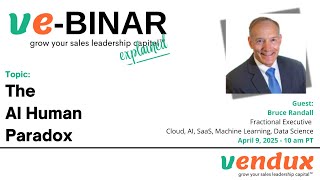
Henning Schwinum and Bruce Randall discuss the merging of human consciousness and AI, covering neural implants, agentic AI, and in-body sensors. They examine ethical concerns around access and belief-based objections, then focus on how AI reshapes sales through lead generation, analytics, and LLM workflows that turn transcripts into actionable data.
Questions this video answers
April 9, 2025.
About 45 minutes (conversation ~25–30 min plus Q&A).
"Within the next, I'd say four months." (speaker quote).
LinkedIn: Bruce D. Randall.
Chapters
Welcome, everybody. Welcome to this webinar. This webinar, as we call it, of ours. We're very happy to have Bruce Randall with us and he'll be introducing himself shortly. We're here to talk about the AI human paradox and in the little warm up conversation that Bruce and I had, we already got very philosophical about it and I'm really excited to explore this topic with him. A few housekeeping notes. We'll ask everyone to stay muted during the course of the webinar. That just enhances the sound quality. And we'll do about a 25, 30 minute conversation between Bruce and I and then open it up for Q and A. We're happy to take questions if you're watching us on LinkedIn Live that you can put into the comment box. You can also put questions in the chat on Zoom and otherwise, if you are on Zoom, then please go and stay with us until we open the mics for a more formal Q and A. Bruce, we're here to talk about the AI human Paradox. Tell us a little bit about yourself and how this topic became a topic of yours. Because as we said in the warm up at our age, nobody was born and said, I want to become an AI expert, since that wasn't around at the time.
That's very true. So I've been in software sales for about a decade and in with that came cloud and AI. And when I saw Neuralink put the chip in Nolan's head and he could control the mouse with his thoughts and he said, sometimes it moves before I think. And then I've taken MIT courses on data science and I'm building an AI application right now. I've read a number of books and talked to a lot of experts about this. So I've become a thought leader and done about 23 podcasts on AI. And what the book is about, it's about bringing consciousness together with AI because they both got one foot on the bridge. And we don't know where or when or how long it's going to take or even if they're going to connect, but we think they will.
So today, most of us using AI tools today have a clear separation because we know when we're using an AI tool. I know that when I go to NotebookLM or ChatGPT or any of the other tools that I am using AI, and then there are other events in my life where I don't use it. When I sit on the front porch and drink a glass of wine with neighbors, I'm not there to to use AI. But what you're talking about is that these two pieces will merge and will be together at all times.
Well, it's, it's yet to be determined, but with Nolan getting a chip in his brain and being able to use telekinesis, when you put it in a human, you have both consciousness and intelligence. So that's, that's the quick way to do it. When you work with AI, with all the different types of AI that are coming out, it's getting more intelligent. And Bernard Mar put a post on LinkedIn saying, Do you think AI will ever be sentient? And there was mixed results on it. So the topic is out there. There's not a lot of people that can talk about it because they're, they're strictly AI, but I'm meditative and AI and I can reflect on that better than most. So that's what I talk about.
Are there what I would label, like different flavors of AI, different formats, where that connection is more prevalent than in others? Will there continue to be purely AI tools and purely human interactions?
Well, right now there's AI tools and human reactions. And that is unless there's the, you know, three or four people that have a chip in their heads or they've got a bot that put in their vein and it's reading everything in their body, which this technology is, is happening now or has happened. So it's real, it's just not real public out there. But what I see is, I see AI progressing because we've got agentic AI now that can actually make decisions and take actions, although it's not out there in, in a lot of fanfare yet. And we've got AGI that it's reports that Google has that they're just not opening the door to it yet. So it's advancing very, very quickly. And if you're into AI and you're studying it every day, you're seeing the daily advances or every few days the advances that come out. And that's very fascinating because right now in the lab they're growing brain matter with AI intelligence. And that will never be sentient because it's grown, it's created. But there's, there's all different ways that AI is being propagated now. And it's because it is so new and so intelligent and there's so much potential there that. And there's no rules on it. So everybody's trying to create what they can, just to see what they can create and to get new reports out there.
Well, I mean, obviously it comes with Risks. And if there is no, if there are no rules, it can also be abused. So what should someone like me, the common man, be looking out for? What should I expect to happen in the next five or ten years?
Well, five or ten years is actually a long time when it comes to this because we're looking at robots that can come out and do your house chores that are AI based in the next year or two. So it's, it's coming to a home near you as soon as they perfect that. And they're, they're enablers. They're supposed to enable us in many ways, whether it be on the computer and the apps we use or whether it be with, you know, the pending robots that are supposed to be coming out and they're supposed to be affordable at some point, and that will be know, beg the masses to, to bring them in, to help them out. What you can do to protect yourself is really just, just your normal protections, your cyber protections, your, you know, two, two types of authentication on your accounts and so forth. AI is not a, is not being used for nefarious reasons, that I can tell, because that's under the radar and that doesn't get published. I'm just reading what's above the radar, which is all the good things that we're doing. But with the, with the speed that it's coming out, it can really, it's going in many different directions and nobody knows where it's going to be in six months, never mind a year, because it's, it's moving rapidly. It, it's moving. When Cloud came out, it was moving very rapidly, like Cloud three months was a year. With AI, you've got in some cases a year progression in, in just a few months. So it's moving very rapidly.
So for your book and also for this webinar, we use the word paradox when we describe that relationship between humans and AI. What does that mean to you? Because you chose it first for the book.
Good question. Yeah, I chose the Paradox. It came to me in meditation because, you know, we can't, we don't have enough information to determine if it's going to be mostly good or mostly bad. I tend to believe that it's, it's going to be mostly good because what neuralink is doing is they're, they're putting the chip in quadriplegics to give them a way to mix into the public and be able to have a better life. The next thing they said is they know they can hook up to the ocular nerve and they can restore sight or they believe they can do sight. And he said, there isn't anything we can't do. So it's just a matter of making the connection. So when you take a computer and you're building something, if you can connect it and you can get the software to talk to each other, you can do it in a human. If you bring AI into the, into the body and you can get it connect, you can pretty much do what you want as long as you can get the connection going. So it's bridging the gap. It's early stage right now, so not a lot of people are really looking at this. But because it's near and dear to me, and with the AI I'm working on, it's building applications and working in the data science. But also it is the holistic part that deals with the cutting edge that the medical community is doing right now. And the medical community, a lot of what they do doesn't always get out, but the AI that they're doing is getting out because they want to show that they're advancing in this and that they're going to be a leader in this. And. And I'm sure there will be leaders that come out. But in my opinion, we're still going up the bell curve of AI. We're not at the top. And I've met people that have said they disagree with me and they think we're at the top, but I don't think we're there yet because there's still a lot we don't know. And, you know, there's some pullback now. There's some data centers that are being jettisoned by some of the larger companies. So nobody's made money with AI. So the fact that they haven't made money with it, you know, the boards are saying, look, we, we need to reconfigure this because we can't keep spending millions and billions and not have a return. So it's that mix that's going on right now that shows that we're still going up that curve. And when we get to the top of the bell curve, then, you know, the strong companies that have something that the people want usually are emerging there, and they get stronger as we go down the curve. So we're still, we're not up there yet. We're still in the developmental stages and very much in that area.
So you describe projects in the, on the medical side where disabilities or defects can be corrected using it or physical functions can be enhanced. You describe the robot, and certainly A lot of the other tools that are out there today, they're designed to make mundane, non value added tasks to be automated and to not take our time as humans. So those are sort of two types of projects. What other types of projects are out there where we're bringing humans and AI together?
Well, there's projects dealing with inbody. For example, one of the companies that's out there has, has cut the carotid and put a, put a, a pill in that has bots in it and the bots dissolve and go over the body and they can read any part of the body. Now this is real and it's happening now. So that's something that is giving a big advance for medical community because it can tell you what's going on inside, you know, in a real time basis. You've also got, you've got agentic AI which isn't, isn't strong yet in a lot of places, but agentic AI can actually make a decision and press the button where, you know, previous AIs haven't been able to do that. And that's in the development stages right now. So you've got cars that, that have AI that, that drive themselves. And I don't think that's been perfected, but it's getting there. And you've got AI and you know, in some level in traffic systems, you've got it in aviation to some extent. So it's, it's getting out there slowly but surely in a vetted way. And when I was selling software, the apps that we were selling six years ago had AI in it. We just didn't tell them it was AI. We told them was smart analytics. Right. So it's been there, but since the LLMs have come out now it's been mainstream and now everybody's talking about it because now it's on their computer and they're working with it. So now it's, it's real because it's in front of them.
I know there are experts out there who look at the relationship from an ethics point of view. In, in your observation, do you feel there are ethical boundaries, for example, that shouldn't be crossed? Are there things that are happening that are, that you wouldn't consider ethical or are we still in, in, in the right space?
Well, you know, that's a very good question. And ethics is really based on the person looking at it because everybody's got a little bit different ethics and it's based on opinions and belief codes. So that's where the ethics come from. My, my perspective on it is that we need to be careful in that area because if you have, for example, religious beliefs, you may be violated before somebody that doesn't have religious beliefs. And that's a belief code. Right? That's what that comes from. And when it comes to things in the body, although it's benefiting some people, their comment in their first press release was, well, if you have the money and you check out health wise, you too can have a chip in your head. Right? So it's open to those that can afford it. And that pressure was just kind of open it up for me. I'm like, really? It's commercial. I mean, it's a select group of people that could afford that, but it's commercial now at some level. And they haven't pushed that any further, probably for good reason. But that's where it started. And where it will go from here is really anybody's guess. And ethics is really up to the individual.
Right. Right now we, we have a lot of sales leaders, people that are in a, in a career that you were in prior to what you're doing today. What can they expect when they, when they take on sales leadership roles in companies?
Yeah, that's a great question. AI is an enabler. So you can get more data on your salespeople and you can get more data on what you're offering and you can feed it into AI or you can build a lead gen application to go out and have conversations online and bring leads into you. And then when you feel your, your team goes out in the field, you can arm them with different perspectives that can get attention of people and they can incorporate AI into what they're offering. It's in analytics now. Right. And that's really the core of, of most, most companies. But in sales, the more information you have on the prospect, the better off you can make the presentation. And with AI, you can get all kinds of information on a company or an individual. You can get personalities based on the profile that you put in on LinkedIn. So you can really understand who you're going to meet before you get there. So you can make a better impact and make more sense to them because you know the personality that you're going up against trying to help out or if you go in the old fashioned way, I call it. Right. It's just how you and I did it, Henning. Right. You meet somebody and you start with a small talk and, and, and you figure your way through. It's like getting a jump start to that process. Yet you have a Lot more information going in and, and you can get there faster.
Now, the, the, on the sales side, there are also, there's also a lot of things where, a lot of situations where AI is taking over the process. So it's not just about gathering information prior to a sales call, but you might have a bot engaging you, and the idea would be that you don't realize it's a bot.
That's right.
While, you know, maybe today, we're not quite there yet, but your point about rapid advancement will very, it will very soon be such that you might be speaking to somebody, you think you're speaking to somebody on a zoom call about a product, but it's really just an avatar and not a real person.
And keep in mind that AI is a software program. So you program it and it comes from a repository. So even when you create an AI agent, you're programming in what information's there and you're programming in some of the responses. So you can tailor that and you can put just a regular conversational prompt or you can put a more formal prompt. You know, you can, you can program however you want to build that agent. And, and depending on the market you're going to, that's, that's how you'll frame the agent and the responses.
And now do you, obviously, from a, as a, as somebody who's grown up in sales and made a career in sales, do you look at those developments as something positive or something just inevitable, or is it at some point something negative because there's less human interaction in the, in the entire sales process?
That's a great question. And some of the old timers will look at it as, it's negative because they don't want to understand it and they don't want to use it. But when we come more, center stage is an enabler. So it's helping us get to where we, we want to go. The information, there's more information available. There's more analytics available for this. In fact, I used to look at my sales people and I used to do the numbers based on the appointments and their hit ratio and so forth. And I used to train them based on their, on their numbers. Now you can get an AI to look at the numbers and tell you where they need help, and you can even send them some links to help themselves before you, before you help them. I mean, it can be a whole turnkey system and, and if the person's going to accept that and they're going to listen to that information and they're going to respond to it, they're going to show better numbers. So it can be all automated, it can be a mix, or you can just do it the old fashioned way and talk to people and they all work. It's just a matter of your vertical, which one works best.
And verticals, for example, defined by what it is that you're selling. Right. If you're selling a widget for $500, you can invest a lot of sales time in that. But if you're selling, you know, in an enterprise environment, million dollar software installations, then you know that human element still is very, very important.
Yeah. For example, the AI can, can look at the 10Ks, can look at the annual reports and pull the pertinent information out and you have that all in a short period of time. And then you look and you say based on what I have and based on what the 10k says and the annual report, now I know where my opportunities are and where they're not. That's just one example.
So when, I mean, I use a number of different AI tools and every day I'm on this roller coaster between admiration for the just phenomenal analysis and guidance that it provides. And then the next moment I turn around and I see that it totally misinterpreted a conversation, for example, and didn't get the context right and the recommendations are totally off. So I mean, where would, where, where do you see the, the in specifically for sales tools? The, the direction going in the next six or 12 months. We're not talking about a year, five years or 10 years, but just the next six or 12 months. What, what are the things that AI scientists and developers should be working on in this time period to make the tools better?
Well, I always say if it's something very important, trust and verify. So you have, you trust what you get and you have to verify it. Like I, I use perplexity a good amount. They give me the sources that I can verify and if something doesn't look right, I can check back and look at it, which is a good thing. And, and you can ask for sources also when you go into other AIs. But I think in the next six to 12 months, you know, AI is progressing quickly and I think that it's going to increase its presence in sales and marketing more than it is right now. But to, to say where it's going to be in 12 months because that's one vertical in, in a whole mix. It's, it's hard to say, except that it will be more capable in 12 months than it is Right now. And you probably, based on the, on the data that they're using, you probably wouldn't have to test it as much. And one thing that I've predicted, and it's starting to happen now is went from data silos to data lakes and now we're starting to go back to data silos. And the data silos are where there's true data and there's accurate information for that vertical or that profession. And it's happening in the medical field right now. So when you get those verticals and sometimes those silos, you have to pay to get into them. You know that what you're getting is accurate and you don't have to check it. And it's, it's true data, which is sometimes a mystery to find depending on the organization that you're in. So that I see that continuing. I don't know how broad it will be in different verticals, but it's starting now and I see that propagating.
Yeah, let's expand on that just a little bit because I've used like Notebook lm for example, because I can create my own data silo and tell the prompt to only use that data silo. Whereas on ChatGPT, you go out and source everybody and what it ends up being is regurgitation of what it finds out there. And while it provides you the source, you, you do still have to check and make sure that that source is legit and not just a source that can't be trusted. So, you know, in sales again, you know, where do you see the application for data silos and for data lakes?
Well, I have, I have, I know one company that I, I podcasted with that has a pay only you, you have to enter by paying a fee every month. Their data is true, is their true data of all their content for their whole career. And if you put in a word or two words, it will find everything in the repository for those two words. Like if you have, if you have price negotiation, it will bring up all the things with price negotiation right there for you to look at and study to see what you can apply to. That's a good example. This person was in the forefront. He did this early on. He didn't particularly like AI, but he's using it right. So there's your paradigm and your paradox. But I, in the medical community, my, my wife is a, is a doctor and she's, she's putting, she's, she was talking about doing this before AI came in. And then when AA came in, I said, honey, you can put this in AI and with all the data you have from your global work, you can, you can put a pay wall in front of it or you can just let people use it. It's your choice. But she's a global nutritionist, you know, in many countries. So she has that data that the nutritionist would want to, want to see and also other people because nutrition in babies is more important than anything because that's the core of how they develop. So you've got different areas that are going to use it more than other areas and those that lead in the field are going to come out first until of course, something better comes out.
Great. Well, we're nearing the 30 minute mark, so I'll just a heads up for everyone out there. If you have questions, get ready. I'll ask one more or cover one more topic with Bruce and then we'll open up the microphones. Bruce, when does your book come out and what's next for Bruce Randall in, in his quest to solve the paradox between humans and AI?
Well, my book will be out within the next, I'd say four months. I have it written. I'm just getting it all organized, which is taking more time than I thought because it's my first book so that's coming out. And I do touch on quantum computers in there because quantum is where AI used to be and it's moving quickly, so. Well, it's not, it's moving, it's not moving that quickly. When the two of those come together, we have complete paradigm shifts. Okay, thank you for that. And what's next for me is I'm, I'm working for myself in sales right now and I'm, I'm loving it. So I'm helping companies with sales and with AI.
Cool. Dan, you, you raised your hand. Give us the honor of a first question from the audience.
I did. I'm a lower now. Whoops.
Where do you go? Sorry.
Can you hear me okay?
Yes. You can?
All right.
So about 10 years ago I developed, I had some software developed in Ukraine for me to build a scorecard for sales teams. So the scorecard would, is a promise based management system. I, I've talked about it on here two years ago, believe it or not. So I've been looking at redoing that software. But then I've been thinking and I thought maybe my AI would help me do that. And my AI said that he could. But now you're, now you're giving me an idea that I could literally embed my system, scorecard system in AI. Give it information from each client and have the, the feedback come back from AI. A hell of a lot easier than creating a dashboard. And you create a dashboard in the AI but be very simple and then monitor as the client perform clients performance goes forward. So you've changed my thinking. I don't have to do that. I don't have to.
I don't have.
To go out and develop damn software again.
Right. Because a, you know AI analytics has been around for a long time. So you can get analytics to do this for you and AI can drive it and it can be all automated with my view of what your scorecard is, which I believe I understand.
Yeah, it also creates a differentiator for me because nobody else has even thought of this way of approaching specifically and I'm about to add other clients to use the system with their clients. And forgive me for putting my hand up here, I, I, I dropped a tooth, knocked the tooth out yesterday. I'm going to the dentist about an hour so I'm a little self confident about that.
It's just a tooth.
I know it's just a tooth, but now I look like a hick. Now when you talk about analytics, help me understand that what you're talking about.
Where I find it, you can, you can ask AI because there's probably analytics that can support you out there. You can sign on to any analytics platform and look at what they, what they provide based on the data that's input and like I can go out and get an AI lead gen app built by somebody that I know in like three hours. Right, right. So there's a lot of people that, that can build this for you and you just have to find them because maybe if it's something specific you'd like to have it built for you versus using what's out there and you know, it's not complex, it doesn't sound like it's that complex of what you're doing. So I, I don't think that would be that bad either. And then you, then it's an auto updating type of program.
Yeah, I think you changed my, my paradigm about this.
So thanks. Yeah, you're very welcome.
Thank you for the question Dan, and for the comment. Any other questions from the audience? Andrew, you unmuted yourself?
Yeah, I, I have 182 questions. Start with the first. Hi Bruce, good to see you. Thanks for your comments and insights. Dan, Good to see you Bruce. I spent about 30 minutes with a prospect this morning on a call and based on my usage of AI across the Board with many different kinds of apps and the ability to research extensively using many different tools. I got more in a 30 minute call than I could have ever gotten from any third party external source.
Right.
And I'm sure you can relate. Humans are still doing business with humans.
Correct?
Is that, can I ask a question.
For of you Andrew? What information did you enter and where did you enter it to get that? Where'd you get the, where'd you get the source? And then what did you enter it into to get the result you're looking for?
No, no, maybe you misheard me.
Yeah, I did, I'm sure.
Is that in a 20, 30 minute call with a prospect, I got more out of that one, one to one personal conversation with the human than I got anywhere else. So my point is that people are still doing business with people in many ways. Right. I'm not ordering a widget online through E commerce and getting it, that's a whole different thing. But at the enterprise level with important contracts and relationships and, and high ticket kind of value added purchases in services particularly that require kind of, at least require people to people interaction at the moment. So my point, my point is people are still doing business with people. And for me I can get a lot more out of a 30 minute call with a person and in, in a constructive consultative kind of conversation than I can through any third party research.
Right.
I have another question for you. Zoom has the capability of, because I know, because somebody sent me this after a call, the ability to record this, the whole conversation and then print it out, you know, in letters, you know, just print it out. Could you take that and enter it into AI and maybe get a, some kind of information from that?
For sure, for sure. I mean that's a great point. Yes. You can take a call, transcript, put it into any LLM and say, you know, give me some forecasts about how I can move this conversation to the next level. For sure. Yeah, yeah. But the key question Bruce, is do you see this, this dynamic being disrupted anytime soon? Where this, this human to human, person to person interaction is being diminished with the most important high value added or high value kinds of conversations and interactions?
I think the most important high value are going to be the last to go if they go. And I don't think they're going to go, I think they're still going to be needed. But a lot of the supporting, like when I was in software we used to have to meet with the clients, ask them 101 questions, you know, scope something and, and then decide on A plan to migrate. But now we send them, we, we connect to their, to their software, we scan it and we have an automated system that, that will migrate for them. So we, we cut out a lot of the laborious work that doesn't need to be there, that can be replaced, but the selling of it and the high level of it has to happen for that portion of it. So I think you're going to see segments of these areas be automated or be enabled with AI, but you're not going to see replacements for a long time because you just can't replace the whole thing yet. It's not there.
Thanks. Yeah, and a different kind of question, and this is one where, you know, you, you might be advising young people, you may have relatives in there who's 15, 18, 20 years old. Their, their lives, their futures, their careers are just ahead of them, entirely ahead of them.
Right?
What, what are you telling them?
A good question. I just talked, I was at my son's wedding this weekend, I talked to quite a few of those and what I tell them is look in the vertical that you're in, find out how AI can enable you and then get to know AI. Learn about AI because it's supposed to make you better, it's not supposed to replace you. And if, if you don't do this now in what you're doing currently and start learning about AI, in a couple years, you're going to be looking from behind as the people who did are ahead of you. So I guess my, my message is understand, Even if it's LLMs, understand how to properly prompt or how to prompt to get the best answer instead of just asking a question in AI, learn how to ask second and third questions to really get to the point. And this class is for AI prompting. I don't think you need it because I just think you need to think about it and use common sense when putting in a prompt. And then if you're curious, you know, take a, take a course in understanding something about AI, whether it's building an AI app on top of LLMs, which is not hard to do, right? There's programs out there that can do that and it's actually pretty easy. But then you've got knowledge. So when you're working on your business problems, you have knowledge of what you may be able to do that can help you work out your problem. Sometimes it's a matter of data and you just need to get more data or get better data. You can do that also to fine tune your decision makings. But if you just choose to randomly use AI when you need it and you don't really pay much attention to it. You're not going to advance yourself as I think you need to for the future. I mean that's why I'm, I'm an older person. I've taken a data science course, I've taken, you know, an AI application course because my perspective is if I'm going to work with people on this I have to have a hands on experience to be able to advise them the best they can do. Right. Because if I just have concept, I'm no different than the other person. You've got to separate yourself from everybody else and figure out in your vertical what you can do to make yourself better than everybody else and just continue on that path.
Henning, we should have webinars more often these days because during this webinar Trump just paused reciprocal tariffs for 90 days. So thank you for doing that.
Andrew, Are your questions done? Can I Bruce, for a second please?
I mean my questions are not done.
But I like your question.
No, I'm gonna call, spend the whole day with Bruce next week. But no, go for it Courtney.
So Bruce, I think I've been trying to go to different AI events in Arlington where I live and I see a lot of it's either like a VC guy who knows it all because his money's in the data center or me in my kitchen with chat GPT and you're kind of, or a well funded startup, etc. But you're kind of the anomaly middleman that is a little further than we are but obviously without the $10 billion. So what, what does your like home lab look like past chat GPT, pre data center and physical GPUs.
Yeah, well, you know I'm, I'm always taking courses by really smart, by people that I can relate to that are smart because I want to learn what they, they know and I want to be able to understand. Like I'm, I'm building an AI app right now and I don't need anything. I'm just building it because I need to know how to do this right. There's programs I've never heard of bubble lovable hunch. Have you ever heard of those? These are really good programs that enable you to put together a question. I'll give you an example. I put, I put, I was putting a program or a request in, in bubble and it's, it's kind of hinky. So I got out of that and I went to, I think it was Lovable. And lovable. I asked the question and instead of giving me pieces, it gave me a complete website and landing page, all complete, just by asking the right question. And I'm like, I, I'm done. I just have to hook an email to it and I'm. And I'm good, right? And put an API for the search engine I want to use and I'm done. I mean, it's, it's so simple now if you just take a look at it and try or take a course and I, I've got courses I can, I can recommend that I've taken that have been very good or find one of your own that all of a sudden you've got a capability that you never thought you'd be able to do, but it's a lot easier than you thought and all of a sudden you can do it. Right. If you don't try, you're not going to get there. And with AI, you've really got to try different things and find out what works for you. And I don't know what you do, but even in your vertical, if, if you can fold something in there that can help you do what you do a little bit faster, a little bit better, then you know, you've got more free time or you've got, you know, you've got higher accolades because you did it faster and you did it better.
Right.
Thank you.
You're welcome.
Yes, thank you. Bruce, we're at the 45 minute mark, so we're going to close the webinar now. How can people get in touch with you? Bruce?
The best way right now is on my LinkedIn and it's Bruce D. Randall and I'm on, I mean, I'm easy to find because I'm posting and it's there. I have a website for my, my book that's not quite done yet, so I don't want to really put people to there, but that's going to be posted on my LinkedIn when it's done.
Right, well, thank you for joining us. Thank you for sharing your insights. Obviously very important and I think everyone here said it, they walk away with something new that they've learned along the way. So thank you for taking the time, everybody who's listening live, thank you for joining us and those who listen to it later. Thank you for listening in and join us for our next webinar in two weeks. Take care.
More from Henning




ve-BINAR - The Revenue Tornado Methodology: How 3 Power Sources Create Exponential Growth


ve BINAR: Executive Cloning: How AI is Reimagining the Role of the Fractional Executives




veBINAR: Unlock Client Value: Why Compliance is Crucial for the Startups You Serve
