veBINAR Use StorySelling to Stop Selling Widgets and Start Selling Wisdom
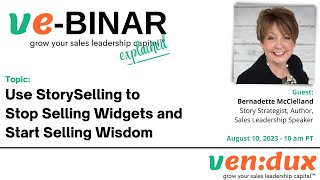
Webinar (hosted by Henning Schwinum) featuring Bernadette McClelland on "StorySelling" — a sales approach that augments traditional methodologies by using three concentric story circles (Internal, External, Essential) and nine story modes to deepen conversations, elevate buyer engagement, and shorten sales cycles. Internal stories cover sellers' identity/authority/value beliefs; External stories are visual narratives (aspirational ladder, 2x2, Venn) to guide buyer understanding; Essential stories are the buyer-elicited narratives uncovered through a coaching approach to reveal emotional and logical buying criteria. The talk includes practical examples, remote-visual tactics (whiteboard, slide animation), implications for full-cycle B2B selling, and a brief Q&A.
Chapters
Welcome everyone. Welcome to this Vendocs webinar, or as we call it, the webinar. We are proud to have Bernadette McClelland with us and I will let her introduce herself in just a little bit. A few housekeeping notes. We're recording this webinar and we'll make it available later on our website and our YouTube channel. We will go and ask everyone to stay muted for the duration of the webinar and we'll open up the mics towards the end for a Q and A session. If you feel more comfortable putting questions into the chat during the call that you can do that as well. We'll monitor the chat and we'll have Andrew Miller post questions as they pop up. I'm very excited about the topic of today's webinar because as a salesperson I truly consider it a dream come true. If you can build those deep connections, generate conversations and then accelerate your pipeline. That is obviously every salesperson's dream. And with the help of Bernardet, we're going to make it hopefully a dream come true. Bernadette, why don't you introduce yourself a little bit so our audience knows who they're talking, who, who is talking to them and who they will be engaging with later on.
Yeah, beautiful. Thanks so much. It's really, it's really a pleasure to, to join you on this webinar. I just love that and lovely to have met you on the journey. As you can tell, I talk a little differently. So I am from Australia and moved across to the United States a year ago. So my, my background I guess is 20 odd years in corporate Australia. And so I worked at a little company you might have heard of called Xerox for a number of years and I started off in the sales space. I was one, I was a sales coordinator at Xerox and I remember way back in the 80s and I was doing the guys orders and their commissions and I remember looking at the amount of money that was being made by the caliber of person making the money and I'm thinking I can do this. If they can do that, I can do this. And so I applied for a sales trainee role but they knocked me back a number of times that they said I was too nice, didn't have what it took to be in sales and wasn't aggressive enough and I finally got the job. I think I might have proved to them I had a little bit of that in me. And then 20 years later when I left, I left as one of the senior sales leaders and I think that the journey really showed me that you don't need to be aggressive today. You actually, it's. It's a real. To your detriment if you are. And being nice is okay. And so I guess from that, my journey then morphed into being a business owner of a bricks and mortar business, and it just morphed yet again until I went out on my own as a sales leadership consultant. And so I've been doing that for a number of years now and working in that space of B2B sales. And so what's near and dear to my heart is a combination for sales leaders and salespeople and business owners is really at that intersection of owning your personal leadership, bringing in thought leadership, and marrying that with your sales leadership. And. And so that, I guess underpins everything I do as a sales leadership consultant and as a motivational speaker on transformation and sales.
Great. Well, welcome to the U.S. about 10 years ago, somebody told me, welcome to the U.S. so I think we share the fact that we talk a little differently compared to those who are native to the US you beautifully described your transition into sales and out of sales. And I guess the question when we look at the headline of stories selling, how did you get to this topic? What was it that brought you to a point where you're now saying, we need to do things differently?
Yes. So you and I met and our paths crossed when I was running a program on storytelling and storytelling in the traditional sense that all of us probably understand. The many of us understand the hero's journey. You know, there's wonderful facilitators out there. Donald Miller. There's a whole raft of different storytelling models and methodologies. And I. I looked at that and I thought, you know what? I think that there's something even more behind the word story. And so I sat down one day over a coffee, and I thought, how can I build out a body of work that is going to impact every one of those three avenues I mentioned before? Personal leadership, thought leadership, and sales leadership. And then thinking about what our buyers are saying today, you know, 71% of them saying that salespeople are not bringing enough value to our conversation, so why should we even take the call? So I looked at that and I thought, well, how can we augment sales methodologies that we all know? Spin Challenger, you name. It doesn't really matter. What can we augment and what can we put on top of those methodologies that work really well to make our approach to the market even stronger? And so I sat down and I started to kind of play and I started to do what I normally do to kind of capture some ideas. And I drew a Venn diagram. And so I looked at it and I thought, well, what are, what are the three challenges that salespeople, sales leaders, business owners, any of us that you know, are needing to go to market and drive revenue, what are, if I could simplify it, what are those three areas of challenges? And I thought, well, as a sales leader, we want our salespeople to elevate their level of connection away from the easy, for want of a better word, the path of least resistance, whether it's user level, operational level. How can we elevate those levels of connections to the most senior levels? How can we then take our sales conversations and make them deeper so that they are more meaningful and more significance driven? And then how can we accelerate our conversions? How can we build on that and shorten that whole time to market? And so that formed the three challenges that I see businesses are having. And then it's like, well, what's the root cause of those challenges? And if we drew a Venn diagram, we know that the magic happens at the intersections of each of those circles. And I thought, okay, if I'm looking at story, and we consider story is our oldest form of communication and selling is our oldest form of commerce, I thought, at the intersections has got to sit the internal stories, those stories that sellers and sales leaders and business owners tell themselves about the buyer, tell themselves about the deal. And then at the next intersection is, what are those stories that sellers should be telling their buyer but aren't telling their buyer? And then what are the stories, the third lot of stories, the essential stories, what are the stories that sellers need to elicit from their buyer? And so that formed the basis of the story selling circles. And so from there, I just built out that model yet again. And for each one of those circles is three story modes. So in, in total, the book or the concept has nine story modes to actually build that out for a seller. So kind of a long winded answer as to how I kind of came about it, but it's really, it's taking those conversations higher, deeper and broader.
You drew a beautiful verbal picture of a Venn diagram, just so we summarize it quickly. The three intersections at the inner, inner circle of the Venn diagram, what are those again?
So it's the internal stories, the external stories, and the essential stories.
Okay.
And from those, then you grow outward and you end up with nine story modes.
Correct? Correct. So, seller. Yeah. So if we look at the internal stories, any of the sales leaders on, on the call would know. And then salespeople were kind of hand on heart, honest. They kind of thing, you know, that, that resonates with me. You know, the internal stories relate to identity being enough authority, demonstrating expertise and money, which is expressing value. So there are three internal stories and then there's three external and three essential stories as well. So builds out from there.
Can we walk through an example, something where, you know, you've seen this model work really well and how it changed the approach the salesperson or the sales team would be taken towards clients?
Yes, definitely. So I'll just kind of duck into one from each, each of them just to keep it really simple. So if we take the, the internal stories, money is just such a huge money and authority kind of an identity. They all kind of morph together. If we think for a minute that most of us have grown up in environments and it doesn't matter what level you are in the company, most, most, most of us have grown up in environments where we have been taught to respect those people in authority. Whether it is the school teacher, whether it is the, the priest, whether it is the police officer, there's always this kind of level of respect. If those of you have ever been kind of moving a little bit too fast on the freeway and you see a cop car behind you with the lights going and the, the siren going, what do you do? You immediately pump the brakes. Why? When you're not doing anything wrong. So it's this whole thing around authority and into the business world relates to having a CEO on the door. Even if that decision maker is younger than you, there can still be this belief. And so when you think about, you know, research that's been done and I looked into this, nearly 25% of people have a fear of authority. And you spread that across the sales profession. How does a sales leader work with one of their team members when they're not able to get an appointment with the C level? So, you know, that's kind of one of the internal stories. If we look at. And we'll go the other way around the van. If we look at the essential stories, that is the stories that a salesperson needs to elicit from their buyer. This, if you were looking at a three legged stool, this is the leg that is often missing. And it's because salespeople are not able to coach their buyer through change. They're still selling them. And today we need to be able to go to the table and be able to have a facilitative conversation or a collaborative conversation. And that means knowing how to ask the questions that are going to elicit those stories behind the stories. So quite often a salesperson will ask a question and they'll just take that question at face value and they'll run off down their own rabbit hole. Now, the buyer may be nodding and the salesperson thinks, yes, they agree with me, when in actual fact, that buyer is nodding because they hear you. So how can you elicit, how can you go deeper with your questions? An example to give you there. You know, if you ask if you are used to speaking to a user level or an operational level, that's often content or ideas driven, like it's typically technical or it's typically product. But if you're going to speak to a C level, you've got to know how to contextualize that conversation and you've got to know how to actually bring it to a higher, more focused level. Because we know that the senior, the more up in the organization, the less they're interested in what you've got to sell. So how do you do that? And that's through what we call the coach approach. So those three story modes, if you like, is around expanding the conversation and building in flexibility. Because the person who is able to take a conversation from a contextual level down to a content level and then back up again will always, always lead the conversation. It's understanding and identifying the emotional and logical buying criteria. We always hear the mantra, we buy an emotion and back it up with logic. But we also need to know what that really means in a sales conversation practically. And then it's getting the decision. And the decision isn't always just about what's your decision making process or when are you going to make the decision. There's so much more psychology involved in the way that we make decisions. Do we make decisions based on past experiences or future? So there's a whole raft of decision drivers. So they're examples of the essential stories. Well, where my approach differs is actually in the external stories, the stories that we need to tell our buyer. And what I've done here, which makes it extremely unique, is the fact that we process data. 83% of our processing is visual, 11% is by hearing is auditory. And so when we talk about storytelling in the traditional sense, who's doing all the talking? The seller. So how can we shift that style of storytelling to be more visual so that we can actually draw our buyer in? And that's where these three external stories are based on progression and guiding change. It's based on tension and being able to build that right kind of intensity into the sales conversation. And it's also based on integration and how do we articulate our outcomes, what we do. And so the three visual diagrams that form these visual stories are the typical aspirational ladder such as Maslow's hierarchy. It'll be the two by two, which is typically, you know, Eisenhower matrix or Kiyosaki's model that we would know by two by two matrix and the Venn diagram. So one is a why change, one is a what change. And the Venn is always the how change. And so when you're able to get brave enough to understand your buyer's business enough that you have the courage and the conviction to be able to capture their stories and share it back to them visually, it forms such a platform for collaboration and co creation. And an example there is this week or a couple of weeks ago, I started to work with the managing director of a revenue generation marketing firm and she was trying to articulate what she does what that they were looking not at rebranding, but just repositioning. And so we got clear on three outcomes and we created a Venn diagram. Now she yesterday actually spoke at a Dell conference. And what she did, she was able to use her own mental model and be able to use that as a slide that captured the essence of her story. And we all know a picture paints a thousand words. And so she didn't need to worry about getting into the weeds. The visual did it for her. So when we can do that with our buyers, whether it's prospecting, whether it's negotiating, it's a game changer.
So you're obviously doing a phenomenal job without any visualization tools, explaining this model and talking about the importance of visual representation in a world now where we do a lot of our selling through zoom through virtual tools as opposed to in person sitting in front of the same whiteboard or being able to draw on a yellow pad on a table, how do you suggest to salespeople that you work with to use the visualization on a zoom call, for example?
Yeah, and I have a big whiteboard. I'm old school. I have a big whiteboard. I am getting brave and I am going to go down the line of two cameras. I am so not technical. I am super scared I'm going to press the wrong button, but that's the way I'm going to do it so that the two cameras. So I've got a switcher so that's for me, but for anybody else, if you have a slide deck, you know, and, and just have the animation and build it out as it goes, just like I would do if it was like a, a true webinar where I was using slides, I would build that out. Apart from that, my trusty whiteboard. If you've got a flip chart, it doesn't really matter because people will get drawn into a visual. And so typically that's what I do.
Yeah.
Really. I think at the end of the day, if we're on zoom, that's all you can do. But you can still do it.
Yeah. When you talked about authority, you threw in the salesperson, the sales leader and the CEO. And it reminded me of something that I tend to say a lot, which is we all sell. Everybody sells something. If nothing else, they sell themselves. So how does story selling apply beyond what we would naturally think of, which is the salesperson selling to a client?
Oh, it goes across the board because it's all around. It's around communication and it's around influence. And so you may not have a, a dedicated sales role, but you still, if you're a leader, you've still got to influence people. And so the ability to be able to a identify and read between the lines that if you have a team, even if it's a colleague, even if it's a friend, if you have somebody that you can see has the potential to do more but perhaps isn't, then how can you guide them, how can you question them, how can you coach them? So there's the coachability part of it, which is extremely important. But if you want to influence anybody, you need to know what influences yourself first. And so that all falls into the internal stories. There's always a story that's stopping us doing something because we're human. But understanding that and, and hand on heart stuff, whether it's about money, whether it's about authority, whether it's about you being enough. That's crucial, a crucial baseline for any business or any person.
Any person. Exactly. Any business, any person, any role. Absolutely.
Yeah. And the higher up the organization that you go, the more responsibility you have, the more changes you will have to make. Not everyone's going to be happy with your changes. How do you language changes so that people are on board. So there's a whole raft of different uses, for want of a better word for it.
Yeah. You already hinted throughout the last 25 minutes at the whys, you know, why is this important? What's the relevance of This, I think the one thing we haven't talked about much is are the changes that are happening in the sales profession and how the roles of salespeople vis a vis their buyers is changing. So how would you position the relevance of stories selling in, in the context of those changes?
Great point, great point. And, and, you know, I think, you know, and you probably are hearing the same thing as well. We, we've come through a moment in time where the changes. A couple of things. I think anybody who is. I think what Covid did was highlighted the fact that those who weren't cutting it before COVID weren't cutting it during COVID And so I think that spotlighted perhaps those that, that, that didn't have what it took before COVID Secondly, through the pandemic, we invited people into our homes. And I think as a result of that, there is now an expectation that might be the wrong word, but I think there is a propensity now for people to expect a little bit more humanness in their sales engagement. Our buyers and we, we, we know this mantra, you know, I mean, think we're all getting sick of it. No more. You know, they know more because, you know, they have access to data and all the rest of it. So. But however they are wanting somebody to sit opposite them that is going to be 100% relevant and provide insights that, and once again, we hear that word as well. And what does that mean? Like, how can we make story selling really relevant? So let's just, let's just create a scenario here. Just say that you're a salesperson, you're a sales leader, you've got a team. And, and getting in front of the buyer is harder today. Everyone's still remote businesses. Like, I actually went to a couple of businesses last week, you know, to deliver lumpy mail, because I'm looking at lumpy mail because that always works. And both businesses are global companies. The floors are empty, they've gone. And so where have they gone? Because the Internet, the Google still says they're at that address. So it's, it's harder for salespeople now to get in front of the buyer. So what have we got to do that's different? And so we know that we've got a research and now we've got AI in as well. So we know we've got a research. How do we take what we're reading about them and create an approach that's memorable, that creates a mental model that captures the key data about their business? And so I'm actually Going through the throes at the moment of being my own test case on this. So I'll come back to you in a couple of months to give you the results. But it's. We really do have to do something that is biocentric, that is totally relevant and that brings wisdom to the table. Not just us selling our widgets.
Yeah. I think that you're. I mean, that's obviously a key piece of, of sales. It has always been, but in earlier days, and that means 20, 30, 40 years ago, wisdom could be masked by widgets. When you just talked about the thing that your product could do that no other product could do. But I think we're, we're past that. That no longer is wisdom or considered wisdom. There is too much equality between products and services. And so it's back. Back to the seller and their ability to stand out and wisdom. Absolutely stand out.
Yep, totally. Totally. You know, and you just think back to Peter Drucker, you know, management consultant Peter Drucker, you know, he said years back, he said, we've got to become wisdom workers. And that was back in the industrial economy and, you know, and the different economies we're moving through, you know, we've gone from hunter gatherer to agrarian to, you know, the steam engine to the industrial economy, knowledge economy. You know, I was at Xerox and we all went through the knowledge economy stuff and technology. And so we're now, as Seth Godin says, we're in the connection economy and it's moving. And now AI has come into the mix as well. And it's like, okay, we really have to tap into the resources that we have inside us, the resourcefulness, and think differently. And, you know, Dan Pink, in his book To Sell as Human, he says, we are now in the wisdom era. And that's why I sat there. Coming back to your first question, I sat there and I thought, what can I bring to the market that augments existing methodologies, that helps sellers think differently and shift the way they think so that they can help shift and disrupt the way their buyers are thinking?
Yeah. Before we open the floor here to questions from the audience, let me just show you what you already know because I have a version of your book hand signed by the author herself. Can you just tell us a little bit about what this latest piece of work of yours is all about?
Yeah, it's. It's basically what I've been sharing. It's, there's, there's a bit in there. It's a, it's a. It really is. If you were to use a Swiss army knife metaphor. It's a number of disciplines rolled into one and those disciplines definitely story because we need to tap into, you know, the emotional side of it. We also need logic, which is the mental models. The book is filled with examples of my mental models that relate to the content. So I've kind of walked my talk throughout the book. It brings in psychology. Absolutely, psychology. Because we need to know in order to influence others, we need to know what influences ourselves. It brings in coaching, it brings in the coach approach, what I refer to as the coach approach, and it also brings in neuro linguistics, a lot of the brain. I've done some work around the brain and just our language and how we ask those questions when we're with buyers. So it really is unlocking the future of B2B selling with mindset, mental models, more meaning and money.
Wonderful. If you have a question, please unmute yourself and Andrew, I'll call you out first and have you ask the very first question to break the ice.
You're on mute.
Thanks. Heading. Thank you, Bernadette. Wonderful insights and stories. It's, it's a very complex subject. Nobody wants to be sold to anymore.
Yep.
Really, nobody wants to be sold to. And in the world of B2B sales, there's more and more push to roll out and develop systems and messaging and tools that enable companies to scale more effectively, which means over time perhaps there's fewer and fewer personal selling opportunities. What are you involved in, in any work clients thinking that around employing your ideas, your tactics to businesses that want to scale in a larger way away from more personal selling. Or do you, you know, all of your work is really focused on that, that person to person approach.
Yeah. You know, the, the businesses that I work are what I call full cycle businesses. So I, I work with the sales people who are responsible for prospecting right the way through to following up and customer experience. And I know that, you know, businesses, a lot of businesses today, especially the tech space, they really have dedicated, you know, SDR roles, BDR roles, account executive roles, account management roles. That's not the space I play in because I like to work with the leader and with the team as people and that's what I do my best work. So I've chosen that, that is my business model to work with those companies that are what I call full cycle businesses. So I can actually, I, I'm not from a responsibility perspective, but yes, from an ROI perspective, I can see growth and, and it's working with those leaders once again. I'M very clear on working with leaders who are growth focused and have that. And when I say growth focused, that incorporates their people.
Got it? Yes. So, so big picture, what are the trends in this business of, of B2B, person to person, full cycle sales just over the years? You know, what have you seen evolve to where we are today? And what are you seeing around the corner in terms of the trend lines? Are companies moving back to a more personal approach or increasingly moving away from.
You know, I think, I think that there's a lot of confusion out there, to be quite honest. I think that there's a lot of, you know. Well, not. That's pretty harsh word. Well, strong word. There is a little bit of scratching the head and it's like AI is coming in now and we can see that everywhere. And it's like, whoa, whoa, whoa. We're seeing leaders that are, that are encouraging their, their salespeople to just spam us. Yeah, I mean, that's just completely out of control now. And what I am seeing, however, which I am a big proponent of, is that person to person, direct mail, but relevant. What I'm also seeing and what I'm encouraging as well is more the, let's look at the rifle approach rather than the scattergun approach. And let's get very, very clear on our top 20. Let's get very, very clear on who it is in our database that we really, really want to get to know and we want them to get to know us. At the end of the day, I can't see it working any other way. And if you think of, you know, Dunbar, Robin Dunbar, you know, we really only have the most effective number we can have in our community is 150, otherwise it starts splitting off. So if we look at our database and we think, well, okay, who's our 150? Let's break it down even further. And how can we work with them and become an extension of their business and vice versa.
Thank you.
Wonderful. Any other questions from the audience? Sharon, Jeff, David. And if there are not, then Bernadette, how can people get in touch with you?
LinkedIn, Bernadette McClelland. And for those that do, would like to have a casual conversation about your business and how this conversation today, because it, there's a little bit there that's advanced that would like to have a conversation just, you know, to see what, what it's about in relation to your business. Please reach out to me. My consultancy is three red folders. So the number three or the word three, number three, redfolders.com and the connect page there will take you right through to my calendar. So feel free at any stage after today if you're listening to this, even in a couple of weeks time.
Great. Wonderful. Bernadette, thank you so much for taking the time being our guest here. Thank you everyone for joining us. Thank you everyone for watching and listening later on. Have a wonderful rest of your day. Take care. Bye Bye.
Thanks Bernadette.
Thank you.
More from Henning




ve-BINAR - The Revenue Tornado Methodology: How 3 Power Sources Create Exponential Growth


ve BINAR: Executive Cloning: How AI is Reimagining the Role of the Fractional Executives




veBINAR: Unlock Client Value: Why Compliance is Crucial for the Startups You Serve
