Ep109 Traditional business to online courses with Melissa Browne
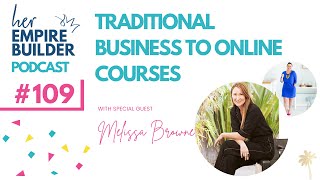
This is a YouTube video titled "Ep109 Traditional business to online courses with Melissa Browne" created in January 2021. It features a conversational interview between Tina Tower and Melissa Browne discussing Melissa's journey from running a traditional accounting firm to building successful online courses. They cover topics such as entrepreneurship, mindset shifts, online business strategies, financial empowerment for women, and practical financial advice. The conversation highlights Melissa's personal and professional transformation and the challenges and successes in transitioning to an online business model.
Hello, Melissa. Mel. I said just before we started, should I call you? It feels weird calling you Melissa.
I feel so formal.
Welcome to her empire builder. It's so nice to have you on. Okay, so there's so many questions that I want to ask you because there's so much value that you have to be able to share in so many different areas.
Thank you.
But can give us your origin story?
Once upon a time. You mean my business origin story?
Yeah, like tell me all about you.
Oh, good lord. So I'm an accidental entrepreneur. It's probably how I best describe myself. I was incredibly shy, incredibly awkward, leaving school, always wanted to be a lawyer. I loved debating, I loved arguing. Still do, my husband will tell you. But I got to uni and the reality of that was really different than LA law, which I loved, just gave away my age. And so a few years into that I just realized it wasn't for me. And I was so lost because that my dad really pushed me into law because I had the money. If you're a smart girl, therefore you have to do a profession, you can't do something creative, that's the path for you. So he really pushed me into that and I didn't want to let him down. I was so. I had such low self confidence and he was an accountant and he just said to me, mel, look, there's some law in accounting, why don't you study that? And for the lack of anything else, I just started studying accounting. And at the end of my twenties I wanted to do a bit more study. So theology of all things, just philosophy and theology has always fascinated me. So I started my business and I took on a few clients just to sit, just to support that study for no other reason at all. And then I kind of woke up five years later realizing I hate I had an accounting firm, I had no interest in being an accountant. But more than that, I was in a marriage that I was really deeply unhappy with. And it was just time to throw it all up in the air and see what happened. So that that sort of set me on a path to studying an mba, moving into a frat house with a bunch of friends, giving the entire divorce settlement to charity to Opportunity International and set up a bank.
Did you really?
Yeah. He did a throwaway line, my ex husband, where he said, you're not going to make it on your own. Wanted to ring them the next day and ask for it back. Because I kept quite literally nothing. None for bond, none for wages, none for my business. Like I cleaned out the account Extreme.
That, gentlemen, is an extreme emotional reaction.
Oh, such an emotional reaction. So now when I'm counseling women about money and finances and divorce, I'm like, do you have a person that's your go to person that you have to run or your financial decisions buy them? Because that was so much. It took me quite a few years to recover from that where I talk about having quite less than nothing. But I worked out through all of that in reading and an MBA that I loved business, like, that was the thing I was excited about. And it didn't matter what shape that was. Yes, I was. I had an accounting firm, but that meant that I had access to people's figures. It meant that I'd seen the breadth of businesses, I knew what their pain points were, and I could actually help them grow their business. And that's what I got excited about. So that was my convoluted way to that. And then from there, because I was very trying very hard to look like a boy, which I kind of already look like. I've got no boobs and look like a traditional accountant. And I worked out that, you know what my point of difference is? I was six feet tall and blonde and young. And how about I embrace that?
Yes.
So I started wearing what I wanted, pink on my logo. I wrote my first book, More Money for Shoes, which was a full color illustrated business book that compared building a wardrobe to building a business and worked out the more that I was my authentic self, the more successful that I was. And that is totally led me to where I am today. The more I am, I tap into that thing that's uniquely me and the more successful I am.
That's fantastic. And you have to do that. Yes, yes.
Okay.
So we kind of came across each other towards the end of your traditional bricks and mortar business. And this is what I think is so helpful for people, is there's a lot of people that listen to the podcast that, that don't have online programs yet and have that really traditional business background and going, can I do it?
Should I do it?
I don't know. And you went from like as traditional business as they come with an accounting firm with staff and doing that into this new life. So how long has it been now since you sold your accounting firm?
So November 2019. I sold so 1st of November. And we set up. So interestingly, when I launched More Money for Shoes, actually launched an online course with that called the Business Makeover series, but I didn't market it, I didn't push it, I just created it. Yeah.
Yeah.
And I did it again later on. I called it the Numbers Lounge again. I told some clients about it in a couple of newsletters and then kind of let it go because I thought, obviously it's not successful. Yeah, I'm a typical entrepreneur and I know how to create stuff. I'm just freaking hopeless at sticking with it and selling it. What I have learned you really need to do in the online. Such a different animal.
Yeah. And this was so many people do is they do like they put it out and they send it out to their email database and they go, okay, it's out there now. I've ran a webinar. It doesn't happen overnight. It's like, oh, okay, well, maybe this isn't right for me. But it does take a lot more than that. I mean, I know I still remember sitting at a business chick's lunch and looking and you were like, yeah, yeah, I've got my online course like here. And I asked how many you'd sold and done that. And I'm going like, I knew you as best selling author, amazing profile, all of these things. I'm like, that is bullshit that you.
Have sold that many.
Like I could get you selling so much more so quickly. Yes.
And you totally, I think when we first met just to, to I think really push me. You just would love telling me how many different course of different people it sold. Come on, that's not okay.
That's what worked for you. Yeah, I can do it. I can do it.
Yeah.
So what have you seen is the biggest shift in going or how was that moment for you in going from that traditional business and then looking at the online courses, trying to work out, is this a real business or is this a side thing I'm going to do? Like, how did that process go?
So I, if I hadn't sold my accounting firm, it would have been a side thing and I don't think they'd be anywhere near as successful because it needs to be a business in its own right. It needs to be given the same love and care and consideration as a business. So I wouldn't have got that or it would have taken me a long time to get that, which would have been a shame. It still doesn't feel like a business some days because there's a lot of time spent with me and I'm fortunate in that I have another. I have a preschool business and I've got Lauren in this online world with me. So it's not just me on my lonesome, but it is a different Animal. And I'm sure it will start to feel like a business soon, but it just, it's still foreign to me because there's not people, there's not people coming into my office. There's not a lot of one on one. But what I know is that I'm an introvert. So it works so beautifully for me.
Like, it's great that you can be in your own little world and do that, but it's also in an online course, often you are the product and you're selling your thought leadership and your expertise and it's very much based on that. Has that with having your introvertedness, has it been hard to be the product?
Not really. And I think that's thanks to Covid. So when Covid hit, I decided I was just going to start serving my community. I'd never done videos really before. I hadn't really used social media in that way before to really put out content. So I just decided this is what I was going to do. I didn't think I'm becoming more of a product. I didn't think anything like that. It was just, this is how I'm going to serve my community. And as a result of that and people loving that, it made me realize, oh, okay, the more I do that, the more I'm prepared to put my head above the parapet, risk of being shot at. But the more I put myself out there, the more people are going to want it, are going to connect and are going to know about my product and are potentially going to feel safe enough to purchase it. So I kind of became okay with being the brand in an accidental way, which I'm really grateful for.
Yeah, that's it. Yeah. I do think it's always like a lot of people see course creators and go, gosh, you're very extroverted and you're doing all of this stuff, but it's kind of performing and you can get on performance and then you can actually go back into your own little shell where you're alone in front of your computer and it's.
Yeah, it's a beautiful business and no different from speaking. So when you go and you get on the stage and you do your thing and you then go into your bubble. So yeah.
Okay, so I want to talk about the road to six figures and doing that to get it from the zero up there and getting it off the ground. How has that been in terms of. Because I know when we first started working together and we were talking about launches and you were going through and you're going really I have to do all of this sort of thing. Like is that what's been the hardest part about having to do that for online that's so different to when you had your accounting firm.
I would say sticking to the process. So for me I'm a bit of a bright shiny object. I want to keep trying things, creating and writing and putting stuff out there. I have learned the more you stick to the process and the more you add in the automation and the follow the system that works, the more successful it is. And not to just trial something and say well that didn't work, but actually to adapt it and to trial it again and to trial it again. And certainly my fourth launch was the most successful launch by miles and if I hadn't kept going I wouldn't have realized that. But it was taking my learnings and adapting them and Lozi and I are in the process of preparing for the next launch and it is all about that process. Right. What social tiles do we want, what automations need to happen, what insta lives need to happen, what challenge needs to happen which kind of goes against what I love. I'm not the disciplined follow the steps person, but Lozi is the disciplined follow the steps person. So having someone like her that loves process, I love the systems absolutely. And you know, we've got a local business that we love to talk about where it was a running club and for the first few months he just kept turning up on a Wednesday and they would have one or two or three people turn up to their running club. Now about three years later there's 100 and more of them. It was that discipline of turning up every week even though only one person came up that more people found out and there was that groundswell that meant then that he had this great business. And for me it's the same for the online world. And because you don't have that shop front, Google is your shop front. It's a different mentality, it's a different way of standing out.
I think a big shift for you in your mentality too, from my point of view in watching you was I know after the first webinar and this is the thing, you always had huge fault on social media, huge amounts of people that came in and you're so used to serving people, giving it all away for free but not used to selling. And so there was a big shift in going, you know, I remember we got to the end of one webinar and I looked at the numbers.
I'm like I would expect Your conversion.
To be so much higher than that. Did you tell them and drop the link in that this is all you can buy? And you were like, no. Now your conversion is, like, sky high.
Yeah.
So what were those key things that you changed that could do it in a way that suited you?
So, firstly, accountants suck at selling. You just do. And I don't think that's just limited to accountants. I think a lot of people. I think it's a lot of. I think it's a lot of people.
It's hard to sell.
Yeah, absolutely. And particularly when you're selling yourself, you know, I can sell you something, this lip balm that I'm holding because it's the best thing ever and you totally need it.
Yes.
That to buy me, that's a lot harder. So, as in my accounting firm, we used to talk about, these are the benefits, you know, this is how you're going to be able to grow. And so I had to then refresh that mindset to go, all right, well, I'm not selling. But if I truly believe my course is going to be transformation, transformative financially for people, then I need to tell them about it. And I remember you put me onto Colin Boyd and I watched his webinar bits and Bobs. That's the official term I'm sure he uses.
His slogan is selling, is serving.
See, there you go. And that just resonates with me. And again, Colin sells a system and he sells paradigms and he sells templates.
So good at framework making.
So good at framework making. And once I popped my. What I was doing into that, it meant that I could understand my customer in a different way and I could pepper the webinar with what they needed rather than, oh, God, oh, God, oh, God, here it comes. And then at the end going, oh. And then if you're a little like that, you can buy it.
Yeah. Which is what makes people tank all the time.
Apologetic. Exactly.
I'm so sorry.
I know. And of course they're not going to buy it because you're apologizing. You don't even believe in it. So once I realized, again, there's a system, and once I realized exactly why my customer needed my product, I had no problem peppering it. True. Yeah.
And I do think that's the key is, you know, it's the conviction and that belief, knowing that what you've got is so valuable, that you will bring so much joy. And I think that's easier once you start, because I know once you saw people start going through and the impact that was making and the change that was making. Like, you know what? I need more of that.
And you can confidently say then, I know this is the result you're going to have because you've seen it. Whereas before you'd worked with people offline. So you can say, I know the result I have within there, but not the result I'm having inside this course. So the more people that go through, the more confidence.
Yeah. Was there a moment that you had where you've thought along the journey? Because I know, you know, you're a skeptic in a lot of things. You're like, you know, show me the proof. Show me the figures. Yeah. And I know when you say, you're like, you know, I think this will work, and I think we will do this, but we'll just see how we go. Was there a moment where you were like, you know what? This is gonna work. I'm doing this thing.
Do you know what? I don't think I'm there yet. Which is weird. So Lorzi is 100% there. She's like, I'm there. I'm committed. We're so going to smash this. I believe so. And I was talking to my husband about this only last week. I said in my accounting firm, I could predict with almost certainty because people have to come back and do tax. They have to. In my preschool, I know that once they come in at three, I've got them till school because they're going to stay. Whereas in the online course world, I've never sold something like that, where people can choose to use it or not, where it's not an essential service.
Yeah.
So I know that I have a business and I'm hopeful. Like, we've done all the work, we've got all the numbers. We're already seeing the result, but I feel like I need to see it. I need to keep seeing it.
See, for me, because my moment was when I ran my first webinar and three people bought. I was like, this is me. I'm here. Like, I was 100% committed from that moment, because I was going to.
This is amazing. Yeah. I must admit, it was the last webinar where we had 48 people on. And it was just the energy of it. And I realized that we'd hit the number that we wanted to hit. I'm like, oh, okay. Okay, there. Now there's some momentum happening. That was probably the time when I was. When I realized that, okay, if we keep going like this, this is a frigging amazing Business. And I clearly believe in it because we're now creating that same another online course for the preschool. So I know, I know it.
Yes. Now I want to switch and talk about your genius zone because you are a genius in this area. And I love it so much because I do think that, you know, you look at the stats in the world and the wealth that women have compared with men and how we do retirement and all of the different things, and I think it's so important. And I love that you look at both the money mindset. There's so many courses out there for money mindset, but doesn't give you the actual tangible skills in going, what do I apply the mindset to? And you've got all of that, like looking at it from an insider point of view meant you guys, this is amazing. Of course. So this episode's airing in January just after Christmas, where people are probably.
We're feeling so much more relaxed. Thank you for Teresa supporting me there.
Yes.
Right.
Yeah.
Yeah.
So talk to me about what that normal January period is like for people and how you can start to get the year off to a good financial start.
Yeah. So often what happens in January is we've overspent during Christmas or especially for this financial year, I'm concerned that we're going to hit January and it'll be a bit of a, oh, thank God that year was over. And so we have that twin thing of a financial hangover because we've spent a little bit more, a little bit of hopefulness that this year's going to be different. But I think this year, 2021, we're also going to have a bit of fear around. I know I need to do more with my finances. I know that that was a lesson I learned from last year. I just don't know what. And that's where we want to come in to say it's more than just money mindset that's so freaking important and it needs to be the bedrock that you build your finances on. So I know that and I know that's why those courses are successful because it is the first step and it's vital. But we've just made over the course and added in a lot more goodness because we also know that it's about creating that financial plan, figuring out where you are now, plan for debt, where you want to go, but also learning about investing. You know, if you started the financial year going, I know I need to do something more. I just don't friggin know where to start. And I've got no one to ask questions of. You know, we have three modules within the course on investing, shares, property and business and then habits for your money types. And we're not selling anything. And I think that's what I'm excited about. You do a share. Totally. And they're trying to sell you their system. They're not trying to do that. It's just about education and empowerment and then encouraging you to have a go yourself.
Yeah. And this is the course Mel's talking about his financial adulting plan, which is. It's amazing. It covers everything in there and if you're listening to this when it comes out, it is open now for a very limited time and then if you've listened late, then it opens three different times of the year. So you can join the wait list.
And get in there later.
But so coming in to January and doing that, aside from joining the course, which I think is like the most amazing thing to do if you want to get real serious about it. But what do you find is like the lowest hanging fruit of something really simple that a lot of people could benefit from cutting out? I know the tip you gave to me that was fantastic, which I'll share.
After, but I've probably got a few. So one would be do a 30 day financial detox. So 30 days of not buying anything new and I'm talking needs, not wants. No, wants, not needs. Oh yeah, you're that right.
Yeah.
Obviously buy groceries, all that sort of stuff. But clothes, shoes. So my hubby, it's coffees and croissant. By the time the chat, his 30 day detox, he's literally two at a time. Coffees, croissant on the top and then he goes back for his third and another croissant and buying lunches. So that's his thing. But it's a 30 day detox and during that time you're asking the question, why am I spending and what's causing me to spend? You know, am I spending because I'm stressed? Am I spending because I'm bored? Am I spending because it's a Friday night and I'm lonely and I'm sitting here with a glass of wine and the phone's out? Am I spending because of a host of other reasons and it's questioning those and then unsubscribing, unfollowing from all those things that are causing you to spend and changing your behaviour and your money environment so that you're not tripped up by those things? Yeah, so that would be my really big one. And for anyone listening, that kind of felt a bit sick when I said that. A little bit of vomit came up in your throat. You abso freaking lutely need to do it.
Yeah.
So that would be my one thing. The other thing I'd highly encourage you to do is go back through three months worth of spending because a lot of us have these values. It might be, I want to care for the environment or I want to care for, you know, I really deeply care about mining and I'm anti mining, or I very deeply care about black lives matters or whatever the thing that you're passionate about or modern slavery. And I encourage you to go back through three to six months worth of spending and just look at how you're spending in light of those values. Because often when we're time poor, often when we just, just need to get things done or we're hurried stress, we don't realize that we operate with our spending outside of those values. So just highlighting those times or those spends that potentially are outside of those values and then question, was I stressed, was I time poor or have I just never equated the fact that that spend is against that value and what could I substitute instead? And then going and swapping, pausing or cancelling those expenses? So that's a couple of really easy things you can do just to start to bring financial consciousness to you and already start to make a difference.
I love that. I mean, for me, I've gotten out of control this year because of no travel. Like, I've pretty much drilled it down to not having the excitement of travel because I travel a lot. I go overseas four times a year. I'm on a plane usually every second week. And that kind of lights me up and gives me a different change of scenery and something to look forward to. And I found very 2020 with the consistent weeks.
Yeah, you needed to bring in some happy.
I needed to like, manufacture some happy. And I found myself following all of these amazing places on Instagram and every time they would post something, I'd go, oh, yes. And it got to the site where like every day something was arriving. I was going, I think I have a problem. And then you said, we'll just unfollow everything. And I'm like, what? But they're so pretty, I don't want to unfollow them. And I went through and literally went from 1300 things that I was following down to 800. So like 500 of them when I was going through was like, oh, yeah, they're making me buy. They're making me buy and making me buy. And I haven't bought anything since because I haven't seen it.
The consciousness. Right. It's no problem buying it if you choose to.
Yes.
But it's the. I'm not even realizing. That's why. And I'm following 500 sites that are causing me to buy. And of course, if I'm jumping on my phone and seeing one of those 500, or let's be honest, 100 of those 500, because we know the algorithms is the more you look and click on those things, the more you shown those.
Well, that's the ones I was following. And then it's everything else that they push in. Into me. And my thing is because I love wearable art, which I have some on right now, I like to call it wearable art. But with them, they do limited runs.
So you miss it.
You miss it. Yes. And so I think just. Just that alone is such a great tip. Because I'm not alone in that.
Oh, God, no. Instagram shopping, especially in the year of COVID Yeah. And I call it curating your money environment. You know, we're so careful with different environments that we curate. It's doing the same thing for our money environment so that we're the ones in charge of our spending and savings and investing decisions and goals. But I love those hacks, you know, the simple things you can do. One of my favorite is that I do because I'm a bit like you. I get a bit bored. I'm used to. I miss the thrill of going and speaking and traveling and doing all the things, just despite being an introvert. So I tend to bring a bit of happy thanks to net a poor day.
Yeah.
So I have a rule that I can. And I've just changed it. So it used to be if I spend a dollar, I have to invest a dollar in shares.
Yeah. I love that.
That way, bit of happy coming in, but I'm also looking after my future self. So I have to be able to afford twice and it can't go on credit.
Yep.
Now I add in a third, which is I have to. If I want to spend a dollar, I have to put a dollar into shares and I also have to give a dollar to charity. Wow.
Yeah.
That way I now have to afford three times as much.
Yeah.
Therefore I'm then really being conscious around what's coming.
Do I really need this?
Yeah. So I still can buy. Yeah. I just need to be able to afford three times as well. Yeah, I like that.
And so with all the uncertainty that we've had this year. Like, I think finances usually is uncertain. Like, I know at the best of times people talk to me about shares. I invest in property because I understand property and I got very small amount of shares because it's always like, it blows my mind how company shares can go up and down. Announcement that I'm like, what? That's so out of my control and so volatile. But so I think at the best of times, we're confused. And especially after Covid, there's so much uncertainty. It's still, it's still a good time. Like any time is a good time. Like that Chinese proverbial, you know, the best time is 10 years ago. The second best time is now. Should you still just go for it?
Look, I absolutely think so. And I have a thing where you're not timing the market. It's time in the market.
Yeah, that's a good saying. Write that down.
But it was. What I loved when Covid hit is I'd had two cohorts go through the financial adulting plan. I reckon half of them contacted me during it and said, mel, I realize that shares are on sale and I've bought my first lot of shares today. So they were buying shares when Covid hit because they understood that, sure, they didn't know when, if shares were going to keep going down. They also didn't know how long it would take to go up, but they understood they're on sale and if I've got a long term timeframe and I've got this money that's not earmarked for something in the near future, I can invest. So they were only investing small, but they were investing and I was so freaking proud of that. So many people during COVID during 2020 invested in shares and more young people invested in shares than ever before because they've kind of given up on property. They realized, oh, hang on, this share market thing, I can get into that with 500 bucks. With 100 bucks.
Yeah.
So I'm. And I was jumping on insta lives and doing things like when Adore Beauty did an ipo, I jumped on and said, should we be buying Adore Beauty just so that people could start to realize this is something that we can make up our minds about. We don't have to believe the hype and we're all equipped to make to choose whether we want to invest in shares or not.
And you're amazing sharing all of the knowledge like that.
Well, I just shares for something is that I totally hear what you're saying around volatility but it's that thing where it's so accessible. Property is not accessible for everyone yet shares is accessible for everyone and it can be a way that you can start to invest without feeling like you're never going to be able to get ahead.
Are you on a different strategy for each person depending on their situation or you think if people want to get some they should go for like the common blue chip shares or pick the things that you use or totally different.
Depending on your risk profile, depending on your situation. And that's all stuff we talk about in the course but and it depends if it's active investing or passive. So some people just love an exchange traded fund. Anytime you buy the top 200 shares you don't have to think about it and you can keep contributing to that. Then if one drops out of that every quarter you don't have to do anything, you just are in the top 200 shares. So it's got a little bit more volatility than a blue chip and a blue chip just means a BHP or something super safe and it's going to pay dividends. So there's a bit more volatility but also there's potentially there's a bit more return as well. And we certainly have seen them go great guns over the last whereas others love and have got the time and inclination and want to pick individual shares. And so what I do is I actually open up my share account because I think that we don't what we don't know, we don't see what we don't know. We know property, we drive past it, we see it, we know people that are buying it, we know how to buy and sell it but we don't know that for share. So I actually open up my account and show people how to do that in the course.
It's amazing that you do that.
Well, I just think, I mean it was difficult, it was humbling to do it in May, it was either Feb, no, it was the Feb cohort because my shares had just been smashed, I was behind and I opened it going right and let me just explain why I'm not stressed and why I'm not selling. So it was humbling but also that good lesson to be able to show that you don't sell just because the market takes a dip. You don't look at it if you need to, you don't necessarily sell. So yeah, I think part of it is.
Showing people this is the practicality of it. Yeah, I know the only shares I've ever bought are the shares that I companies I use. That was my thing and going well if I use it I know what it is.
And that can also be a great way to start. You know I used to say to my accountants, you know Xero for Xero and when they floated I would say to them we go to Xerocon, you get the. They talk about the figures, they talk about the uptake. Come on. That was probably the most I've ever pushed. And of course none of them bought it because they felt unsure. So I would then be the person that every week came in and go well it's up to here now. But because she had me bang on about it for two or three years Lozi when Covid hit went and bought Xero shares and a few others that she knew because she'd been hearing it and as you said, she felt really safe with it. Yeah. So if that's your strategy, that's fine as long as it's the same thing as buying as only buying property in your suburb. You don't want to do that. You don't have that. You don't have that diversity with shares. You don't just want to buy what you know. If all you know is retail or medical. Yeah. Need some diversity there too. Yeah, sorry. I could bang on about this.
No, I love it. I'll be in financial adulting.
Okay.
I love it. Now one last question I want to ask is like what are you focusing on for 2021? Because I know that through 2020 it's messed with a lot of people and going what I knew for sure and what my beliefs were and how we conducted business and all that is going to be different in that has alter something for you that you're like, you know what, this is what I'm focusing on in 2021.
Absolutely. So 2022 big things. I know what I stand for. So I'm so excited about helping women empower them financially and through their business. So that is my absolute go to. I know what I'm not. So I have said no to so much work. Anything to do with the Buy now, pay later site.
I love that you did that too.
Because that's much integrity and it just I just saw too many people saying yes to it and I inherently know buy now, pay later cause you to overspend. They'll say it's a budgeting tool, but it's not. They're aimed at retailers and they tell retailers you put this on your site, your average spend goes up. They know that yeah. So I know what, I know who I'm serving, I know what I don't, what I'm absolutely going to say no to. But I also learned that I want to work any more than three days a week.
Yeah.
Just. I want to have some. I don't need to hustle for my worthiness anymore.
Yeah.
Really let go of that. The ego associated with the large firm and everything that came with that. I just don't.
How liberating to let that go.
Well, you know, what a, what a basket case I was when I was trying to do all the things. And I look at my diary now back then, and I feel physically sick.
But isn't it like that when you. I mean, for the last five years of my last business, I did 12 hour days. And the thing is, when you're on it, it's just so habitual and the adrenaline so pumping that you. But now I look at it and I go, what was I even thinking at the time?
You're like, no, of course. This is just what you do. This is the next thing. Whereas next year we're going to be. We've already put our plan together. We want to make more than half a million through online courses alone then. Plus everything else that Lozi and I will do. And then the following year we want to hit a meal. So. And that's where when you said to me, do you believe this could be a business? That's where I think, yes, it can.
Yeah.
If that's mainly profit, that's a fucking good business.
It is, yes.
Without people, without staff.
That will be the social media quote.
Yeah.
I love it. I love you. I love what you do. I love the impact you have for so many people. And I've seen it with so many people I've worked with as well that.
Have worked with you.
So everyone get on it. I will link it in the show notes, but it's also MelissaBrown courses with.
An A on the end of brown. Just because I'm strange one. And I'm grateful for you too. Gosh, I'm so grateful that at that retreat you were there and gave me the prod to realize that actually you can do this and you don't have to think traditional. There is another way. So I'm inherently grateful that I've discovered you.
Oh, what a love fest.
We're finishing.
Thanks, Mel. Thanks, everyone.
Thanks.
More from HEBA




Mastering The Mental Game of Business with Jacqueline Snyder on Her Empire Builder Show







This year, be the woman who takes risks, starts the business, grows the business, makes the money, t