Protect Your Empire: Legal Must-Knows for Course Creators with Autumn Witt Boyd
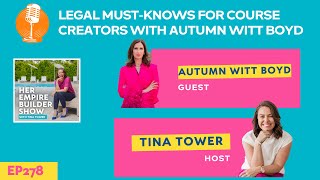
Autumn Witt Boyd, a lawyer for online course creators, walks through contracts, trademarks, copyrights, and liability. She covers what you need to know about AI-generated content and protecting your business legally.
Hi, friend, and welcome back to her Empire Builder, the podcast for women ready to create wildly profitable and deeply fulfilling online business. Today's guest is someone I am so excited to bring, you, Autumn Whit Boyd. Autumn is an experienced lawyer and legal powerhouse for online business owners, and she is on a mission to help experienced entrepreneurs grow and scale without running into costly legal roadblocks, something we all need. So. So in this episode, we're diving into everything course creators need to know about legally protecting your content, your brand, and your business as you grow. We're talking trademarks, copyrights, contracts, and the small steps to take now that could save you serious stress later. When I went to start this episode, I was going, I've never had a lawyer on before. I hope I can make it exciting. And let me tell you, Autumn brings the excitement. So whether you are just launching your first course or scaling to multiple six or seven figures, this conversation is going to give you the clarity and confidence to move forward fully protected and empowered. Let's dive in. The fabulous Autumn Whit Boyd. Welcome to her Empire Builder show.
Thank you, Tina. I'm delighted to be here. Yay.
Oh, so I did say before we hit record, okay, how are we going to make this fun? And. And you've assured me it's going to be fun. As we talk about all of the legal considerations for course creators, which I do think, you know, it's. It's crazy that, you know, I'm up to nearly 300 episodes of the podcast and I've never had a lawyer on.
So, you know, I was scrolling through your episodes as I was preparing, and I didn't see one, so that's tough. Great.
It's fantastic because there are so many different considerations that we have, but my first question is, what got you to go into this niche of serving course creators? Like, what is your background? How did you, like, go through this web?
Yes, yes. Well, I've been a lawyer now for almost 20 years. This is my 20th year. And about 10 years ago, I was very burned out. I had worked for several different firms for a judge, and I was just working all the time. I had these twin babies at home. They were like three, and I just never saw them. I was working all the time.
Like a path.
Yes, exactly. And my husband sat me down and was like, this is not working. Like, you can decide what else you need to do, but something needs to change. And I. I'm sure you're familiar with Danielle laporte. So I sat down with the desire map book and I tried to Figure out, like, what. What am I going to do next? Um, so my husband is a consultant. He encouraged me. He thought I could be an entrepreneur. I didn't. I would have told you I did not have an entrepreneurial bone in my body.
That was probably because of, like, your lawyer training, though.
Yes. We're so risk averse. Yes. Yeah.
And for jollies and. Yes, yes, yes.
So I was like, okay, I'm going to try this just for a couple months. My background, I was a copyright lawyer, so I had been a litigator. I represented a lot of photographers and stock photo agencies. So I was, you know, in kind of a content creator world. But when I first started, we have a big startup community here where I live in Chattanooga, Tennessee. So I thought I was going to be a startup lawyer. So that was my plan. And I don't know if you spent any time with startups, but they have no budget for legal. I had a lot of meetings, Big.
Dreams, big delusions, all the things that you need.
Yep. And I had several where, you know, I'd give them all this strategy and we'd map everything out and then they'd be like, okay, great, I'm gonna go do this on LegalZoom. So I realized very quickly that was not a match. And at the time, this was 2015, I was looking around, trying to learn marketing and sales and all the skills they don't teach you in law school. And I was listening to podcasts. I was listening to Marie Forleo and Amy Porterfield, and they all had Facebook groups. So I joined all these Facebook groups, literally, just to learn. I did not have any ulterior motives, but I noticed people were asking legal questions, and so I just started answering. And it really did build. Like, little by little, people started asking, oh, well, if you know that, like, can you help me write my contract? Sure. Um, and then I started doing more networking. Like, once I realized I really enjoyed the industry and the people that we were working with, um, I started being a little more intentional, trying to meet more course creators and coaches. And so in 2020, we went all in. I kind. We kind of released all of our clients that were in other industries. And. Yep, since then, this has been the niche that we're focused on, which is.
Such a great timing to do it in 2022. I mean, Covid made the.
It was a little bit forced. Yes. Because we were doing too many things. And I was like, we just have so little time. We have to be really efficient.
Yeah.
And so by working with just one type of client. We see the same things over and over. We have really good, you know, forms and templates. Yeah.
So we're seeing the same things over and over. What are the most common legal mistakes that you see course creators making?
Yes, I think the biggest one is not having a contract. So typically with course creators, we call it like your terms and conditions or your terms of use.
Yes.
So it doesn't have to be something that's actually signed with a pen or a DocuSign. It's usually just a checkbox at checkout. Yeah. But that is really, really critical. When we see disputes or unhappy customers, the first question we always ask is like, well, what do your terms say about whatever the problem is? So we're always going to start there. We go back there. That is going to protect you if there is a problem or a chargeback. We, you know, so I can go on and on about how important it is. Yeah, that's my number one.
So off the back of that, because there's a lot of people I will work with, people generally on Kajabi. Probably three quarters of my clients are on Kajab and they have like the default terms and conditions on there. Is that something people can use or do they need independent legal advice to create their own?
Yeah, so using something is better than nothing for sure. So I'm never going to poo poo that I would say the key is to read them. They're probably long and boring. But this is like, will be time well spent. It'll probably take you 30 minutes and see if they're actually like in line with how you do business with your refund policy, with, you know, if you want to kick somebody out of your course, if someone misbehaves or your online community, it's an area where customization can be really important because, you know, people do different, have different policies and do business differently. Yeah. My kind of back of the napkin is usually if you are making like a couple hundred thousand dollars from a single product, it's probably time to talk with a lawyer and sorry, I'm in US dollars. It's probably time to talk to a lawyer about getting something custom because you're relying on that revenue. You know, maybe you're starting to build a team. There is more at risk.
Yes.
And so you want to make sure that it's really, really covering you.
Yeah. So that leads perfectly into the next question that I had was what stage should course creators start looking at legal protection? And so when it comes to things like trademarks as well and Copywriting, is there a certain stage, do you think that, you know, if you're going to start something and you're like, this is going to be big, which we all think it's going to be big at the start. But if we're like, this is going to be big, should we trademark right at the beginning or should we see it, you know, see it through to a certain stage or at what stage do you think? Or is that too late? Because someone might see what you're doing and then you've missed the boat.
Yeah, that's a great question. And 1. We get a lot. So again, one lawyer, one opinion. Opinions definitely vary on this. And it's not.
We need to have, like, the lawyer's disclaimer.
Our disclaimer. Yes.
None of this is personal advice. Really fast disclaimer, voice.
I think you're okay. Um, yeah. So trademarks are gonna protect your brand. So that could be like the name of a podcast or the name of a product, or if you have, like a signature framework that you offer, that's where trademarks are gonna come in. Copyrights will protect the actual content of your course, like your curriculum. So what we say, usually trademarks are the things we get asked about. And in the United States, this differs in other countries. So this is definitely a. Like, check your local rules. But in the United States, we have a race system. Like you're running a race, so the first person to use a trademark, whether it's registered or not, wins the race. So they get all the rights. So you have this, like, baseline of protection whether you register or not. So I'd say the most important thing is to check and make sure no one else is already using either your trademark that you're wanting to use or a similar trademark.
So is it worth doing still? If it's like the right of first use?
So, yes, you will get extra protections if you register. But it take. Right now, it's taking about 12 to 18 months to get an application through at the US Patent and Trademark Office. It takes a long time. Yes. And it's expensive.
The US like three months ago, and I think we. Did you start, I think, 2020, late 21 or early 22?
Yeah, yeah. Because you can hit kind of bumps in the road that make it take longer.
Yes.
So it's an investment name. Yes, it's an investment of time and money. It's typically, you're going to budget. I won't ask you what you spent, but if you're working with a lawyer, you're probably going to spend at least a few thousand dollars.
Yeah.
And the filing fees, even if you do it on your own, are several hundred dollars. Yeah. So I will typically say, like, if you're just starting something new, especially if it's your first business, like you're going to try lots of things, you're going to throw a lot of spaghetti at the wall, which is what you should be doing. Yeah. And what I, what I have seen and don't want to see more of is someone has an idea, they start it and then six months later they change to something else. And if you've spent all that money and time and energy, it's just kind of a waste.
Yeah.
So I will typically say, like, let you know, you've got those, we're called, they're called common law rights. You've got that kind of baseline of protection if you were really the first one to use. So I typically say to wait until you're making money from it. I have kind of three key things. You're making money from it, you're going to stick with it. So again, because it takes so long, I like to say, like, do you think you're going to keep this for three to five years? And then there's like a gut check which is just like, do you just really love this brand? And would it just feel like someone stole your baby if you see it being infringed? So maybe the other two don't apply. But you know, if you've got the budget and the time, sometimes that last one, people just like, I just want it.
Yeah, yeah. With the. Because I'm an Australian business and about 50% of my business comes from Australia and 50% with the rest of the world. And even for a lot of, you know, U.S. based businesses, as soon as we go online, we're operating in a global market. We've got people all over the world that are buying our products and our services, which is fantastic. There is no global trademark.
Correct.
What do we do?
Yeah. So trademarks are territorial, like you said. So what we will, I will say most of our clients only have them in the US that just, just kind of standard because it's as you've seen, if you've registered multiple countries, it can get very expensive.
Yes.
You're having to pay all these fees that I just talked about. That's basically that like add those fees for every additional country. Plus you have to find a local lawyer.
Yeah.
I can't file a trademark registration in Canada. I have to find a Canadian lawyer to work with. So we will usually talk with our clients, like, do you have some key markets? And my guess is that's why you're registered in the us, even though you're an Australian business.
Yeah.
Because the benefit to a registration is it makes it easier to shut down copycats. And so if, let's say you have a huge number of students in the uk, you want that extra ability. If a competitor comes in and is, you know, confusing your potential customers by having a similar name, you want to be able to shut that down. So which is, again, there's no right answer.
Like, the global market we're in now, it's really hard to protect. The reason I ended up getting the US trademark was one of the biggest. We don't have much. We're very different to the us and we don't have much like, legal action in Australia compared to the us. But we had a massive trademark dispute between Katy Perry the singer in the U.S. and Katy Perry the dress designer, who. It's her name, Katy Perry in Australia as well. And looking at the way that all played out, and in the end, Katy Perry, the dress designer who had been operating for, like over a decade, could no longer. And that was just. I was like, oh, wow. Like, this is. We have to do it in other countries. And so because I knew that I was sticking with it, like you said, for years, and the brand now wasn't going to change, it was worth it to us to do that. But I'm like, this just seems crazy that it's not like somebody that protects it internationally. So, I mean, the best that I've done with a lot of the other programs that I run is like, buy every extension of domain name again.
And that is some protection. Yes. Yeah, that's it. Yeah. Now there is an international trademark treaty that makes it a little easier. Like, once you have a registration in your primary country, you can kind of piggyback on that and it makes it a little easier. It's still expensive and time consuming.
Don't make it easy. So what should you. When course creators consider, like, naming their new programs, what should they do so that they don't accidentally infringe on someone else's trademark? Is it. Is it a matter of just checking trademarks and domains? Is there other things that people should be considering in there? And how close can you go?
Yes. Yeah. So the first thing that we encourage people to think about is to choose a really unique name. Like, the more unique, the more interesting, which is the less harder it's. I know, I know.
Empire Builder was like my 30 something friends, my company, all of them.
And I bet it's like whack a mole. Like, do you see people using something similar all the time? It's really tough.
I love that name. Next.
I know. Yeah. So the more unique you can be. I had one client who talked about, they were trying to think about, like if, you know, Willy Wonka was trying to name something, what would he name his? So she came up with any more cortical. It's like very whimsical. Yeah, but that doesn't really work for most online courses.
Like, well, no doubt kind of the problem colloquial and, and Google.
And you want people to know what, what the course or what your company is about. So it's always a balancing act. But if it gets too generic, it can't be protected as a trademark. So you know, something like how to grow flowers, you know, is just too descriptive. It's too plain.
Yeah, well, I, I run the women online conference in Australia. Couldn't trademark women online.
Right, Right.
Yeah, yeah, yeah.
Twice.
Yeah, they wouldn't give it to me.
There's sometimes workarounds, but that one's pretty.
That one's pretty generic.
Yeah, yeah, yeah. So that's the first thing. Like try and be creative. And you're also then less likely to hopefully step on someone else's toes if you have a more creative name. Yeah. And then we usually do a couple searches. It really is just see what you can find. We use a paid tool when we're doing these searches for our clients. But if you're, you know, you can do this yourself. We usually do a Google, but do like a deep Google, like go to page five or six, like keep looking. Yeah, we look at the state Secretary of state, like wherever your business is located, just to see if there's another business locally. It's hard to do that with all 50 states unless you have a paid tool. And then we will usually look at social media, like whatever platforms you plan on using for marketing, whether that's YouTube, social media platforms, podcasts. We will search like the podcast players just to kind of see like those are for our clients, the main places where we see problems popping up.
Yeah, that's awesome.
Oh, and then how close can you go? No, go ahead.
Oh, yes, yes. How close can you go?
Yeah, I'll touch on that. So the, the trick is even if something's not identical so it doesn't have to be her empire builder, if it's similar enough that a potential customer could be confused, that could still be infringement. So it could be your empire builder.
Or the last one down was Empire Builders.
Yeah. I was about to say it could be plural. Yeah, that's a. There's, you know, little differences. It could even be sound alikes. I had a client named Mom Source. It was like a recruiting company, and they received a trademark opposition from a company called Crom Source Cr. At the beginning, I know we were like, who would be confused? But like, there. So there's a lot of gray area.
Yeah, yeah. Okay.
So I would say if you see. If you're doing a search and you find there's like a very large company, use it especially like a multinational, like, huge, huge company. They're going to have a big legal team. They're probably going to be more aggressive. You probably don't want to step on their toes. Sometimes we can negotiate even if things are close, but those are tougher to get past.
Well, you know, a funny one that I saw the other day that I was like, how have they not not solved this problem? Because my son's a golfer and we were looking at when Liv Golf is coming back to Australia. And so I looked up on Instagram, Liv Golf. And Liv Golf is a girl called Liv who plays golf.
Oh, my gosh, Europe.
And she has the handle Live Golf. And Live Golf, the organization is like Live Golf Official or something like that.
I wonder if she had it first.
She had it first. Yeah. She's been going for, like, since she was, you know, a kid. She's like this golf prodigy and she's now in their teens. So she's been going since before Live Golf was going. But I'm like, I wonder why they didn't buy that or. Or what happens.
I know. Yeah.
But I'm going.
I never know what's going on behind the scenes. Yeah.
And if she would have an issue with that, I was like, oh, this could get interesting. Yeah.
Anyway, that was.
That was my latest funny one that I saw with different names. Um, but when we're talking about course creators, I know for. For a lot, it's. It's a nightmare if someone, like, totally rips off their content. Not talking about names, but what should someone do if they find out, like, their course content and materials are being copied and sold without their permission?
Yeah. So we see this actually a lot. And it's really hard to shut down, unfortunately. So again, under us, this is protected by copyright. So you have an automatic copyright in all of your content as soon as it's kind of out of your head into a Google Doc or a video, any kind of. They call it a tangible medium. So you have that automatic protection, but you cannot actually file a lawsuit until it's registered. So we encourage our clients, again, once you've got a single product that is making maybe six figures or more, to go ahead and register that copyright. And that will allow you to shut people down more easily. So you can send what's called a DMCA takedown. You may have heard that the Digital Millennium Copyright Act. And that's just. Usually most websites have a little form you can fill out. It's very easy. You don't have to have a registration for that, but people can respond and kind of oppose that. So it's not always a quick fix. Yeah. And so being able to threaten a lawsuit, whether you're actually ever going to, you know, file a copyright lawsuit, being able to threaten one is very powerful because unfortunately, when you see a copycat, you're in a negotiation.
Yes.
Like, there's very few very easy ways. You know, sometimes the DMCA will work very quickly, but a lot of people don't back down. And so now.
Oh, really?
Especially. Yes. Oh, my gosh. Ah. People will act like they had.
And some of your story people have said, oh, I didn't realize, or different things. I'm like, yes, you did.
But.
But so. And then. And then it's gone down, like, straight away.
That's great.
Yeah. We've never had to fight all kinds.
Yeah. So sometimes I would say the hardest is if they change it just a little bit, because there's no, like, right. Rule of, oh, well, if you use 30% of my copy, then you're in trouble. And so that, that is very tricky under US Copyright law. And so a lot of times people, like, if they refuse, you have limited options other than filing a lawsuit, which is, I mean, a hundred thousand dollars easy. It's very expensive. And so what I'll usually talk about with my clients is if you're seeing this, congratulations, people are paying attention.
Yeah.
Like, no one wants to hear that, but it is kind of. Yeah. Um, it is kind of a mo money, mo problems situation. Um, but I asked them, like, is this really impacting your revenue? And usually the answer is no, that they're not actually seeing lost sales. It's just, it. It's frustrating. It makes you angry because someone's taken something that you slaved over.
Yeah.
Yes. And so I just, you know, encourage our clients to, you know, people buy from you because they like you, because they are inspired by you, because they follow, you know, all those things. Like we are even the online businesses that aren't a personal brand, it's all personal brand.
Yes.
And so I say, you know, that other person is never going to have, you know, the Tina Juice that, that you do. So, yes, try it. Try and just, yeah. Walk away from the ones that aren't really hurting you. Yeah.
And so what do we do now? Or has the law caught up to AI generated content? And you know, with that becoming so much more common, are there copyright protections there? If, if, say we've used ChatGPT to generate some course content, which I saw someone the other day talking about how they've done their entire program with Chat GPT and I was like, really? And they're like, I can be an expert in anything and just churn them out like this. And I'll go, oh, don't know if that's full of integrity. But then also, on the other hand, why not? So is there like, what are the legal implications around using AI generated content?
Yeah. So right now in the US it is very much in flux.
Yeah.
There's. Yeah, lots of lawsuits.
Have it sorted yet?
Yeah, I don't think anybody has it sorted yet. It's so new and frankly our last copyright act in the US was from 1976 and they've like made little adjustments, but it's still like real old. Yes, we're behind the times in many ways. So I mean, the, the kind of stance that the copyright office is taking right now, and this has not been tested because it's too new. There's not been any lawsuits to kind of test this. So this is just what they've decided is that generally AI created content is not protected by copyright. So you can't stop someone from copying it, basically because you don't really own it. It's created by a machine.
Yeah.
Now there's like some developing rules about depending on how much input you put into the AI, maybe some of it is protected. But you know, we're kind of counseling people like, do not count on that. So if you want to be able to protect your content and stop people from copying it or shut them down after they do, you really need to maybe use AI as a starting point, but that it should just be like your very first rough draft. Like you want to make sure there's a lot of your work.
Yeah.
In your.
I say that as well. I say get it, get it from where you're not staring at like the blinking surface. Yes. And then it can flesh it out and Then. Then it's all you, babe. It's all you from there.
Yeah, exactly.
What are the like liability wise as well if people are using AI, like say you were to create a legal course using AI and it got it wrong.
Terrifying. Yes.
Like that would have massive legal implications. Right.
Yeah. And so we're, we're also seeing, we're talking with clients about having AI policies and you and I are a mastermind where. There's been some talk about this as well.
Yeah.
Both like internally, how are you allowing your team to use it? Like, what are you. What's okay, what's not okay? And then also just disclosing publicly like this is. I'll let you know when it was written with AI or like, I promise nothing is. You know, I mean there's a big spectrum of what you can choose to do.
Yeah.
It's evolving really fast.
I know. Yeah.
Yes. We actually had actually just yesterday in our teams at my law firm, we have four lawyers and we had kind of like a gnarly contract issue and one of the lawyers said like, oh, I put like this sentence into chat GPT and here's what it told me and I was like, oh my gosh, we need an AI policy here at. So yes. I mean it is just like it feels like we've got a tiger by the tail a little bit.
Yes. And it's going so quickly. I mean I just yesterday looked at. I mean when this episode comes out I will have been and gone there already. But we're recording it just before I go to south by Southwest to the text conference in March and I love it. It's my favorite conference. But I was scrolling through all of the talks and there's a couple of AI and the legal implication style.
Oh, I bet that'll be really interesting. Yeah. Yeah.
Which I can't wait to go to because I'm like there's some things that are. How are you even going to police this? Like how are you even going to know for a lot of it?
That's the trick. Yeah. Is the knowing. Yes.
Yeah.
Yes. But no, I am very worried about the liability. There's all kinds of like AI legal tools coming out and I'm kind of like, ah, sure, I trust it yet.
Yes, sure.
They're good enough for me to like stake my license on.
Yes. Well, even yesterday I was doing. Because you know, we were having this conversation about time zones earlier and I was running a webinar at 11am So I asked ChatGPT so I didn't have to do it manually. What time will that be in New York, la, London and China. And so. And it told me the wrong time.
No.
Yeah, told me the wrong time.
That is something so basic. But it's a calculation. It's a calculation. And yeah, it's not great if you realized.
And so I, I wrote back, that is incorrect. When it is morning in Australia, it is Evening in the US it's like, no, it will be at 9am I'm like, still wrong.
It didn't correct. It was like incorrect.
It said, sorry for the confusion.
Here it is.
And it did the same answer. And I was like, oh, my goodness. I was thinking up until now, I'm like, it's given me fabulous answers for everything. So now, like, I really need to check everything.
Yeah, Trust but verify. For sure.
Trust but verify. Yes. Um, okay, so when we're talking about Facebook groups is a big one that I know that a lot of course creators that I work with, they. They have some angst around Facebook groups with memberships in going, how can they legally protect themselves from. From liability inside those places? Is it. When you have a Facebook group, are you liable for those spaces as a course creator? And should we have separate terms for that specific group or is that part of our terms when someone joins the program?
Yeah, so, I mean, maybe there's never a black and white. Like, yes, you're going to be liable. Um, but yeah, I mean, you are kind of responsible for that space. So we were just talking about how different the litigation culture is in different countries in America. I mean, anybody can sue anybody for anything, and it's pretty common. So, you know, if someone's really unhappy, just, you just never know what's. What can happen. So you could be sued. Whether you'd actually be found liable, you know, is a different answer. But there's some protections and what you mentioned, having some rules or terms specific to the Facebook group, I think is really helpful. So what we usually do is in the. The main terms for your program or your course, we'll basically say, you know, we have, we have an online. We may have an online community that gives you the option to shut it down.
Oh, that's good language.
Yes, we may have an online community and, you know, we will post rules in that group. So that gives you a little flexibility because those, those rules you may want to change more often than you'd want to change, like your contract with your customer. Yeah, yeah, we. You have to. And I would say this is almost like customer service or really just running a good business. More than legal. But it. It is important to have community managers and people in the Facebook group kind of keeping an eye on things, making sure people are following the rules. You know, it. It's like a little town, so it's going to have its own culture and its own. It should have rules to kind of help people make sure they're doing the right thing, the thing you want them to be doing.
Yeah.
And then it is really important in your contract that if someone is violating those rules, that you have the ability to terminate them, to kick them out, to get them out of the course. We actually had a client recently that had that problem. They had an unhappy customer who was causing all kinds of problems in the Facebook group. And so they just said, you know, you are no longer part of this group, and terminated them. But their contract didn't actually cover that. Yes. And so then they got. The customer got even more angry. You know, I didn't say I wanted to leave. I was just.
Would like to be super unhappy, but.
Also let him just like to really ruin the vibe of this whole group.
So what did they do in that instance?
It's a new. Like I said, it's a negotiation. We're trying to figure out how to, like, make them less unhappy.
Yeah, but.
Yeah, but it's very toxic for them to come back into the group. So, you know, our client is not. Is wanting to avoid that at all costs.
Yeah. Okay, That's a good tip. Put that in that you can boot anyone.
Yes. People forget to put, like, how can we fire each other? Even in a course or a program, that's really important.
Yeah.
Okay.
So practical advice for a course creator who's feeling, you know, there's so many things for us as entrepreneurs that we have to take care of. For someone who's feeling overwhelmed by the legal stuff and has listened to this and then just added three more things to their list of things that they should start looking at. What is the first step that they should take to protect their business?
Yeah, contracts are always the first step. That's like your foundational legal protection. So if you don't have a contract, you know, like you mentioned, your course platform may have an option that is a good starting point. We sell contract templates, which are affordable and very easy to use. So I will usually say, like, don't feel like you have to spend thousands of dollars hiring a lawyer. If you're in those earlier stages using.
A template and getting it done for you, like, the end result, like, I know, customizable. You'll get a better result with one on one. But is there they're legally just as strong as each other.
They are if they actually match what you're doing. I think that is the biggest risk with templates is that maybe you don't understand something or you delete some things, you don't think it's important or you fill it in incorrectly. But you know, I usually say for most businesses you're never going to go to court. Like this is just, it's, it's kind of like a baseline for how you're going to work with your people. So I, I usually say it gets you like 95% of the way there. And you know, once, once your risk is higher, once there's more at stake, then, you know working with a lawyer for that custom contract is a better thing.
And we'll link all your templates in the, in the show notes too, so people can see them easier. So is that the most, like when you're thinking about costs and budgeting and it can feel really expensive at the start. We've already talked about like the cost of trademarks is without breaking the bank for it at the beginning. You'd wait for that timeline. Contracts for the first one, go for templates at the beginning, like right from the very beginning of the inception and then for the trademark until you're like often racing.
Yeah, that's typically what we'll recommend. And there may be, I think there is also value and I would say once you're at maybe 100k, 200k annual revenue of just establishing a relationship with a lawyer. So you may not need them to do a big project, but you just may have questions that pop up or you know, the unhappy customer is really common where you're just kind of freaked out and you just need to talk to someone. Um, and so the contract can be a nice first project to just kind of like open that relationship. But some lawyers will, you know, you can just hire them for an hour or you know, have like smaller increments. But what you don't want is to be trying to find that person. Like when you are stressed out and you know something's gone really bad. Um, because it takes some time. Like if someone wants to work with us, it, you know, I have a call with them and it takes a little like, it takes a week or so to schedule that. Like it's not instant. And so having that person kind of on in your Rolodex, I'm showing my age in your Rolodex, in your contacts can Be really just reassuring. It can help, like, give you a lot of peace of mind.
Yeah, for sure.
Um, okay.
Without naming names, can you, can you share like a legal horror story that you've seen with an online business and, and less that other people can learn from that?
So many. One that comes to mind that it was like I, it was like the story that just never ended. We had a client and I'm going to keep this kind of vague, so I'm not going to share anything confidential, but we had a client who was a well known coach and had, you know, a kind of offer ladder, various offers at different price points. And some of the clients in her very highest offer felt like they did not get their money's worth and got very unhappy. Started demanding refunds and because she felt like it was an integrity just to say, well, if you're not happy, I'm just gonna give you your money back. Her contract, you know, had a no refund policy. So she wasn't required to do that. But she just felt really good about that. And then it was like the shark smelled blood in the water and then everyone, oh, it was awful. Yeah. She was trying to do the right thing. And then it just became really bad. It got really bad.
Had.
And she had just a huge run of refund demands and you know, people kind of talking badly about her and you know, there's never one right answer. But I do wonder, you know, kind of if she had put her foot down. And which I do think this is a difference I see with some of our female and male clients. Like a lot of the males are just like, no, like my contract says X, like I'm not going to do it. I did, you know, you. I can't go back in time. But I do wonder if that might have, you know, being a little sterner at the beginning might have stopped some of that. So your contract is only as good as you enforcing it. And that is sometimes the hardest thing to do is just to say no and to take that angry customer feedback. But to know, you know, you are in integrity if, if that's what the contract said and they agreed to it, there's nothing wrong with saying, I'm not going to give you a refund because you're unhappy.
Yeah. Which I think is like you're touching on the male female thing. So there was, yeah. At our end of year conference last year and we do tickets for that, but because we, we have to pay the venue and all the different things, we have no refunds once it gets to 30 days before. So before that they can. After that, everything's paid, so it's done.
And that's very standard with events. That's actually really generous. Yeah.
And so she couldn't make it. She had another Christmas party on and couldn't make it and so wanted a refund. And the stink that she kicked up when I said no. And in one of her emails back, she said, I would have expected your behavior from a bigger business, but not from you. And it was one of those things in going that I think sometimes being female and being a small business, we are expected to bend a lot more than. Than bigger business. She probably would have never asked a bigger business because she knows that it's standard. So what's your advice to. Because, I mean, most people listening to her empire builder are women. Uh, what's your advice to women in actually, like, it's one thing to have your terms and conditions, but then feeling brave enough to enforce those when it comes to. Because it will hit everybody at some point.
Yeah, everybody. I mean, we have unhappy clients from time to time. It just, it's part of doing business. Um, I think if you can look back and say, what did I promise and what did I deliver? And you feel really good about that, like, you did everything you said you were going to do and you can't control what another person experienced or things that came up in their life, it really does become a good boundary. It's like, it's just a good way of doing business. And so, you know, something that I have started saying to myself is, like, this is just what a business at my level does. Like, this is just part of it. Like, and I think it can be really hard on your team if they're the one, like the customer service rep, if they're the one kind of taking the brunt of that. Um, so we have a. We have had a couple instances where the. Our clients have said, like, can you just deal with this person, like, as the legal team? And it's not because they want to escalate it. It's really just, like, it's gotten really toxic.
Yeah.
We just can't handle this anymore. So I think there's no shame also in, you know, telling your team. Like, you don't have to keep responding.
Yeah.
Like, no can be a complete answer. And if they just keep email, like, email can't. It feels terrible, but it cannot actually hurt you. Yeah, that's it. And we've had unhappy customer. Not our firm, but we've had clients who've had Unhappy customers, like file complaints with the state attorney general and try to, you know, Better Business Bureau, try all of these tactics to kind of like get the knife in. And at the end of the day it really does not have a huge impact. So I think also people worry that. Yeah. That it's going to ruin your business. But I think, and I think even if someone makes us think about it on social media, like those things tend to be a flash and then fade. Like, as long as you really know that you can stand behind what you did.
Yeah. You can feel good about that important part.
Yeah. If you are not sure, if you're kind of like, maybe I didn't do the right thing, like, maybe that's the time to compromise.
Yeah, that's it. So with your business, what does your office suite look like now? Because you're not just serving people one on one lawyering. So share with us how how your business looks right now.
Yeah, we are primarily one on one services. So that's definitely the biggest chunk. And then we have the contract templates, which is another digital product revenue stream. And we do have a subscription, but that's part of our one on one services that we work on retainer with some of our clients. Nice.
And we've got some resources down in the show. Notes for everybody that they can grab. Autumn, thank you so much. I know that they're questions. Everyone is wondering. They're questions that people don't really want to know a lot of the time about. It's. It's something that you're like, I'll get to that later. Like that's with a lot of people that I talk to. They're like, it's a later thing. Yeah.
But it's frankly, like I, I don't think that that's terrible in the beginning. Like, what I never want is for people to feel like they can't get started or they can't get going because they're so worried about legal. So yeah, I talk about your. Your legal needs are proportional to your risk and your risk is very low in the beginning, but it does increase, increase as your business grows.
But I totally agree. The terms and conditions and having your contracts in place so that you can have those boundaries from the beginning. So incredibly important. So that is a beautiful takeaway. Autumn, thank you so much for joining us.
This was so fun. Thank you, Tina. Thank you.
More from HEBA




Mastering The Mental Game of Business with Jacqueline Snyder on Her Empire Builder Show







This year, be the woman who takes risks, starts the business, grows the business, makes the money, t