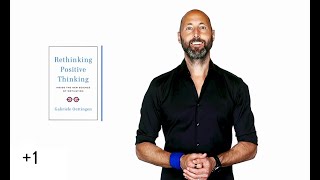
Brian Johnson (host of the +1 series) critiques uncritical optimism in this short episode. He summarizes Kate Heffron’s “Caveat to Optimism,” warning that excessive optimism can lead people to try to control biologically uncontrollable situations, ignore medical advice, and suffer greater distress. Johnson endorses Gabriel Oettingen’s Rethinking Positive Thinking and emphasizes balancing optimism with realistic appraisal and psychological flexibility.
Chapters
Hi, this is Brian. Welcome back to another Optimize plus one. In our last few plus ones, we've been optimizing our optimism. After hanging out with some long lived nuns, we spent some time with Martin Seligman not smoking two packs a day. Then we spent some time with Sony Lybomirsky journaling on our awesome future lives. Today I want to go back to Kate Heffron's textbook Positive Psychology in the Body. Right after the section in which Kate chats about the nuns, she shares some wisdom in a subsection called Caveat to Optimism. Cue suspenseful music. Dun dun dun. We've actually got a very important link to that soundtrack. Here's what Kate has to say. As with most of the topics in positive psychology, we must take into consideration the alternative viewpoints. We need to be very open about the benefits and indeed the negatives when dealing with optimism in health. Optimism may cause individuals to persist at trying to control situations that are biologically uncontrollable, which may in turn lead to enhanced levels of distress, disappointment, and depression. It may also cause us to forego adoption of medical advice and treatment. Overall, the cult of optimism and tyranny of positive thinking must not go unheeded. Kashdin and Rotenberg have argued that psychological flexibility is imperative in illness and health environments, enabling us to adapt to uncertain environments and outcomes and to better adjust to these. Ah, the cult of optimism and the tyranny of positive thinking must not go unheeded. Which is why Gabriel Oettingen's Rethinking Positive Thinking is one of my favorite books, and why we come back to her wisdom again and again one more time. Science says we must embrace the constraints of reality and honestly appraise obstacles. It also says that unmitigated good isn't good. Instead, we'd be wise to counterbalance our levity with the appropriate gravity to create optimal buoyancy. Check out that +1 when how about today? Cue the winning sound effect here. We've got a very important link to that as well.