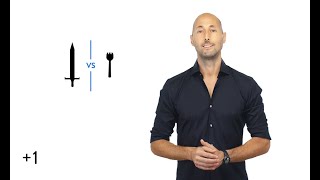
Brian Johnson compares forging a sword at 1200–1800°F to molding a plastic spork at 500°F as a metaphor for two kinds of growth: intense, disciplined transformation versus low-effort outcomes. Real change requires extreme heat and pounding, then recovery, not comfort.
Questions this video answers
Around 1200–1500 degrees Fahrenheit.
About 1800 degrees Fahrenheit.
Around 500 degrees Fahrenheit.
April 18, 2018.
Chapters
Hi, this is Brian. Welcome back to another Optimize plus one. In our last couple ones, we stepped into our World Champion you training camp. If you take even 20 seconds to actually think about that, you realize just how intense of a commitment that is right now. We've talked a lot about activation, energy and the fact that, for example, nothing happens when you rub two sticks together and and create 100 degrees of heat. Or 200 or 300 or even 400. You need to get to the magical tipping point of 451 degrees. Then, bam. Let there be fire. Now, all that's nice, but I got to thinking that a World Champion training camp is a lot hotter. Then I thought of a sword. Enter Google Search Enter at what temperatures are swords forged? Enter result number one via howstuffworks.com thanks guys. No matter which type of blade Smith uses, the desired result is the same to heat the steel to the proper temperature for shaping the sword. Steel becomes red hot around 1200-1500 degrees Fahrenheit and glows orange at about 1800 degrees Fahrenheit. Wow, 1500-1800 degrees. That's hot. And then there's the pounding required to forge the perfect blade. Which reminds me of Rumi's parallel wisdom. This discipline and rough treatment are a furnace to extract the silver from the dross. This testing purifies the gold by boiling the scum away. Then I thought to myself, hmm, I wonder what it takes to make a spork. You know those handy dandy plastic spoon forks, those guys? You only need around 500 degrees to mold the plastic into a perfect shape for eating food. You probably wouldn't be eating at a World Champion U Training camp. So today's plus one. What are you forging? A sword or a spork? How can you joyfully turn up the heat and pound a little more today? P.S. know this as well. That sword is forged by alternating the extreme heat of the fire and the cold of water. We need to be intensely on and intensely off, remembering that growth occurs during the rest that follows the stress. Here's to oscillating and forging our best selves. Isn't it a bit odd that we went from math to science to history, but somehow missed the class on how to live? For some wacky reason, optimal living 101 never made the schedule. Of course, it's too late to go back and change that, and you're too busy to read full time to catch up. But if you're like us, you're all about optimizing your life so you can actualize your potential. So imagine this. Imagine having someone read the best books on how to optimize your life and pull out the big ideas that can really change your life. You know those sections? You underline an asterisk and mark all up. Then imagine that guy me connecting those awesome ideas to other great books and helping you actually apply the wisdom to your life today. Well, that's what I do with something we call Philosopher's Notes where I've distilled hundreds of great books into 20 minute super practical summaries. Then imagine me taking the absolute best big ideas from those great books and sharing them with you in hour long Optimal Living 101 classes on everything from productivity, purpose and confidence to nutrition, goal setting and conquering procrastination. Helping you optimize every facet of your life so you can actualize your potential. You've got a personal trainer. I'm kind of like your personal philosopher. Ancient wisdom, modern science and practical tools. That's what our optimized membership program is all about. If you're feeling it, we'd love to have you join us.