A study of 2,000 people found they spend half their time lost in thought, and mind-wandering predicts lower happiness no matter what they're doing. Ian Robertson connects wandering minds to worse recovery after trauma. Brian Johnson recommends meditation and deep work to build focus.
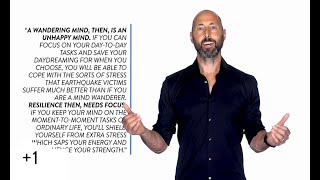
Hi, this is Brian. Welcome back to another Optimize plus one. Not too long ago we spent some time with the brilliant neuroscientist Ian Robertson, discussing some ideas from his great book, the Winner Effect. Today we're going to chat about a powerful idea from his book called the Stress Test, which is all about how pressure can make you stronger and sharper. Here's the short story on the idea I want to discuss today. He tells us, and I quote, if you let your mind wander, you'll make yourself unhappier. Here's the slightly longer version. A wandering mind then, is an unhappy mind. If you can focus on your day to day tasks and save your daydreaming for when you choose, you will be able to cope with the sorts of stress that earthquake victims suffer much better than if you were a mind wanderer. Resilience, then needs focus. If you keep your mind on the moment to moment tasks of ordinary life, you'll shield yourself from extra stress, which saps your energy and hence your strength. End quote. And here's the fascinating research behind those declarations. Here we go. Ian tells us. I quote, the SMS signal in your phone bleeps a question on the screen. How are you feeling right now? You choose a number from between 0 very bad to 100 very good. Another question. What are you doing right now? You scroll through and click from the choices. Then the final question. Are you thinking about something other than what you're currently doing? You thumb one of the four options. No. Yes, something pleasant, yes, something neutral, or yes, something unpleasant. More than 2,000 people signed up to allow Matthew Killingsworth and Dan Gilbert of Harvard University to send them these messages at random times, roughly three times per day for a few weeks. People's minds wander a lot. As the replies came pinging back, they gave the intriguing picture of 2000 minds wandering roughly half the time. And here is the even stranger. It didn't matter whether they were doing a really grungy home chore like cleaning the bathroom or sipping cocktails on the sun drenched deck of a yacht. Minds were equally likely to wander to good, bad or neutral things, whatever the activity. Not only that, but a wandering mind was almost always less happy than a mind focused on what it was doing. Even if drudgery was being done. You might think, ah, but if I'm sitting on a yacht sipping a Manhattan while dolphins frolic under the gleaming white hull, how could my daydreams not make me happy? Wrong. People are no happier during pleasant daydreams than when their minds are focused on scrubbing the lavatory. How fascinating is that? One more time. A wandering mind is an unhappy mind. And here's what's scary now that we're being inundated with more inputs in a single day than our 15th century ancestors were exposed to in an entire lifetime. As we bounce from text messages to email to news to this and that and back again, and I get dizzy just thinking about the cascade of inputs, we're basically training our minds to to be constantly distracted, rarely focusing our attention on any single thing for any significant duration. And in the process, we're basically training our minds to wander, which is basically saying we're training ourselves to be unhappy, which is why we continue to make such a big deal out of training ourselves to focus on what's important now. Oh, by the way, that wisdom was from a chapter called what a New Zealand Earthquake Taught Me about Nietzsche. You might wonder what did it teach Ian? Well, it taught him that people who allowed keyword allowed their minds to wander suffered more after an earthquake than those who didn't allow their minds to wander so much. So let's train our focus, especially in the midst of so many challenges going on in our world, and do it today. P.S. how? Well, you tell me. What's your favorite practice? Mine, of course. It starts with meditation, which is like hitting the Focus gym. Then it includes huge bubbles of zero input, time for deep work and deep love, etc. Etc. Etc. Remember, a wandering mind is not a happy mind. Let's train our focus today.