A short '+1' episode by Brian Johnson highlighting James Nestor's book Breath and arguing that breathing (and lung capacity) is a foundational pillar of health. The host cites research—particularly analyses from the Framingham Study—claiming lung capacity predicts longevity more strongly than genetics, diet, or exercise, and ends with a practical nasal, diaphragmatic breathing exercise (inhale through the nose into the belly; exhale slightly longer).
Questions this video answers
In the 1980s
5,200 subjects
Two decades of data
Lung capacity (lung size/efficiency)
Chapters
Hi, this is Brian. Welcome back to another Optimize plus one. I recently read a book called Breath by James Nestor. It's all about the new science of a lost art.
Thanks for the rec, Zach.
Now, James tells us that breath is the missing pillar in health.
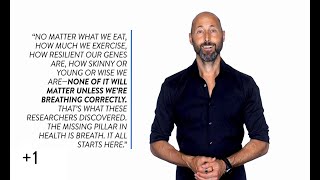
In fact, he says, I quote, no.
Matter what we eat, how much we exercise, how resilient our genes are, how skinny or young or wise we are, none of it will matter unless we're breathing correctly.
That's what these researchers discovered.
The missing pillar, he says, in health, is breath. It all starts here.
I say yes to that, which is.
Why we've included breathing as a core fundamental for years. Right there with eating, moving and sleeping. See breathing 101 in our notes on breathe.
Perfect breathing.
The healing power of the breath. Breathe in, breathe out and anxiety free. And of course, the oxygen advantage. Four more, all linked in the plus one. One more time. How we breathe is fundamental to our well being. We can survive for weeks without food, days without water, minutes without breath. And yes, of course, we should be able to breathe right without being taught how to do so. Same goes for eating and moving and sleeping.
Our modern society has given us an.
Array of ineffably awesome advantages. Mastery of the fundamentals is not one of them. Now, we've talked about all that before, but get this fascinating research. Did you know that lung capacity is one of the greatest predictors of longevity?
Yep, and good news, it can be.
Developed via proper breathing.
Let's explore some wisdom. James tells us, and I quote.
More recently, science has begun testing what.
The ancient Tibetans understood intuitively.
In the 1980s, researchers with the Framingham Study, a 70 year old longitudinal research.
Program focused on heart disease, attempted to.
Find out if lung size really did correlate to longevity.
They gathered two decades of data from 5,200 subjects, crunched the numbers and discovered.
That the greatest indicator of lifespan wasn't genetics, diet, or the amount of daily.
Exercise as many had suspected.
It was lung capacity.
The smaller and less efficient lungs became, the quicker subjects got sick and died. The cause of deterioration didn't matter.
Smaller meant shorter.
But larger lungs equaled longer lives. Our ability to breathe full breaths was, according to the researchers, literally a measure of living capacity. That's today's plus one, proper breathing. It does a mind, body, soul good. Let's take a nice deep, relaxing breath. Now remember our 1, 2, 3, number 1 in through your nose, 2 down into your belly.
Exhale slightly longer than your inhale.
Repeat all day and night. Today, let's do one right now.
In through your nose.
Down into your belly.
Back out.
Exhale slightly longer than your inhale.
Flip that switch on the parasympathetic nervous system.
Relax. Build your lung capacity and in the process, extend your longevity.