Short video/audio 'Plus One' by Brian Johnson arguing that constraints enable optimal performance and creativity. He cites thinkers (Seth Godin, Alan Watts, Igor Stravinsky, Austin Kleon, Dr. Seuss) and offers practical examples of self-imposed limits (fixed lengths for philosopher's notes, episode formats) to reduce paralysis from limitless options and encourage focused excellence.
Chapters
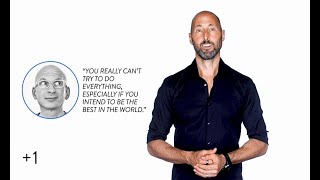
Hi, this is Brian. Welcome back to another Optimize plus one. In our last plus one, we got our inner freak on as we spent some time with David Rendahl and learned to embrace constraints as we reminded ourselves to approach this whole game of life as optimalists rather than perfectionists. Using our ideals as guiding stars, not distant shores, we explored the value of constraints on a high level. And. And I promised to talk about the idea in a little more detail in terms of choosing what we want to do with our lives and in the day to day of actually making things happen. So David kicks off the chapter on the power of limiting our options with a quote from Seth Godin who tells us, you really can't try to do everything, especially if you intend to be the best in the world. Amen. And. And as I read this chapter, I thought of chats I had back in the day with Steve Chandler when he and I worked together one on one. He loved Alan Watts's wisdom that tennis is more fun with a court constraints for the win. And he loved Igor Stravinsky's wisdom that I quote, the more constraints one imposes, the more one frees oneself and the arbitrariness of the constraint serves only to obtain precision in the execution. Now, as I search the old database of 600 plus philosopher's notes on my Mac to find that quote, I found this parallel wisdom from Austin Kleon Steel. Like an artist, he tells us, and I quote again, in this age of information abundance and overload, those who get ahead will be the folks who figure out what to leave out so they can concentrate on what's really important to them. Nothing is more paralyzing than the idea of limitless possibilities. The idea that you can do anything is absolutely terrifying. The way to get over a creative block is to simply place some constraints on yourself. It seems contradictory, but when it comes to creative work, limitations mean freedom. The right constraints can lead to your very best work. My favorite example, Dr. Seuss, he says, wrote the Cat in the hat with only 236 different words. So his editor bet him he couldn't write a book with only 50 different words. Dr. Seuss came back and won the bet with Green Eggs and Ham, one of the best selling children's books of all time. By the way, check out our note on the brilliant biography Dr. Seuss and Mr. Geisel where we talk about those exact same constraints. It's awesome. Now, as I chat about in our notes on Steel, like an artist, I love constraints. They or my friend, when I remember them obvious constraints I use creatively include each philosopher's note is 6 pages long, not 3 or 8 or 12. 6. The plus ones are short and sweet, not crazy long. Except for the rare plus 11. The optimal living 101 classes and mastery series sessions. They're each 10 ideas in around an hour, not 3 or 7 or 14 or 2210. So today's plus one back to you. What limitations can you impose on yourself? How can you constrain your options more so you can enjoy your life more? Remember the paradox of choice and the illusion of choice. Simplify. Go all in on being your best today.