Areté: Activate Your Heroic Potential — The Livestream Experience
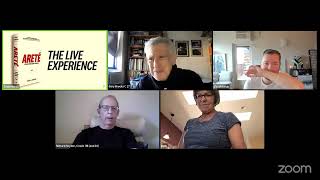
Brian Johnson hosts a livestream launching Areté, discussing the book's retail rollout, corporate pilots with Mariner Wealth, military partnerships at West Point, and his Virtue Compass framework built on cardinal virtues. He outlines plans to reach a million readers and embed the program across organizations by 2030.
Questions this video answers
Users who hit one target were on average 23% more energized.
About 1,500 total employees; roughly 750 participated in the study.
88 cadets received R; event in D.C. on December 6th.
About 1,500 boxes shipped worldwide by the Blackstone team.
Copies were purchased at Barnes & Noble/independent stores in 48 states.
Chapters
Check in. Check in. Happy day one. Welcome to Sunday. Welcome, everybody, to the live stream. We're going to kick things off as we have done with a dance party. Couple quick announcements just before we do that, though, again, lost and found. If you have lost anything, we'll have it at that front table. Workbooks, books. Go ahead and check inside your workbook to make sure that it is yours. If it is not yours and or you picked up any other workbooks throughout the weekend, check those two to make sure that those are yours. Some folks have lost their workbooks. They all look remarkably similar. Similar from the outside. So zero worries there. And then we'll have some other pieces later. But let's. Let's go ahead and get our groove on. All right.
See?
Let's dance.
Let's dance.
Or move. Whatever you feel like doing. Oh, yeah. Yeah. Perfect. Yep. That guy. Okay. Yeah, Yeah. All right. Awesome. Perfect. Perfect. All right, let's go ahead and ground into the nose. Deeply, diaphragmatically into the belly. Back out through the nose. $one dollar to the first person that can identify that voice. We got a great day today. Gonna have a lot of fun. I'm gonna kick it off with a short celebration. We're gonna welcome Hal Elrod. Brian is going to light us up. Activate our hero. Who's had fun so far this weekend. Is anyone still cold from the cold plunge? Who is going to install a cold plunge? Practice. Yeah, Jeff. Where's Jeff at? Let's give it up for Jeff one more time. Good morning, brother. Good morning. What a weekend, huh? Oh, my goodness. I'm still buzzing. I went home early last night. I'm training my recovery today. I'm gonna. I want to make sure I connect with everybody. So if we haven't connected yet, please don't be bashful. Don't hesitate. Today's the day. Oh, bless you, Wendy. How amazing is Wendy? Oh, sweet woman. What's that? I love it. This is our beloved Wendy. Oh, love you so much. I love you, too. People ask me who I work for, who I write for. There you go, Wendy. Wendy's picture was in my studio in Ojai. Wendy on this side. And Coward and his beautiful wife Asma were kind of up there. And when I would get ready to do my take, I'd look at them and say, all right, this is for you. So plus he won the. Oh, geez. Well, there we go. Over under. What were we out there, folks? 90 seconds. Great to see you all. Great to see all the live streamers. It's been fun. To see all the social posts as well this morning. I'm like in tears, like, oh, my goodness, look at these guys in front of that restaurant. Etc. So what we want to do, we want to kick today off celebrating our team. Our team works so hard to support you, you know, and I want to bring them up and give them some love, Maybe come through it. We found you, Brother Bernardo. This is the team that makes the dream work. I'm so proud of you all. This weekend has been great. The last year has been great. And yeah, let's just give it. I'm going to give them individual. Give it up one more time for this group. So I'm going to go from this side over. Philo is our product manager who helps build the product below. Ali flew in from the uk, longtime student. Everybody here, almost everybody, has been part of the the movement in one way or another or is now obviously part of the movement. Building the movement. Ali from the UK flew out with his beautiful wife and daughter. Helps engineering TEAM BUILDS what you use. The speed with which the engineering team is coming together now, by the way, is really, really inspiring. I've been involved in building and creating two social platforms. I kind of know a great product development team when I see one and they're just really beautifully hitting their stride and it's so exciting to see them coming together. Paulina, also on the engineering team last year. Brian is a big man. This is Brian, who does a little bit of everything. He's also got an awesome RTE tattoo on his wrist. Ambassadors. You've connected with him. Etc. Yana does it all. You know, this. This morning I was again, I was getting emotional looking at those pictures, those videos. I think Barnabas took one of the videos of us in the cold plunge. There's a couple of things that struck me. One, I'm like, did Michael put himself to my right, my right hand guy? Because I was holding his hand with my right hand. I'm like, oh, that's so sweet. And Yana's on my left. I'm like, that's perfect. And then Bernardo, my favorite part of that shot is Bernardo is our CTO who's done such amazing work before. He joined us and has really done a beautiful job leading our, our engineering team and also really helping us create the culture within heroic. Your beautiful man and that, that video and the image of you. So Bernardo is holding hands, but he's not just holding hands with the people to his guy and girl to the right and left. But you brought their hands together. It was such a Beautiful, symbolic, like, representation of what I think you do for our team. So that was just so great. We've got Brett, who's worked with Bernardo for a very long time, who does a lot of the really important infrastructure, architectural stuff behind the scenes. My brain hurts thinking about what he has to do. So bless you. We've got Matt. We've got Matt, who you get to hang out with almost every day at 101. How awesome is that? We've got Kotch, who's another really, really important and strong part of our engineering team. Nice work in the cold yesterday. We've got Jesse, who you may have interacted with behind the scenes. We've got Alexander, our kind of media ad buyer, who's been doing some great work. We've got a lot of exciting stuff on that behind the scenes. Great work, jt, if you've ever interacted with jt. Oh, so jt, you know, JT is like the most soft, beautiful, humble, loving, present man, and he also travels with swords. So Emerson comes up to me and says, jt, tell me a chokehold. It's way better than what my jiu jitsu guy taught me. I'm like, oh, JT is integrating here, folks. That's so good. Cowman does it all as well. I don't. I don't know if there's a job or a position within heroic. The Kalman has not fulfilled. I don't think he's written a line of code yet, but outside of that, think he's pretty much done it all. He's done some HTML. Oh, there we go. All right, cool. So just when I was wondering if there was something you couldn't do, the answer is no. All right, great. We got Zach. Zach. Zach wins the award. How long has it been, dude? Zach has been with me and us for 10, 11 years now. So bless you, brother. Such a good, good, good human being. And then we've got Patrick, director of operations, and again, same thing. The team is just so good. Such good people, a who are so committed and so passionate and so capable to do so many different things. So again, I don't know if there's. Have you written code? He's written code. Isn't he's like, yeah, I've done that when we needed to do that. And then. And then we've got some folks who are not here with us. So Yuva, Kartik, Sonia, Ekram, Fred, Tanya, Maybe you're watching via live stream, but we've got some folks who weren't able to make us Come to team. And then we've got Mr. Michael balchan. Exactly. There we go. I will just start weeping if I get any details. I love you, brother. The fun has just begun, and we cannot forget. We've got my family. Bring up my family here. Oh. Oh, buddy. I didn't get to say nice work on the cold you hopped in there. My beautiful wife. How many of you have meditated to her meditations? How many? How about the kids and the kids meditations? Love you, wife. Anything you want to share, I get. I get to kiss my wife while I give her my mic. Let's go. Oh, this is a brilliant. Oh, let's go. All right. Seriously, come on in. No, I just get emotional. I mean, that's awkward. Yeah, that's like us. Let's go. Just you sharing all of the team.
All the team.
And just feeling super grateful and just feeling the emotion and the team years and just how hard everyone works and how committed everyone is and how their soul force is so incredible. Our whole team is just amazing. Anytime we need anything, seriously, I mean, Patrick has done so many things, so they just are always on call and ready to do anything. And truly extraordinary humans. So feel very grateful. And none of this would happen without everyone here, so. All right. Hello, hello, hello. Thanks, buddy. You having fun, bud? All right, we stay up here. Okay. It was fun, too, to see this morning. So yesterday had some dinner, and we were talking about, like, who's gonna go to the gym early? And we were in different groups, and Yana's husband family was like, oh, let's get out there early. So I get a text from Yana like, hey, we're heading up to the gym. So I go up there, six, 15, meet them, start to work out. Brian tears up there as well. Greta's there doing. Doing stuff. And over the course of, like, 15 to 20 minutes, without having actually coordinated anything, just different team members kept filtering as, like, cowman showed up, and then Patrick showed up, and then Zach showed up, and then you guys all started showing up. And there was a point at which the gym was literally full of people either wearing heroic gear or part of the community. So it was really, really fun to see everyone practicing their philosophy first thing in the morning. Got some burpee sets in. I'm behind, by the way. I've got my five. I just banged out 44 here. I slept in a little bit. But I'm excited to do some burpees with you today. We got a picture to represent the. Yeah. So if we can get the. We'll see. So when I. When I think of our team, what's. Do we have the picture from last night's dinner that we get up here? Yeah.
Okay.
So when I think of the team, you know, this is our core team. It's the team behind the team, you know, and we're working with John with Toronto fc. He used the phrase the team behind the team. So he's got 75 people that are behind the scenes, from the chef to the assistant coach and everybody in between to help the team that's on the team. I see this. That's on the field. I see this as the team behind the team. You all are our team. So that way, you know, we're just hustling front, right tire, guys, you know, doing everything we can. But this picture, this is one of those pictures like, oh, no. What? Look at this. This is our team. You all taking over that. So inspiring to see you all here and to be able to connect in this context. And then, you know, we kind of look at the ripples, right. Of this and everyone you're already affecting and then going out. And then we've got a couple other fun slides I think that we might walk through, but we'll talk more about it. What's up, Justice? Dude, that's amazing. The ripples, the ripples. We'll talk. We'll talk more about the extended team when we come back. We talk about the vision and then we talk about kind of how I'm framing up here to 2051, but let's leave it at that for now, and we'll bring Hal on. We'll have a great chat with him. We'll go from there. But one more time for our team, guys. Love you. Appreciate you. Day one. You want, you want like I thought. Yeah. Hey, front. He's got swords. Two lines go in front of the table. Yeah. Do you want us to go in front of the table or. Okay, cool. Get tight. Let me, let me. Yeah, yeah, There we go. Here we go. I think my over under timing was hit. I think my over under in the first 30 minutes has been hit five times. Crying Patrick, laptop. All right, we got Hal Elrod, who's going to join us? Hal was going to join us in person, and he sent me a voice memo this morning saying he wasn't feeling 100%, and I encouraged him to stay home. It just both for us and for him, obviously, but for us, knowing that we've been traveling and we're kind of wearing it. We don't know what he's got. So we're going to zoom with Hal Elrod. He's in Austin, which is one of the reasons I thought it'd be fun to have Hal on. And he's also an amazing human being. How many of you know his miracle morning? Awesome. Oh, there we go. We got it. So we'll do that. But Michael, any other administrative stuff before we bring him on? In a minute. How Elrod is in the book as well. So savers miracle. Let me get the. Oh, sorry. So we've got a slide. I think that's got the specific page numbers. Oh, we're also. I heard you guys had just an amazing. A bunch of you were meeting up thinking about what you can do with local and all the things that we can do. So that's exciting. And we're so excited about the workbook Michael and I were crafting during the movie yesterday. Kind of thinking about me. I don't know.
There we go.
Wait, that was me. Well, check it out. I was ready for the wife. The workbook. We're so excited. So current thinking is hardcover, but. But you can write in it, you know, I mean, whether it's Moleskine or something cool. Maybe it's in between a hard hardcover and this. But 212 tools. So 451 degrees to activate your heroic potential with the book. But 212 degrees, 212 tools in the workbook. Systematically walking through the seven objectives. All 100 plus tools we already have in the app and another hundred plus tools that we will put into the app and really, really creating this as a just a. We do our job. A piece of art as well that goes with this. And then launching it as heroically fast as we can. So we're really excited about that. And we got Hal. What's up, brother?
All right, I'm unmuted. You hear anybody?
Let's get you off of mute. Make sure we can hear you.
Can you hear Brian?
We can hear you and we can see you. Good to see you, brother.
Brian. Dude, have you ever seen this book? I can't get enough of this book, Brian. I catch myself in interviews where I'm supposed to talk about the miracle morning, the new book, and I just keep. Have you read Arete though? I'm seriously, man. I've told you. I just. I'm so proud of you. Incredible, man.
Oh, dude. Well, there's one way to start. Bless you, man. Big hugs. And appreciate you taking the time bright and early on a Sunday morning to. To spend the day with us. How's Your morning, dude.
It's good, man. It's a miracle, man. It's a miracle.
Miracles.
Yeah. Every morning. Yeah, yeah. A little under the weather. I started to come down with something last night and then, yeah, this morning I voice text you. I was like, hey, I'm, I'm in. I'll, I'll push through. I'll be there. But out of respect for everybody in the audience, just want to let you know and you know, so thanks for looking out for all of them. And I got to be honest, I'm like, oh, that's, that's nice. I can just be home.
Yeah, that's great, man. And I appreciate you still making the time and I love you, dude. I appreciate you. You've impacted my life deeply. Who you are, how you've shown up, your own hero's journey I want to talk a little bit about. And then we're going to come back to that and talk about it in our one on one when we do a master chat as well. But just for those who don't know, Hal Elrod Miracle Morning among many other things in the chat, in the live stream, throw up the link, check out the note on it, talk about how in the book, etc. There we go. Miracle Morning. And you've got your new. Let's just go there. Two million copies sold. Let's go revised edition. Just tell us about the book and then we'll get into, you know, some details in terms of how we can go about creating a Miracle Morning. What arete means for you and some other fun things.
Yeah. So if you look back here on my wall, that that's the original self published Miracle Morning book that Brian, you did a philosopher's note on came out 11 years ago and then right now coming out in a month from I think today, the, the Miracle Morning updated and expanded edition. And So I added 70 pages of new content plus rewrote almost every page and there's two new chapters. The Miracle Evening, which is your strategy for blissful bedtime and better sleep and the Miracle Life, which is the path to inner freedom. And so really excited about this. And Brian, I'm just so honored that you, you featured Miracle Morning and in your book and it's an honor.
Oh dude. And that's so exciting. I'm so happy that you, you're bringing in the PM bookend is what we call it. So I like to say that your day started the night before. Yeah. And how you ended your day yesterday is going to directly impact obviously. I mean this is an obvious statement but to really get it and then to operationalize the truth of that is everything. Let's go straight there. So tell us about that. Tell us about that distinction, how you would frame it up for us. Yeah.
So I've been asked for years, people always go, hal, what's your evening routine? And I've always been a little bit embarrassed when I'm like, I don't really. I don't really have one. Like, I just. I just kind of go to bed and. And then, you know, just like you said. And I realizing that, well, how I end the day might be as important as how I started. And I kind of realized, oh, I actually do have a routine. I just didn't realize it was rout. It was just what I do, you know? So where this really came from, though, is in 2020, I finished my third year of chemotherapy, and they call it chemo brain, but it's poisoning your brain. And it really took a toll on me to where I lost a lot of my cognitive function. I feel like my IQ dropped 30 points. And I stopped sleeping. I was sleeping, like, two to four hours a night for good. Four, five, six months. And if you ever sleep two hours in a night, right, you're a wreck the next day if you compound that for four, five, six months. I was delusional. I was a mess. I was depressed. I was suicidal, Brian. I was a mess. And so I went relentlessly pursuing, how do I cure this? How do I cure this severe sleep deprivation, this insomnia? I reached out to some of the best sleep doctors in the world, and I figured it out. And then I started. When I would speak at events, I would say, hey, by a show of hands, how many of you have trouble falling asleep or staying asleep? How many struggle with sleep? And it's over half the hands consistently that go up in audiences, right? And that's when I realized, man, this is a big deal. And so this evening routine wasn't just about, like, you know, having a nice way to end the day. This is really about, like, if you struggle with, you know, sleep deprivation, insomnia, if you do. If you're like, probably 90% of people, where you end your day focusing on things that are out of your control, because when you lay down to bed, you got one thing you could control, which is falling asleep. But most of us are thinking about what went wrong that day, the conflict we had earlier with our spouse, what's going on in the world that's out of our control, what the government's doing, what the economy's doing what's on our agenda for tomorrow and next week and. Right. And all of that is a recipe for poor sleep or not being able to get to sleep at all. And so the miracle evening is a seven step ritual that includes everything from. And it's organized in acronyms. Slumbers, S, L U M B E R S. We got the savers for the morning and the slumbers for the night. But like the first S is stop eating three to four hours before bedtime. Right. And actually go into like digestion. And what, what does that look like? And what does that do to your body? If you eat close to bed, you might be asleep, but your body's working all night long. And then you feel like you were hit by a truck in the morning. Right. You don't get that restorative sleep that you want. And then I talk about letting go of just stressful thoughts. How do you. And for me, it's like I want to go to bed feeling blissful. I want to go to bed totally at peace with all the things that I can't change because I can't control them. Who cares?
Right?
And I want to just feel grateful and joyful and drift off to sleep feeling that way. Because one of the things that I realized years ago is that your last thought before bed and your, your mental and emotional state as you fall asleep is almost always what you wake up with. You wake up with that same thought you went to bed thinking and that same emotional state that you dwelled in. And I'll tell you, when I go to bed using the miracle evening, that blissful bedtime, the benefit of that is I wake up in a blissful state and I'd say, you know, nine out of ten days now that's what I get to do. And that's a far cry from being suicidal after being sleep deprived to this. And so that's why I wrote the chapter. It's a 22 page chapter. And I was like, I want to pay this forward because I know people are struggling with sleep and I want to share what I did to overcome that.
Let's go through. I'm seeing people taking notes. We got slumber real quick. Stop eating. Let go.
Oh, dude, I'd have to open the book. I don't even remember all the.
Dude, you're an acronym machine. Well, you got this. Let's step back then go find the page because I do want to go through it real quick. Get the book.
Okay, I got it. I did find it.
I got you putting you on the spot. Yeah, actually, yeah, go there. Then we'll step back and I want to talk about your. I'm going to plant the seed though. How is the embodiment of anti fragility. So we'll talk more about his near death experience with his cancer and how he battled that and then how he has gone through that and alchemized it into the humble yet heroic wisdom that he's now sharing. So I just want to make that explicit that this is what heroes do. Heroes face those dragons that they feel may kill them at times literally in Cal's case. There's other stories in your life in which you experience this. And you, you, you struggle. You're not always winning and you're not always learning. You're just getting your butt kicked. Yet the hero moves from that victim to the creator to the hero. And your arc on that is just. It's so inspiring, man. And thank you for sharing that. To have the humility to share it and let us know we're not alone. Stop eating. Let go. What else did this guy have?
So let go of stressful thoughts and feelings. That's the L. Wait, wait.
Sorry, sorry. I was, I was speaking over you. Say it again, please.
So, yeah, so. So the first is stop eating three to four hours before bed. The L is let go of stressful thoughts and feelings. Right? And I teach how to like, I call it flipping the switch, where it's like, oh, wait, this doesn't serve me. Okay. The only point, the only thing I.
Should be thinking about are things in the audience. We also call it flip the switch, baby. Let's go.
Nice.
I tell you, we're brothers.
There are no new ideas.
All right?
The U is use natural sleep aids if needed. And I just felt like I'd be, you know, I should let people know, like, hey, there were supplements as part of my, my healing, you know, So I wanted to share that. The M is for map out your next day, right? And that's just get it out of your head, get it on paper, write it in the journal. Make sure you don't have to think about what you're doing tomorrow because you already wrote it down. The B is for boycott blue light. That's pretty self explanatory. The E is for enter a blissful state with bedtime affirmations. And I give the bedtime affirmations that I use to allow me to enter that state. Right? And so that way it's. It's what you talked about. Targeted thinking, right? In arete. You talk about targeted thinking. And it's. That's what those affirmations do. It's like these. I. I've already decided in advance and. And edif or edited those affirmations. Like, this is exactly what I should focus on and think about and affirm right before I go to bed. The R is for read a book that makes you feel good. And I have a drawer full. My bedside table. I've got a drawer full of books that are. That fit the bill. I've got Loving what Is by Blinken.
Yeah.
Byron, Katie.
Yep.
I've got Michael Singer. Right. I've got some Michael Singer books. I've got some Eckhart Tolle books. I've got. So, and, and, and here's an important distinction, is they're books I've already read and they're underlined because there's a difference between reading something that's brand new for you and you're like, oh, my God, this is. And then now I've got to contemplate it. I' to think about it. I've got to. Right. Versus I'm only reading things I've already read. They're underlined. I don't have to remember them. Right. So it takes that pressure and stress off of overworking your brain right before bed. And then the. The S is for sleep like a baby. And, and I mean that in a couple of ways.
But you think about, well, I got my wife back here. Is she still in here? Oh, my goodness. But go on. Yeah, sleep like a baby that sleeps. Well, go on.
Yeah, yeah, exactly. That's right. I've had somebody. There's some pushback on that. Yeah, Maybe some people.
Oh, no, we're good, dude.
The point being that the, you know, a baby's state of consciousness is one without worry. Right. That. That's the essence of that, is that they're not thinking about their to do list. They're not worried about the future. And so that's it. It's getting back to that state of innocence and of. Of safety. Right. And so, yeah, so that, that's it. And so those slumbers, those six practice or seven practices. Right, those kind of seven steps. Yeah, that. That's the essence of the miracle evening. And then the, the, the underlying theme, of course, is just the idea that at bedtime you only have one objective, and it's to prepare your mind and body for restful sleep. So how can you set it up so everything that you do leading up to bedtime is aligned with that singular objective?
Brilliant, dude. I'M so happy that this is in your new book or the updated edition. This is so good. So to repeat team slumbers. Sounds a lot familiar to what we talk about, huh? But framed up so good. Stop eating three to four hours before you go to bed. Let go of stressful thoughts and feelings. Use natural sleep aids as necessary. Map out your next day. See it, get out. Get it out of your head. Visualize it. Boycott blue light. That is fantastic. Way to frame that up. Enter a blissful state with positive affirmations. I want to come back to that for you and hear what you do there. Then we've got read a book that makes you feel good. I love the distinction. On you're not reading Arete for the first time before you go to bed. All right, let's go. You know, Michael Singer, great call for the end of the evening. You know, tick nhat hanh, whoever you got. And then we've got sleep like a baby. That sleep's great, but that consciousness, that's. That's free. That's. That's just relaxed in a state of calm. Let's go. Let's sleep quickly before we go back in. Targeted thinking. I love that you connected it to targeted thinking. So the end of the day routine is, we're done. The day's done. You may or may not have done everything. Well, you certainly didn't do everything you wanted to do at the highest possible level. That's a given. So have the wisdom to know that. But let it go, you know, and then your next target is a good night of sleep. So I have this ritual, too, and I'm going to integrate some of the ideas that you've shared that I do implicitly. I'll make it more explicit in what I do, but I literally. I wear earplugs at night because our dogs can get a little nuts. Put on my. My Whatever little eye mask thing. But as I put my earplugs in, I'm like, today's over.
Boom.
Today was a great day. It's like a ritualistic thing of. Nope. Dropping in. And then when. And if. And I do a certain breath and kind of affirmation in my own way. But when. And if I get up in the middle of the night, which is pretty much every night because I'm on right now and I'm thinking, and sometimes it's celebratory, sometimes it's real creative. But I remind myself of what I want. So I go targeted thinking. What do I want? I want to get back to sleep. I Want to have a great night of sleep, Perfect. Then I work that protocol. But that targeted thinking at the end of the day is so cool. What, what are your affirmations, to the extent you're open to sharing some of them that you use to get into that blissful state?
Yeah. Essentially the first thing that I affirm is that no matter how many hours of sleep I'm getting tonight, my body is going to, it's a miraculous organism that is going to rest and rejuvenate and repair and I'm going to wake up feeling incredible. And that's part of the idea that your first thought in the morning is the same as your last thought before bed. And if you, you know, if you go to bed going, oh my God, I got so much to do tomorrow, I'm gonna, I'm exhausted. Or, or if you have a belief that you need eight hours of sleep but you're only getting seven, then how you feel in the morning becomes a self fulfilling prophecy. Right? Which is like, oh my God, I need eight hours of sleep, but I have to get up early, I only get seven now, I'm gonna be tired, I'm not getting enough sleep. Well, and then when you wake up in the morning, that's exactly how you feel versus, oh, wow, I'm only getting seven hours of sleep, but that's perfect tonight. Right. And just, it's just deciding like I'm going to tell my body what it's going to experience throughout the night and I'm going to decide how I'm going to feel in the morning. Right. As opposed to, you know, letting some uncontrollable, you know, circumstance at this point decide that. And then the other is I just, I actually, I just go through tonight. I am focusing on what I have to be grateful for as I fall asleep and as I go to sleep, that's what I do is I drift off. You know, it's the old, it's the old counting your blessings, I guess. Right. But I just think about what I'm grateful for and I'll. Sometimes I'll replay a conversation I had with my daughter in the evening, you know, connecting with her. I'll be grateful for my wife. If I had a tough day, if, you know, if I had like, let's say you have the worst day ever. Right? It was just a bad day. You, you had, you know, some conflicts. Yeah, it was stressful. You didn't get done what you wanted to get done. Like if there's not much to replay during the day that actually lets you feel rested, then I will simply be grateful for the bed. I will go deep into gratitude for the pillow and I will hug the pillow and I will go, thank you for giving me a place to rest. I will go, you know, thank you for this bed. And I'll stretch. God, so comfortable. And then a really important part of this, and I recognize this a few months back, or I guess while I was a few months ago, six months ago, when I was writing the book, but is one of, if not the most important thing to affirm as we fall asleep is I am safe. I am safe. If you don't feel safe, then your body, your brain cannot shut down and allow you to fall asleep. And there's many. Not feeling safe shows up in a lot of forms. You might not feel safe in your finances. Right. You might not feel safe in a relationship. You might not feel safe in the fact that maybe there's, you know, crime is up in your city. So it's a literal state. Right. Whatever it is. And so going back to my singular objective is to prepare my mind and body for restful sleep. Well, feeling safe is the only way to effectively do that. And so that's become a really important affirmation is not only I am safe, but thank you, God, right? So it's combining the safety, the feeling of safety with gratitude that I am grateful that I am safe in my home, in this bed. And I'm going to get a great night's rest.
Beautiful. I'm feeling, I'm feeling safe in your presence and I'm feeling excited in a calm, tranquil way. We did a cold plunge with one of our dear coaches here. We did Wim Hof. So it was. I'm excited to go hop into that cold plunge. £4,000 of ice. I feel excited to put this into work tonight. So much we can talk about there. I've already seen a bunch of people say, got the book. Get the book. It's great. Hal's got the same conversational, humble, non pretentious communication of really practical ideas, which is why I loved it when I first read it. Miracle Morning forever ago. And he just, he concretizes these ideas really, really well. So if you're enjoying this, get the book. I want to talk. I don't want to talk about my book per se, but I want to talk about what arete means for you. So. And I know that you've. And if you haven't seen my interviews with Hal, each of them that we've done have, we've done Three so far.
I think so Two on Arete maybe, and then one before.
Yeah, forever ago. They're tied for first for my, my all time favorite conversations. Hal has a similar style and being able to elicit the best from me in our conversations. So I'm really, really proud of those conversations and I'm really excited to share them. So check those out. We'll put those in the live stream. We'll follow up with this here. I know that Arete has resonated with you, and I would just like to hear kind of, I guess on the highest level, why, like, what is it that you found to be such a deep connection in the form of that book?
So first, and it's, you know, as I'm reading it, I just have to mention, like, when you read a book as an author, right, you're. You're reading it in two different lenses always. Right? You're reading it through the lens of like, okay, how's this content impact my life? And then how does this author write his book? Right? Like, what might I learn from his writing style or her writing style or. Right. And so, you know, just mentioned everything when I first got the book, I told you, like, it's the only book I've ever rubbed on my face because it's so soft. Like, that's weird. But it's, it's like you just, you just did such a beautiful job with the book. For even opened it up, I'm like, oh my gosh, this is, this is gorgeous. This is special, right? Like, and that's. I know that was your objective, so congratulations, right? It's that the Steve Jobs.
That was the goal.
I'm a germ freak, so I couldn't lick it. The face rub was the closest I could get. But then, But Brian, here's. So here's the deal. First, it's. It's your writing style. You are the most conversational writer possibly ever, you know, and in, in such a fun way. And that's one thing that I actually, again, going back, I'm like, oh, I wish I, you know, I could model that more in my writing. Like, you know, I love that you don't. You don't obey the. I forget the name of it, but you know, like the, the property grammar. Like, you capitalize words because you're like, this is. And, And I get that. I, as I'm reading your book, I just hear you talking the entire time. Like, it's like, I have the audiobook. Even though I'm not listening to the audiobook. I'M reading, and I get your voice, and I hear when you're. When a word's in all caps, I just. I hear, you know, hey, Hiro, Day one. Let's go. Like, I just feel your energy, and it's. You have a really amazing writing style. So that was. That was one. So it's really enjoyable. And I like, I love coming back to it. In fact, I broke my own rule. You actually said, let's not. Yeah, don't read arte at night. No, I broke my own rule. I, like, started reading in the morning, and I'm like, this could actually be a nighttime read. Even though I'm gonna have to underline a lot, right? Like, so I've gone back and forth. I've been having it. I've had it on the bedside table. Then I take it out in the morning. You know, it kind of goes back and forth. But the other piece is. I love how you made it so personal. And you like the way you're the story of Emerson and you in the beginning. And I love how. I love how the. The flow between chapters, like, you're just taking me on a journey, whereas most chapters in most books are very disjointed, right? It's like, topic, begin, end, right? Topic, begin, end. And you're taking me on this journey. And then the fact that your chapters are so short, I love that because, you know, like, at night, sometimes I'm like, oh, I'm tired, man. I don't have time to do a bunch of reading. But I can knock out a chapter in arete, right? I can read the. I can read three pages, get some. Some wisdom, get some. That Feel that Brian. Energy and love as I'm reading. So, I mean, I could go on and on, man. But yeah, I'm. It's. I told you the other day, I'm. This is. I don't ever say this until the end of a book, right? I want to. I want to, you know, but it's. But it is. So far, it is one of my favorite books of all time.
So much I can say in response to that, thank you. As a. As a writer, as a creator, as a guy that's worked hard to be worthy of those kind words, to see the things I. I really wanted to create reflected back from you, someone I respect and admire so much, means so much to me. So bless you. Thank you. And I'm loving. I'm loving the image of you rubbing that up. No, truly, though, thank you. That's exactly what we hope to do with the Book. What does arete mean for you? I asked this question to my dear friend Mark Devine, former Navy SEAL commander, and he gave me an answer that was just an Austin answer that was just so beautiful. What is it? Because again, what I'm. Why I'm excited about the idea of arete is, you know, what is that word? How do you spell it? You know what I mean? How do you pronounce it? And from my vantage point, that word should have never left our cultural vernacular. This was. This was the philosophy of the ancient Greek and Roman eras. Why is it that we have all these other words and we don't have this word that was preserved? So it was a bold choice to do what I did with the book, to go as deep as I did, as many ideas, et cetera. But I think one of the things I'm excited about with the book is it taps into a universal felt sense of. That's just right. There's something there of, yeah, yeah, yeah. When I live with virtue or excellence or express my best self, I feel a certain way, you know? Um, but I want to hear. I would love to hear your thoughts on what that means for you. And then I want to connect it to anti fragility, which, of course, is a big theme that I think you are one of the most beautiful living embodiments of. But can you frame that up for us of how rta, what it means for you?
Yeah. When I, you know, when you and I talked on our last conversation on my podcast, the. It reminded me of, and this is how I think that where I link it is book I read years ago when I was writing the Miracle Morning. I read Matthew Kelly's the Rhythm of Life. And he. He. His definition of life's purpose is to become the best version of yourself. And as I was writing the Miracle Morning, I was like, oh, that's what the miracle morning is. It's like this is a daily practice that enables you to become a better version of the person you were the night before. And if you do that every single day, you become the best version of yourself. And to me, that's what arete. That's what arete means to me. Right? It's. It's. It's fulfilling your potential. It's. It's becoming the best version of yourself. And the other piece that I would add to it is the. To what end? Why are you. Why Arete? Why become the best version of yourself? Why fulfill your potential? And to me, fulfilling your potential is the greatest gift you can give to the people that you love and the people that you lead, because that is what enables you to lead by example and to inspire and empower and encourage and show them how to fulfill their potential. Right? So us embodying arete is the greatest gift we can give to those we love and those we lead because it's what enables us to help them embody arete. And then, like Phil Stutt said, if enough people commit to this, it will change the world. And that's it.
So beautiful. Dude, I love that you brought it to. To loving and leading. And you know, Cal Newport, how Elrod, Cal Hal has a great blurb that we have in the book. Cal Newport has one about, you know, optimization for the sake of the self ultimate. He doesn't use the word narcissistic, but at the end of the day, what's that for? That's shallow to use his frame, but we need to commit to something bigger than ourselves. So I want to hear from you what it means to be heroic, as I also try to redefine what that means. That it isn't the famous, wealthy, hot people you're looking on who have all the most Instagram followers. Like that isn't, you know, but your phrase of to love and lead. This is what Mark Divine said, former Navy SEAL commander, very integrated, spiritual guy. He said, arte is love in action, you know, and to hear you talk about doing the hard work to forge the strength for two, as I would say to. To love and to lead is ultimately what it's all about. And then also the. The hero becoming the guide is a theme I'm making more and more explicit in our work. So the number of heroic quests you've been on personally and how you've used that to become the guide to train the heroes who become the guides who train the heroes is also a beautiful thing. I want to hear more about your story and I want to hear more about you embodying anti fragility and. But start by saying what antifragility means for you. And then if you're open to. To sharing some. Some stories in your life and you touched on your cancer journey and those things of how you've alchemized those challenges and operationalized that wisdom. Would just love to hear you frame that up.
Yeah, yeah. Anti fragility, you know, I think it's being courageous. You know, you mentioned you asked about my definition of heroic. To me, it's doing the right thing, not the easy thing. Like, that's something that I learned when I was 20 years old from a mentor. And he said, hal, the secret to success in life is do the right thing, not the easy thing. And that was so simple and so memorable that it never left me. And to this day, when I'm like, what should I do? I'm really tempted to stay up super late, or I'm tempted to eat this food because it's full of sugar and that's really yummy. But in my heart, and I think that for all of us, very rarely do we not know the difference between the easy thing and the right thing. We almost always know if we just stop and get quiet and go, you just know. And to me, that's whether you call it your intuition or the voice of God, right? Or higher consciousness, whatever you want to call it, or just your own inner wisdom that being heroic is doing the right thing, not the easy thing. Because it's always easier to do the easy thing. And that can be in the midst of little choices, like what you eat, right? Like, okay, the right thing is the thing that contributes to my energy and my longevity and my health and will enable me to be around for my kids for a long, long, long time. Like that when you really unpack it, like, that's the right thing. It might seem like a little choice, but do I eat this food or this food? But if I actually realize the implications of these little choices, and there's something I talked about in the miracle morning called one of the causes of mediocrity. And let me define mediocrity really quickly because I've had some people get offended by that word. How dare you call me mediocre. Well, to me, mediocrity is not about how we compare to other people, right? Like if you compare yourself to certain people, you're like, everybody, I'm mediocre compared to all these other people. Mediocrity is simply a gauge against your full potential, right? And if you accept less than your best, you are accepting a degree of mediocrity for yourself. And by the way, I do it every day. We all do it every day, right? There is no one that's impervious, you know, perfect and right. I always accept less than my best, which is that striving with Arate to consistently, you know, try to up level and get better and better and better and be okay with progress, not perfection. Where was I going with? I started, I diverted from my point.
We were talking about mediocrity and some people get offended, which is when I often glitch too. It's like, oh, wait, yeah, at that time I did offend that person saying that.
Yeah, yeah, yeah, yeah. So now in the new edition of the book, I have a little section that's like, hey, don't let this word offend you. Let me explain what it means. Right. But doing the right thing, not the easy thing, I think was the part of it I said. So whether it's small choices like the food that you're going to eat or. And I'll transition real quick into these stories and then when I was.
So here's back after you wrap this one up because there's some stuff I want to reflect on because we're so aligned again, but go on.
Okay, so, so I'll do a real high level overview and we can unpack all these. But so three really life or death situations that I've had in, in my life. The, the first was when I was 8 years old. I woke up to my mother screaming across the hall and I ran into her bedroom and my 18 month old baby sister was dead in her arms. My mom was performing cpr, you know, breathing into her little mouth, trying to just to save her. And at 8 years old, I didn't fully process what that, you know, like, I didn't, I didn't get it. I mean, I know our family was devastated. My mom was a mess, my dad was. We're all, we're all, you know, just. We lost our sister, my sister and their daughter. But within six months, my mom was leading a support group for other parents who had lost children. And to me that's heroic, right? It's like the right thing is to turn her, you know, she decided to turn her pain into purpose and help other people. And that planted the seed for how I would take, you know, lead my future adversities. Now you fast forward 12 years later. I was 20 years old, driving home after giving a speech at a sales conference that I was a salesperson for. And my car was hit on by a drunk driver at 70 mph. My car spun off. The drunk driver, the car behind me crashed into my driver's side door at 70 miles per hour. And I broke 11 bones on the left side of my body and was found dead at the scene. I bled to death. My heart stopped for six minutes. I ended up revived on a helicopter, you know, with the defibrillator and with blood pump back in me. I was brought back to life, rushed to the hospital, spent six days in a coma and came out of the coma to be told I would never walk again and that I Had permanent brain damage. And you know that. And again, we can unpack that, but, but that's the high level. And of course my mindset was I will walk again, but if I never walk again, because I don't know what I don't know and maybe they're right, maybe I will never walk again. If I'm in a wheelchair the rest of my life. I will be the happiest, most grateful human being that you've ever seen in a wheelchair. And I want to add just, just to connect with everybody. What's your wheelchair like? What's the experience in your life, either in the past or in the present that causes you emotional pain and you think it's because of the wheelchair or the divorce or the bankruptcy and what I learned in the car accident and that experience is like, no, I can actually choose to be the happiest. We can choose to be the happiest, most grateful we've ever been in the midst of the darkest, most difficult times we ever experienced. In fact, to me, that's the only choice to make. Why make any? Why make a lesser choice than that? Right? And then the third adversity was six years ago, seven years ago, at age 37, I was diagnosed with a rare, aggressive form of cancer. I was given a 20 to 30% chance of surviving. The stakes were a lot higher because I had kids. I had a 7 year old daughter, 4 year old son and my wife, of course. And I made the same decision, two decisions. The doctors say there's a 20 to 30% chance that I'm going to survive it. No, that's not that I'm going to survive it. Those are the statistics globally for every human being that's diagnosed with this cancer, including those that give up the faith that they can win, that they can live, that they can survive, including those that live in fear, including those that don't do everything in their power, holistically, naturally, in every possible way to beat the cancer. And I told my wife and I decided there's a 100% chance that I will be among the 20 to 30% of those that survive this. And I encourage all of you to consider that no one sets your statistics. Anytime you get a statistic that's a global statistic, it has very little to do with you. You decide and you create your own statistics. And so, yeah, so those are the three major life, you know, life and death experiences that I had, Brian. And you know, learned a lot from them.
Other than that, not a lot going on that we can talk all Right. Wow. What a beautiful story with your mom. I'm so sorry, of course to hear that. And the heart wrenching experience for each of you and the antifragility, the pain to purpose the. All right, well, I'm going to be the absolute best steward of the wisdom that I have, I have gained in this tragic incident to help those who are going through it, who may not have the same wisdom system that I've been blessed to have. What an amazing modeling. And then your story with as a young man going through that and, and I loved your all in not attached. You couldn't say that you're going to get out of the wheelchair yet. Okay, perfect. I mean this is, I'm sure at that point you hadn't been into stoicism, but this, this is the embodiment of the stoic philosophy. I'm looking at sweary stoic Lydia here who approves radical acceptance. You cannot change that which has happened to you. But you do have control over your thoughts and your behaviors. So what are you going to think? How are you going to perceive the situation and what are you going to do about it? And then, you know, most recently with your cancer journey, my brother went through something similar with stage 4 pancreatic. Very different attitude, very different lifestyle. But it was one of the things I pulled out in conquering cancer 101 and 102, which is. Stats mean nothing for the individual. Yeah, they're an interesting, you know, thing certainly and they're useful to an extent from. For a general population. But goosebumps, the intensity with which you describe that and Ray Dalio believability here folks. It's one thing to talk about these ideas in the abstract. It's an entirely different thing to be connecting to a person that's been there, done that, you know, and we've all got our challenges, we can bring them up. But mine aren't going to compete with Houzz. Yours might. But here's how's embodiment of these ideals. I found that to be just beautiful. How did you do that? So this is the definition again of anti fragility. The wind extinguishes a candle, it fuels a fire. So Hal literally exited that cancer treatment healthier than he went into it. That's a profound thing. It's an incredible demonstration that's really easy to say and to get intellectually but then to miss, and I'm certain of that, that you today are healthier, physically, psychologically, emotionally than you were the day before you got the diagnosis. Is that accurate?
Yeah. Yes. And I would say that, you know, the, the three years of chemotherapy took a toll on my body. And that, and that's actually. And you know, just in full transparency that it's really. That's a disheartening piece. I didn't want to do chemotherapy. And the first day I met with my oncologist and he said, because your cancer is so aggressive and right now your organs are already failing, the chemotherapy regimen is one of the most intense chemotherapy regimens in existence. So they wanted me to do, roughly, I think it's 700 hours of chemotherapy over a seven month period. I ended up getting through seven of the eight sessions. The last, they thought I would die. They didn't think my body could survive the final session, so they canceled it. So I was, I was very close to death. I went from being £170 to £125. You can imagine that, right? I mean, just losing my bone density, my body mass. And anyway, I didn't want to do chemotherapy. And the very first day that I was told I had to do that, I said, hey, doc, give me 24 hours to, you know, to do a little research. He said, okay, but you only have one to three weeks to live. So I would decide quickly. And I kind of thought it was a scare tactic a little bit. I was like, all right, you're trying to get me to do your chemo, but I don't even know you. I'm gonna do a little research. So, Brian, I reached out to two of the best holistic oncologists in America, and one was Dr. Brzezinski in Houston. And I thought, oh, I'm in Houston. I'm getting my chemo treatment here. He's here. It must be meant to be. And I reached out to these two holistic oncologists, and they both said, hal, your organs are failing. There's nothing we can do for you. Your best bet is actually you've got to do that chemotherapy. So it's very difficult. Like, I know that it's going to do irreversible harm to my. Or, I don't know if it's irreversible, but, but it's going to do some major damage to my body. But if it sounds like it's my only choice, if these two holistic doctors aren't going to take me on, I can't go rogue, you know, so, but. So here's the decision I made. Number one, okay, I'm doing chemotherapy. Number two, I am not leaving my life in the hands of some doctors that have no skin in the game, right? I am not. I am not leaving it up to them to save me. I am taking 100% responsibility for saving my life. And so I will do the best western medicine has to offer, but I will do it with my using my miracle morning to maintain an optimal mindset that the chemo is killing the cancer, but my body is strong enough to survive it. And then, number three, I will relentlessly research every holistic practice known to man, and I will implement everything I can to counteract the negative effects of the chemo. So I took 70 supplements a day. You know, I juiced every single day. I had, you know, a phenomenal diet. I did ozone sauna multiple times a week. I did lymphatic massage. I meditated every day. I used all of my miracle morning practices. Meditation, affirmations, visualization, all targeted toward healing my body from within. And I did three coffee enemas a week. And if you don't know what that is, Google it. It is not comfortable. But when you're doing it, you're thinking, man, if I'm willing to do this, I'm gonna beat this cancer. There is no other option. And, yeah, and once again, kind of like the car accident and walking again, the doctors were kind of blown away by how well my body was responding and how quickly I was responding to the treatment and so on and so forth. And if it wasn't for the holistic practices, which began with my 100% responsibility to take ownership of my healing, I do not think I would be here today, Brian. I do not think I would have survived the chemo. And that's the thing. The reason that it's such grim odds is, is because it's such an intense chemotherapy regimen, and the average person is doing only what their doctor tells them. And I will tell you, I asked my doctor on day one, hey, what part does diet play in my healing? He said, it doesn't matter as long as you do the chemotherapy. And it took everything to bite my tongue and go, how dare you not tell people that what they eat has no effect on their healing? Anyway, sorry, I'm on my. I'm on a rant. But, yeah, man, that was the journey.
Again. The goosebumps, the wisdom with which you're communicating this, you know, in the humility and the deference to western medicines is heroic. I mean, it's a miraculous thing that, again, I've got mundane, ridiculous example. But if I didn't, I have 20 screws in my arm, you may not know that, but I shattered my arm. And had this been 100 years ago, I'd be the dude that's got part of an arm. There's no way that my arm would have been salvaged. Acute trauma like what you were experiencing, what I was experiencing and you experienced a couple times, you know, in the most acute situation. My goodness, what a blessing that these men and women have dedicated their lives and their teams to save our lives. And one of the other themes and frames that I learned as I was working with my brother is patient. Patient goes to a doctor. The word patient means to submit, essentially. So you basically said, yeah, yeah, I'm gonna, we're gonna partner on this and I'm gonna do my best to be a great co creator of my health. But I'm a conqueror, so the opposite of one who submits. And again, with deference to the medical industry and all the other things that are going on and those trying to help us, we are conquerors going out and claiming victory for our health. So I love that. And then there's a book I haven't done a note on yet, so I don't recall the author or the title, but it's a Navy SEAL who is just ambushed and blown up and shouldn't have. Shouldn't have lived. Like, there was no situation where he should have lived. Fought to the last second, somehow made it through, but he's just blown up, is just a mess and he's in the hospital and people are feeling sorry for him. He puts up a sign on the thing, do not come in here if you feel sorry for me. I nearly died doing exactly what I wanted to be doing, serving my brothers and serving my country and don't get it. Do not come in here unless you're coming in with a positive attitude, because I'm going to do all the things that you just described how. But he also makes the point that after things like that, your 12 inch ruler gets cut back sometimes to 11 inches or 10 inches or 9 inches, and you simply can't do the things you did before. So there are, quote, irreversible wheelchair kind of limitations that are imposed on us that didn't exist before. But then you say to that, perfect. I radically accept that I'm going to be the happiest version of me I can possibly be within the new constraints of my reality. But, man, so inspired by you and who you are and how you show up, what else can you share with us in terms of how we can take your experiences and Forge our own antifragile confidence that we have what it takes to meet life's challenges.
Yeah, I think that one of a couple of things. I want to take just a few minutes to share the five minute rule, because I feel like this is so important, and this is the. How did you get to the place where at 20 years old, you were totally at peace with a car, you know, being told you're never going to Milwaukee? And, like, that's not normal? It was because a year and a half prior, I had learned the five minute rule in my Cutco sales training. And the five minute rule simply says that when things go wrong, it's okay to be negative, but not for more than five minutes. And we were literally taught to set our timer on our phone for five minutes whenever we had some sort of adversity, be it. Be it major or minor. Normally it was like, you know, your customer, you know, didn't show up for the appointment. You really needed that appointment, or they cancel their order, or, you know, you called and they. They were rude on the phone, and they hung up, and you have this pit in your stomach, like, oh, my God, how could they be so mean to me? Right? And you go, all right, five minutes. Process the emotion, move through it. And that was what my. My mentor taught me is he said, sales is a microcosm for life's adversity, amplified, meaning the average person occasionally faces rejection. The average person fails every so often. You know, maybe annually they fail to reach a goal. He said, a salesperson, you're going to be rejected every day, and you're going to fail multiple times a week. Definitely multiple times a month. He said, you need a strategy, a tool, a method to quickly move through challenges, adversities, disappointments, and just keep going forward. And so that was that five minute rule. And after the timer went off, after five minutes, he taught us to say three really powerful words, which are can't change it. It's a simple acknowledgment that I can't change what happened five minutes ago. And by the way, this is true for any time frame, y'. All. If you have. If you're still suffering, feeling pain over something that happened five months ago or five years ago or five decades ago, which many of us have. The time frame is. Is arbitrary. But after the five minutes, it's the can't change it is the decision, okay, I can't change what's happened in my past. So I only have two choices. I can continue to suffer, wishing it didn't happen. Resisting my reality. And we have to understand that every painful emotion that we experience is a result of resisting reality. Wishing and wanting something were different that's out of our control. Whether it's a past experience, a current experience, another person and how they treat you right. And just imagine the degree that you resist reality and go, no, it can't be this way. They can't be this way. Why are this way? Why is life this way? It's not fair. The degree that you resist reality determines the degree of emotional pain that you create within yourself. That's choice number one. It doesn't serve us. Choice number two is I can accept my reality exactly as it is. Accept reality exactly as it is. Now why would you do that? Because acceptance is the doorway to peace, inner peace. It's only once we accept life as it is that we liberate ourselves from that resistance and that self created suffering. And we can then choose consciously, elevate our consciousness to a state of peace. I can't change that I was in a car accident, but I can be at peace with it. And I want to be happy, I want to move forward, I want to enjoy life. So the only logical choice I have is to completely be at peace and with my reality exactly as it is. And there's one important distinction here. Being at peace does not mean you're happy about it. I wasn't happy that I was in a car accident. I wasn't happy when I wasn't sleeping through the night. Right, you weren't. You're not happy if you go through horrible things in your life. But there's a major difference between happiness, which is a positive, short lived, fleeting emotion, and any of your negative emotions. And then in between positive and negative emotions is the state of consciousness known as peace. Or you can call it inner peace and it's emotionally neutral. I don't have to be happy that I was in a car accident, but I can acknowledge I can't change it. So the only choice I really have if I want to live a good life is to be at peace with that which I can't change. And from that place of peace, now I'm free to choose the mental and emotional states that would best serve me in this moment, on this day, on my journey, going in the direction that I want to go. And so that lesson, that five minute rule, was the greatest lesson I learned. And I use it not just in major things, but in traffic. If you hit traffic, and most of us can relate if you hit traffic and you know you need to be somewhere in 20 minutes. And now you're going to be there in 4, 40. Most of us spend those 40 minutes just emotionally tumultuous, right? Just. Oh, go faster. Gosh dang it, I'm gonna be late and my boss is gonna be upset.
Or.
Right? You spend that 40 minutes. And that's how too many of us are spending our lives. We're focusing on things that are out of our control, which causes us to feel out of control, which perpetuates feelings of stress, fear, anxiety, and depression. And the key to all of that, to the freedom from all of that, is to accept the unchangeable and work on changing the changeable. It's the serenity prayer, right? God, grant me the wisdom to accept the things I cannot change, to change the things I can, and the wisdom to know the difference. And so that, to me, has been the greatest lesson I've learned. And I applied it to cancer. It's why when I was diagnosed, I'm like, well, I can't change it. I might as well choose to be the happiest, most grateful human being that's ever gone through cancer. Because I'm going through cancer either way. And it's going to make it that much easier to go through that experience.
We're going to give Hal a real big round of applause in a moment. Hal, dude, I'm so inspired. I'm so humbled by your presence and your wisdom and your commitment and your demonstration. You're a good one, dude. I love you. I appreciate you. Thank you for being you, dude. Thank you for living your hero's journeys over and over again with so much wisdom, discipline, love, courage, gratitude, hope, curiosity, and zest. And then more love, man. Bless you, team. If you can give it up for Hal, I would appreciate it.
Thank you, everybody. I love you so much, Brian. I love you, man. Thank you guys and gals.
Omg, dude. I mean, you've written so many great books, but I'm. And you share some of your story in all of your books, but I'm really, really excited about your next book. You know what I mean? Everybody's gonna go get Miracle Morning. We're gonna do everything we can to support you with that. And there's just. There's there's so much wisdom, you know, in. In you and your essence and your story that just feel blessed, man, to be connected, do everything I can to support you and amplify your wisdom. Thank you. Bless you and hugs in person soon.
Dude, I can't wait to see you and everybody this is one of the greatest books ever written by any philosopher, living or dead. And thankfully, he's living and he's right here in front of us, Brian, so I love you, man. Thanks, buddy.
Oh, dude, can I ask you one more question?
Yes.
Who are your two favorite heroes?
Oh, my mom and dad. I mean, I think that's an easy answer. My mom and dad. Yeah. When I had cancer, my dad gave up everything. He's an executive for a company. And he just called in and he's like, hey, I gotta go to Texas. My son, you know, I gotta go help my son beat this. We got an. We got an apartment next to the hospital. And he just told us, he told his boss, you know, if you can. If you can let me do this, great. If I can come back, great. But, like, this takes priority. And he was willing up to give up everything to save me. And so, yeah, mom and dad.
They're so proud of you, dude. And I like to say that we are the. My goodness. We are the kind of the integrated integration of the best qualities in our two heroes. And just to feel the truth of that, you know, the story you shared with about your mom before I asked you who your hero was, you know, and how she handled the tragedy you all experienced as a young boy. And then to feel the love of your dad being there, man, and to see you so fiercely committed to making him proud, you know, and to be in the best version of yourself, Matthew Kelly style. We both love him so much. In service to them, you know, and as a demonstration of the qualities that they so gracefully and graciously gave to us. Bless you, man. Love you. Appreciate you. And day one, all in. Let's go here.
All right, everybody, take care.
All right. Wow. Unreal. If you're watching still, how that was absolutely beautiful.
Every.
Every interaction I was journaling about just how good. Mark, that was amazing. Giovanni, you yesterday, between the. The. The Finding Joe and the Hero, just what you were sharing, what Hal shared. I. I saw one comment. I think it was Brian. Brian plus Hal is 452 degrees. You know, I was looking at that. I saw that thing pop up, too. And I'm like, no, that's 2200 degrees. We're. Then we're officially. And then again, you bring. I mean, Phil talks a lot about the field, you know, that's kind of his way to frame up that thing you can't explain. And the power of, particularly the collective of what happens when people come together and that soul force is aggregated. And again, remember, this is Gandhi. This is mlk. It's this power. So it's me and Hal having that conversation and what, again, a beautiful human being. I mean, frankly, I appreciated Hal and his, his style and what I learned from him practically, you know, but the depth of his wisdom and the depth of his embodiment of that wisdom, Goosebumps like that, that's. That's the living embodiment of the Byron Katie wisdom, the Michael Singer wisdom with this ferocious ambition. You know, what he's done in life and, and who he is as a human being in his energy, in his work, in his love is. I'm profoundly moved. But the field, it's me and Hal, but it's us. It's us being together. And now we're on day three. So the energy in here is a sacred thing. It's a really, really beautiful thing. Of course, the virtual energy. And this will be part of. When we get back, we're going to talk about the next steps. I'm going to share how I'm framing up our vision for the movement, for our public benefit corporation, and use kind of my process as hopefully inspiration for you to get your idiosyncratic clarity. But one of the things we're going to talk about is the importance of us. It's heroic us. You know, this isn't me, this is us. It's us coming together, literally. So now we've got the private beta, a few of us, you know, a thousand of us in the online social platform. You can feel the power of that, the nascent power of, oh, wow, fast forward a year, 2, 3, 4, 5. But it's, it's this, the offline local that's so inspiring for me to find ways for us to come together in community, whether it's two people or three people or 20 people or 30 people. So we'll talk about that. And let's take a quick break. And how long did you want to take, Michael? Let's do, let's do 15. So. And do we want to do a little. You guys want to connect with one another and kind of share what you got out of that? Before we break up and have the informal oscillation, would you like to spend a few minutes? Let's do this. Then we'll frame it up. Calling the audible connect dyads or what? However you feel inspired to connect. You all are adults and you know what you want to do. But, but talk about that and what you got from that. And I'm, I'm excited for you to idiosyncratically figure out how you want to take that, but I think that'd be important. Let's do that five, ten minutes maybe and then take a break for. Yeah. So we'll resume at 10 till. So over the next 25 minutes, connect, take your break as you feel inspired. We'll resume at 10 till and then a quick favor. If you have an arete or heroic real tattoo, love all the temporary ones do. Be ready for a quick picture right when we get back. So and let's get a professional shot of each individual one correct.
Fired after that.
And by the way, photographer, where is he? He might not. Oh, this guy is absolute. Yeah. We need to celebrate the team. So then let's do that right now. Then we're going to segue in. So team, can you guys come up real quick? We got photography, we've got the audio visual. Team, Derek and your team, if you can come up, I want to give you guys a real quick love. Before we forget Jim, Jim Stone, the photographer, he has shared a links to the gallery. We'll be sharing that with all of you so you can go find pictures. We've gotten a lot of photographers. The quality of the photos, especially in an environment like this. Absolutely. Next level, like truly world class professional. So you see it?
Yeah.
All right, thank you guys for making this thing awesome and like so break up. Enjoy one another and we will see you 10 till the hour and love you. Appreciate you. One more real quick on Derek and his team, because you were talking with Derek. How many events, Derek, have you done now? For the fourth, we decided, I think.
Yeah, I'm not too sure how many you've had, but I guess the first one and now, yeah, this one.
Beautiful. They've taken good care of us for a long time. Great work, brother.
Thank you.
Walk. All right. Buffalo soldier. In the heart of America. Stolen from Africa, brought to America fighting an arrival. I think. Let's go ahead and find those seats. Who's ready for a cold plunge? So we'll circle back for those tattoo photos after this bit. Let's go ahead and find our seats and ground ourselves. Big breath in through the nose. One more. Blinking the eyes open. That was some nice, wasn't it? It's amazing. That energized tranquility. I forget who was taking the picture with me. When they're like, you're always excited. Was it Lori? But aren't you always excited? I'm like, no, actually I'm not. This is the way I'm able to be this is that. That the flipping the switch, finding that calm confidence, that energized tranquility. And we do it. You know, for those of you and many of you here, join us every day at 101. We bookend those calls with that flip the switch in a single breath. What you just said, Michael, it's just astonishing to me what we can do. That's. To state the obvious, one of the most powerful ways to step in between stimulus and response in that gap is our freedom. And our breath is the conduit to that. For anyone that doesn't know, every Single day at 1:01pm, Brian does live coaching with the community. So if you didn't know that, you can join us. The links are in the email. The links are in the app every single day with asterisks. It's been a few days, but when I'm not there, then, then Nat or someone on our team, JT Etc, Sonia will play Alexander's meditation for the day and then connect. So it's not just me showing up at one on one, but also us connecting with one another. So we've gotten so much great feedback out of both of those. But look, I want to, you know, we're gonna, we're gonna wrap this part up at noon. I want to spend more time connecting. I want to make sure I connect with every single one of you who would like to connect with me. So we can even kind of prioritize it up. If you need to hit the airport and take off, then let's make sure we have that time. If you'd like me to sign some books and stuff like that, we'll set that up. But I'm just really excited to connect. I deliberately didn't stay late last night. Do we have my RS car up there? We do. If we get the slides, I'll go. So I'm trying to discipline myself to. Literally, Monday is like that. That's. That's. But I had to make a trade. You know, there's. I could have, I could have sacrificed that. And. But Monday's like crazy. Like Monday is literally probably going to be one of my busiest days. I don't know if I've ever had that many things in my calendar. Then we launched the book on Tuesday, so I'm really, you know, deliberately training my recovery. So that's me last night, kin to bed nice and early and it's like, Jeff. I don't know if you're still here, Jeff, but thank you. That help the HRV push. There you are back there. But my point was sharing that is, I want to make sure I connect. So at these events you've heard me say I earnest in. I want to connect with every single one of you and I haven't taken the time I usually do to make sure that happens. But I want you to know you're important to me and I want to connect. So we'll wrap this up at noon and then we'll have two, two and a half hours, top secret, not so top secret meeting with the head coach of U.S. men's National Team at 2:30 to talk about what we can do. I'm going to talk to the team on Wednesday before they talk or before they take the field on Thursday. So before dinner. Let's go heroes. It's going to be fun. I actually in my journaling this morning and I don't have that page of notes but I. This is great. So we'll go to my journaling. We do you want to hit this guy? Let's hit this guy. So I do not need to read this, thankfully, but I do need to. And we do need to visually represent this. We have an open crowdfunding and bless all of you. How many here are investors? Oh, bless all of you. Truly bless all of you. And I'm looking at all of you and thinking of all of you. It means so much to us to have your support in every context. For you to be here, to have bought as many books as you have, many of you to have become investors in our movement means everything. But with the open round, we need to put this up. So I'm going to talk about things as I share my personal vision and our vision for the days and weeks and months and years and decades ahead. And I'm going to talk about things that are forward looking, to use the technical terms, all of which comes with huge hundred font bold asterisks of. I'm talking about a vision here. All the risks inherent to what we're doing, et cetera, that. Check the box team. Yeah, can we get a thumbs up from Patrick? We check the box there. Patrick. Is he in here? He's in the other room. All right, I got thumbs up flying around. So we'll go to the other slide first. So every morning, as you know, again, if you've been following along in the 101s, I spend three to five minutes journaling. I reflect on my, my, our strategic vision and my strategic vision. Now science says that doing something like this, and I'm not saying you should do this, but I'm going to share what I do on a daily basis. And I literally do this every single day. I don't miss a day doing this. I prime my consciousness with that which I have committed to achieving in my life and over a certain period of time. But science says Sony Lipomirski, who is on the back of our book, by the way, which we're really proud of, who did all the research with us with the Coach program and also helped with the corporate work. Oh, there we go. Is right. Hang on. This is. I gotta take this off. Oh, got you. Is so there's Sonia, very beautiful, thoughtful note, who's become a good friend and just a wonderful human being and super supportive. But she says that this is one of the most robust ways to build your hope is to take the time to envision your future. Three, four. It only takes three minutes a day is what she says. Three, four, five minutes a day. So we want to cultivate that hope muscle. So if you want to run an Ironman, you got to train. You can't just show up and do it. And it's going to take you time to get clarity on your vision. And again, this is my idiosyncratic expression. I'm not suggesting you should do this, but I want to share it as a model of what I do and take what works, throw away what doesn't, obviously. But do know that this is scientifically proven. It's a. It's a fundamental, fundamental foundational part of my own practice. I used to do it after my meditation. I now do it. And this is somewhat more. You guys impressed with my handwriting here. Is it more legible than the normal matrix I've been told script? It's usually matrix script because I'm like in my meditation, meditative posture and I'm like, right. And over here, you know, just kind of like scribbling it. But I'm doing it for myself. And then I share it. But I just want to walk you through it. But. But again, the intention here is I want to share it. So you're thinking about you. So day one, what did we do? We framed it up. We talked about the fact that arete equals heroic. And Hal Elrod just articulated that perfectly. The moment you express the best version of yourself, you are heroic. You don't need to wait until you achieve something way out in the future and then you're going to be worthy of all the things. So that's the first thing I write the little mountain here, which represents for me the Everest we're attempting to summit. And I want to have a Coherent Narrative for My Life, which William Damon talks about. Stanford Scholar on Moral Development and Purpose. Dan Siegel talks about it as well. Coherence. In your narrative, you want to be able to integrate your past with your present, with your future. And as Hal said, you better accept every single thing. I didn't want to even say anything after he was done because it was a mic drop. You don't say anything after that. You know what I mean? This is Phil Stutts 101, Radical Acceptance. And he was channeling Byron. Katie Loving. What is. You can tell he's reading that book thoughtfully every night. But we've got to have coherence in our narrative. So whatever's happened in your life to this point, perfect. Truly perfect. And. And Phil does go so far. You gotta love it. Love it. Like Eckhart Tolle. Act as if you scripted it radically. Accept this is what you needed in order to become the person you are destined to be. The heroic gods have blessed you with all the perfect opportunities to become as strong as you can possibly be. But I draw that mountain to represent the quest, and then I draw that X in the middle. And again, I didn't want to riff on mediocrity with him, but it's a big theme in our work, as you know. And I'm seeing head shake. It's one of the chapters in the book. So arete means excellence. If you look up excellence. Well, if you look up mediocrity in the dictionary, you will learn that the etymology of the word mediocrity is medius ocras. It's to be stuck in the middle of a mountain, a rugged mountain, Medias ocrus, literally the middle of a mountain. So there are a lot of synonyms to mediocrity. Ho hum. Average run of the mill. There's like. It's actually funny. There's a lot of synonyms. Then you click on the thesaurus antonym. The antonym to mediocrity is excellence. Oh, interesting, Arete. So we can be a hero. In the beginning, I draw that little dude at the bottom. That's. That's the extent of my current illustrating skills. I did get into drawing for a while, and I do actually have more capacity than I thought. But that dude's got a big old smile. Joy is really important for me. You know, there's a lot of joyless urgency that can creep in when we're so committed to being our best selves and I'm not enough yet. And we're not looking at the gap in this Moment which should be joyful. That should be an amazing. I accepted everything. Boom. Part of my practice is, and I'm not practicing my philosophy if I'm not eudaimonic. If you're not joyful, that's a sign you're not doing it right. To put it directly, I forget who said it. Walter Russell. He says, you know, a mechanic who knows cars can hear a car that isn't quite now, goosebumps right now isn't quite operating and they can actually detect which part of the car is not quite right just from the sound of a car. A car should sound a certain way. And he says the sound of a human being who is living in integrity, we would say with their philosophy is joy. It's just a felt sense of bliss, that felt sense of joy. And this is why Joseph Campbell, who calls it bliss, says if you have lost that, find it. Get back to that. Because that's your sound that you're looking for. So if there's a gap in your joy in any given moment, your love for life, your love for yourself, your love for everything that you're up to, step back and pause and see what might be a little bit misaligned, if you will, or need a little bit of tightening. We want to work on that and know that joy, joy matters. This is the whole point, you know, arete equals love for ourselves, for our lives, for the opportunity to be here together, etc. Easier said than done, obviously, but that's, that's what I have. That guy right there, I got that X in the middle. I expect challenges. I eat obstacles like an energy bar. It's my number two love target. So my top three love targets are. I recommit to being with my beautiful wife. Are you back there? Are you chasing kids? Chasing kids. That's like her 51 years is the goal. You know, obviously everything. 51 for me, right? But I recommit to being with her. I recommit to being best friends with my adult kids. I recommit to and imagine being their papa. I already imagined my kids having kids and I want to be worthy of being their best friends and being their kids Papa. They're 11 and 6. But when I look at them and I think of them, I'm thinking what I'm doing with them today is going to impact that relationship. Gives me tears, minds. It takes me three seconds, if that, to do that. Boom. Let me recommit. But the second thing I commit to in my love protocol is eating challenges like an energy bar. So I expect challenges on A heroic quest, which is a really good way to make sure you don't get overwhelmed by them. Of. Oh, yeah, yeah, there's another one. Oh, there's another one. Perfect. I'm not doing it wrong. I'm doing it right now. Again. I love pain. Except when I don't. Oh, remind yourself I love pain. Approach. Don't avoid. Bring it on. I gotta get comfortable being uncomfortable. So. But this is what all this means for me. And then all of that RT equals heroic. 51, 2051. As you know, every morning I continue to look down on my arm. And all day, every day, I'm looking down on my arm and hero. I see a world in which 51% of humanity is flourishing by 2051. And then I'll talk more about what's underneath that. But everything is that. So is what I'm going to do now helping that in my energy, my work and my love. But a fun thing I've been doing lately is we've had a countdown for the book, as you know, with the. The launch coming up, it's two days now. Heart skips ANOTHER beat Two days? What? Oh, my goodness. Even the last couple days, we're now approaching 17,000 sales, which is cool. So we've got two days plus five days until the end of the week, at which point the count is over for the first week with the New York Times, Wall Street Journal, USA Today, you heard me say it on day one. But really, really proud. Instant bestseller is what I have there. So now we've laid it all on the court. So we'll see. Now it's, It's. There's a few variables out of our control in addition to the number of books sold, but instant bestseller, New York Times, Wall Street Journal setup. But I've been counting down to that for a long time. Like, that's been. All right, what do we got? What do we got? What do we got? And I'm priming that big 51, 20, 51 vision. I want to bring that back. You guys have all heard me talk about the rubber band, the dynamic tension between your ideal future and boom. Bring it back. So we want you to think about what your big goals are. None of us know how many years, let alone how many moments, let alone days. Years, weeks, months, decades we may or may not have, right? Memento mori. Dear friend had to leave because his brother just lost his dear wife to an aneurysm. And, oh, my God, just the preciousness of this life. So we have that big vision, we pull it back to today. And I'm doing that now with the next day's goals, and then weeks goals, and then months goals, and then year's goals, and then decades goals. And I'm trying to line up dominoes in my consciousness to see that what I'm doing now extends into the future. And it does something really interesting where I can be all in. As Phil tells me, you want to be all in on whatever you've said is most important, yet simultaneously not attached. And I remember when I first heard that from Deepak Chopra Like 15 years ago, I'm like, geez, that would be amazing.
What is?
That you can actually be both. All right, well, you're all in. You're committed to being committed is what Phil says. That's the most important commitment to what? To living with art. The moment you do, you are heroic. The worse you feel, the more committed you are, et cetera. But it's been really helpful for me to take these near term goals and to hold them in the context of something bigger. My stress is mitigated and alchemized when I can see a long arc. So that's why I'm doing the days, the weeks, the months, the years, and what you may want to consider doing. Because then you can show up with urgency today knowing that if you can put enough of those days together, you can create a great life. And oh, by the way, you don't need to wait until you hit the goal to feel great. Because the moment you close the gap, goosebumps. You experience eudaimonia. Oh, and by the way, you're never going to be exonerated, so there's no there there. So the next moment, are you closing the gap? Because if not perfect, and when you don't perfect, to practice your philosophy is to recognize you didn't and not shame yourself. But to say perfect needs work. Let's go moment to moment to moment. Two days and then six weeks, that's how many. So after we launch, there are six weeks until the end of the year. Now this is where we all come in. You know, you're been so supportive of the book, but that doesn't mean anything for you per se. But there are 50 days left between here and the end of the year. That should mean something to you that you can do. You know, you could do a lot in 50 days. 50 days is goosebumps. That's like a perfect amount of days. Maybe it's 49, I didn't do my math on it. 49, 50 days until the end of the Year. So my question for you, as you reflect on your own processes, what are you going to do? What fires you up? For us, we've got some goals with the book sticking in the top 10. We've got coach class 20 coming up, which is really, really exciting for us. We have over 10,000 coaches that have gone through our program, and we're very, very excited to have another 10,000 come through again. Asterisk. We have an open crowdfunding round. This is ambitious. We want to double that in 2024. And then we're pulling it back and saying, can we actually get there with Coach Class 20? Not impossible. And we've got some things we're doing that are very exciting for us. I remind myself of that. That's top 10 and XX represents coach class 20 for me. But what's inspiring for you? Happy people have projects, happy people have targets. We need to focus your energy on something that fires you up and then align your energy on that. Not someday, but today. So think about that. 50 days till the end of the year. What are you going to do? And then I push it out from days and weeks to months, 13 and a half months until the end of next year, January 1, 2025. I think that's a really cool frame. 2025, where did that come from? Right. Came up fast. What are you going to do between now, the end of the year and the end of next year? Now we've got a longer arc that we can think about and get excited about. So how do you finish this year strong, activating your heroic potential so you can. You can make this the greatest year of your life and finish strong. Create the momentum such that next year is amazing. What inspires you in your energy, your work, and your love. It's one shortcoming of the app, by the way. We want to have wildly important goals, tangible goals associated with your energy, work and love. Right. Peer response, because we kind of start character, fundamental identities. Who do you need to be in your energy, work and love? What virtues do you embody? What specific behaviors are you going to engage in? But what are you aiming your life force at? What's your wildly important goal that makes it easy for you to say no to the distractions it's missing in the app right now. So we're excited to insert that in there so you can see every morning. Yep. That's why I'm going to show up as the most heroically energized, the most heroically productive, the most heroically connected version of myself. Then we go from 13 months in our unapologetic intense is doubling the business, just doubling the business impact, doubling the business coaches, doubling the business revenue. Goosebumps, tears my eyes. Boom, let's go. And I can feel the power of where we're at again, asterisks, et cetera. And then we've got months to years. 20, 30 is another frame. So there's six years until 2030, 13 months until 2025, six years until 2030. I like round numbers. That's a beautiful frame. And then all of this brings us to. And then of course there are two and a half decades until 51. 2051. And then you've seen me present this before in one way or another, almost certainly. A million equals a billion equals a billion. So Aaron, I think it was asked me, yeah, yeah, this is exciting, but how are we going to reach normal people? Right. Which is a really important question. How are we going to reach normal people? You know, everybody here is fired up. You know, if you haven't noticed, we're kind of the minority in these, these, these times. But the way we're going to change the world from my vantage point is I look down at my arm and again, hero, I see below the 51. 2051 is 101 and then a million. So my, my zero as you go down is me at 101. So independent of what you decide you're going to do in your life, we all have the same zero goal. From my vantage point, we need to get your soul force to one on one. There's no, no way you're going to activate your true heroic best potential unless your soul forces at 101. Whether you measure that in the app or not ultimately is up to you. But that idea that you are showing up as your best, doing the things you know you could do to be your best, one on one and then a million. So my stair stepped back. Tangible goal en Route to 2151. 2051, which again is 25 plus years from now, is a million people. A million people in our heroic app. Defined as in our heroic app hitting three targets a day. A million people hitting three targets a day is a billion billion virtuous targets a year. Or an ARV annual recurring virtue which is the primary measure of the success of our business ultimately hit a year. It's my belief that a million people like us who are so different, who are so diverse and just expressing your genius in so many different ways gets me emotional. Just feeling into who all you are and what all you do that million at 101 makes a difference in the world. World. And we can measure that practically in our app with a billion virtuous targets and then the billion. I'm unapologetic in my ambition as a CEO of a public benefit corporation. I think we need to win at scale. Actually, I know we need to win at scale. Improve that businesses run the way we're aspiring to run our business. Like the heroes that I admire succeed at scale. And so this is what 1 million equals a billion equals a billion means for me. Now, again, all that's nice and warm and fuzzy, but then I want to stretch it out against time again. So I write down literally every morning, 2024-2025-2026-2027. I'm writing it down. So while I'm doing it, I'm like, give it time, dude. Give it time. Give it time. Make today a great day. 2027-2028-2029-2030. And then I write, day one. Boom. And today's the day. And now I've got this coherence that I feel is. Is inspired by my demo and countless hours of crafting, too, by the way. We've talked about this a lot, but this is. I have. I have hit this rock so many times. That's the high level. So my question for you again is, what's your equivalent high level, idiosyncratically expressed. And I go, 01230, again, is my soul force at 101, and this is universal. What do you need to do to get your soul force to 101? We're going to flip the. The page here in a moment, and I'm going to show you the back of this. And this is this morning's journaling that you're looking at. The back is much more important than the front. It's who I'm going to be in order to hit that. But you need the clarity of the targets in order to get the motivation for the back. So my soul forces at one on one. When I draw is a phi symbol. I've shared this a number of times, and many of you have probably heard it, but a phi symbol represents. Which is that circle with the line through it. Of course, it's the abbreviation for phi, which represents philosopher for me, but it also represents our virtue compass. So the top and the bottom points of our virtue compass are wisdom and discipline. So when I write that my Soul me at 101 equals Phi, I'm thinking me living with wisdom and discipline, no nonsense to be Mr. Rogers about it when I was talking to the team, I told the kids to plug their ears and said a different word. But boom. Be in integrity. Be the philosopher. You say you are committed to being. Practice your philosophy as a warrior today. Then we got our own 1, 2, 3. I like to think of things in threes, as you've heard me say a million times. This is again, Phil Stutz inspired. It works for me. It coheres. So 1, 2, 3. Anti fragile social book. Won't bore you with the details here, but again, anti fragile for us means we're profitable. EBITDA Positive is the technical term for the the level of profitability we want times six. Something interesting may or may not happen at that point. It means something for me and then equals 2x. I want to double our business. Then I look at that and say I want. And Michael and I are always setting aggressive goals. Tell us the story briefly, Michael, of you and Kristen. It's one of my favorite reflections on the NIMS purchase story. Yes. We were on a trip to Europe and Brian had recommended the 14 Peaks documentary to me. So I downloaded that on Netflix. I could watch it. And I'm watching. I'm like, so fired up. And you've seen the documentary. It's like just so inspiring. And I'm telling Chris about. I'm like, oh, my gosh, this documentary is amazing. This guy decided he was going to climb the 14 tallest peaks in the world. The previous fastest was like seven years. And he's like, I'm gonna do it in seven months. And she's like, that sounds like some.
Real Brian Johnson right there.
Oh, is that. That, that, that is good, dude. Oh, my goodness. So when we're setting goals, I like to do kind of that. Okay. How heroically fast might we. Literally, we have an acronym for it. Hhfmw. How heroically fast might we stand up this or ship this or achieve this goal? So how heroically fast might we 2x our coach? Individuals who have gone through it is 10,000 in coach, 20 in 50 days. So we've got a strategy through which we can execute that. And again, everything's got to go just the way it needs to go. How does a book relate to that and our marketing efforts here? And this happened and that happened. But when I use really aggressive creative constraints like that, it's kind of Mark Devine's 20x 10x is easier than 2x is the name of a great book. Right. That note coming out soon. Paradoxically, when you really go for it, you have to identify the One or two, maybe three things that will help you get that. And if you're in, I'm all about incremental growth. You steadily improve, you show up consistently. But there's also opportunities for quantum growth in life where you really lean in and you go for it. And so by setting really aggressive goals like that, it forces us to think about what we could do. The highest leverage things, the Gordian knot swings. I've shared as a story the key that Lincoln talked about that would win the Civil War. If he got Vicksburg and he had that key in his pocket, he would win the Civil War. So everything he did was around getting that, that keystone thing solved. So by setting aggressive goals, it forces us to come back to today. And the way we do that, by the way, is we get a hundred thousand new people in the, in the community. At the highest level, 5 to 10% of those people tend to become coaches. Boom. That. There's math to that. A hundred thousand, ten thousand. Now, I then pull that aggressive goal and I have the ceiling goal to use that frame that I've used a lot and a floor goal of. All right, cool, let's go for that. Knowing that the odds of that are very small. Yeah, let's do our best. All in, not attached. And let's make sure we get there end of next year. Now, even that's an aggressive goal, but in the context of this and what we're going to do, it's much more doable. That's 2x our business in all the things I just said, revenue, impact, coach, et cetera. And coach remains unbelievably important to us. We're going to roll out and we did a little bit of what we wanted to do with the workshop kind of training. But even as we were getting to the final stages of prep, that's training like that's a three day get out here and we're going to get together. Goosebumps. And we're going to teach you how to do what Jeff did for Wim Hof. He didn't do that in a. In a few minutes. That was a really rigorous training that he went through with Wim Hof. So we're excited to do something similar to help you become just a mastercrafts person at running heroic workshops. Coaches remain the force multiplier in our entire movement. Full stop. So details to follow on that, but that's the antifragile. And then we're going to have fundraising money in the new year and we'll figure out the context for that, but I also don't know what's going to happen. I have no idea what's going to happen over the next 1, 2, 3, 4, 5, 6 days and weeks, literally. It's. It's now unpredictable for me. I'm genuinely curious. I'm like, all right, we've done everything we can. How is this going to go? This is so fun. Let's go social. If you haven't noticed, we launched a private beta for our social platform. I write down every morning. We're creating the answer to the social dilemma. A hero gets a guide gets buddies. Boom. That's our platform. And I see it, and I see Hal, Elrod, I see all the people that we've connected. Mark, Devine, Giovanni. We've talked. I've talked to each of those guys and of course, so many other women about being the guides on our platform. And then I will think about it. 2024-2025-2026-2027, 2028, 2029, 2030. And I look down at my. At the icon on my wrist and I see that red icon on our app now. And I love the red. You guys love the red? Yeah. I want that on every single one of our webpages and profiles. You got Facebook, you got Instagram, you got TikTok. I don't know what that symbol is. I don't get out much, folks. I haven't seen it in a book yet. And you got Heroic. Anyone interested in making a difference in the world by leveraging the best of social and persuasive technology for the best? Let's go get you on Heroic. You got those global thought leaders. You've got our, you know, coaches who are growing their reach and. And serving in the local community and doing so many other things. Check out Lydia's new book on stoicism coming out soon. I'm going to put you on the spot in which she's going to integrate her feminine perspective. But how do we empower people who are in the business of empowering people? Hero becomes the guide. The guide is the one who trains the heroes. And it's that at scale that will allow us to do what we're here to do. The other really important thing I want to emphasize is using technology to go offline. So you've heard me say this a million times, and now we're here. So now we're at the point where, how do we activate local meetups? You come here and we do it once a year, right? Now, we've heard from you that you Want it more often. Perfect. We'll figure that out. But I want it every week. I want one of these every single week in a thousand cities, in 100 countries around the world, led by you. Whether it's 2 people, 3 people, 5 people, 10 people, 20 people, 50 people, whatever it is. And this is going to be a big part of 2024, is using our technology to connect you with one another and with your community offline. So that's something that we're just exhilarated about. I'll pause there and then I'll wrap up with the book and the simmering and then flip the page and then we'll flip it to you to share what you're thinking with one another. Yeah, I was thinking about the social platform and seeing all of you on the social platform and even the comments around this just feels different. When I'm. When I'm sharing on there, when I'm connecting on there, when I'm getting feedback and comments on there, it feels like a group that's really supporting me. That's something that was really intentional. I'd love you to speak really quickly to that, that density and how important it is that you all are the ones that are setting the tone and setting the pace and setting the energy of that as we grow towards that 1 million over 2030. So your energy is so, so important. And you've done such a phenomenal job of creating that space now, but maintaining that in the days, weeks, months to come. Yeah. So Ken Wilber, I'm a huge fan and student of Ken Wilbur, and we met forever ago when I was running, you know, Zods, the social platform that preceded this 15 and almost 20 years ago now. But he talks about the center of gravity of culture. And so if an individual will either be brought up to a center of gravity of the culture or brought down. So in our current culture, we're trying to push it, and we often feel pulled back to the center of gravity. Now, the center of gravity is important because there are people who are not at it, who need to be pulled up to it because everyone's on their spectrum and stage of development. But what we want to do is, and what we are all individually and collectively trying to do is push that center of gravity up. So people are talking about and thinking about these ideas more and more consistently now in our social platform. What's you're feeling implicitly that, but just to make it explicit, is the center of gravity on our platform is here. So you're not on TikTok Facebook Instagram social wise or in your normal world and navigating the mixture which to say of vice and virtue and you're having to kind of, you're feeling pulled down, sometimes you're feeling inspired. It's like you're kind of feeling like you're dragging something that's behind your weight behind you. So it's very important to me that the social platform, it's not how fast it grows, it's how pure we are and how committed we are to preserving, you know, the terms of use. Mike, it was Michael's idea. We were thinking about anytime I celebrate you, I get tears in my eyes. He does so much. Give him another round of applause. So we were thinking of the terms of use, you know, and I had these ideas. You got to enter the platform, you know, like you're entering a place of worship where you're entering yoga studio. There's different contexts. And his thing was, I commit to participating in this platform with wisdom, discipline, love, courage, gratitude, hope, curiosity. There you go. That's what it is. But that's really important. So we're not trying to grow as fast as we can. That's never been the game I played. I'm not going to start playing that game. We're obviously going to do the things to allow for growth. But right now, private beta, perfect. We've got X thousands of people hanging out and we're getting the product built, we're getting the energy created and we're going to be very, very, very deliberate in that this isn't a. Oh yeah, let's see how fast we can possibly grow. I'm not interested in those numbers. I've earned the gray whiskers. I want to create a community of people with high standards, remembering the fact that's the fastest way to change your life. But then again, going offline with that is going to be exhilarating. Is that what you're hoping for? So then there's the book. Of course we've talked about the book. I mean, this is a book launch weekend, but I feel like we've talked about the book enough. I just want to thank you and celebrate you for your support. I do think we have a couple of fun stats even from the last 24 hours that we can look at. But, you know, the intention with the book and why we're going all in on it is catalyzing the movement. So I believe that the book is just, it's a concrete thing. How funny was Halloween on the. On the. Oh, my goodness. So more context to our standard for design and felt sense. And why Brian asked how, if he licked the book, is like, we want it to feel lickable. Like. Like a genuine. Like, oh, that is so beautiful. Like, I just. So the app, all the things that we do so. And it's Steve Jobs. So I put Steve Jobs behind John Mackey. On my wall of heroes. I've got Emerson Lincoln and then the best, most heroic version of me, and then Marcus Raelius and then John Mackey and then Joseph Campbell and Phil Stutz. But behind Mackey is Steve Jobs. So Steve Jobs rule number one of his strategy was it has to be insanely great, and it has to be unbelievable. Be unbelievably beautiful. So you hire the absolute best designers. You make it. You make it feel different. Every single thing that Steve Jobs did, as you know, if you've read Walter Isaacson's biography of him, imputed what? It imputed excellence. It imputed orte. Like, there's tears, my eyes and goosebumps. I've never actually made that. That connection quite so clearly. But literally, you open the box and you're like, oh, you want to lean in. It's a work of art. It's beautiful. There's something about it that you. You trust that it's the moral charisma I'm talking about in the form of a physical product that he got the back of a Macintosh. And a computer is designed as beautifully. You'll never see it. Literally, they made it so you can't open it up, but it's designed as beautifully as everything else you see. So if you got a VIP box, who got a VIP box here? So we worked really hard on the whole thing. We wanted it to be something that just. You got it and you're like, what? Like, this is just different. And it imputes that excellence, that virtue, that arete that we're so committed to doing. Of course, we don't hit that standard, obviously, every time, but we're really committed to that. And that's what this book was. Was. I wanted it and I wanted it to be different. Like, I wanted it to feel in your hand, like the weight. I didn't want it to be obnoxious, but I wanted it to be like, oh, what do we feel? The. The weight of it, the gravitas of it. Yet at the same time, of course, being hyper readable, which Hal reflected back so, so beautifully. And then just to have that aesthetic, our team works so hard. Michael and I designed everything. And again, he's just a ninja. I've got A kind of vision for things. And then together we've developed this style where it came together. The team did everything on the interior stuff, and it was such a team effort. And then our, you know, even just feeling it. We wanted it to have that tactile sense of all of the. What's the word for it? The compass ticks. Each tick has a varnish on it. So as you rub varnish, as you rub your finger over that cover, you literally feel tick, tick, tick. The. The letters. You'll see ancient wisdom, modern science. Our Stephanie and the team at Blackstone, but literally went. And the original file that we had for this had a couple of letters that were just slightly misaligned. I'm talking, like, a millimeter. It was literally. We were going to approve the final cover, and I'm. The team and I are looking at it, like, wait a minute. That O is like, a half a millimeter too high. And. But if you look here, you can see this. Oh. Is like just a touch. And so she went through, and every single letter is. Is probably lined up against the circle. Those tick marks on the back. Brian will look at a thing like this, and he will say, hey, you know, it kind of looks like in discipline, that first line is not exactly lined up across. So she would. She. We got the ruler out, zoomed in super far. Like, each line is perfectly straight. Everything lines up, so there's truly attention to detail. The heroic was a little bit thicker, but the felt sense of that feeling it. And to celebrate Blackstone, beyond just the final corrections on the thing, when I watched that video of the woman actually building it, and I've shared this before, and just that felt sense of seeing the team. One of our calls, we had 50 people, you know, on their team doing their thing, and to see that woman coming through. But, yeah, just. This is your book, by the way. I just noticed this one. Oh, cool. Yeah. You know what? I felt. I felt naked this morning. I'm like, oh, my goodness. I had a book, but it wasn't. I didn't even know that that was it. So we would have been like, who's got Brian's book? I'm so happy. Some folks need to sign it still. We'll have that at the signing table afterwards. But, yeah. Excellence in. Yeah. Sorry to interrupt you, but. But that. That commitment to the details and the little things and then this book being the means through which we can catalyze the movement and having that. That kind of physical thing is just easier. You know, the app is abstract. All of you have tried to share the app some of times more successfully than others, but here's the book. Here you go. Let's go. So instant New York Times bestseller. We'll go back up to that real quick. And then all the other things and then million copies. I've been unapologetic in my ambition. The top 10 sticking. How long can we stick? But just feeling this, even just the adoption, you know, individuals. Well, this is a slide celebrating you all. We bought. You all bought. How many of you bought from a independent bookstore or Barnes and Noble? So part of our strategy was to make sure we had broad geographic distribution. So we asked you, hey, can you do us a favor? And before we had it on Amazon, we asked you, can you buy it at a Barnes and Noble or an independent bookstore? Sure. Obstacles make me stronger. What? All right, you go through it. Every single state in the country. You all have purchased books at a bar. Every Barnes and noble. That's in 48 states. I think you purchased a copy of a book. So we watch this thing get filled up with black and that heroic mark, which is important. Do we have the slide on where we are? We've popped it up a couple times on this guy, like the distribution of it. This is yesterday. So that's fund. No, we don't have the. Yeah. So you know, independent where you'd expect Amazon, Barnes and Noble, independent bookstores. Hudson, as I've mentioned, were featured in the airport bookstore CEO pick. That's going to be super cool. I think the screen outside will have R on it. The thing that I get a kick out of is FedEx. So we're going to be in the FedEx stores, which is kind of fun. So I'm personally can't wait to buy a book at FedEx. And as an aspiring author for so long and having waited so long, that was always one of those when I'm in FedEx, I'm like, that'd be cool. That'd be cool to have a book there. But they've only got a couple of dozen, so that's fun. And then plus one is simmering. So in addition to everything I described that we're excited about, and by the way, all that's going to reset very soon because this is 2024. So I'm already feeling the creative tension. It's not quite anxiety, but the creative tension of reentering the unknown, of that's really nice and pretty and clean and I've directed my energy toward it. It. And we're going to continue through the finish line. But then it's what's 2024? So what are we going to do in 2024 specifically in lining it all up again? But we feel really blessed to have a lot of energy in the corporate world. I mentioned to you the research we did with the individuals at Mariner Wealth. Where's our Mariner wealth, dude? What a small world. So Michael and his organization, which is run by Marty Bicknell, who is now our biggest investor, our biggest supporter financially. He and his wife are level two or three heroic coaches and they rolled heroic out to their organization. About 1500 total employees, I think 750 of them, as I mentioned, went through the study pre post and the data from that I've already shared, but randomized, controlled study. If you hit just one target in the app, just one, without even getting the coaching from us, you're 23% more energized on average. And we can make a causal statement because you use the app, one target, which again forces you to do your big three, which we're going to get to in a moment. And then I want to send you off thinking about who you need to be to achieve your goals. But corporate is exciting, as I've said. I think that'll be the biggest part of our business. And even Aaron, that's a direct answer to the question if we can take people who are in the 53rd percentile of flourishing, you know, Michael's here. I don't know how many other people at Mariner wealth before they knew about us were into self development in general, let alone had heard of us. So to be able to take, quote, normal people. And of course there are no normal people, but normal people, as measured by a scale of flourishing, 53rd percentile is literally the definition of average. It's 53rd percentile right there. Normal. To take someone who had never heard of us from the 53rd percentile to the 70th percentile in 30 days with four one hour coaching sessions plus the app is significant. And I think that that's actually the way we're going to change the world most directly to take people in a normal corporate environment and to be able to serve them in a way they hadn't otherwise been served. And by the way, we didn't just do this for the team members but for their families as well. So it's a really exciting aspect of our business that I believe will grow in 2024-2025-2026-2027. I think it'll be the biggest part of our business by 2030 one of the things we talk about is a company I admire is Accenture. So I worked for the old Arthur Andersen, which was, you know, pre Accenture. They work with 91 or something like that of the 100 biggest companies in the U.S. that's exactly my standard. Can we serve 90 of the top 101 countries in the U.S. through tools that have already been scientifically proven to help people find flourish, moving from theory to practice to mastery again, asterisks, et cetera. But that's the vision. Corporate is simmering military. Tim, are you still here? Stand up, please. Hero Tim. West Point. West Point grad Army serves now leading the ROTC division at Loyola University in Washington, D.C. see, I'm honored to give a presentation. We're honored to be serving their cadets. How many cadets we got? 88. 88 cadets. Their. Their slogan is Pause up. It's their. Their motto. Kind of playful thing. 88 of them got RTE. So we got this great picture of all 88 of them holding up RT. They're going through the exact same study that I just talked about from the ROTC Cadet Vision. We're going to be hanging out together in D.C. on December 6th. I'm doing a talk with Rear Admiral Mike Menaser, who wrote Learn how to Lead to wind Phenomenal beautiful human being, and Brittany Loney, who does some elite cognitive training with a bunch of different frontline individuals. So can't wait to be there with you and to serve your community. We feel blessed to serve the cadets and staff and faculty at West Point. As you may have heard me share, we have some things in work with the Special Forces Command and some other stuff I can't share publicly that we're really, really excited about. And I should say on this front, I've shared it in the one on ones on occasion. Phil Stutz, you know, and I have talked about this a lot and he says a lot of people will a word I don't use in public but will poop emoji you regarding what they think about you. Right. They're kind of B.S. you right on. Yeah, yeah, that's great. You know, not the military. It's life and death. You've either met their standards or not. There's absolutely no of that, none of that in this world. So to have the respect of the individuals that are serving and protecting our freedoms means the world to me. And then to serve them and you've heard me say it a million times. I felt that yesterday's. I had a lot of highlights of the weekend but our opportunity to serve our veterans meant a lot to me. That was very, very emotionally powerful for me. So to serve the individuals who are protecting the freedoms on which our flourishing is so dependent means everything to me, from the ROTC cadets to West Point to. We're in discussions with the Naval Academy as well. And then we've got the Special forces, we've got general army and navy, and then VA seeds planted across each of those. By 2030, my vision is every single cadet, every single active service member, and every single veteran and their families being served by heroic military again next six years. And that's important. I mean, even Scott, Scott Parsons, who was the. The individual with a friend of mine who remained anonymous, who helped lead, gets me emotional there. The West Point integration, you know, character development at West Point, there's just war. There's a right way to engage in war, you know, and it's obviously a very nuanced conversation, you know, but. But we've got a lot of work to do, you know, and to continue to. His PhD was on the Virtuous Soldier. So to be able to take these ideas and to be able to help not just those within the military at every level, but leaders in general embody more and more of these ideals in their own idiosyncratic ways. Just. It matters. So then we got that. We got sports. This is going to be super quick interjection. What's up? Oh, I left my. I left my thing over here. Brian, can I send you to the hallway for like two minutes and then share a quick. Sean Casey, let's go to prompt that while you go hit the hallway. What do I need to do in the hallway? Someone's waiting outside to say hi. That hat literally has two minutes. Oh, perfect. Let's go. Yes, I think so. So. Well, we'll get it up. Calman, will my iPad play audio or do I need to send it to you? Let me. I'll send. I'll send this video to the. The group thread with Derek and John on. Give it up for Derek and John again, I just, I. Is it better here or better through the.
After this?
After. Yeah, yeah. So send that video. We'll get that video up with sound pumping through so everyone can experience the amazingness. And then we'll continue the sports and education. Thanks all for your patience there.
There's a special guest who literally had.
A couple minutes and Yana. Brian. Brian came out. Brian Tear. You've seen him. He's a monster. Six, eight or something. He walked back, he's like. And Then Jana's like, so. So pull that up and pull that up. Let's. Yeah, yeah. Straight to you, cowman. Oh, perfect.
You'll airdrop.
Thank you, technology. By the way, I've just been playing with this coin. I don't know if everyone has a coin. The VIP boxes. What's up? I'll tell you. You will get it, I promise. It's on. So staying on the sport chain, Patrick sent some boxes to some folks we really want to keep private, anonymous. And he had something like 30, 35, 40 boxes. And it took him like, eight to nine hours to get all the labels printed and on the box. Then shifters got a picture of him in, like, a wagon taking him to the. The FedEx office. So 30, 35 boxes took one man eight to nine hours to execute getting those shipped. Our team at Blackstone has shipped out 1500 boxes all around the world. Each of those boxes has a different size T shirt in it. So they are literally matching. Who's the person? What's the T shirt size? Some of them had handwritten notes for. For some of the early boxes at a certain level, Brian written. So every single one of those had to be matched in the right way. So it's a logistical. Just. Wow. So anyone that's been waiting on their box, apologies. I promise we are. We will get it to you. And we can also check with the team. We may be able to do something now, and we're good with the video. So let's. We've been teasing this thing all weekend. Let's see if we can get a 16. But my goodness, he is polished, and he seems like he's ready for the big stage to. You're not. We good there? There we go. Oh, my goodness. Is that good or what? He got married yesterday, and then this morning. This morning, he gets a flat tire, taking his friend who married him. And what does he send? Me and Brandon? He sends a p. He's got this little video about that long, and he's like, dudes shows his tire and he points it back. He's like, dudes get married Yesterday, driving my buddy home who married us, I get a flat tire. Oh, Literally, it's like. Like, I love this guy. That's how it sounds. Hey, I've got a new friend here, Joe Polish. I want to bring up real quick. You may know Joe. I sounds like a lot of you know who Joe is. So Joe is just an extraordinary human being. We met years ago at. Via Joe decenna at a Spartan World Championship, and he was giving a Talk. And we connected, and then we reconnected over the last several weeks, and just the connections kind of started activating. But I appreciate you, man, and I'm really excited to be able to shine a quick light on you. Your important work in particular today. He does really powerful work with addiction recovery. And you all know my story with my father, his father, my brother, etc, so I just wanted to again, let people know about you, your work. We're going to show the trailer to his movie that just won an award at. Was it Sedona Film Festival? Sedona Film Festival. I did it with a guy named.
Akira Chan, who's the film back there. He's amazing.
And Akira and I worked together forever ago. Remember the curriculum we created for Harvard Westlake forever ago, the prep school in la? Akira did it, so he was on the team that built it, and then we just met one another. He works with a bunch of people doing great work. So we met at that. That little picnic I went to a couple weeks ago and hit it off. And then here we go. All right, cool. When you follow your bliss, people appear, you know, who are there to support you on the journey. And I feel that with you, Joe, and just so excited to be able to connect with you right now and put him on the spot, by the way. He's like, I'm in Austin. Well, I'm in Austin. Let's go. Come on. Can we connect? So he was in the back, real brief connection, but then just wanted to get you up here, man. Anything you want to share before we.
Other than just say congratulations? I mean, I know you've got so much work, and there's so many years that's been put into this, and I apologize. I have a very excellent cold right now, so I don't think I'm contagious, but I'm just, like, completely under the weather.
And I've not been.
I've not had a cold in a long time, and it's probably interesting. And I had a friend that was getting married out here in Austin. I didn't even know if I'd be able to make the wedding, but really important friends. So we flew out, me and my partner, Cherie, and here we are. And you're doing this. I'm like, can I. Because I have to fly back on a flight in a few hours. I was like, can I come here and just say hello, make an appearance? So, yeah, I'm just an entrepreneur, and I'm a guy that spends about half my time helping people that struggle with addiction. And so we've had a text message back and forth with some of your upbringing and things in your life. And so my goal is to help change the global conversation about how people view and treat addicts with compassion instead of judgment, and then find the best.
Forms of treatment that, that have efficacy.
And work and share it with people. So I think it causes so much suffering. And so we live in a world that we're more connected electronically than ever before in human history, but we're more disconnected as humans. And so part of it is, I think everything that I tried to do in my entrepreneurial life is about connection. And I was very disconnected in my own life. Drug addict, sex addict, work addict, I mean, you name it, I openly talk about all that stuff now. But it's, it's, you know, with, with whatever journey you're on, whatever is disconnecting you from others, that is, you know, that's the core to really look at. And I know that your work is so just, there's so much depth to everything that you're doing. So I'm really just here to just see what's going on and be in the energy of, of what you're doing. And, and it's, it's awesome.
Oh, dude. Well, I, I appreciate that. And again, our mission is, you know, the hero becomes the guide. So you battle the dragons, you win, you learn, you get the dragon scars and you come back with your transformed consciousness. And the hero who has conquered those challenges becomes the guide to others. So our whole movement is predicated on shining a bright light on people that are demonstrating that. So to be able to be here with you today and then to, to, to share your trailer now, which I think we have ready to go. Team. Is the trailer ready? So I want to share the trailer. When does the movie come out? Give us a.
Well, so here's the thing. So me and Akira have not deterred because we're expanding it right now. It's a 34 minute short film called Blackstar. It's something that we, I created back in 2015 called Artists for Addicts to let art be a force for good. And so it, it features our very first art piece which is called Blackstar, that was done by an artist named John Butcher, who's a friend of ours. So we don't know yet, but we are happy to do a private screening at any point in time because I just sent him the link to the. With a password and watch it and.
You decide, I can tell you already that that's going to be powerful.
But it's a really powerful film. And so, yeah, we'll show the. We'll show the children.
Almost everything we think we know about addiction is wrong. One negative story after another. I'm alleging more addiction to drugs. People just can't describe it.
People are ashamed of it.
My addiction was dark.
999. People aren't going to make it. And one person makes it to long term sobriety. What really causes addiction?
It's the addict's attempt to solve a problem in the first place.
Why do we carry on with this approach that doesn't seem to be working.
To take addicts and punish them? Because we believe that would deter them.
It would give them an incentive.
Just stop.
When I was a drug addict, one of the few things that allowed my brain to escape was I now used to make pottery. It was the only artistic skill at the time that I thought I had. And when I spoke to a group of artists last year, six people came up to me. And one man had tears in his eyes and he said, if it wasn't for art, I would be dead. And it got me thinking, you know, why not go to the exact people, people that seem to struggle and suffer the most from this and have them be the ones that help create art as a force for the good.
I'll tell you why that vision resonated so deeply with me. Not just because of my art background, but because addiction has totally devastated my family. Addiction's almost taken my dad many, many times. And it's almost gotten me twice in my life. I mean, addiction's not just a nuisance in my family. It kills people regularly.
All addictions are ways of trying to.
Solve your problems from the outside.
I had an addiction.
There's things I want to do, which is too much.
I went out disappointment. And I'll just say the.
So David Bowie's last album was Black Star. And so David Bowie's highly featured there. He's in the very middle of the painting. And he was when he was 28 years old, 27 years old, him and Iggy Pop were total cocaine addicts. And they went to. They were in, like, England, and I think they spent, you know, a couple of years on, you know, pretty much consuming cocaine and milk. And Bowie ended up, you know, obviously getting sober. And he went on to make, you know, 40 years of art and music and just incredible stuff. And there's so many people that if you watch their movies, if you read what they write, their songs, there's so many people that struggle with addiction. And to Tie it into this, though. Think about this as you read Brian's book and you go through, you know, I just downloaded your app last night. It looks so freaking cool. And so, you know, it's. Think of intimacy. I heard this definition of intimacy. So intimacy is a mutual exploration of a shared safe place. Abuse is anything that takes away the safe place. And addictions are what we do to make ourselves feel good when we don't have a safe place. So if people don't feel safe in the world, they're going to look for a way to scratch the itch, you know, because people want more woo and less.
Ah.
And so all the things that people do for woo. I heard you. How many people went through the cold plunging here yesterday?
It was a good one. I don't know. Yeah.
So how many of you did not? Because you're like, I can't do that yet. Okay, well, here's the thing. So I have a friend, Dr. Anna Lemke, who wrote a book called Dopamine Nation. You get a. This is. These studies were done on mice. So we'll, you know, you have to translate this into humans. But you get a 55 hit of dopamine from chocolate, you get 150 hit from sex, 200% hit from cold plunges. So you get more of a dopamine boost than sex. And 225% from cocaine, a thousand percent from methamphetamines. So the number one killer of substances for people in the US and in many parts of the world is sugar first, tobacco second, alcohol third, opiates fourth. We live in a world where people are constantly seeking dopamine hits, staring at sugar screens. So the question is, is not are you seeking joy and pleasure and connection, but are you doing it in a way that's actually serving you or not? And there's a lot of people that just don't feel safe in the world. There's a lot of traumas, which is different than living in woundology because I love the fact that there's so much talk about trauma, but a lot of people use that to gaslight and manipulate themselves into thinking they can't take responsibility for their lives. So when my life didn't work, I was reacting to everything. When my life is working, I'm responding, which is responding with ability. So I think so much of what Brian's work is about is not just, you know, connecting with others, but connecting with yourself. And if you. And if you feel disconnected, that's what this community is for. That's what he's put so much work into this. I think there's a. You know, and again, I'm interpreting this. I mean, you could dive.
We're, we are. Clearly, we share the haircut again. Look at all these soul brothers. I got Giovanni Marsecco on. Yes. Sitting like. All right, brother, there we go. Yeah, Hal's got some good hair. Mark's got some good hair. But yeah, yeah, look, you know, I.
Gave, I gave Giovanni his first marketing program. That's what got him into that space. And that was probably 13 years ago at Strategic Coach when he used to work there. And I've done a book with Hal Elrod, the Miracle Morning for Addiction Recovery. So, you know, there's a lot of tie into all of this. Just, you know, just trying to do good stuff.
Day one, man. Thank you for making the time. Super happy to be here. Congratulations. Thank you. Bless you. Go get home with everything. Bless you, Akira. So good. Thanks for stopping by. Teamwork makes a dream work, huh? All right, cool. So we were talking, we were talking about so much so then addiction. So there's another, there's another simmering, you know, imagine a community of individuals who feel safe together. This is exactly what we're creating here again, online, offline, etc, and it's interesting too, because I was going to go into sports next right when we called that wonderful audible. Good call on that. And we, and we got Sean. Okay, that was perfect timing too. So meeting with, you know, my new friend Greg here, John Herdman. We've got a ton of other things in the works. NCAA championship teams have been using heroic for a long time. Philosopher's notes were before that. But a lot of what I'm doing is trying to help my dad. So, you know, again I'm asked a lot, like, who are you writing for? Like, what do you. Why do you work so hard? You know, there's, there's a level of how, if I could, how could I have reached my dad? You know, like, like how? Because he wasn't into this stuff. He's way too busy. My father worked in a grocery store for 39 years, you know, and good man, good conservative, blue collar guy. And he wasn't in this world, so how could we meet him in the world in which he lived? In his corporation, one of the largest grocery store chains in the world. His union there. I mean, there's a lot of ways in, through the corporate side of things, right? Military. My dad served in the Navy. He enlisted at 17. You know, he barely made the weight requirements. Got it from My dad, lean guy, you know, serves in the Navy. Shoot. What if we could have been serving the individuals who led him with heroic military? That could have been a way that could have changed his life. And again, I wouldn't change anything with my life. But when I think about it creatively, I think, well, that would have been an interesting way to serve him. So let's serve everybody in the military. Because these guys and men and women and you look at who's serving now, it's disproportionately skewed. And that's, that's a whole nother conversation. We got to find ways to serve them. Then you get to sports. My dad was really into sports. Unfortunately, my dad and I didn't have a lot of conversations and when we did, it was him profile, watching tv. And what was he watching? Sports. So when I think of sports, I have fun meeting with, you know, world class athletes and coaches and working with them and their elite, you know, team members and performers and you may not have known, but the former head coach of the national team, current assistant coach, did the cold plunge with us yesterday. Is Dave still here? You have to go, Dave. Canadian team, he had to leave. So Dave Simon is the orthopedic surgeon for the men's Canadian national team. So I'm connecting these two dudes and I'm like, all right, there you go. And he's like, yeah, nice job beating us. Two months ago, the first time I ever rooted against the U.S. was when the Canadian men's national team played the U.S. men's. I'm like, I feel terrible right now, but I really want John and his Canadian team to win. Let's go. But that isn't why I'm so passionate about sports. Why I'm passionate about, passionate about the sports opportunity with heroic is the fan base. So when you think about who I as a young, lower middle class, blue collar, devout Catholic little kid grew up idolizing, it was my baseball team, the Angels. Which is why Brandon Guyer, being the mental toughness coach for the Los Angeles Angels, meant so much to me, you know, but that's not enough. What I want to see is these athletes using heroic, the social training platform where they're sharing not just, I don't want to see their six pack Instagram selfie. We got enough of that. I don't want to see their TikTok shorts per se. I want to see them being good men and women in their energy, their work and their love. How about we find a way to shine a light on these Heroes such that the younger generation and my dad are looking to them for wisdom. We have coaches who work with our coaches who work with coaches that you would know if I named who also have helped people deal with recovery, that you would know if I named who have been featured on Monday Night Football talking about their recovery. What if my dad had seen that? And what if then he can see what this guy did to conquer his recovery, his addiction. But anyway, we're in discussions, as we've discussed in the past with a number of people who can help us do that. Like this is a thing that sports teams and I talked to the GM and the president of the Toronto fc. Our meeting became a two hour meeting talking about this as the long term vision. Imagine every sports team using heroic and truly using it and their fan base connecting to the heroes on the field who are showing up as heroes off the field. That's the vision for heroic sports. Again, simmering. But that's what I think of when I write that. And then education, unbelievable opportunities in education. I think Andy had to go as well. Andy, did you have to go? Yes, Andy is rolling out heroic at again. We've got West Point, one of the most respected institutions in the world, different prep schools, tons of exciting opportunities on education. So that's what I think about with simmering and that's the context for us to share our movements, vision and public Public Benefit Corporation. But the real intention with that was twofold. One, here's what we're up to and what we're working hard to fulfill. And more importantly, what are you up to? How are you going to play your role humbly yet heroically well, to be that one person who's at a sole force of one on one doing your idiosyncratic heroic work for us. The hero, the guide who trains the heroes who trains the becomes the guide who trains. So then flip the page over and if we can look at my Every morning I after I do what I just shared with you, I flip it over and I do this. Now the nuance and complexity to my screen is probably overwhelming for you and you're like, I'm nowhere near that. That's not what I do. I can't see the gap between where I am and there. That may be the case. Okay, perfect. Do your own thing and again, do as many reps as I've done on it and then we'll have a conversation because that, that is insane number of reps. But this all of us can do. Who are you at your best? Energy, work and Love. What is your identity? What virtues do you embody, and what specifically are you going to do? I write this, and it takes me a minute and a half. Athlete, heroic. Boom. That's my commitment. I'm an athlete. Draw the lines over the top. One who competes for a prize is what the word athlete means in ancient Greek. The ultimate prize I'm competing for is me at my best. Best. I'm a philosopher, CEO. I'm a soulmate. Who are you at your best? Energy, work, and wealth. Who do you need to be in order to achieve the things you aspire to achieve and make the contributions you aspire to make? And then what three virtues will you embody today? I love this practice. Old school, coach, one grad. What? Yeah. So if you got into this journaling, you're probably like me. You're like, I still just like to write it. Well, so do I. You know, I still tap, tap, tap it because that gets me to hit the things, and it's a really powerful thing. But again, each of you will find your own path. But I love to write it. And science is clear here, too. The app works because you're setting your intention. Your attention follows your intention. So if you don't start your day intentionally, you're just going to react. When you do something as simple as write this down or tap, tap, tap. In the app, your intention is set. Your attention will follow, and so will your behavior. But if you just wake up, roll out of bed, I had a terrible day. I said, I don't feel like recommitting anything right now other than sleeping some more, but, oh, wow. All right, well, then you're going to react all day and you're going to be pulled down, by the way, to the center of gravity of our culture. You need to pull yourself up and do what you need to do to get yourself fired up. But my three virtues are the same. Actually, they vary a little bit now in. In work and love, which I'll share. Athlete, same every day. I'm disciplined, I'm calm, and I'm confident. Boom. It means something for me. Each of those. And then the 5 symbol I already represented for you, which is boom. Practice your philosophy today. And I know what that means for me. It's basically my targets in the app. And then philosopher, CEO. I've put joyful as my primary virtue in work before. Fiercely ambitious, which means something too. But I want to bring joy to what we do, and I want to people, the team to enjoy what they're doing. I want them to feel like we're winning. I want to celebrate all the hard work we've put in and are doing now. So that shows up in both my work and my love. And then I'm fiercely ambitious, which is my Abraham Lincoln. Every time I write that down, I think of Abraham Lincoln and Jim Collins. So Abraham Lincoln as Doris Kearns Goodwin. It's my favorite all time philosopher's note. Leadership by Doris Kearns Goodwin. I'll make that, that statement right now. It's my favorite. It's. It's tied for first, his favorite book, but it's my favorite note, the one that I've read the most. So she talks about Abraham Lincoln, Teddy Roosevelt, Franklin D. Roosevelt, principally. And she, they're very different leaders, you know, who rose to the times and they showed up and she said, they're unbelievably different. You know, they had different socioeconomic backgrounds, they expressed themselves differently, you know, charismatically or not. But they had one thing in common, which was their fierce ambition. And. But for something bigger than themselves, Lincoln wanted to be worthy of being remembered. He was unapologetic in his personal ambition for something bigger than himself. He wanted to be worthy of leading individuals. I think of him every morning in that ambition and my own ambivalence that I've talked about a lot of no go all in. And Jim Collins says the same thing about Level 5 leaders, which are some of the virtues I commit to in the, in the app every morning. But you're simultaneously fiercely ambitious and humble and you're committed to something bigger than yourself. And that aspiration means that's what I. Every time I write that down, I'm like, boom, own it. Do what you can to be your best and focus on what's important now. So then I'm thinking about what's the most important thing I can do today. And that's ultimately the secret sauce. We didn't talk about it this weekend. Energy. Focus on what's important now to the power of consistency every moment. As Cal said beautifully, you know, that isn't the issue. The issue is did you slow down long enough to ask yourself, he didn't use the word daimon. He said inner guide, God's voice, divine power, et cetera. Your daimon is there waiting for you to ask it what it thinks you should do at any given moment. Do that. Never perfectly, but more and more consistently. And then in soulmate virtues, I'm joyful again. I'm grateful. That's a really important thing for me too. Just to feel the depth of gratitude for you all and for everyone in my life and for everything that I have, I'm connected, I'm encouraging, and then humble again. And then today's what's important now. That little carrot thing that comes to a focal point. Day three equals day one. Love and connection. So now we've gone a little long, but it's really important to me. And then. And then here I drew a square because that is my work and my love. You tell me, what am I doing right now? Am I working or playing? Is this work or this love? The self actualized among us, Abraham Maslow, says the dichotomy between their work and their love dissolves when we're doing it right. We're embodying these ideas. As Mark Devine said, arete equals love in action. When we put that love in action and we show up as our best selves and service is something bigger than ourselves. We are what we are. Heroic. So that's the. What I got in my. My. My love. My gratitude for you is profound and I'm excited to connect. So I actually think we should perhaps just have fun wrapping it up and then taking time. Because it's really important to me that. That I get a chance to connect with you one on one, even if it's for a short period of time, knowing that we've all got flights to catch and all that good stuff. But tell me your thoughts. Do you want to do the quick meditation? We could. You want to do that? What you got? I like that. As a bookend. And then we. We'll move from there into the connection. It was PowerPoint. As you were talking about Dave Simon too, I thought about the posters that he got, which we have. Which ones? The. That jumbo. What about them? The virtue posters? Yeah, three big ones. In the. In the situation. Yeah. Yeah, that's cool. I'll keep that one. But wrapping up with that.
It's such a good.
I think we started with that. Oh, I got you with the virtues. Yeah, yeah, let's do that. Yeah, cool. Why don't we wrap it up with the meditation? We. We touched on it, but we'll walk back through our Virtue Compass and I'll frame it up intellectually, too. So then if we can. We probably can't capture that. Can you get that on? You all know that how the Virtue Compass came to be? How many of you know the blending of the sub compass points? Hands up. I didn't write about it in the book, but frankly, it's volume one for reasons. As I said, there's a lot more behind it. So I ended the last chapter in the book, of course, is the virtues, which is the back cover of the book. The first thing that we built in the app is the virtue compass. It's Eudaimonia via arete. Flourish by putting your virtues in action. I actually looked at the coin more closely this morning, and I'm like, oh, wait, what did we put around the edge? Oh, yeah, yeah, yeah. Eudaimonia via arete. Flourish by putting your virtues in action. So at the end of the day, everything comes down to that. You want to live with Arete, which, again, means virtue and excellence. How do you put the cardinal virtues of every ancient wisdom and faith tradition that modern science affirms and built the entire positive psychology movement on into action right now? And wisdom is basically knowing the ultimate game and how to play it well, of course, and knowing which virtue to put into action. Sometimes it's more discipline. Sometimes it's more love. Sometimes it's more courage. Sometimes it's more gratitude. Sometimes it's more hope. Sometimes it's more curiosity. Sometimes it's more zest. And sometimes it's all those above. You need to go, Wendy, what time is your fight? Give me a hug. Let's go. On the way out. Wendy. What? All right, travel safely. Y. We do have und. We're going to wrap up in five minutes, so we're all good on that. If you need to catch a flight, totally get it. But the. The. The virtues. So wisdom, obviously, cardinal virtues, wisdom, discipline. Most. Most traditions call that temperance. And again, we've adapted that because temperance is a. A bit of a weird, weak word. Temperance. All right, I don't eat too much or sleep too much or whatever. I got it. But discipline, and it used to be self mastery. You know why we trimmed it down to discipline? Didn't fit. We're like, no, we gotta. It just needs to look better. You know, it isn't quite fit. Can't go two lines on one of them. Discipline. We also changed the declaration. And we love. We love Phil, just so dearly. The old declaration was a little bit less view, a little bit less heroic, a little bit less us. So change the declaration. So we've got a new declaration there. Discipline. I forge antifragile confidence with every action that I take. And even that was so beautifully iterative between Michael and I that we had so many permutations on that. What is it? How does it go? And I remember some epiphanies in the cold punch, by the way. I get great ideas is 30, 30 seconds in the cold plunge. Whoa. Yeah. There's a solution to that problem. That's great. 200 whatever. Oh my goodness.
So funny.
200. So wisdom, discipline and then love again. The ancient Stoics and Greeks called it justice, which is a very, very weak word for love. That's what these individuals meant. And then courage, of course was there. So we've got those four cardinal virtues, which are the four cardinal virtues. Then of course we've got the five virtues most highly correlated with our flourishing which include gratitude and hope. Arm wrestling for second place. Gratitude and hope. You cannot be simultaneously depressed and either grateful or hopeful. In that moment it's not possible. And again, it's more nuanced. But in that moment can you be grateful? Can you be hopeful? And then of course we've got curiosity, being open to life and paying attention to what's working and not is, etc and then zest, which I repeat is the number one virtue most highly correlated with your well being. But just, you know, the blending of this I like a lot it will be in volume two. If you look at that and we were trying to place it and we actually got it wrong the first time and we moved around the, the order as well. Michael had an intuition that was right. Took me a year to see it. And we moved around one of them subtly and it switched. But we preserved the, the kind of blending here. So when I was trying to figure out where to put and we were trying to figure out where to put each sub virtue, I realized that you know what wisdom and courage, when you have the wisdom to know the game you're playing and the courage to be willing to act in the presence of fear, you have hope. That's what it is. And it needed to be up and to the right which is why we moved it in that position. It used to be on the other side. And then you look at courage blended with discipline. So now you're committed goosebumps to forging antifragile confidence. Doing what needs to get done whether you feel like it or not. Well that takes a lot of courage to look at what's working and what's not. That's the virtue of curiosity. If you don't have the courage to shine a spotlight with compassion on what's working and not, then you won't cultivate the discipline you need. So that's why curiosity got locked in there. And then wisdom and love. When you truly know the ultimate game and you love your life and everything in it, you have gratitude. So that is where that when came from. And then finally, when you demonstrate that love for yourself and for life with the discipline to show up and do the things you need to do, you get that zest. So that's kind of the architecture of the Virtue Compass, Volume two, coming in a few years, not soon. And so you know, too, the idea here is I want five volumes. So I want, God willing, you know, God willing, 51, 2051, 25 years. I mean, this is every three to five years. So I'm going to get back to new plus ones is the current intention. And I'm going to keep on doing my work. My craft is I. I study, I integrate ancient wisdom, modern science. I do my best to craft, my ability to teach, to embody and to empower. But five volumes of 451 degrees is 2200 degrees. That's a forge. So that's, that's the vision that we have and why we put volume one on this guy. But that's not happening anytime soon. We got some work to do between here and there. But with that, let's connect. Anything else you want to segue before we do the meditation itself? Connect to ourselves is what I was going to suggest. Thank you. Give you a hug. That's all. What do you got behind that, dude? I'm struck by how everyone here has.
Just been so touched and so impacted.
And you share with the team this.
Week about reaching back to how could.
You have impacted your dad and the.
Different ways to do that.
And many of us have been at.
Times your dad in different ways. And you've reached us and you've touched.
Us and this book and this, this willingness now to shift your identity. No, Giovanni is talking about identity forging.
Creating a new identity.
And you over the past couple of weeks, you and being willing to get this book out, all of you, and being willing to take this book and use it to impact your communities. As a result of having been impacted yourselves and felt this work, every single person here has been changed. I know, I've heard it. I felt it by you.
And I've heard many times. We're just like, I want to help. I want, I want to take this and pay it forward.
And you've just given us those tools in such a beautiful, humble way.
We talk a lot about confidence is humble.
Your humility is so powerful.
And I know that a lot of the relationships that people that are raising.
Their hands to say, you've touched me.
You'Ve changed me, I want to pay.
Something forward that's a result of you.
Just doing the work over decades with the humility. Just be. Be the person who's worthy of leading and serving.
And it's a blessing, it's a gift to be able to. To be up here serving with you.
And I thank you for the impact of my life.
And I know that, that, that, that thank you comes from everybody here, so. Bless you, brother. Well, to state it again, I don't do what I do without this guy. So I'm going to give him another opportunity to feel your love, truly. And, you know, he was. He's done everything for our business. As you may know, he was the chief of staff was kind of the title that we had from a while, but he's been running the business for a long time. So Michael's now our president and head coach of the business, and he's done such a phenomenal job just running the show. Yeah, I write for my dad, I write for Wendy, I write for Khaled and Osma. But this. This guy that is the living example of. Of what a life of full, full, full, complete commitment to his energy, his work and his love. And just what that looks like. And my favorite moment of the weekend, tied for first with this right now, is a moment Michael and I had as I was getting ready to go home and go put myself in bubble wrap to get a good night of sleep. Well, he came back and did everything he needed to do, was just celebrating him and his power and his humility. You know, he stands behind me and he does what he does and shines a light on me the way that he just did. But your fierce, fierce, fierce commitment to me, to yourself, to your creator, to giving your gifts and greatest service to the world, to your beautiful girls, it inspires me every day, dude. And to be worthy of you. You know that. The part of the book I'm most proud of is the end of this book. The last thing that I wrote, two last things, were the intro chapters with Emerson. That was the hardest thing. How do you introduce this idea? And then the acknowledgment and thanking you, dude, in the. In the. Frankly, I didn't get emotional. I got. I felt everything else, but I just. You and your fierce commitment and what you do to allow me to do what I do means so much to me. I feel so blessed to have your support. And day one, dude, the funds just begun, so give it to Michael again, please. And I gotta say, this is it. This what I wanted to end the. What I wanted to end the meditation with was love. So I'm not even gonna do it, dude. This is it. I wanted to go back through wisdom, discipline. Discipline, love. You know, courage, gratitude, hope, curiosities. Yes. And come back to love. But your demonstration of that, for yourself, for me, for our community, for our movement, and then everything that we've just created here feels to me like exactly what I was hoping for. I was going to end with love. The hero has strength for two. The hero is willing to do the hard work to have that strength for two. For whom will you have the strength? And what. What are you going to do? How are we going to serve together? But I love you. I appreciate you all. It's truly a sacred honor to be here in front of you, to have your support. And as you know, I'm so fiercely committed to being worthy of that, doing every single thing in my power to empower you, your families, your communities. And I've never been more confident. We're going to change the world together. We may or may not hit the 51. 20, 51. That's as crazy as it has ever been. But we can do it. We are doing it. I think we can take the future tense out of it. We've got a lot of work to do, but I can see the pathway, and I can see each of us here and doing our best, and it's time and reps at this point. Let's just do the work. It's day one. Blessed to be on the journey with you. What did Hal say? Day one. All in. Let's go, hero. Love you guys. I. I do want to get this tattoo picture. So if you have. If you have. Oh, let's go. That's the way to end this. This is it. Oh, here we go. Here we go. Here we go. Yes. Dance party. Of course we're gonna dance party it. All right. We're gonna get some music, and then again, I'm gonna park myself somewhere and then let's connect. I'm gonna grab a quick bite. So I can go until you need to go, but I've got until 2:30. About 2:15. While. Can the tattoos come up while we start the dance party? Can I get a kiss? And can we celebrate? Alexandra? Yes, please come. First date, 16 and a half years ago. Is this what we imagine this is? We probably talked about it on our first day. I don't think this works. We went on a hike. We went on a hike.
See if that. I. I think the on button just laid that up for us.
Oh, there. Yeah. We went on a hike and we were talking about this. This moment. I mean, this is what we've trained for, and. And Alexander and our family have made a lot of sacrifices for me to be able to do what I do and love you. All right, so Octavio, pop up there. Brian's going to be signing in the hall. So the table in the hall. If you. If you brought your book, please bring that. If you. If you forgot to bring your book, please don't hurt your foot more. If you forgot your book. Find a team member. We have. We have some. We don't have enough for everybody to get another book, but we do have books that can get signed if you did not bring your own table in the hall. And then we have this space until 2 o'. Clock. So you're welcome to continue connecting in here. Again, anything lost and found will also be at that table, but Brian will be parked at that table outside. And Roger, I want. Is Roger here still? Roger, we got to get. We got to get a nice shot of you. We got to get. Got to get that Soul Force equation. Yeah.
More from Brian

Heroic +1: What’s THE Most Creative Act in the Universe?: Turning Around Glitches (#2024)









