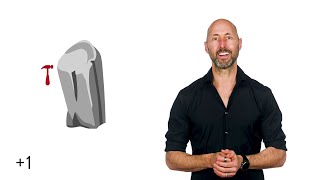
Brian Johnson explores integrity as living an integrated life, drawing on Vice Admiral James Stockdale and Stephen Covey. He argues that repeated choices chisel character and close the gap between who you are and who you can be, creating the joyful tranquility that follows living honestly.
Chapters
Hi, this is Brian. Welcome back to another heroic one. In our last couple 1s, we spent some time hanging out with Vice Admiral James Stockdale, exploring wisdom from his great little book, Thoughts of a Philosophical Fighter Pilot. As you may recall, we talked about heroes and the fact that a hero's secret weapon is love. Today we're going to spend some more time with Stockdale. We're going to talk about integrity. The wise, stoic Vice Admiral tells us, and I quote, integrity is a powerful word that derives from a specific concept. It describes a person who is integrated, blended into a whole, as opposed to a person of many parts, many faces, many disconnects. He continues by saying, and I quote again, the word relates to the ancient distinction between living and living well. Contrary to popular thought, a person of integrity is typically easygoing, with a sense of humor. He knows himself, reflects a definite and thoughtful set of preferences and aspirations, and is thus reliable. Knowing he is whole, he is not preoccupied with riding the crest of continual anxiety, but is free to ride the crest of delight with life. Two things to discuss, integrity and the resulting joyful tranquility. First, integrity. When we live with integrity, we are integrated, complete whole, rather than a disintegrated, crumbling array of conflicting parts. In primary Greatness, Stephen Covey tells us that, and I quote, a life of total integrity is the only one worth striving for. He also tells us about the Latin phrase esse quam videre, which means to be rather than to seem. He says this should be the motto of every person seeking primary greatness. Unfortunately, too often seeming to be substitutes for real integrity. It's seeming as opposed to being to be rather than to seem. That's the target, the result, joyful tranquility. As Stockdale tells us, knowing he is whole, he is not preoccupied with riding the crest of continual anxiety, but is free to ride the crest of delight with life. David Brooks echoes this wisdom in the Road to Character. Here's how he puts it. I quote again, we don't live for happiness, we live for holiness. Day to day, we seek out pleasure. But deep down, human beings are endowed with moral imagination. All human beings seek to lead lives not just of pleasure, but of purpose, righteousness and virtue. As John Stuart Mill put it, people have a responsibility to become moral over time. The best life is oriented around the increasing excellence of the soul and is nourished by moral joy, the quiet sense of gratitude and tranquility that comes as a byproduct of successful moral struggle. The meaningful life is the same eternal thing, the combination of some set of ideals and some man or woman struggle for those ideals. Life is essentially a moral drama, not a hedonistic one. Now, how do we build that type of integrated character? By chiseling away one choice at a time. Jim Rohn talked about this in his great book leading an inspired life, where he tells us, and I quote, personal success is built on the foundation of character. And character is the result of hundreds and hundreds of choices you make that gradually turn who you are at any given moment into who you want to be. He continues by telling us that character comes from a Greek word meaning chisel, or the mark left by a chisel. Of course, he says a chisel is a sharp steel tool used for making a sculpture out of a difficult material like granite or marble. And Rohn tells us, character isn't a magic wand. Character comes from chisel. And I hope you'll remember that. You've got to chisel your character out of the raw material of yourself, just like a sculptor has to create a statue. The raw material is always there, and everything that happens to you, good or bad, is an opportunity for building your character. All of which begs the question that leads us to the point of today's plus one. How's your integrity? What's important to you? Who are you at your absolute best? Have you taken the time to get clarity on who you are at your best? If not, we'll talk about the fact that you have even more issues than someone falling short of their standards. We'll talk about that in our next one. Assuming you've taken at least some time to get clarity on who you are at your best, are you living in integrity with that best, most heroic version of yourself? If so, fantastic. You're more consistently closing the gap between who you're capable of being and. And who you're actually being in? My very strong hunch is that if that's true, you're more consistently experiencing the eudaimonic delight that we all experience when we're living with areta. If not perfect, you're human. What needs work. How can you close the gaps? You can more consistently experience more of that eudaimonic delight that comes from living in integrity with your highest ideals. Here's to seeing that the eudaimonic joy that we all seek follows the pursuit of the good life versus the good mood. It comes from living with integrity and doing the hard work of chiseling our character as we move from theory to practice to mastery together. Today, day one. All in. Let go, hero.