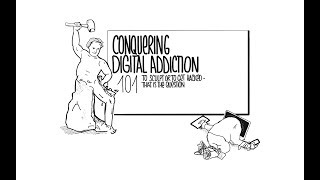
Brian Johnson outlines 10 strategies to break digital addiction, from deep work and removing triggers to using your phone to sculpt your life instead of being sculpted by it. The attention economy has a $7 trillion incentive to hack your focus. The goal is indifference: using technology on purpose, not by default.
Chapters
Hi, this is Brian with Optimize. Welcome back to the Optimal Living 101 Masterclass Series. Today I'm thrilled to be chatting about conquering Digital Addiction 101. To sculpt or to be hacked, that is the question. As always, we have 10 big ideas. Let's take a quick look and then we'll jump in. All right, so our first big idea. Tools addicted users, smashing Luddites and sculpting optimizites. We're going to talk about the fact that tools or technology has been around for literally millions of years. Two and a half million years ago, proto humans used stones for tools. It's what's made us human is this use of tools. So we're not talking about conquering digital addiction by smashing the technology. We're not talking about that at all. But we don't want to be an addicted user. We want to be an optimizite vis a vis a Luddite. We'll talk about what that means and how to go about doing that. The second big idea, we're going to look at what it means to be an addicted user in the mind hacking economy of of the input age. Over the last 25 years, things have changed so much it's crazy. Researchers call this the input age. We're going to talk about mind hacking, aka the attention economy. It's a $7 trillion economy. $7 trillion. That's how much money businesses make hacking your attention. We need to be aware of that. We're also going to talk about the fact that only two industries refer to their customers as users. Can you guess what they are? I'll let you know. Drug dealers and tech companies refer to their customers as users. You don't want to be an addicted user. The third big idea is addiction. We're going to talk about the ancient Latin Roman etymology of the word addict or addiction. Do you know what the word literally means? Well, we'll talk about what it does. Short story. It means to be sentenced to addiction in ancient Roman times was what happened when you couldn't pay off your debt, you became addicted. Now it means a strong bond to something. Right. We're going to talk about developing its antonym, indifference. Yes, you can use the tool, but you're not addicted to it. You're not compulsively using it. We're also going to talk about the fact that the leading researcher on attention and mindfulness admits that he's a little addicted. Richie Davidson. Fascinating stuff. Rule number one of addiction is admit use. You're addicted. Then you could do something about it. That's our third big idea. The fourth big idea we're going to take a look at the costs of being an addicted user everywhere. From your attention, your time, your productivity, your connection to others, your energy, your happiness and ultimately your overall potential. The stats in there are crazy. The fifth idea comes out of that, which is look, ultimately we want to become an optimizzite. Who's sculpting the optimist? You. The best version of you. What would that look like? And then how do you use technology in an effort to create, to literally sculpt like one of those self sculpting statues. How do you use technology for that? I'm excited to use it in my own idiosyncratic way and this class is all about helping you discover that. But my game is how do we create a multi million dollar online business where I don't use email and and I don't use a smartphone. So really the whole point of this class is to help you discover optimist you. What's the absolute best version of you look like? Energy, work, love. How is technology getting in the way of you showing up as your best Energy wise? Work wise, love wise? We're going to drill into that and help you create the best version of you. The sixth big idea is an extension of the costs idea with an emphasis on productivity. And we're going to talk about deep work flow versus continuous partial attention. Task switching. So a lot of people think that they can go from one task to another and they can blow up their minds digitally and not suffer any consequences in terms of productivity, et cetera. I'm going to give you a test which will show you just how much your performance diminishes across tasks that are really easy. But when you switch, it's crazy how much more effort and time it takes you to do simple stuff. Task switching is not where it's at. That leads to burnout vis a vis flow, which is how you get into the highest best version of you and you feel good. It's kind of like junk food versus health food. One feels great in the moment, not so good long term. The other you can discipline yourself to enjoy both now and in the big picture long term. Our seventh big idea is switching defaults via your unplugged supercomputer. So researchers call the mode your brain is in when you aren't constantly stimulated. They call that the default mode, which is kind of a weak branding term. They should call it supercomputer mode because when you're in that mode, that's when all the magic happens. That's when you get clarity on your purpose. That's when you are most creative. You have your best ideas in a shower or on a hike or whatever. Right. But you need to allow yourself to get into that default mode. And if your default is to always be stimulated, you won't flip on the switch to turn on your supercomputer and instead that computer will get hacked all day. That's our sixth big idea. The eighth big idea is a pickle picking party. Plus two questions, plus one more question. So we're going to talk about the fact that addiction researchers talk about certain people have cucumbers that have become pickled. Right. So for me, I don't have an issue with drinking. For example, my father did. Right. And it's part of the reason why I don't have any issues with it. His brain was pickled for alcohol. Right. My brain is pickled for technology, for news, for sports news, for using my smartphone. It's pickled. Right. And it's no, you can't take a pickle and make it a cucumber again, is how the researchers describe it. But we're going to talk about your pickles and how we go on a pickle picking party to remove them from your life, create some bright lines, et cetera. We're also going to ask two questions that researchers have shown are really effective to help you change from addictive behavior to more constructive behavior. And then I'm going to wrap it up with one other really powerful question. Our ninth big idea is kind of bringing it all together, which is Willpower 101. We taught a whole class called Willpower 101 and another one called Habits 101, where I go into detail. But we're going to talk about those ideas in this context. Then we're also going to talk about the two AIs. There's artificial intelligence, then there's ancient intelligence, is how I describe it, riffing on Ray Dalio's ideas about programming your brain with algorithms of if this happens, then I do that. And leveraging your basal ganglia so you do the right thing automatically. It becomes harder for you to engage in the addictive behavior than it is to do the right thing. Obviously that takes time, but that's the ultimate goal that we have for this class. And then our 10th big idea is to sculpt or to be hacked. That is both the subtitle of the class and the ultimate question. Are you using technology mindfully purposefully such that you're sculpting your ideal life? Or are you being hacked by that $7 trillion economy of mind hackers and engineers out there? And remember, an idea we'll talk about. Behind every screen you use on your smartphone or your computer are a thousand really smart engineers trying to hook you into using that technology. Tristan Harris shares this in a 60 Minutes episode called Mind Hacking. If you haven't watched that yet, check it out. For now, let's jump in. Next step, go to Optimize Me and sign up today.