Creativity 101 - Behind the Scenes
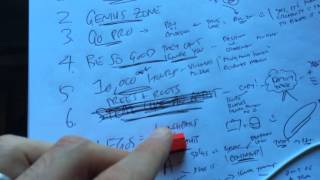
Brian Johnson walks through how he builds his Creativity 101 class: brainstorm rough drafts, distill influences from books and philosophers, pick 10 big ideas like "your life as your number one project" and "go pro", then use daily rituals like meditation and no-Internet to protect focus. He delivers unscripted and treats attention as his primary asset.
Chapters
Hi, this is Brian. I'm sitting here preparing for the next class I'm going to film, which is on Creativity 101. And I kind of finished my initial draft. That's going to be helpful for me as I take the next steps in preparing for the class. And I thought I'd just turn on the phone and capture a little bit of my creative process, seeing that this is a class on creativity and I've had a lot of people request videos, kind of behind the scenes style. So anyway, first thing I do on a high level is kind of feel what I've already done on this series. So I'm creating the Masterclass series. As many of you may know, we've done Greatest Year Ever. We've done Masterpiece Days. We've done habits 101, conquering procrastination 101, love 101, positive psychology one on one meditation one on one, conquering depression 101. We're sharing this week and then we're sharing confidence 101 soon. And we've already created purpose 101 as well, which is still in production. But basically I just kind of go through these classes and just kind of remind myself just energetically, hey, look, this is awesome. We've got momentum, some great classes. As you know, if you've watched these classes, I do 10 big ideas. That's my big thing. One of my constraints, which is going to be one of the ideas we talk about in creativity, is every single one of my classes has 10 big ideas. So what I need to do is arrive at the 10 big ideas that I'm going to share in any given class. That starts with me just kind of brainstorming all the possible ideas that I can share. We might have a little man who just got up and might come up and say hi to Daddy early morning here as I'm recording this. But anyway, I basically give myself the permission to have a kind of crappy v1, right? I don't need it to be perfect. Of course I'm not going to come up with the top 10 big ideas in my first pass. So I have a really, really ugly, bad first draft. Boom. These are all the ideas that I could share. Some of them will make it, some of them won't, but who cares? I just want to get the process going. And then I also, of course, lean into all the philosopher's notes. My whole process is I want to master the. And help you master every aspect of your life. Creativity is one of them. Of course, there's a ton of others. So I read these books and I distill them into philosopher's notes and then I distill those best ideas into these classes. But we've got Steven Pressfield's the War of Art. We've got Turning Pro. We've got do the Work kind of his series of books on the creative process. We're going to integrate all these ideas. And I want to familiarize myself with different things that inspired me. But I also want to. I always do my first pass. Just what affected me, my power when I have it as a teacher, is when I'm sharing stuff that's most resonant with me. So I'd like to review this stuff. But it's really an opportunity to see, well, what works for me. How have I applied these ideas to creativity or to my own confidence or purpose or whatever. Anyway, we got Austin Kleon, show youw Work, Art and Fear. Awesome book on writing, Stephen King's process. Some amazing stuff. The creativity book, the Creative Habit. A ton of great ideas from great books. So weeks ago I did this first pass and then it got a little bit cleaner, right? And now. And I also capture ideas. Anytime I have an idea that might go into a class, I write it down. Boom. So one of the ideas is the number one project is your life as art. Like, that's literally our number one big idea. Number one project equals your life. Well, that was just. I don't even know if that was on my first brainstorming. But then I thought of the idea and I said, okay, well, let's capture it. It's a bit big idea. We'll talk about when you have an idea, capture it sounds obvious, but you need to do it. And then obviously organize it well, etc. So anyway, that brings us to where we are now, which is a rough sense of what the 10 ideas are that we're going to cover. Right? We've got your number one project equals your life. You got to create systems. You got to dedicate yourself to what you're going to do with this one precious life of yours. You need to discover your genius zone. This was a big idea we talked about, talked about a lot in purpose 101. You need to get out of your incompetence, competence and excellence zones and into your genius zone. We're going to talk about that. You need to go pro versus being an amateur Steven Pressfield idea, which will be really fun. Be so good they can't ignore you. Cal Newport's title, which is such a great line from Steve Martin. And we're going to talk about the difference between a passion mindset and a craftsman mindset. 10,000 hours. We'll walk through Malcolm Gladwell and Kay Anders Ericsson and all that research around that. The science of excellence, really. Right. And then Trees and Roots. I thought I was going to call it Steal like an Artist. Then I decided that'll be part of Trees and Roots. You need to know your family tree. Who's inspired you? Who have you stolen from? Right. Copied some of their stuff and what did you really like about their work and what kind of didn't resonate? And that family tree is important. Who are you? And then also your roots, like what's your background? That's the fuel for our authentic creativity to own all this stuff. The positive and the negative. Legos on my desk you might see I have my son Emerson's Legos. I've got a lunch pail there. Let's bring these over here. I got a lunch pail and I got an astronaut helmet. And he generously allowed me to keep these up here. This for me represents. There's a little helmet, right? There's our lunch pail. This represents for me, dream big, go for it. Have this big vision, high hanging fruit, moon shots, etc. And do the work. Show up today. That's how you hold the dynamic tension between what you want to create and where you currently are. Lunch pails and astronauts. And what do I look at that every day and remind me, remind myself of this process. 50 pounds equals A. If we went over to the studio, actually, I'll show you that. Here's the calendar which I need to do a video on. Here's the blackboard we use for my studio, right? And the PNTVs. And then it's a little dark over here. Let me see if I can get some light on my little board that I use to create the micro classes. 50 pounds equals A. I constantly remind myself that 50 pounds equals A. Not judging myself on the quality of my work per se, I'm judging myself on the volume and the process of showing up and doing the work and trying to get a little bit better day in and day out. Little walking treadmill I need to use more often at my standing desk. Anyway, 50 pounds equals A. And then you need to ship it, right? You do all this stuff to prepare, then you need to ship it, go to market, then you need to deal with troll poop. You're going to have people that are critical of your work. Just yesterday I got the most absurd comment on YouTube, which is just awesome. But we'll talk about this and how to deal with trolls, right? One of the key ideas here is key ideas that Brene Brown shares from one of her friends. You're not a jackass whisperer. You can't convince people who are having a rough day that you're worthy. You need to develop some thick skin and deal with that. And you need to deal with your own troll in your own head. So we'll talk about that and all the comparison you might do, etc. Then the 10th big idea currently is your mind equals your number one asset. You got to get your attention going. And then basically each one of those ideas has its own little kind of mind map of things that I'm going to explore. And again, this is the rough version. I'm going to do this at least another one or two times before the class. But I don't script the whole class. That's not what Ellen Langer would say is mindful. You want to have a basic sense of what you want to say and then you want to let it rip. At least I do. And we'll talk about that in one of our classes on public speaking. I'm not sure we'll call it public speaking 101, but basically presenting 101. But for me, I just want a basic idea of the threads that I want to pull and the big ideas that I want to share, and then let it rip and not have it be canned, etc. So that's a quick look. Other really important things that we'll talk about in the number one project being your life, is the systems. And so for me this morning, it's like 7:45, I've been up for a few hours, and it started with meditation, started with a good night of sleep, went to bed super early last night, got a great night of sleep, meditation, a little bit of movement, and then no Internet. As you know, if you've watched much of my stuff, going online is the best possible way to blow up your brain. And if you're serious about this stuff, and we're going to talk about it in one of these ideas, you can't go online before you do your most important creative work. So there you go. That's a super quick look. Actually, it's a super meandering look. Somewhat long look at some of the steps in my creative process. I'm excited to share the class soon. And there you go. Hope you're doing great. Thanks for all your support. Have an awesome day. See you.
More from Brian

Heroic +1: What’s THE Most Creative Act in the Universe?: Turning Around Glitches (#2024)









