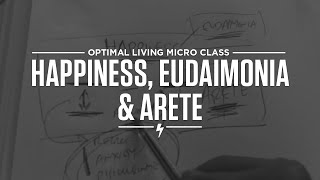
Brian Johnson explains eudaimonia, the Greek idea that happiness comes from closing the gap between what you're capable of and what you actually do. He calls this moment-to-moment excellence arete, and argues practicing it reduces regret and anxiety.
Chapters
Hey, guys, what's up? This is Brian. I am back again very quickly. I just put up my first video recorded on the iPhone and put it up. And this is amazing how efficient it is. I used to have to export to imovie and do all this stuff. Now I'm just doing it straight off of the iPhone. Anyway, first comment was from Melissa. Melissa, loved your comment. You said, well done. Well, thank you. There's a big link here with hedonic extrinsic versus eudaimonic intrinsic pleasure in the quest for happiness. Beautiful, baby. Well, thank you for that too. And what's kind of funny is that this was actually going to be. Let's get that focused. There we go. This was actually going to be my first video was either going to be on intrinsic motivation or on this idea of eudaimonia. So the Greeks, well, all great teachers, really tell us that the primary end of life and purpose of life is to achieve a higher level of happiness. You can call that by a number of different names. Well, being contentment, peace, et cetera. And there are a lot of different things you can do to achieve that. But that's what Talban Shahar would call the ultimate currency, happiness. It's one. That's why we do anything. You go after any of these kind of things that you think are going to make you a lot of money or make you famous or make you hot, okay, that's great. Or even if you deepen your relationships or you grow as a human being or you make contributions, why do you do them? Well, these great teachers would say you did them because you want to be happier. Not very complicated right now, the Greeks, their word for that was something called eudaimonia. I'm going to get good at writing while looking at the camera. We'll see if I can do that. So eudaimonia. Now, that word isn't so much the happiness as we think about it, of feeling good and kind of a happy emotional state. It's more of a flourishing of a sense of being alive and an actualizing, as Maslow would say. And what they said you need to do if you want to live with eudaimonia. Help. If you spelled it right. There you go. You need to live with a word that is, in fact, my favorite word. I have a couple of favorite words. Arete. Enthusiasm would be another one. But arete, they said you need to live with arete. Now, arete directly translates as virtue or excellence. But as you know, if you've read any of my stuff or listen to some of these videos, because I talk about it quite a bit, it has a deeper meaning. This word arete, it means something closer to basically being your highest self, moment to moment to moment, expressing that which you are intended to express, right? And the way that I describe it is there are kind of two lines, right? There's a line at the top which talks about what you're capable of doing. There's a line here which talks about what you're actually doing. Now, if there's a gap between what you're doing, capable of doing, and what you're actually doing, in this gap, right in there is where regret, anxiety, disillusionment, continue your list of favorite things you don't want to feel. In short, ixos. That is where ixos lives, right? In that gap between what you're capable of doing, what you're actually doing. Now, if you live with arete, what you do is you close that gap, right? What you're capable of doing and what you're actually doing match. You're expressing your highest self in this moment. Now, when you do that, you just closed the gap. You just closed the space where regret and anxiety and disillusionment and the eeksaus live. And you're feeling happy, you're feeling. You're experiencing the sense of eudaimonia. It's the sense of actualizing, the sense of enthusiasm as you express your highest self. So what we want to do is live with arete, moment to moment to moment. Now, an important distinction we want to make. And this is actually a distinction that just came to me with real deep clarity last week when I was talking to Alexandra. I hadn't really looked at it this way, but you can think of capable and actual right now. That's really only useful as a means of kind of analysis in this moment. If you think about what you're capable of having done by this age, whether it's 25 or 35 or 55 or 85, if you think, oh, man, I was capable of doing that. And I've actually only done this, well, to a degree that can be healthy to catalyze more effective behavior. But usually we use it as a shaming tool, and it becomes something that depresses us. So I'm not talking about that. I'm talking about in this moment. In this moment right now, you can choose to show up more fully from your highest version of yourself or not. And if you're capable of being here and you show up here and you don't take that deep breath before you Respond angrily to your spouse or to your kids or to your colleagues or whatever, and you show up here. Well, guess what? There's that gap you didn't live with Arte. You're out of integrity with your highest version of yourself, and you got this ugly stuff coming in. But when we close that consistently again and again and again and again, and we live with Arete, this stuff has no room to show up, and we feel this amazing sense of eudaimonia. So there you go. Kind of a meandering look at it, but one of my favorite words, Arete, a core concept in my life and in my philosophy and what I teach. And I think it's at the heart of. Of us experiencing more of all the goodness we want to experience in our lives. There you go. And thank you, Melissa. Hey, there I am, too, for sharing in this discussion. If you have any ideas about what you'd like me to cover, let me know. I had this kind of vision of doing these videos last night and kept myself up, actually. I created 100 ideas in a little tool I use called Omnifocus, which helps me capture my creative ideas. And that will actually be one of my videos I do. How I kind of create and how I get clear on what I want to do and then capture the ideas and then go make it happen. So we'll get to that later, but let me know if there's anything in particular you'd like to see me riff on and we'll have some fun. All right, There you go. Video number one, intrinsic versus extrinsic. Video number two, Arete Eudaimonia. Happiness. Closing that gap between what we're capable of doing, what we're actually doing, getting rid of all this and moving more into this state of happiness, joy, bliss, etc. So how can you show up more fully in this moment and the next and the next? It's a theme we're going to come back to a lot in these videos, and I hope you enjoyed. Have an awesome day. See ya.