Hero-ology: The Study of a Good Hero ← YOU!
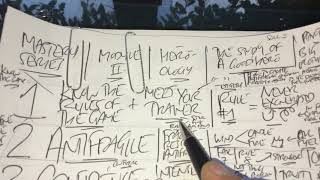
Brian Johnson introduces Module 2 of his mastery series: "Hero Ology — The Study of a Good Hero." He frames the module as a three-part course (Big Picture; Train like a warrior; Armamentarium/tools) focused on building antifragile confidence, heroic courage, and responsibility so life challenges become fuel for growth. Key themes: expect and reframe obstacles, define antifragility and confidence (confidere), heroic as 'protector' with love as a secret weapon, courage as the heart of virtue, response-ability (choosing responses), training protocols to build heroic stamina, and an operational practice called the "hero sandwich" (obstacle as meat + wisdom/self-mastery as bread + top virtues as toppings). He closes with signup info for OptimizeMe (250-day series, trial/pricing).
Chapters
Hey guys, what's up? This is Bri. I am sitting here preparing for our next mastery series, Module two. It's going to be on Hero Ology, the study of a good hero. Module one was Eudaimonology, the study of a good soul. We were planning to do module X this week. This session kind of following this little progression. New demoinology. The module X, antifragile responsibility. The big three times two. Carpe diem, then doing heroic quests, right? Then algorithms and then the fundies. Then Optimus u virtue embodied. 25 sessions, 250 days, etc. Anyway, as I was sitting down preparing for this session on module X, reflecting on the fact that I hit a speed bump in module one, I'll spare you the details right now, but realized that I want to produce this in the studio and just do it, right? Best work of my life. Have Michael, our head coach come in and just hammer from theory to practice to mastery. Alexander is going to be doing meditations for each of these sessions, etc. So anyway, I'm preparing for this session and realized, you know what we need to do? We need to talk about not just how to respond with anti fragility to whatever happens in our life, but to combine that with the ultimate quest that we're all on. The heroic quest. So welcome to Module 2. Hero Ology. The study of a good hero. How to create antifragile confidence. Heroic courage plus responsibility. To use everything as fuel for our hero's journey. This is gonna be a three part module. Part one. Which is what? I just finished my prep for hitting the studio after the trail in Sunto. What time is it? Seven. In almost exactly two hours. Yeah, fired up. Part one, Big picture. We've got to know the rules of the game. So module one was you got to know the game you're playing, right? Which is Eudaimonia via Ortega. You got to close the gap between who you're capable of being and who you're actually being, right? So you can go from optimize equals optimus equals best equals eudaimon equals hero. So that's the game we're playing. But then you got to know the rules of the game, which we'll talk about. Rule number one is expect challenges. Then we're going to define some key terms. Then we're going to make a choice and commit to the heroic quest. But we're going to make that choice again and again and again. That's part one, Big picture. Parts two and three. We're going to train like Warriors. We're going to stock up our armamentarium, which literally means it's an arsenal, which literally means basically a bunch of tools. Arma is to arm with tools. We want to have all the tools ready at hand that we can use as we face inevitable obstacles. It's going to be awesome to look at the difference between being a victim in our lives and a hero. There's a ton of different distinctions we can make. We want to arm you with the tools you need, the weapons you need to show up and be your best. We're also going to talk about the fact that I was in a documentary called Finding Joe, which is awesome. On the hero's journey with Deepak Chopra, Robin Sharma, Laird Hamilton, Tony Hawk, some other amazing people highly recommend it. Findingjothemovie.com I believe. But this session is basically going to take the best of that and operationalize it. Moving from theory to practice to masteries. That's our high level three part series. Can't wait to share more. Now I will give you a quick overview of what we're going to talk about in the big picture session. Again, Master Series Module 2, Hero Ology. The study of a good soul. How to create antifragile confidence, heroic courage, responsibility and use everything as fuel for our growth and optimizing in hero's journey. Big idea number one, as we discussed. Know the rules of the game and meet your trainer. We're gonna have a lot of fun with this. We've got an Epictetus quote that I'll share in the class. It's hilarious. Yeah. Rule number one is you're never exonerated. Challenges are essential to the process of actualizing. I'm actually reading a book, kind of the children's version of Ray Dalio's principles. To my son Emerson, 7 years old. You know what Dalio says? He says, look, you have a goal. Then the next thing you encounter is a problem. Rule number one of life. When you're trying to live a life of meaning and depth and purpose and actualize your potential, you need to expect obstacles. Quit being surprised by them. You're never going to get there. There is no there there. Anyway, your trainer is. We're going to lean on some William B. Irvine stoic wisdom. He calls it the stoic gods, right? Epictetus says, look, imagine these challenges you face. It's as if God is giving you a great training partner. Here's your sparring partner. This challenge is the exact thing you need to actualize your potential. So face it like a hero and get Excited about it. Then be antifragile. Don't be fragile and break. Don't even be resilient and be able to handle a lot of challenges. Be antifragile. We're going to define this term. You want to be so strong that when you hit obstacles, when you get knocked down, you come up stronger, you fall. 7. Rise. 8. Stronger. A wind will extinguish a candle but fuel a fire. The obstacle is the way ohms obstacles make me stronger. Antifragile. As I say in the notes here, this is arguably one of the most important themes of our entire work together. We've gotten incredible feedback on that. So we're gonna have fun with that. Three is confidence. You know what the word confidence means? Confidere. It's Latin for intense trust. Intense trust in what? That things are gonna go perfectly? Ha. No. That you have what it takes to respond to whatever life gives you. And not only that, to respond with anti fragility. You're going to get stronger. That level of confidence is earned by being the type of person who shows up on a consistent basis. We're going to talk about how to earn that trust where you literally rub your hands together when something inevitably goes wrong, rather than pulling the sheets over your head and staying in bed. Fourth, big idea. Heroic. Again, we're defining terms antifragile, confidence, heroic, encourage and responsibility. What do these words mean? Why do we have optimize Optimus best equals eudaimon hero? Because it means something deeply to us. The ancient etymology of it is protector. A hero is not a tough guy or a killer of bad guys. As we discuss often, a hero is a protector. A hero has strength for two. Their secret weapon is love. So we want to step back and look at these challenges we're facing and get cleared on for whom are we building this strength. We've got to be willing to do the hard work and also embrace the fact that it's not supposed to be easy. On a hero's journey, you're battling dragons, not lizards. Wear your scars like metals. Paulo Coelho tells us. I love that. And when you face challenges and you fall down inevitably and that dragon gets a good swipe in at you, you get one of those scars. That's a reverse indicator. That's not a sign something's wrong. That's a sign you're in the game. You're actually playing a heroic path. That's our heroic side of things. Courage is actually really related to hero. The word courage comes from the Latin word for heart. Just as a Heart vitalizes your arms and legs and vital organs. Courage is the virtue that vitalizes all the other virtues. Without courage, none of this stuff matters. It's all theory. We're not moving to practice, to mastery. So courage is the hero's heartbeat, the heartbeat of virtue. We, we want to know that it's a virtuous mean you can have a vice of deficiency, too little of it. But you can also have a vice of excess. Too much. We're going to share one of my favorite quotes from the guy named David Reynolds, a Zen therapist. Anyone who says they're never afraid, he says, is both stupid and lying. This is a conservative Zen therapist. I love that. So it's not about you having fear. It's all good. It's not about not having fear. It's about having the fear and then doing what needs to get done, which again, by the way, is how you build confidence. You're the type of person who gets what needs to get done done, whether you feel like it or not. Then you know you can handle life's challenges. Which leads us to response ability. Can you step in between stimulus and response and choose your optimal response? This is Stephen Covey's habit number one, be proactive. Ultimately, this is the game again. Stimulus, response. Can you step right in there and actually choose the best response? We're giving that, making that choice moment to moment to moment. Which leads us to our seventh idea. Simple and profound. Make your choice. What game are you playing? Are you seriously committed to actualizing your potential? Well, then you need to decide you're going to be a victim. You're going to be a hero. In our sessions two and three, for this, we're going to walk through all the different choice points and the ways you can respond as a victim vis a vis a hero. Ultimately, the question is, what do you want? Do you want to actualize your potential? If so, then go back to here. What's the best possible response to this situation? Then we want to train like a warrior. Stockpile our armamentarium with all the tools we need to make that choice wisely. Then we're going to talk about, after having defined some terms, making our choice, a few simple practices and we'll go into the nitty gritty and some other details. Thank you, Timex Thousand second timer. You face an obstacle in life. What do you do? First thing you do is you flip the switch. You put on your cape to have fun with it, and you flip the switch both in your mind and your body. We're going to talk about how to do that via your breath, your physiology, your posture. Then we're going to have some fun with. We're going to call that hero presence, hero mantras and hero prayers to get our minds right quickly. We've got some ideas on that. That'll be fun. Then. The ninth idea is heroic stamina. I'd argue that offer that antifragility and heroic stamina, what my coach, Phil Stutz calls emotional stamina, we're going to call heroic stamina are perhaps the two most important and very related ideas. When you are facing obstacles, it is extraordinarily important that you just go deep on your protocol. So you create emotional stamina via working your protocol. That begs the question, what's your protocol? What do you do when you're at your absolute best? Well, when you are at your worst and you're facing your biggest challenges and you're on that hero's journey and you're getting knocked around, that's when you need to be more committed, most committed. And as Phil taught me, and I just absolutely love, the worse you feel, the more committed you are. The worse you feel, the more committed you are. If we can get one idea across in this work together, I hope it's this one. I hope that when you have a really bad day in quotes, that's the day that you check in and you say, who am I at my best? How do I make that my baseline? What are the things that are non negotiable for me? Because if we do that and we energize and we pay attention to the number one virtue, which is zest, our highs are going to be higher and our lows are going to be higher. It's going to be really hard to have a really bad day, frankly, and certainly a series of bad days because you eat all of these challenges like energy bars. Which leads us to our 10th idea will be a fun little way to send us on our way before the next session. Hero sandwich. How to make a hero sandwich. I call it an Ohms sandwich as well. Sometimes obstacles make me stronger. A hero sandwich. Eat your virtues. Step one. Let's say you're faced with an obstacle. Fantastic. There's the meat for your sandwich. We're going to use it as fuel. Vegan options available, of course. Then our bread. First two cardinal virtues. Wisdom. Remember the game you're playing, how to play it well. And then self mastery. You got to actually play the game, right. So that's our bread. Paleo options available. So you got your meat, you got your bread, then you get to add on your favorite virtues top five times too, which we talked about in the last session. We've got the universal and the unique virtues that we want to use often. I realized I could have been showing you the actual details here. Huh. So our universal virtues are gratitude, hope, zest, curiosity, love. When you're faced with a challenge again, how can you bring gratitude to it? How can you bring hope to it? How can you bring zest to it? How can you bring curiosity to it? And love to it? We're going to talk about how to do that, operationalizing virtue so we can close that gap. Last week's exercise was for you to go to viacharacter.org and identify your top five unique virtues. Well, what are they? How do you put them into practice when you need it most? That is a quick look at the first session of Module 2 Hero Ology. Kind of fired up. The study of a good soul. How to create antifragile confidence, heroic courage and responsibility. To use everything as fuel for our hero's journey. Let's do this. And people are asking how they sign up for this. So I should say something about that. Just go to Optimize me and you can sign up. Basically, you'll get access to this 250 day mastery series and everything I've ever done. So thousand plus ones, 500 plus philosopher's notes, 50 optimal living classes. Yeah, we've got a two week free trial. I think it's like eight bucks a month if you do the annual and something like 13 bucks a month if you do it. Month to month to month. 2 weeks free. Check it out. Let's do this.
More from Brian

Heroic +1: What’s THE Most Creative Act in the Universe?: Turning Around Glitches (#2024)









