Heroic Chat with Patricia Ryan Madson: Finding the Balance
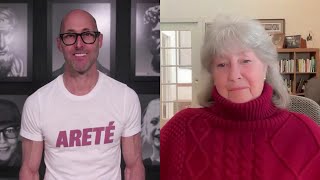
Patricia Ryan Madson, who founded Stanford's acting program and wrote Improv Wisdom, shares the four A's of improvisation: Attention, Acceptance, Appreciation, and Action. She offers small daily exercises to live more improvisationally, from saying yes to embracing being average, and discusses how improv changes as you age.
Chapters
Foreign.
P.m. central Time. And it is good to see you, Kimmy, and all those books, my goodness. Bless you. Michael and I were talking about you just this morning. Gary, great to see you. Robin, great to see you. Is it a short haircut or is that a hat or a little bit of both? It's a hat. All right. It's a hat. Very good. Lisa, good to see you. Coach Lanny, Julianne, Frank, nice to see you. Carolyn. Andrea, Lou, Eladio, Jeff, Sarah, Mike, Barnabas, missed the workout. Dude, great to see you. Ron, great to see you. Always enjoy your social posts. Kira, Iron. That's right. We got our iron lady. Good to see you. Sue, great to see you. Gene, Vlad, nice to see you, sir. And Angelo, on screen one. Today we have a very special guest, Patricia. Ryan Madsen is joining us. Patricia, I will give you a longer intro in a moment, but great to see you.
Thank you. It's great to be here.
I'm buzzing just from the first few minutes we had together before we came on Live today, but as you may know, Patricia wrote improv. Don't prepare, just show up. She taught at Stanford for three decades in the drama department. And this book is the distillation of her life's work. It's absolutely phenomenal. So if you haven't checked out the Philosopher's note yet, check it out. More importantly, check out the book. It's a super quick reading, super inspiring look at how to engage some of the principles of improv wisdom in your everyday life there. I mean, we could talk about this for a weekend. I know you do your own workshops, Patricia, but so much wisdom here and just feel so blessed to have you in my life and to be here with you today. So again, thank you. Bless you for all you have done for us. And today I am very excited to learn more about you and your heroic quest that led you to this book that led you to today. So bless you and again, welcome.
Thank you, thank you, thank you, thank you.
Where shall we start? Origin story. A good hero story begins with an origin story. Tell us about you, your life, your heroic quests, plural, that led you to. To where we are today.
Please, I love this. Okay, let's see. My origin story is that when I had the amazing good fortune to be hired at Stanford University, my job was to head up the undergraduate acting program. And I had been teaching acting at Denison University in Penn State. And so I came to this prestigious university and my students were so bright and so in their heads and so amazing and I could ask them to do almost anything and tell them what I wanted and they produce that result. But if I said to them something like, what would you feel like if you were in this situation? What is your human response? They often, they were puzzled. They didn't know the right answer. And so because they were used to having the right answer. So my journey started with a conundrum of how do I teach these amazingly bright intellectual students how to become more human? And I really didn't, I didn't have a clue. I was off on my own sort of journey. I went down to the Esalen Institute and did a workshop with a man named Al Huang, who was my Tai Chi master at the time. And he had invited a guest, a man named Keith Johnstone, who is an improvisation teacher. And he had just published a book called Impro. And the book I never really heard or knew much about improvisation. I knew it was a kind of a musical form and that it was also some games and exercises. So I met this man, Keith Johnstone, and I read his book Impro and he, he led me to some games and ideas that I started using with my Stanford students. And lo and behold, that sort of boom opened the door to getting away from some system of thinking into finding their own truth, their own feelings, their own imagination. And so together, starting to use improv and some of Keith Johnstone's ideas, it really, it opened up my Stanford actors. But better than that, the school invited me to teach a, an improv class for adults for the continuing studies program. I thought, well, I don't know whether grownups are going to want to come into a room and play improv games. But they did. And as it turned out they came back and said, you know, this improv stuff is changing my life. I'm discovering that I'm more likely to actually listen to my husband and, or to, to say yes to something. It's, it's made my relationships with my children better. You should really write a book about that. So it, it sort of started with feedback I got from students about how learning how to loosen up and trust your ideas and not be so self critical was also something that could be applied in everyday life. So long longer story, shorter. After sort of 20 years of teaching and working on the book, I published the little book improv wisdom in 2005. And fast forward to today because of Brian's having found the book in his early philosophic quest and reporting on it as being useful, the book is, is now moving around the world and in nine languages. And I absolutely blessed because it's Sort of taken off. I. I consider improv wisdom to be my daughter in the world. And she's. She travels around. She was born 2005, so she's coming up, grown up.
Patricia. She's grown up and she's flourishing. That is so great. There's so much I want to talk about with the. The wisdom in improv wisdom. And I appreciate your origin story starting where you started it, and I'm going to ask you to go back.
Okay.
How does one become, you know, a professor in any university's, you know, school of Drama, Drama department? My hunch is that you, as a young girl and young woman needed to trust yourself and you needed to be willing to take some risks. And you probably face some dragons. You probably had some guides and some buddies that helped you get to a point where Stanford invited you to join their faculty. You're open to sharing any and everything that came up, ideally with some dragons that may have appeared, you know, that you got to tame and perhaps wanted a ride and all those things, but open to sharing some of that. And then we'll go through Stanford, into some of the ideas in the book with, you know, our families and overall, you know, creative expression in life.
Great. Okay. Well, that's a great challenge. Well, if I back up from how I got to Stanford, part of it was, I think I was born curious, and that was a fortunate thing. And when I was a young, a child in Richmond, Virginia, growing up, the thing I wanted. Wanted was permission to visit different churches. I was interested in world religions or at that point, religions. I didn't know world, but my family gave me permission to ride the bus and go to the Quaker church and the Episcopal Church and the Catholic Church. And so. And at about age 12, I would. I would pretend to be a member of the congregation and sneak in and do whatever they seem to be doing. I'm sure I got into trouble because in a Catholic church church, I really wasn't qualified to take communion, but I did. I pretended I knew everything and did the prayers. So my interest in philosophy sort of led me to. To, to wander. And that took me. When I came to California, I realized that not only was there all these Christian religions that I knew from Virginia, but my goodness, there was a whole, whole raft of Buddhist religions and a whole bunch of Sufism and oh, and. And h. So all of the Eastern religions sort of jumped into my visual and. And physical field. And I continued on this journey, trying out things and going to workshops and taking classes. And in 1980, I had been teaching for a number of years. And I realized I had to, I had to take some time off because I was burning out as a teacher. I needed to fill myself up. And so I packed one suitcase, a little brown suitcase without any wheels in those days in 1980, and without a phone, and decided to take a trip around the world. So my journey literally was to liberate a year and a half of work life. I got a grant from the dean to go around the world to study performance pedagogy. And I set out on, on a circuit. I bought a ticket that started in California and took me to the east coast and then to England and then to India and Thailand and Asian countries. So I had this kind of wild world adventure. And it was, it also was full of, of not always delightful moments too. There were, there were dragons and I got stuck on a beach in Thailand far from anything, and I was dehydrated and I thought I was going to die. But some kind person found me sort of parched on the beach and helped bring me back to, got me some water and got me out of the, out of the sun. So there were times in this trip around the world and by the way, you could never take that trip today because, because of cell phones, even if you didn't carry one, because they exist, somebody would be able to call someone or, or you could find something out. So my trip around the world was basically talking to people and learning from. If I arrived in a small town somewhere, I'd have to ask the, ask someone who was on the bus, do you know of a place to stay here? And so what I learned was how we are all in the grace of each other and the importance of human connection. And I guess I became an improviser on that trip around the world for a year and a half and staying in small villages and learning that no matter what the circumstance that you will have what you need. And that's a deep belief I have now that you already have what you need or it will be provided for you. So there's a, it's not self confidence, but it's reality confidence. I, I believe that the, the universe reality, however we want to parse that is, is friendly, as I understand that was one of the questions that Einstein needed to be able to answer, is the universe friendly? And I think it is, even though it may not seem so to me on a particular day. So my, my lifelong philosophical quest, which was also part of that trip around the world, is mentioned a lot in the book too. I, I spent time in Japan and. And studied different kind of philosophies. So I. I share with you a deep philosopher as someone who is always been interested in looking at how the world works. And. And then when I coupled that with finding improvisation at Stanford, the sort of. My philosophical mindset, if you will, it sort of came together that I ended up learning some things through the travels and through my study of world religions and philosophy that were really fundamental. Simple life. Life maxims, they ended up being called. Now, have I covered most of that?
This is so good. There's so many things we could cover. Now that I remember, we met through David Reynolds. Right. So, yeah. Okay, cool. And I found David Reynolds through Dan Millman. So Dan Millman was the first teacher. I read everything he wrote. He and Paulo Coelho, you know, but. And then I became friends and he said, you have to read Constructive Living by David Reynolds, on which it became apparent Dan Millman had based so much of his philosophy, you know, and then we connected through that connection, which also speaks to the improvisational, you know, unknowable threads that bind us all so much there. Briefly, then I want to get back into your story that is the universe friendly. I'm reading Stoicism for Dummies, which was written, just published by one of my dear friends, Tom Morris. My tattoo happens to make a cameo in the book, which is kind of amusing, but he talks about the Stoics, cosmic optimism. They believe too, that the universe was friendly, ultimately, which is why they radically embraced whatever reality was present for them. They believed that it was serving a bigger purpose. It just made me think of that as you shared that. Yeah. And then that trip, you know, in 1980, where you actually needed to connect with someone one on one. What a concept. But tell us now, let's get into what it means to live improvisationally.
So.
So what does that mean for you? And then we have the adages and some of the principles I talk about in the note, which we'll explore. But. But how would one. Should one consider thinking about what it means to live improvisationally?
That's a great question. I. I think it means that every single day is. Is a new beginning, a fresh start. And we can. One of the maxims is start anywhere. So we can begin our day with the. Whatever needs to be done. And I know that. That you're a great believer in setting. Setting up things for yourself that you accomplish that you set a. A goal or some. And sometimes that is absolutely what needs to be done. And sometimes what needs to be done is just get out of bed. One of the things I really want to talk about now because I'm representing now a, a category. I turned 81 in December and happy birthday. Thank you very much.
I want to be like you when I grow up.
Well, let, let me share what I've discovered is that the 81 year old me is really very different from the 61 year old me or certainly the 40. Or that that one of the realities that has become part of my improvisation is, is actually living with and recognizing certain limits and not stressing over those, but basically realizing, ah, I really have a different energy set than I had even five years ago. And so check with my doctor, make sure that pretty much everything that is known and controllable and measurable is all in place. And I don't have some particular kind of illness that is causing this. But at 81 I find that my energy level is much lower than it was before. So now my husband thinks that the right way to deal with that is to do more to push myself. He's a runner and at 77 he hasn't lost any energy. So we're having a difference of opinion about how to deal with what I think are the natural, is the natural progression of age. And my strategy has been to accept this sense that I'm feeling much more tired or needing a nap in the afternoon and also still doing what I can, doing some exercises, doing. I have a daily walk up the hill behind the house to try to get my cardio going a little bit. But I'm not fighting reality. And so one of the things I'd like to explore a little bit is the concept of enough, not only enough. Let me backtrack for a second. Because the notion of RJ and the notion of striving toward excellence, one way to look at that is that you are always working to be the better, better version of yourself. What if expressing the best, expressing the best version of yourself is a lot slower and less active than it was? What do the philosophers say about that? Isn't that okay? Or should until I finally leave this life, should I be striving for more and better? I wanted to ask you that. What do you think about adjusting the dials on what we do in life?
Say yes is what arises for me. I love that. And I also love the, the dialectic, if you will, between you and your husband and that dynamic of just really embracing our own sense of truth, you know, and saying yes to what feels most true to us. But I think that the constraints of our reality are so important and Embracing those constraints are so important. And then me. It's not necessarily becoming better per se. It's expressing this moment's best version of ourselves. And that's a nap. When it's a nap, you know, and that's me meditating in the morning or going to bed. I go to bed at 7:00 at night, 7:15, you know, I tuck the kids in, sun's been down for an hour and a half. There we go, you know, So I think it's such a beautiful, idiosyncratic personal truth in the moment, literally, let alone the era. I'm turning 50 in four months, which, you know, that's a milestone for me. Up until now, it's like I'm just hitting my stride. And I still feel like I'm just hitting my stride. But I can no longer ignore the fact that, you know, longevity, individuals who want to live forever aside, I can't ignore the fact that I'm now officially on the second half. There's a beautiful humility for me that comes into that and that humble embrace of the reality that my days are finite. And clearly I don't know if I have another day, let alone. But I think there's something magical about each of us and in this case, me and you and everyone here asking ourselves that question than trusting the answer. And sometimes it will be the vigorous hike up the side of the mountain or another creative pursuit or a really different tempo, you know, at any given moment or days and weeks. What do you think?
I think so too. I. It. It's. People all ask me often now, what are, what are you doing with your time? Because I, I have the occasional wonderful podcast interview. I am walking a little bit, I'm reading a lot, I'm resting. The. One of the things that I'm doing a lot of is really savoring the details of my life. So the, the cup of Earl Gray tea that I have in the morning, I'm tasting it more maybe than I. Than I used to, or I'm taking the time to really, if you will, smell the roses. That life, my ordinary life, doing the dishes, taking care of my cat, listening to my husband's genealogy stories. That is my world now. And it's enough. And I love it. So I think there's something about enjoying the ride, which is the last maxim that I'm really, I'm really savoring. And part of it is because I'm. I'm old enough in a way to, to do with the hours that I have left in a way that seems right. And so I don't need great travels or climbing a lot of mountains, but I'm. I'm reading over my journals of the trip around the world and of reliving some of the amazing people I met and the things that I got to do.
So feels like arete to me. That feels like the perfect idiosyncratic embodiment of you fully being you in this moment. And I appreciate the invitation to, to discuss this. I also appreciate the time you took to send our family a beautiful, you know, piece of art over the holidays. And just the sacred simplicity of the beautiful things. And even that to me feels like a rich expression of the humility, the grace, the wisdom that, that you have practiced for so long, that you are now embodying and showing us, you know, what's possible and giving us permission to be that in our own expression. Walk us through going back to the kind of improv, saying yes, the other principles that have kind of guided your life, they continue to guide your life. Now, what would you encourage us to think about at each and any kind of phase of our lives? What arises for you is kind of the most impactful adage that you want to share.
Well, there are a couple of them. The say yes principle, which kind of now is a little bit overworked in the world. And to. To rediscover that. What, what does say yes mean? It certainly doesn't mean just sort of blind yes saying to the ills of the world or our own. But it's about an openness. I've. I've condensed the 13 maxims into four principles that start with a good for arite. And the first of these is attention that I think we're. Right now, our attention is the. Is the greatest commodity in the world. Every time there's a little red dot on our phones or, or something rings or something goes buzz or when we're reading an article and the ads keep coming up, everything is looking for our attention. So to lead a conscious life, you need to be paying attention to what you're paying attention to, noticing what you're noticing. There's a great book called the Art of Noticing by, I think, Rob Walker, highly recommended. 451 exercises in paying Attention. Really great. He'd probably be a great guest for you too, I'd imagine.
Thinking the same thing. Let's go. Really? 451.
451, yes. Yeah. All these different attention exercises, noticing what you're noticing. So I think the improviser's life. If we slide into not paying attention to what we're paying attention to, then life kind of goes through us. And maybe sometimes that's what needs to be done. But I have noticed that every time I start noticing what I'm noticing, I'm noticing more. And life gets richer. And without doing anything except giving it my attention, my own life appreciates. So attention is first and then acceptance. Once I'm noticing what's going on and what's around me and what needs to be done, I accept that reality. I don't fight it or spend too much time wishing it were different or saying no or I hate that. So attention, acceptance, and then the third appreciation, which is noticing whatever it is as some kind of a gift because we're being supported by everyone else. All of our lives are supported by the efforts of countless thousands of people. Another wonderful book to recommend is thanks a,000 by AJ Jacobs. Wonderful book about looking at a cup of coffee and then spending a couple of years going out and thanking a thousand individual people who made that cup of coffee. Right.
I love it.
It's great. So attention, acceptance, appreciation, and then action. That's doing what needs to be done. And I'm glad you remembered and brought up David Reynolds, because that's a huge part of my story. Along with improv was the constructive living ide is of know your purpose, accept reality and do what needs to be done. And that what needs to be done is likely to be changing over time and during and during different parts of your life. So what needs to be done for me now, for example, yesterday was to get to bed early enough so that I could get up and wash my hair to get ready for looking at you today.
And it looks great, Patricia. I love it in you. Oh, that's so good.
There's a maxim that seems counterintuitive and I often get called on it. It's along with accept, wake up to the gifts is be average. It seems like, how can be average? How does that make sense with expressing the best version of yourself? Aren't we always striving, striving somehow for more and better us? Okay, let me do a pitch for the value of average. Sometimes if we take the pressure off of ourselves, instead of striving to make this the best possible day, suppose you just get up today and you say, I'm going to have a good average day. And I'll go through my routine. I'll get on my exercise machine. I see Barnabas is working my kick. I'm really impressed with. With that.
Showing up, Patricia.
So there's there. There are studies that say when we take the pressure off ourselves, we're often able to that our own natural best self, self minus. The striving is really good enough is really more than good enough. The striving to be better is an added element that sometimes isn't. Isn't our friend. It was a hard sell to Stanford students. Tell them, just be average. But what I mean of course is take the pressure off yourself and see what happens when your natural response comes through rather than striving to make it good. Does that make sense to you?
Oh, 100%. Yeah. I was literally just writing about the same exact theme by one of the world's leading peak performance coaches that you know. And then, and then to, to pull that thread even more, every moment is the moment. So then the, the super bowl just becomes, well, no, no, that's how you show up again, fully alive with our attention focused on this moment, asking ourselves what our purpose is, accepting it. And then. I love how often you come back to David Reynolds. Now it needs to get done. Now it needs to get done. And when that becomes your normal.
Yes.
Then you know, every moment is important, but none is special per se. That leads to the over striving, that leads to the choking, to use the technical term by one of the experts in the field where you're overdoing it. Right. You're over trying and suddenly lose the, the excellence that's dormant and latent and always there ready for you to naturally, effortlessly express it. Right.
And even when we're talking about average and excellence, we're applying a measure. We, we've added this lens of comparison and so really the, I think the deeper meaning of B average is stop quantifying what, what you're up to. That runs in the face of some things which need quantification. I suppose. I, I'm guessing that Barnabas has a certain number of reps or number of minutes that he's, he's on the machine. Is that true? Yeah. You nod at me. Yeah. Ten minutes. All right. Or correct. So I guess some things need quantification or comparison. Oh, he's taking a rest. Good.
I think he's in transition. But even stepping back from average and excellence because average is what creates the apparent dichotomy. And then you have a spectrum of. Well, that was average, but this is excellent. I obviously, I think what we're getting at is. No, there's something that transcends and includes or even moves way beyond and outside of the realm of any comparative, you know, Analysis, where it's simply be present to the moment and express that which is called forth within you in this moment, which can't be and shouldn't be judged with an analytical spectrum of performance, where this is an A, and that's a B, and that's a C, you know? Right. But again, this is arte in its essence. It isn't an A, you know, on a test. It's you fully expressing yourself in that moment, independent of your own judgment or anyone else's judgment. I feel like that's what we're arriving at with how you're living your life right now and how your husband is. And I'm sorry, and everyone here. Is that. Is that an accurate reflection?
Absolutely, it is. And I wanted to ask you, when do you find time to read?
That's a great question, Patricia. And it becomes more difficult when I have exited the cocoon of my hermitage and the wrap is off. This morning. I did two hours, just shut it down after my meditation. All right. Today's the day to read and just at least start my day before I then became engaged in conversations like this. That's one of my biggest challenges now, is to find that time and to, you know, playfully and skillfully manage, you know, my energy and the different things that are calling and pulling my attention. To use that word. This morning was a wonderful opportunity to read, though. Is the. Is the direct answer to that question.
Great, good. Well, my advice to. The answer to that is you don't have to make a plan. You don't have to put it on your calendar. If moving through life from what needing to be done, taking your coffee mug back to the kitchen on your way to. To the office, if you're pulled just to sit down and open the book and just sort of just show up for reading for a little bit. And you don't have to quantify it. We'll see. Maybe you'll read one or two pages, picking up this wonderful book. Then there's some idea in it. Or if you've got a novel that's going, I think I would just encourage people just to just sit down and open the book anytime. Even if you're sort of between some things, maybe there's something cooking and you've got a half an hour before the gizmo goes off, sit down and have those books available. I encourage you to put the books that you're reading in different parts of the house or the bathroom of the garage. You never know when you might have a few minutes or in the car. Is a good Idea because sometimes you're you. You end up having to be someplace in the car and you could get five minutes in on reading.
It's so good. And even starting anywhere, just choose and just yourself, slow down, ask yourself. And frankly, that's what I did this morning. There were so many things I could have done. But then at some point it's just choose, start anywhere. To use that phrase of I'm going to read, you know, in that directionality of our consciousness of, well, now what do you want to decide needs to get done, and then do that and be fully engaged with it, whether it's for a minute or an hour or two. And I think what we're getting at, too, is just the freedom. And again, perhaps it's not either or, but that inclusive. Yeah, we have some structure to allow us to find rhythms and opportunities to do certain things we've decided do help us plug in and maintain the spontaneity so it doesn't become overly structured and rigid. And that the metaphor that one of my favorite teachers and friends, Dan Siegel, uses is the river of flexibility, where you're, you know, you're a little bit, you know, just flowing between the banks of structure and spontaneity. If you flood structure, you're rigid. If you flood spontaneity, you're chaotic. And that the healthy human being is able to maintain a beautiful kind of flexible flourishing, which I feel you're describing now, does that resonate with you?
Absolutely. What you're saying is, makes perfect sense. And we, and we rarely achieve some kind of perfect balance. I think I point out in the book that we're always balancing. I love that we're always sort of between that. A little bit too much structure, a little bit too much improvisation. That's okay. Notice it. And then I think that what needs to be done question is real helpful. So when I'm not quite sure whether to continue into the kitchen to do the dishes or sit down to pick up that book, the what needs to be done questions often really helpful to make that little small decision. Okay, I'll sit down.
When I love how just to highlight it, many of you here listening and watching today are familiar with David Reynolds and his Constructive Living. If you're not, I'm just going to bring that up real quick.
Check it out.
Because again, this is how Patricia and I connected Constructive living. And the number of times that you have woven that in, just it's implicit to how you show up. But David Reynolds's question, as you may know, if you know his Work is essentially at the end of the day, in the end of every moment. Well now what needs to get done? And Byron, Katie echoes this and well, there's only one thing you ever really need to do. If that's the dishes, do the dishes and be fully present to that. But that question as a guide is so powerful then just making decision and getting out of the waffling if you will and kind of the indecisiveness that can lead to even more anxiety of just decide that this is what needs to get done. It's such a powerful tool. Huh.
And it's, it's a very different question from what do I feel like doing now? And really important distinction because the what needs to be done gives you a different perspective. It's the what is it out there that needs my attention.
And walk, sorry walk us through that because I want to hear you describe for us the difference between what do I feel like doing versus and vis a vis what now what needs to get done. Can you walk us through the. And again, of course this is David's work. But, but emotional feelings and behaviors etc.
Well, I think that at any point in time we've got a whole lot of stuff going on. We've got our to do list and our great goals in life and, and the fact that my, my hip is hurting a little bit right now. So that feels. Sir. So if, if I always or only ask start lead with the question. What. What do I feel like doing? My feelings are, are tricky because they're, they're not always helpful in terms of having any kind of purpose in life and we know that, that we get up in the morning. The Japanese have a term ikigai of. Is that right? Yeah. Icky guy. Which is our purpose. Our purpose for living or purpose to get up on any given day. And if we're always and only asking what do I feel like doing sometimes I, I would certainly almost never go for the walk up the hill. That is hard work and, and I'm straining as much. I would, I would feel like I want to just keep sitting here in my nice chair read my book. What needs to be done is not only things for ourselves, our personal health and well being, but how we are part of the world. What needs to be done involves our care of our children and our spouses and the dishes and their house and the world. So sometimes what needs to be done is move aside some of my personal preferences for some work in the world and that if we, if we're only asking what do I just I mean check it out. At any given time what do I feel like doing and then what needs to be done. Compare those questions. I think a feeling based life might miss the mark a lot of the time because being slightly lazy or very lazy is, is pretty much a human norm. And I suppose those lions on the savannah, if they didn't need to eat they would probably sleep all day too. But they, they realize that if they're going to have any dinner they gotta run around the. Run around the turf and find that to prey. So part of it is, is survival and part of it is our relationship to others in the world and, and, and to a meaningful life. Something that has some purpose besides my own personal feelings.
Yep. And I love the connection with the purpose, the acceptance and then the action which comes back to your four And I love that you distilled our adages into the four A's of attention, acceptance, appreciation and action and that that the action was followed. The appreciation for the thousands of lives that if our lives are so dependent on, you know, how do we give back an equal measure? To paraphrase Einstein and his thousand thanks, I do that, that exercise that I can't wait to get the book. Thanks a thousand. You know when we drive home from a chess tournament, Emerson and I, it's one of the exercises we do. And you think you, of course you mentioned it. Thank those who dug the well. And even when I take a shower at times it's like all right, well this water coming out is a miracle us connecting like this. To think of the infinite number of people over the last X centuries that created would have become this means of communication. And we're going to complain when the Internet drops for two seconds. No, no. Thank the, the individuals that created the miracle that is this connection. But love to do that with them of to thank the people that made the weekend we just experienced possible. You know, from the hotel staff, people that built the roads and the car and the gap. It's an infinite, wonderfully connected cycle that brings our purpose and meaning. And then that, that action. And then of course David and you talk about that the feelings follow the behavior. So the feelings you really want to have are going to be a byproduct of you doing the things that you do when you ask the question now it needs to get done. Right.
Yeah. He A great phrase of Reynolds is confidence follows success. You don't need confidence. You need to put your running shoes on and get out there or you need to, to sit down and write that letter of, of protest but confidence and, and having motivation is a product or a byproduct of having put your body and your actions on the line. We are what we do.
That, that line, his line on the source of true confidence being the type of person who can get himself or herself to do. And I'm looking for right now. Yeah, it's all the confidence you're ever going to need. You know that. What do we. My newest tattoos, which I haven't think, I don't think I've showed off in this context, but anti fragile confidence, the phrase I got there around heroic and it's this intense trust is what confidence means. So intense trust that I can ask myself that question of well now it needs to get done and I can do it and I'm earning my trust by doing that. And Reynolds says so beautifully that being the type of person who can get yourself to do what needs to get done, whether you feel like it or not, that's all the confidence you're ever going to need. You know, and if you can do that, especially when you don't feel like it, then the things that used to knock you out become the things that make you better. And that anti fragile confidence is. Is one of the things that's become a more central theme of everything that we do. So I love that.
Right.
The trust that's earned by allowing ourselves to notice what we're paying attention to, ask the right questions and then take the action that you talk about. So good. All right, we have about 13 minutes. One of my favorite numbers. Patricia, what do you want to make sure we discuss in that time? And if anyone has a question, let's see if we can get a question or two in. If you can raise your hand now, that would be wonderful. But Patricia, what have we not discussed? You want to make sure that we discuss.
Well, we pretty much touched on everything. The appreciation or the. The Nikon part of constructive living. That brings us to asking and answering the question what am I receiving from others? I want to make a note too of not only starting to perceive the details of that, but also acting upon those thoughts in terms of sending thank yous and acknowledging what we notice in that book. Thanks a thousand. Besides identifying a thousand actual individuals who have names that are in the back of the book, the thousand people that are part of his morning cup of coffee. He made the effort to go to Colombia where the beans were grown and meet the growers and thank them personally. So that extra effort of not only noticing, isn't it amazing that we have that the Internet has been created and someone created a zoom program. And today your assistant Nat set this all up for us and, and my husband closed the door and whatnot. Also making sure that we go that extra step to say thank you, write a thank you note to notice the details, and then our action is to respond. And I want to make a really important point between gratitude and observation and appreciation, that somehow gratitude is often connected with the things I like and feel good about. So people do a gratitude practice. I wake up in the morning and I'm grateful for my warm bed and that I have a house. House and whatnot. But sometimes the things that are supporting us aren't even things that we particularly like. And it's in. So gratitude shouldn't be necessarily connected or I, I'd like to separate it from things we like or feel good about and instead begin to notice and appreciate especially those things that we often don't even see or interact with. I understand that, that it's traditional in this program to ask me about my heroes. And that brings up. My heroes are the people that are often working in the, in the trenches in health care and whatnot. Right now with the, with the wars going on in the Middle east and in Ukraine, there are probably thousands of healthcare workers probably not having enough supplies and whatnot that are in the trenches helping people. They're my real heroes are the medical workers and those who are dealing with digging out of rubble in times of terrible tragedy and whatnot. There is unsung. I don't know their names and I wouldn't know exactly how to personally go to thank them, but that, that's what comes to mind are those incredibly difficult jobs of dealing with people in great distress or pain that are there helping to me, that's the, that's the essence of, of heroism.
Yeah. Bless you and, and amen to, I mean in the etymological sense, the protectors, those who are, you know, serving us in such profound, humble, significant ways. And I love the difference between gratitude and appreciation. Gratitude being, oh, nice warm bed and house, which are wonderful practice, of course, and then the direct appreciation. And it made me think of Robert Emmons as taking things for granted versus as granted. And one of my practices is. And again, this is how I like to use structure. So every morning I commit to being a certain version of myself, encourage our community to consider doing that. And one of my practices is to appreciate someone or something. And one of my practices that has been most powerful for me when I remember to practice it, which is not all the time is when I'm in a customer service call with something going wrong, can I use that as the opportunity to make sure that I'm ending it with. And starting it with deep gratitude where the entitlement can come in. And now I'm going to complain about some miracle that had a glitch, you know, and that mundane opportunity to alchemize one thing into another thing. But love it. And you. Anything else before we open up for a question or two?
No, nothing. Nothing that needs to be said right now that I can think of. So.
All right, let's go. Anyone else have a question, Raise your hand, please. Justin, I see yours. If you can frame it up nice and tight for Patricia, that'd be wonderful.
Hello, Patricia.
My name is Justin.
Just getting to a better place. I have five children, so we'll come in here. So right now, I'm just really working on a situation where I'm just learning about the principle of dealing with shame and realizing that I'm. Me and my wife are on opposite sides of the spectrum to where I, very young, I put on this armor to where I minimized my accountability and just let things slide off my back and never let that part show that I'm struggling, doing what I need to do, and opening up and reaching out. So I closed off in an opposite way to where I closed off with the armor. Like, I don't need help. Everything's perfect for me. And on the other side, you know, I'm very. I'm overly permissive to myself. I let everything slide off, and I don't hold myself to accountable to where she may be on the other side of the spectrum to where she's too hard on herself and feels loads of shame, maybe even at times in the worst depression. Like, I feel like I'm failing in every aspect of my life, but she's really not. She's a beautiful mother and a beautiful wife. And so it's like, what are the things that each of us could do? And I'll focus mostly on me to bridge that gap, to. To open up our connections from each side and heal each other from each side.
Thank you. Thank you for that question. And there's an exercise that Dr. Reynolds often gives for couples, and I suggest this, and then maybe I'll talk about why it might make some sense. Try to do three secret services for her on a given day, so notice what's going on in her life and see if there's something that you. Some action you can take or some. Some way that you can do. Something that benefits her without necessarily showing up with a present or, or taking credit for it. Now she may discover that you've done it and thank you, which is okay. But it's Secret Service for your partner is a, is a way of shifting the attention off of yourself and onto what's going on in their life. You might notice that she's struggling a little bit with the kids and you realize that a Secret Service could be that you can come in and take one of them and take them somewhere or something like that. Or it might be filling up the gas in her car. Or a Secret Service is some small gift or activity or something that you do that benefits your partner without, without you getting credit or telling that you did it. So that's, that's one suggestion. Does that make sense? Oh, Justin, you turned your mutie off there. Need your voice again.
Okay, so I wanted to do one more follow up and I think that's going to set the stage for this next question. Is like over a lifetime you build these triggers. So like, I don't. I'm hearing that if I can up my empathy, that will help her triggers. But it's like, is there anything beyond me upping my empathy to help avoid, you know, those triggered moments to where she might feel like I'm trying to be helpful, but she feels like she's being condemned? Or, you know, your helpful actions are actually less helpful than, than you wanted them to be, you know, and that's where it's tricky. It's like you're lovingly trying to come to help and it triggers it and you're like, oh my goodness, what do I do?
And okay, here's my suggestion. In those moments where she does the thing that triggers you, try breathing.
And it's me triggering her. So like I, I trigger the shame because she already feels like she's not doing good enough and me coming in to try and help makes her not even feel more. Not good enough. You know, that's where I need to find some skills on the empathy side. And I was just wondering if you have suggestions on how to build empathy skills in that way.
Well, one of the, one of the techniques that I recently learned is I was asking someone who knows me and my husband and, and knows that my husband loves to talk a lot and it sort of drives me crazy. And, and I said to him, I.
Would imagine you being driven crazy, Patricia, but there we are. I.
Good.
Thank you for sharing your humanity.
Oh, well, it's like he's going on and on and on. So What?
How long. Sorry, I got interrupted. How long have you guys been together?
32 years.
That's so good. All right. I'm on 18 with Alexander. So good to know. All right, good. So actually going on. This is good. Patricia's human. All right.
All right. So when he does that thing that drives me crazy, what I'm doing now is I'm. No, it's like. I noticed. That's the thing that. That. And I'm starting to feel annoyed. I take a couple of deep breaths, and I realize how blessed I am to have him in my life. It's somehow I. I need to remember that he's my real number one hero. If I. If I finally get to that question. Because he takes care of things. He takes care of a lot of people. He's. He's physically active, and he's taking care of a goldfish pond that's gone crazy. And I give him suggestions about things he should do, but he doesn't need them. If I can notice that we're in one of those. This is. And. And it's just me. I can. I can't fix him or change him, but I can change me. And what I can do is sometimes not do anything. So the advice I was going to give you is if you. But it sounds like the question is, what happens after you've. After you've done something that's created this? You can apologize. And sometimes it's. It's nice to come back to your partner 15 minutes later and say, you know, when we just had that interaction. I'm really. I apologize. I'm sorry. I didn't need to say that. That we're. We're starting to do that more because we notice that there'll be some little moment that ends up being not. Not good. And then one of us will come 10 minutes later and kiss the other on the cheek and say, I'm sorry. I shouldn't have. I didn't need to say it that way. Does that help?
That's beautiful. I appreciate you sharing that. And I would love to get. Do you have another minute or two, Patricia?
I did.
Okay, great. And then I will need to transition soon, but I'm excited to have. Sue, if you can frame up a question for Patricia, that would be wonderful. Good to see you. And.
Absolutely. Yeah.
Good to see you again, Brian. Patricia, thank you for being here. I have a question. There are. I'm sure there are people on this.
Call me.
Definitely.
I'm asking for me.
I live a very structured life. I have a very full Life. I'm an entrepreneur. I also have a job. I run other things as well. And it's very structured every part of my day. And you're encouraging us to live an improv life. So what are some small steps that those of us who live extremely structured lives can do today to help them incorporate that improv life into a structured day?
Great. Wonderful question. Thanks for that so much.
Wonderfully framed. That was great. Okay, cool. Sorry.
Well, I, I would see the, the book Improv Wisdom is filled with Try this exercises. Every, every chapter has a little life exercise that you can, you can actually put into place. So I would suggest that maybe you get a copy of the book. It's also as a. An ebook or a audiobook too. But it. An example would be go home a different way. There's a. Try this exercise. So when you're. When you're leaving from the office or a place that you normally you have a route that you go on. Just, just arbitrarily pick a different way to go home and notice. Notice things that are around, pay attention to, ah, I hadn't seen that sort of house on that corner. Or oh golly, this street dead ends, so. Or go to a restaurant that you've never tried the food of and see what happens. Or decide for a day that you're going to support a particular person and say yes to them all day long. Wrong. Without telling them. So the, the book has got a bunch of Try this exercises in each of the categories of, of of the maxims. And so you might find something that you just purposefully do something a little bit differently and pay attention to it. I think that's the beginning of, of improvising. It's also if it's like, ooh, can I really try that? Yeah, go ahead. Give it a try.
That's so good. And I'm gonna have you in mind, Patricia. When I'm driving home the next time my kids are like, go that exit. I'm like, no, I like this exit. I'm like, oh my God. That's actually going to be a hard exercise for me. I find a way to do it. I want to do it that way over and over. So you're such a blessing. I will. As Aristotle said, we all need to bend ourselves one way or another to find the that virtuous means. Thank you and bless you. Great question, Sue. And thank you, Justin. And bless you, Patricia. You are such an angel and a wonderful human being and really appreciate you and your eight decades that led you to here. And just again to be in your presence, as I said before we came on, is. Is. Is a special thing. So bless you. Thank you, everyone here. Thank you for being here and helping us create this space. We're going to kind of do a little breakout group. Do you have any, like. Do you ever do like a 30, 60 second kind of meditative kind of thing that maybe we could do together, Patricia, that we can do on the way out? I didn't ask you this when we started, but it's actually.
Yeah. I mean, if. I think if. If we sit silently for a few minutes, breathing and looking around our physical environment right now and noticing all of the things that are serving us or that do a little inventory and in your mind actually say, thank you, Tiffany Lamp, for giving me some light and also being so beautiful. So do a little appreciation exercises for the things that are in your immediate environment. Can we do that for two or three minutes?
That's a wonderful invitation. Yes, please.
Okay.
What a beautiful exercise.
And anytime you've got a second or two, when you're between stuff, it's a nice way to fill. Fill 10 seconds in your life as you're exiting from finishing the dishes to going over and putting something in the refrigerator. Ah, I can thank the. Thank the spoon here.
Yeah. It reminded me of Phil Stutz has something called a grateful flow where we do something similar to that. And then I was thinking of the people that created the thing that I'm thinking thanking, you know, and just the infinite overlapping connections. And again, these people that we have to thank for the lives that we have. Unbelievably powerful.
Good.
Yeah.
So substituting thank you for gratitude. Gratitude is more or less a feeling in me, but until that gets translated into, Brian, you've made my day and you've helped my book live, and you've also given me some inspiration for something that I'm. I'm going to do that I wasn't going to do before I. Before your example helped me. So thank you.
Beautiful. And I also felt the felt sense of what David Rounds described as getting. What was the Japanese term for when you're the center of the universe? I literally felt my consciousness going from me to outside of me, you know, and. And that in itself was such a powerful practice to. To reduce myself to zero, if you will. And like, no, no. My life is so dependent on these others. That action, hard to put into words, was another felt experience for me in that.
Thank you.
Thank you, Patricia.
And I appreciate the notes in the chat, too. So there's some kind, kind words words and and I'm happy to be a resource to people if if anyone wants to contact me. The book title at gmail improvwisdom Gmail.
Is.Com is how I'm approachable and improvwisdomail.com you all don't need me to even encourage you to do it. But if you feel called to express your gratitude in the form of a thank you Patricia note, then there we go. That would be blessed and a sacred offering for us to to give and of course any and all comms. And I appreciate your generosity, Patricia. I'm thinking of Tom Morris and Jim Hewling personally shared two of my other beloved friends that made similar offers that our community took them up on and they have shared with me via text and other messages. The connections that have formed through generous offers like that have been so sacred and beautiful. So again, thank you. Bless you. We now invite our community to connect with one another. Nat, if you can facilitate that, that would be great. And again, so nice to see you Patricia and I'm sending love to you and your husband and blessings to you.
And, and all of your folks. So it's been a joy being here.
More from Brian

Heroic +1: What’s THE Most Creative Act in the Universe?: Turning Around Glitches (#2024)









