Heroic Chat with Steven Kotler: Don't Stop Until You Get It
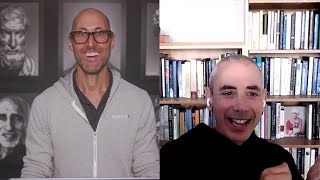
Brian Johnson talks with Steven Kotler about flow states, creativity, and the neurobiology behind peak performance. Kotler shares how perseverance and long-term commitment shape both work and relationships, drawing on his own experiences as a writer and thinker.
Chapters
Foreign.
Heroes. It is 1:01pm plus 3 central time, which means it is day one today. I will give him a proper introduction in a moment, but we're blessed to have Steven Kotler, one of my favorite writers and thinkers, with us today to talk about some aspects of his heroic journey. But before we go there, Aki, great to see you. Two days, very nice. Robin, great to see you. Heidi, Stuart, Anthony. We got to get you a heroic hat, sir. Troy, great to see you. Ryan, great to see you. Christine, Sarah, Zoom, User, nice to see you. Shannon, Sharon, Jonathan, John, R.J. troy, Rob, David, Teresa, Diane, Mac, and Kelly. Rounding out my first screen, looking at the second screen, coach Rick Kimmy, always great to see you. Vlad, nice to see you, sir. Let's get to work. Steven Kotler, one of my favorite authors and just human beings. I love your style. I appreciate you and your wisdom and how fully and iconoclastically and authentically you show up in all the ways. So bless you. Thanks for being here. I want to hear more about your story, but for those who don't know about Steven and his work, I should have done more notes on your books by now, but the Rise of Superman is one. I know. I see someone yelling at me. Robin, I appreciate you yelling at me. By the way. I listened to some of your books, and then it's hard for me to go back and do a note on them. I won't make excuses. But check out the Rise of Superman. This is one of Stephen's many books, but it's. It's a genius look at both the science and the application of flow and how one can get into flow. So among many things, Stephen is arguably the world's authority on flow in general and certainly on the application of the science through which we get into optimal states of peak performance. So check out the notes. We'll talk about some themes probably throughout, but, Stephen, good to see you, man.
Good to see you.
Brian, what's good? What's awesome in your life these days?
Well, I've inadvertently ended up with control of your waiting room, so I can admit people are.
Let's go. Co host. We're both there. We're viewing, we're admitting. I appreciate he does it all.
You should have never given me that kind of control.
He does it all. Well, what doesn't he do? You're in flow right now. I could feel it.
See.
What else is great?
I don't know. What do you. What do you want? It's the tail end of ski season, so we're. I'm still, I'm still progressing hard. Got a whole list of tricks I haven't yet learned this season. Been learning how to draw. Been finishing a huge paper on the neurobiology of intuition. So three years of work, actually more of a lifetime of work, but leading up to a book on intuition. It's a flow puzzle. Yeah, well, it's an ongoing flow puzzle that like, if you go back to my first book on flow, which was west of Jesus, one of the things I poke at is the fact that intuition is much louder in flow, it's much clearer. And then you get those very peculiar downstream stuff, synchronicities, those sorts of things that nobody quite knows how to deal with. And it's just been an ongoing puzzle that's sort of sitting at the side of flow research. And after 30 years, I finally sort of got a into it. I had an argument with Daniel kahneman about intuition 6 years ago and I thought he was wrong and led. It was just a toehold into something that is, is leading to a whole bunch of work. So that's good. I don't know what else is good.
We're gonna go there. No. So there we go. Neurobiology of intuition. Literally. I was speaking, chatting with my, my wife Alexander this morning and I go to her for like, I had a distinction I wanted to make creatively. Should I do this or should I do that? And then she gave me great perspective. And then she told our son, I'm intuitive. He's a chess player, he wants to be a grandmaster. That's kind of his thing right now. He's very logical and precise. We had this chat about it literally this morning. Neurobiology of intuition. So what's the notes on that? Give us the high level kind of overview of how you're thinking about it. What we can look forward to in the upcoming book.
Oh, God, this is.
So then we're going to talk about.
Yeah, this is, this is the very first.
I can't not go there.
No, there's. Yeah. God, I don't even know what I'm gonna say to you. There's a bunch. Here's what I'm going to say to you. What's cool about intuition is that it's actually built on top of the brain's map making and pathfinding software. So the hippocampus and the entorhinal cortex, the parts of the temporal lobe, they do long term memory, but they also, you may have heard about place cells and grid cells. And these are these regions when you talk about peak Performance, aging and sort of my new work in our country, these are really important areas because a lot of the neurogenesis birth of new neurons in the older brains comes out of this area. But it turns out that what we call intuition is built upon a kind of pathfinding software. So the brain is always uses this map make machinery to figure out where to go next. And it's a, it's a summary signal. It factors a whole like risk, asset, this and goal hierarchies and all this stuff goes into that. Intuition is a faster version of that same system. So it's built out of the map making pathfinding system. I'll just stop there. That's a little.
Oh my God, dude, I already got goosebumps.
It's kind of, it's very, it's neat, it's, it's. And it makes it start. So by the way, so is insight, so is analysis. These are the brains of all our brains of all to control movement. So everything sort of that we think of as cognition and thinking evolve first out of movement and intuition is very much that.
Wow. We could obviously talk about that for a week. I can't wait for the book. And it's funny too because, you know, I turned 49 a couple weeks ago and I'm, I'm very excited about all the work, all the kind of grinding and grooving and all the hard work I've done to get some decent patent recognition in terms of the wisdom and my own, you know, vision of what's possible entrepreneurially and leader. All these different things that I can feel like I'm literally just beginning my heroic quest. And the intuitive, the relationship I have with my intuition, I've shared with our community a lot. So I work hard, unapologetically, I train, I do all those things and I recover as deeply as I can as well, creating these really big waves of on and then off. But every morning I meditate for 15, 30 minutes to 60 minutes. But my main thing is in order to tap into what I perceive to be my intuition and just clear knowing via my daimon and into something bigger than me. I try to get my heart rate as low as I can. And it's from that place through which these crazy great ideas come to me. And it's just my own little practice and breath and whatnot. And it's become for me, when, when stacked on all the hacks that you talk about and removing all the blockers you talk about in all of your work, there's like this conduit to something bigger than me that I've been having fun finding a more consistent connection to. But anyway, so much we can talk about there, but I can literally see my heart rate dropping. And this intuitive, almost like two, yet.
Two things I want to tell you. And then we can go anywhere. But this is two things we know for sure. Been well established at this point. One, one of the reasons people are good at intuition, you have to have strong interior reception skills, right? You have to be able to detect internal signals. How do we train interior reception? What's the standard way to train interoception? Have people count their heartbeats so you are foundationally like we know, just by paying attention to your heartbeat and tracking heartbeats. This amplifies interior reception, which amplifies pattern recognition and intuition. We know that. So that in itself. The other thing that's interesting is when you're doing it meditatively, there's an overwhelming amount of evidence that says that when we meditate, we can get past most of our cognitive biases. We have a little space away from them. So our intuitions are more accurate in when we meditate. So this kind of, the kind of practice that you're doing, literally train up intuition is literally a good port. I mean that plus expertise and feeding the brain and feeding the pattern recognition. Those, those, that's the combination, that's the winning formula for intuition. And then regular access to flow because it's so much louder and we get used to listening to it. And intuition also can help. But you're right on the, you're on the right path, training wise.
Whatever is deeper than goosebumps and more kind of alive is what I'm experiencing right now. And again, a lot of my own practices have been informed by you and your work and just the rigor with which you've approached things. Wow. Okay, let's step back. Stephen Kotler. Nice to see you. Good to have you here. Usually I start a little differently, but that one was just my intuition, shall we say, called me to go there.
Hi, Brian, nice to see you.
What are we doing today? Good to see you. We're going to talk about this guy named Steven Kotler. He's living what I perceive to be a pretty, you know, gnar, awesome heroic life. But I want to know about you and what brought you to today. And I especially want to know however you want to tell the story about the hero on his quest, answering a call, battling the dragons, perhaps wanting to tame them and ride them in the process, and returning with the boon through the cycles of your life, however you want to approach that, knowing there's an infinite number of ways we can go. But that's the intention with these conversations, is learning more about individuals I admire who have moved from theory to practice to mastery, knowing it's an ongoing practice, but have done some inspiring arcs and cycles through their own heroic quest. So whatever you want to share in response to that, please.
So it's interesting because I get. I get asked. I have started to get asked the where. How do you become you? Question more frequently. And I've had tons of different answers over the years. And finally, I don't. I think I was talking to Michael Gervais and he asked it to me, and I, like, I just. I blurted something out and I was like, oh, that's the truth. I finally found the truth. So I think the. That the short answer that is you. I am. Everything else aside, I'm fundamentally a creative. I'm a guy who always wanted to be a writer since I was 4 years old. And trying to figure out, how do you make a living as a creative? Was that puzzle plus the. I grew up, I was a weirdo. I'm a punk rocker from Cleveland, Ohio. There weren't a whole lot of people like me around. So where. And. And on top of being a punk rocker, I'm not even like a normal punk rocker because I'm also a science geek and a whole bunch of. Right. Other things that sort of blend in. That actually was president of the punk movement, but it took me a while to find it. So a lot of me was spent trying to figure out, where's my tribe, where's my people? Where do I fit? Right. Where are people I can be creative with, be innovative with all that stuff? So you put those two things together. How do you get paid as a creative? And where are people who are like me, who can help me kind of advance that cause and make me feel safe, that sort of thing. That's a lot of the. Like, trying to solve those two puzzles is, you know, more than almost anything else what led to me. There's a whole bunch of other stuff we can talk about, but two puzzles.
Let's drill down a layer deeper. So then tell us about some of the kind of most salient moments in your heroic quests with an S. Walk us back through that. So four years old, you want to be a writer, which in itself is a whole long conversation. And then punk rocker this, iconoclast that. How do you integrate? How do you get paid to do what you love to do, um, walk us.
Yeah. So everybody, everybody tried to dissuade me to be a writer. And I think this is, I'm just going to tell this story because I think this is everybody's story, right? I don't think this is, oh, I'm special. I think this is. Most creatives have this story. Mine. Like, literally the first time I ever wrote a creative anything, I wrote a creative essay. I was in second grade. We were asked to write biographies and I decided I was going to write my family's biography as told by dinosaurs who were in person, namely Abbott and Costello. Don't ask me. I was in second grade. It was very creative. I got yanked out of class and screamed at for a half an hour by the teachers because I didn't do the assignment now. And it just like that didn't change. They tried to fail my senior year in high school because my senior project was a collection of 50 poems. I was a punk rocker. I was very anti authoritarian, very anti religion. And I offended my very devout Christian teacher and school. Like, everybody got so pissed at me. They tried to fail me. It took me. They threw me out of my undergraduate creative writing program, literally at the University of Wisconsin. Nobody knew what I was doing because I was pushing into American metafiction, doing weird things with words. And I was disruptive in class because I had this. I would tell people the truth about their writing. It wasn't a good thing to do in a writing workshops. I said some pretty horrible things that I probably lived to regret, but yeah, and it took me forever to get into. And when I, when I decided, finally I decided to go to grad school. I only wanted to go to Johns Hopkins because there was a guy named John Barth who was there and I had literally like, he was doing what I wanted to do with words. And everybody, my family, my friend, everybody was like, don't do this, don't do this, don't do this. And I said, you know what? I'm going to go and get into Hopkins. John Barth is the one guy who's qualified to tell me if I should be doing this or not. And took me Hopkins, a very small program. It's very. They only let in like 10 people into the fiction program. And half of those people are alumni or senators, daughters or whatever. This is like three slots a year. It took me forever to get in and finally got in. And it was Bart's encouragement. He. He actually ended up blurring my first novel. But he was the one who said, no, no, you know what you're doing be a writer. And. But all this is leading to sort of the story I wanted to tell, which is what sort of happened right after graduate school. I thought I was going to work in advertising. I had worked as a freelance writer in advertising and worked on Taco Bell campaigns for foot cone and belting and a bunch of other stuff before I went to grad school. They never met me. I was freelance, so they never knew that I had dreadlocks down to the middle of my back and earrings and just was a punk rocker. They didn't know what I looked like. And so I got out of grad school, I came back to San Francisco, and I really thought I was going to walk into this ad job. And I went to an interview that I thought was going to be a salary negotiation until I walked in the room. It was within a second, I knew, they're not hiring anybody who looks like me at all, period. And they. But they couldn't tell me that, right? You can't not hire somebody for having dreadlocks. Even though it was very clear they were not going to hire any for having dreadlocks. So they kept having meetings with me. And the guy who's interviewing me, he kept sort of leaving me in his office. I got to go to a meeting. I got to go to a meeting. I got. Then they tossed me a copy of a magazine called Bikini. It was the first. It was the Proto Lad magazine. So before Details, before Maxim or FHM or all those other magazines that erupted in the late 90s, there was this magazine out of LA called Bikini that was very punk and very funny. And the first issue had just come out, and he threw it to me, said, I got to go to a meeting. When you read this, and when I come back, we'll once again talk about how we're not hiring you, basically. And I opened up the magazine and I read an article that I went, oh, I can do this. This is where I belong. This is weird. These. These. These are strange people. And I went home and called the editor in chief on the phone every hour for four days in a row until he finally took my phone call.
He.
I faxed him 100 pages of, like, anything I'd ever written. I'd never written a magazine article in my life. He got pages of my book, anything, college papers, whatever. And he called me up, like, two days later. He's like, well, kidding. You got chutzpah. His name is Noe Gold. You got chutzpah, but we don't have anything for you, but I'll keep you in mind. And two days later, he called me back and he said, hey, we want to do an article about this kid. He's going to jail on Monday. We have the best art in the world, photographs of him. If you can get an interview with him, you can have a job. And it was Friday night, and he was going to jail on Sunday morning. And I had to figure out how to get an interview. And I figured it out, and that's how I got. That's how I started. That was solving the puzzle of how to make a living as a writer. That. Like, I'm just sort of exemplifying that. But. And I don't think there's anything unusual with my story. I think that's every. I think every creative. I think you have to sort of take a creative career from the world. Not in a violent sense, but it's definitely an act of aggression. Wow.
Again, there are so many different threads we can pull on that. Clearly, it's both universal and unique who you are and how you showed up within the kind of archetypal, not just creative, but heroic path. And Joseph Campbell comes to mind. Who's on my wall back there? Follow your bliss and your blisters. So you knew what you wanted and you hustled and you had that chutzpah, that courage, that willingness to just do what it took to make it happen. And no wasn't an acceptable answer. So everyone pull back. Captain Obvious here. Pay attention. What do you want? What's the price you're going to need to pay? You don't know it, and it's a fraction of what you're actually going to have to pay. And then go pay it, and then go pay it some more and some more and some more and some more and some more. I love the demonstration of that. And then, I mean, it's just the absurdity, the calls, the faxes, all the wonderful things that led to the breakthrough, etc. But I want to go back. Was it Barth to make sure that I get one of your.
Yeah, he's sort of the Godfather of America. Metafiction. Metafiction. So in the 50s, when sort of trust in American politics began to fracture, there were two movements that erupted in journalism. There was new journalism, so that's Hunter Thompson and Joden Didion and that style of writing. And then there's meta fiction, which is writers like Thomas Pynchon and John Barth and early Toni Morrison might slot into that. That though people might argue with me on that. But anyways, his style of writing, they both had a lot of things in common in terms of how they approach questions around the truth and what is reality and that sort of thing. And I was very much of that. I'm very much in that I'm trained as a fiction writer, as a metafiction writer, as a journalist. I was very much a new journalist. Like the. That's where my training is and that's how I approach things.
So you were clear on this is the individual with whom I need to work, nobody else, full stop. What did you do? What's the quick playbook on what you did in order to earn his trust and for him to see the potential in you.
So it's a really. It's a funny story. It's a weird one. So couple things you should know about me. I'm trained as a poet. So my undergraduate training as a poet, I was writing an epic poem my senior year of college, my thesis, and it started to turn into a novel. And I had never considered writing fiction before and that not once I started to realize, oh crap, this is actually a novel. I'm going to be writing fiction. I switched to fiction. I There were a lot of basic skills, writing skills that I did not have when I got into grad school. I as soon as we got into grad school, I the first day of class, they wanted to know who wanted to submit their writing. And I wanted to. I had to get it out of the way. So it was me and another guy. We submitted our writing, which meant the next day in class everybody would review our stuff. And I gave people like 80 pages of the novel. And we came into class and everybody in the entire class, they John Barth, let him talk first. They ripped my writing to shreds. I mean, like, they destroyed me. They hated it. Not any person in the entire class liked it. It was awful. And I don't know if you've ever been in a writing workshop. It can get really gnarly. It was gnarly. And some of it was like, totally my fault. I didn't know how to spell yet. There wasn't spell check. And I misspelled the word tomorrow six different ways in ten pages. I really made stupid mistakes. So at the end of all that, people just ripped me to shreds. Barth steps in and says, you know what? I think you're all wrong. I think this book is awesome. Sure, he's got some grammar errors. And he defended me and for 20 minutes defended my work in class. Nobody had ever done that in my entire life and I didn't know this man at all. It was the very first time anybody had ever liked my writing. Defended. I'd never seen anything like it. And he pulled me aside afterwards and he said, look, he said, I liked, I liked what you did. Come to office hours, we'll talk more about it. But if you make another spelling or grammar mistake, I'll throw the out of grad school. Wow. And I, he literally, I learned, gave me a copy of Strunk and write the elements of grammar. And I like, I did nothing for two weeks but learned all the rules of grammar. So I never made another mistake. So yeah, I don't know how, I don't know how I won him over.
Yeah.
Other than I got beat up really badly in front of him and maybe he felt sorry for me. But no, we became friends and he was really a great mentor to me.
Again, there's so many important themes to that that I want to pull out. Let me rewind the history though. Three people, three slots after you got rid of the alumni, the senate, you know, favorites and all that, how did you get in? How did you. What was there and again, briefly. But I just want to know like who, how you approach things like that.
And then so what's the source of.
Your, what's the source of your confidence and courage as well? How would you reflect on that and how, more importantly, how can we cultivate that within ourselves? Because again, that's the intention here for everyone who's observing you and trying to figure out how they can have a little bit more of that. But knowing again, there's a lot to that. But take us where you want to go with that and then I'm going to bring us back to the amazing relationship you had with him.
I got in, I got to know the guy, the gatekeeper is a guy named Stephen Dixon who's a National Book Award winner. And he was his. Even though Barth was the guy. Stephen Dixon sort of controlled admissions and Stephen Dixon is fundamentally a blue collar guy and that's how I got in. I.
But what did I do?
Because I grew up in Cleveland and I grew up like I, I grew up around, you know, steel workers and things like that. And I was a bartender and I could speak that language. So like, that's how I got in. I let him know that I wasn't what I wasn't like a lot of the other people. He was letting it Tokins so that we had things in common and that also I kept, I just kept at it. I kept, like, submitting portions of my book. I mean, he saw my writing evolve over three years because he was reading it. And ultimately, I like you. The other thing, and this is, I don't. Once I decide I'm going, once I call something a goal, I will not stop. I would have applied to Hopkins every year for the rest of my life until they let me, like, period. I just won't stop. I don't think I'm much more talented than other people are smarter or any of those things. I'm just really willing to work harder. And once I call it a goal, once I say it aloud, I won't stop until it's done.
And I want everybody to pause and actually not only hear that, but feel that. Stephen, you may know my beloved spiritual father, my deepest mentor and guide to use the hero guide model is Phil Stotts, who is in a documentary right now by another one of his clients, Jonah Hill, on Netflix called Stutz. So literally yesterday Tuesday, we were talking about. So I tattooed my body with heroic. And then I put the goal to which I've dedicated my life to create a world in which 51% of humanity is flourishing by 2051. And how we're going to do it, getting the first million people to what we call a soul force, which is your superpower activated at 101. So we talk a lot about blood commitments and basically what you're talking about. There's no scenario where stopping or giving up is a possibility for me. And to hear you describe it that way is just so powerful, where you will pay whatever price for however long you need to pay it, and then there's no discussion about it. So I decided that I'm going to do it. Therefore, I'm going to call this person in this situation every hour on the hour until they open the door. What do I need to do here, Vero?
You're gonna. I mean, he's either gonna tell me to fuck off or go away, or sooner or later, he's gonna open the door. I mean, one or two things are.
Gonna happen and you want that to happen sooner rather than later. So then for me, literally, my approach is kill it. I wanna kill it, or I wanna confirm it as fast as I can. It's either a decent idea or it's not. And again, there's the mission to which I'm never gonna give up. The means by which, of course, is. Is. Is malleable. But go on.
There's two things that I want to just drop in here because they're worth. If you want to make this stuff practical. One is like, we all have to learn this lesson the hard way because it's so unpleasant, but it's the most liberating lesson in the world, which is our. And I think our greatest choice are on the other side of our greatest fears. Right? It's actually in the show notes for Rise of Superman. I think you talk about that very thing. I definitely talk about that a lot in Rise of Superman. But we all have to learn that the hard way early, right? Or eventually, right? If you can't. If you can't learn that lesson, then your fears are just crippling. But when you start to figure out, oh, wow, the things that. That make me ecstatic, the things that I'm here for, they're on the other. I gotta go right at this thing. And then it's a question of, you got to go right at this thing sooner rather than later, because later can eat you alive, right? Later can ruin your life sooner at least. So I'm a big fan of that. The second thing I want to say is there's a whole bunch of neurobiology around this, but we're gold rect machines, and we're also homeostatic organisms. So what that means is we have a certain energy budget. It's a fixed budget. And like for the brain, first order of business is efficiency. The brain has always tried to conserve energy. Same thing with the body. So if you are in the. If you create goals for yourself, and this means, like, you create a to do list for your day and you don't check everything off, right, you're just training the brain that when you create a goal, you're actually lying. It's not really a goal, it's optional. And your brain will immediately start looking for an easy way out because it wants to save energy. Because that's the. But if you never, ever, ever give it the option, this is. No, no. Once it's the goal, it's done. Your brain never wastes any energy not trying to achieve the goal. It immediately starts going, oh, shit, we got it. We got to do this. And it will immediately try to figure out how do you solve this problem, right? And we do that. We do pattern recognition and problem solving automatically. But if you give the brain and out. If you give a way to save energy, as homeostatic organisms, we're going to take it. So you just. You can never give the. You can't train yourself to ever back off, because the brain will learn that that's the that's the thing we do here. And dude, that's. I think I talk about that at the end in our country. I think it's at the.
Okay. And I need to. I need to. I have. In our country. I need to read it. You're just genius. Everyone stepping back. This is antifragile confidence. So I talk about forging antifragile confidence and I juxtapose fragility, resilience and anti fragility using Nassim Taleb's frame. But I apply it to our individual lives. When something comes at you can you get stronger from every challenge? And then you forge that and you forge confidence, which of course etymologically means intense trust. Confidera. In what? In the fact that you have what it takes to do whatever it takes, no matter what's happening in your life, independent of whatever results are occurring. And the only way you build intense trust in any relationship is to do what you say you will do. So if you say you're going to fill in the blank on what you just said and you don't do it, you shouldn't have confidence because you're not trustworthy. You don't trust any individual who doesn't do what they say they will do. Why should you trust yourself? So the way you frame that with the homeostat, et cetera, this is it, folks. It's 100% commitment.
Yeah, it's all. But it's also something you just said like. So this is generally. This is why affirmations fail and gratitude works same. We're talking about roughly the same process, but we have phenomenal built in bullshit detectors. Right? You cannot lie to yourself. But the flip side is also interesting. A lot of people fail to trust their own history. When they go into challenges, they don't look back over their life and they don't go, oh, when have I solved something similar to this before? Right? We forget that we've done a lot of these things. This is interesting, this is tangential, but I take great comfort in this fact. One of the things that you learn if you study peak performance, aging or death and dying is one thing that most people assume, and it turns out it's not true at all, is that the pain around dying is going to be a lot worse than they've suffered in their life. And it turns out that, no, we're actually. If you've sort of made it into the latter half of your life, chances are you've experienced the same level of pain you're going to experience as. As you die. And this is sort of like a well known fact. It doesn't get worse. You're already tough enough to do this thing. Another thing where we don't trust our own history and there it plays a role in mortality and death issues. But anyways, you have to trust in yourself is precious and you have to really fight to preserve it.
Oh, geez. And then, and then we talk about one aspect of the past successes as hero bars. So you got to have a stack, you know, David Goggins calls him the cookie jar, right? The things that you've gone through that allowed you to become who you are, all of the things you're most proud of came on the other side of the biggest challenges. So that's the first ingredient in your next hero bar. So quit resisting the fact that life is hard. Lean into it. You're not going anywhere. 100% non negotiable. You said you're going to do it. As you said, it's done. Now I just need to go from here to there.
But the other thing that most people don't get, and I say this in art of impossible, flat out personal opinion here, but after talking to tens of thousands of people who have tackled impossible challenges, I've never heard somebody who doesn't agree with me on this statement, which is it's, first of all, it's hard here for everyone there. I've never met anybody where it's right. Like we always, you and I talk about this a lot. It's hard for everyone here, period. And it turns out that challenges of going after your impossible dreams are in the end not as hard as the amount of pain you're going to cause for yourself by not going after your impossible dreams. It's worse to not do it than it is to go after after it. And it just is. And Mo, I think most people who end up accomplishing the impossible, they, they end up doing it because they found that like there's a lot of stress relief in going after these like so called impossible challenges. Because you come out the other side, you've, you're, you're more adaptable, you're more complex, you feel safer in the world. Like it does a lot of really beneficial things over time and you start to realize that possible challenge after impossible challenge after impossible challenge. That's when stuff starts to get really interesting.
Well, and the thing that I, one of the many things I loved about the rise of Superman was you actually gave a formula to the impossible where you break it down and it's actually not 400% out of your comfort zone. If you can just every single opportunity go on. A thousand hero journeys a day, not once a life. If you can go 4%, 4%, 4%, 4%, 4%, 4%, 4% out of your comfort zone, then the impossible, as you brilliantly say, is what's for breakfast? You just start doing things that you never thought were possible. And again, you bring it into different contexts in the book. But I also feel at the end of our first chat, forever ago, after I read the Rise and we did the PNTV thing and we connected, I said, hey, what's the one thing you want people thinking about? I would. I'm almost certain you don't remember what you told me, but I'll check in briefly. You don't remember what you told me, do you? So you told me you thought about it. You know, you did what you just did a couple times here today. And you think about it, you're like, what do I want? That's a decent question, right? What? What?
What?
One thing I want to share. And you said, no pressure, no diamonds. So the willing. And that changed my life. So, you know. You know, it's one of the extra things. Oh, yeah, yeah, yeah, yeah. There we go. I've talked about it so often, I've got a, you know, thing on my desk that reminds me of that. Embrace the pressure. No pressure, no diamonds. And then to your point, it isn't as bad as you thought, and the pain of not pushing on that is devastating. And then we go back to Kahneman. Loss aversion is actually the best motivator. So if you can feel the pain of not getting the thing that you wanted and use that as a motive force to go at it hard, then we're bringing all these ideas together, and 100%. There's no negotiation. It's not 99.2% committed. It's truly that 100. Dude, this is so good. I'm so fired up. Anything else on that theme? No.
Probably. But let's say no.
Perfect.
See where you go next?
Yeah. So do I. My God. Let me see where my intuition wants to go. The myth of the hero is one in which the hero gets a guide, right? So the hero has to answer the call. First and foremost, they get a guide. Harry gets Dumbledore, Neo gets Morpheus, et cetera. And then they get buddies. So again, just to shine a light on your heroic quest, you literally said, like, where was your tribe? Where's your community? I'm so out there. Where do I find these people and then you found the guide in Barth and others. But just, just to shine a light on that team that this is part of the overall process and to celebrate what Barth did for you. But let's move past the heroic quest into the really practical, our big three as we describe it. And briefly to frame it up. Stephen Covey talks about roles and goals, things in your life, the roles you play, goals you have. Tony Robbins adapted that to categories of improvement, things you want to improve, and then you do all this. I found that overwhelming. So agreed with Freud that a good life comes down to work and love with an asterisk that if your energy sucks, you're going to have a hard time showing up in either your work and your love. So we tried to simplify self development with all the asterisks. It's more nuanced. But let's get your energy, your work and your love dialed in and you're going to be 80, 85, 90% to where you want to be again. Longer. Philosophical chat aside on that. But when you look at your life and the distinctions that you've made that have been most life changing in your energy, your work and your love, what arises for you?
So. Two separate things. Let's talk about work first. I the most. The defining thing in my career, in a sense was I said no to a lot of jobs along the way. I knew everybody I knew who was a writer wouldn't deal with the panic of oh crap, how do I pay my bills? Where's dinner coming from? How am I going to pay rent? And they took a job as an editor and they became editors. And that's what they did. Now some of them in their 50s and 60s have finally come back to writing and now they're starting to write again. But they weren't writers, they were editors. And I saw that. And so I saw a lot of my peers get scared and take the easy way out. And I just said no to the jobs that were offered to me because I knew that if my time was the most precious, if I was going to write books, I had to write books, right? And so work wise, it was what I said no to was really important. And being willing, like there were times I turned down at any jobs where it was insane, you know what I mean? Where like I can't pay bills, I'm about to borrow money from people to pay bills, and I'm still saying no to the job kind of thing. So there were a handful of those and I don't. And some of It, Ryan, it sounds very heroic. It's not. It's just. It's also that I know myself and I don't work well with bosses. I don't like. I don't fit into good corporate structures. I don't like. It's not. I, I need to be either the guy at the top or not involved at all. Has, has worked for me. And so I knew myself also. So I knew that like, even if I took the job for safety's sake or whatever you were, I was going to get fired. Somebody was going to fire me, wasn't going to last. Right? But that was that. Saying no really mattered. And when it comes to love. So it's funny of the things I'm. I'm proudest of, like, if you were to come to me and say, Stephen, what are you really proud of? I'm really proud of my marriage. Been married for 18 years. It's one of the hardest things I've ever done. My best friend is my editor and we've worked together for almost 30 years. And both my editor and my wife, neither of them are pushovers. Neither. Although both of them have very sharp edges. They're a little like me. They have sharp edges. We're not always pleasant with each other. It's like, like any really long. You have a 30 year working relationship, you have a 20 year marriage there. It's fricking hard. And like, what I love. So when I think about, like marriage, like my wife and I'll be sitting out and trying to talk through some problem, and I realized that, like, this woman has been willing to sit down with me and talk through some problem once or twice a week for fucking 20 years. Oh my God. Like, oh my God. Like, you know, and I've been willing to do the same with her, but, like, that's a massive. So when I think about love, I actually think about work. When I think about work, I think about saying no to other work to protect the work. Those are, I don't. Those are just the things that came to mind. But those are like, I think this, the road to fulfillment is long projects. I think that we like long. There's something to be said for very long. You know, I probably was in a gym for 10 years before I actually got into shape the first time. My first novel took 11 years to write. 20 years of marriage. Like, those kinds of long, long projects. Even the Flow Research Collective. Right. I like the fact that I had a couple other companies beforehand that didn't go the way I wanted them to work. So finally now, you know, I like those kinds of long projects but when it comes to like work and love, those are, that's what pops into my mind. I don't know if that's useful or helpful.
Dude, that's more successful. Yeah, not so good. Again, several things I want to emphasize and just, just make the implicit explicit here. Maslow says that the in the self actualizing individual, to paraphrase the apparent dichotomies between things like work and love. Dissolve. You know, you tell me, am I working or loving right now? Literally you and I connecting us, you know, trying to serve the individuals that are here with us today by sharing something. What are we doing right now? Is it work or love or play or a combination of all of it? So I love that. And then again, amen. I am very transparent about the very significant challenges that my wife, we've been together for 16 years, God bless her. I am not an easy human being to be around. We got a 10 year old, we got a six year old. I'm making some, some commitments, some trade offs, some sacrifices as I go into the mission and that continued process. Love the fact that you've been with your editor for 18 years. I think of my right hand guy, Michael, and I'm like, oh yeah, I want to be worthy of that. You know, every morning I recommit to being with my wife for at least 51 years. One of the numbers I love every morning I recommit in our app to I want to be with her. You know, that's important to me. Let me be worthy of that. I want to be best friends with my kids when they're adults. Target swipe, as we say, all day, every day. Boom, let's go. So I love that. But then I also want to emphasize, I'm going to state the obvious here again. Your nose to these jobs that you knew you'd get fired from. Right. Came on the other side of a deep soul aching. As David Brooks would say, yes, I have to do this. And when we have that mission orientation and that non negotiable, I am going to fulfill this part of my creative potential. Correct me if you think I'm wrong, but it's that yes that allowed you to say no to the things that may have been shiny and gotten you some near term perks, including dinner tonight, but just weren't tenable given your deep soul aching longing to the, the yes you had committed your life to.
I think that's very true. I also one of the things I discovered early on as a Journalist. And I don't know if this is true for everybody, but it seems to be true for a lot of people. And I've been looking at the neurobiology that's to try to figure out if it's true for everybody. But when I was a journalist, you gave me an assignment. I was on a mission, man. I did some of the most insane things. Like Stephen, go sail through a monsoon with pirates to go get. Like I did insane risk your life thing after insane risk your life thing without even thinking about it for a very long time. Because I was on a mission. And it was only later afterwards it was a friend of mine, a photographer I worked with, Chris McCown, a lot of who said, yeah, there's the difference psychologically between an away game and a home game. And it seems like when you go out on away game, you're just, you're willing to do almost anything for the cause. And he caught my attention. I was like, oh, that's true.
It's true.
And especially true for me. And I'm wired that way. So if I know that about myself, I'm built this way. I. Some of my books, a lot, certain of my books west of Jesus is done this way. So same thing with our country, their missions, they're designed as missions specifically because I know one. I'll go so much farther for the mission than I sometimes will in real life. And I also think some of it is because we evolved to be, to think a season ahead. If you couldn't think a season ahead, you, you died right knowing, like where. Okay, it's fall. Where's the, where's the warm cave to protect me from the winter? Okay, the winter. Where are the right fruit trees in the spring? Like we're, we're, we evolved to process information goals that way. And I think some of that hard wiring is left. So these sort of, these mission half year year long goals kind of thing sort of works with our internal hardwiring. But I can't prove it to you.
It's a suspicion at this point yet. So I look forward to you creating the scientific proof to that. Intuitive, intuitive hit. Brilliant. We didn't talk about energy. And again, you're just a machine in this regard. What arises for you as transformative energy wise?
Two things. I sleep a lot. I like napping. I'm a big fan of 7 to 8 hours of sleep every night. I can't function without sleep. And in fact, that was one of the things that kept me out of some of those other editing jobs and journalism jobs is that, you know, editors want to be able to call you up and say, okay, I need you to rewrite this thing. You know, I'll work all night from the morning. And I'd be like, well, no, you, I don't do my best work that way. I'm not doing it. I'm really so. I've been very ferocious about protecting my sleep for a while because I'm so bad without sleep. So when I think about energy, I think protect your, your sleep. But the other thing that I think is, and I sort of get the feeling you do this too. I try not to leave anything on the table every day. I mean, I want to collapse into bed, right? And I want, I want to have intellectually drained myself and like emotionally, physically, spiritually, I want every one of my needs. I want to have leaned into so hard that when the day I let you know, in skiing we say, don't leave anything on the hill. And that's how I like to leave a ski mountain. I think it's the best way to respect a mountain and respect the sport that has given me so much try to leave out. I try. I try to literally ski until I'm about to drop. And that's how I approach every day. So I really sleep and I honor my sleep. And I nap almost every day for 20 minutes in the middle of my day. Those things happen. But when I'm not asleep, I have one speed.
Feel it again, folks. This is the oscillation we're talking about. I frame my own intuition the same way. So we didn't start with a quick check in and we call it flipping the switch where you just you ground. You've done that multiple times today, so notice that there's truth to what you said. But even right now, you've calibrated your energy where when you are on, you're on. When you're not, I can feel you regrounding. And before you respond to a question, you're deeply contemplative and you're reflecting and then you let it rip. So there's this beautiful up and down oscillation. The amplitudes are intensely high, intensely off. We're soul brothers in many ways. My number one target, energy wise is I'm in bed for nine to ten hours. So this morning I got up after like eight hours and 20 minutes, but I'm in bed for nine to 10 hours. So I meditated for 40 minutes in bed, wasn't going to fall asleep again, but that's a non negotiable target. That I hit. Thank you very much, and let's go. And as you can tell, I tend to show up at the level of intensity as well. And again, so much there, but just leaving it all on the court. Phil Sutz again talks about, you watch a basketball game, there's one, maybe two players that are all in every single play. They're just the ones that are just hustling. And the way he frames it is you got to go past what you think you can do in order to tap into the thing that is much bigger than you. Calls it 110%, I call it 101%. But being just that, all in this is precious. Leave it all on the mountain or on the hill, as you would say. Genius. I also want to emphasize one more thing. Looking down at my notes. You have modeled this in your presence with us again, of being calm and yet incredibly intense. And with Barth. So Barth basically loved the fact that you were insane and you were creating in a way that no one had ever done and no one but the best among the world in the world like him could recognize. But then he said, don't you ever come back to me with one single mistake. From a grammar perspective, it's the same thing. It's the you, yeah, you be intense here, but you better be intense here. It's the yin and the yang, but fully expressed, unapologetically, yet integrated. And this is what I find most inspiring, being with you today is, oh, my God, this is that iconoclastic, fully plugged in, fully expressed embodiment of the ideas that I aspire to embody and, you know, aspire to encourage our community to consider embodying as well. What do you think about that?
Hey.
What?
When you were talking, something popped in my head and did it pop back out? Am I gonna remember what the hell I wanted to say to you? I was very excited about it as you were talking, and now it's completely. Oh, I do want to say this so because you've asked a couple times where you got the courage to do these things. How did you. I stepped into. Bit up into big arenas early, and it came from two things. One, it came from realizing that, you know, going right at the things that scare me. There's tremendous to it. But the other thing is this. So I had this weird good fortune. I read a little about this in art. Impossible. But I don't make this point. I study. I was a magician when I was a kid. I was a magician and I started. I worked in restaurants and did bar mitzvahs and weddings. And I was. You know, they. They were. Somebody wrote an article about me when I was, like, 11 years old and running around and working and doing this, which I guess was unusual. But my point being, one of the things that was weird about magic is I was. I wanted to be what was known as a magician's magician. I didn't care about fooling people, whatever. I wanted to fool other magicians. And the way to do that was, like, really intense craft. And you could study. There were magicians. Whoever knew, these are the magicians. Magicians. And you could learn their tricks. They put them in books. You could learn them. So I learned very early on, by the time I was 10 or 11 or 12, that if you practiced hard enough, I could learn expert level. I could be an expert. I could do the same things as the expert, and I could get the same results, meaning I could fool people or fool other magicians. So I knew I was doing it right at their level, which is interesting. So when I got into writing, it never dawned. I competed against the best in the world. It never dawned. Like, when I go into writing classes, everybody else was competing with the other people in the class, and I was like, what the do I give a about? Like, John and Sarah, whatever. Like, they're college students. Like me. No, Like, I want to kid. I want to be better than Hemingway or pinching. Like, it's never dawned on me because in magic, I had already done it. Like, I'd already been like, well, these people are best in the world. I'm gonna figure out what they're doing. I'm gonna learn how to do it. And that's just the learning process and magic. And you can learn remarkably different. There's a saying in magic, which is, anything's easy with 10 years practice. So I knew, like, you know, it would take me two years to learn something, but I could literally, oh, wow. I'm as good as the best in the world. I was too naive to understand there was probably a lot more than what it did to being best in the world at that point. But when it came to writing, I wasn't scared to compete against the best in the world. And what I want to tell people, the point I want to make is that's just a mindset shift. You're allowed to compete against the best in the world. Nobody. Like, you don't. It's literally like, that's the level you want. If that's the level you want to be playing at, that's the level you should be playing at. Don't like, worry about what anybody else you know is doing. Who's best in the world. That's your competition. Go for that. And I, I learned it because of magic. And it, so it never, it never dawned on me that that wasn't, it was years later I realized that that wasn't how most people approach, approach things, but it was very beneficial for me. Peter Diamandis likes to say, you know, if you, if you don't succeed, begin again one level higher. And that's sort of the same approach.
Again. Wow. Another weekend. One of the things I'm most proud of, and that's the question I need to start asking people because it's such a beautiful question, what are you most proud of? Gives me tears in my eyes. One of the things I'm most proud of, in addition to my relationship with my wife, which again, God bless her and us, is my relationship with my son and my daughter and particularly my son right now, he's 10 years old. So as a dad and I've shared this with our community, it's just now I feel like I can finally start being a dad. So Cal Newport and I have talked about this. It felt like up until about now I was helping mom, I was taking the kids and I was with the kids and I love the kids. But now it's like, oh my gosh, I get to be a real dad, you know, and I get to support him in ways that I can support him. So he's into chess. We waited for him to express some passions and things. He got into chess and he's like, you and me, he got really into it. We homeschool him. He spent 6, 8, 10 hours a day playing chess. He watches the world championships like I watched the World Series as a kid. I'm like, you understand that? Yeah. And he's as you get pretty good when you go up it, you know, when you put in that much effort, he's developing the skill that comes from the effort. Anyway, I thought of him because he's 10. So there's a couple grandmasters in Austin. We went to their little chess academy just the other weekend. And a guy comes up and says, hey, you know you want to play? No idea who this guy was. He's just a nice, soft spoken dude, you know. Emerson starts playing with him. Well, it turns out he's a Grandmaster. He's one of the absolute best players in the world. And Emerson now knows this. And the thing that the grandmaster chose and I share this because I'm both proud of it. And I want to create the next generation of heroes who have this level of growth, mindset, fearlessness. The first thing the grandmaster said was, he has no fear. He's playing me, and he wants to win. And he played him really, really well. And there's this level of. And I have goosebumps right now of, oh, my God, this works, because I've been teaching him. Carol Dweck, rub your hands together. I love hard things. It's the only way you get good. Win or learn. Win or learn. What'd we learn? Cool. Let's go. So to feel what you did somehow so precociously that I did not. I was raised the son of an alcoholic father. Catholic upbringing. I had to be perfect, and I had an insane, fixed mindset, and I was afraid of everything. Any confidence I may have now is earned. And to see you, and it's like, damn, dude. I'm asking you because I'm like, how do we get some more of that? And then to see the science of it that you've embodied for all your reasons, and now you tell us how we can do it, and Carol Dweck and others, it's invigorating for me, man. I appreciate you. I appreciate our friendship and your modeling of these things in such a beautifully intense, integrated, iconoclastic way. But I know we're at our time, so bless you. Thank you. Day one, all in. I feel like we're just getting going. Is there anything else you want to share as we wrap up?
Yeah, everybody who hung out. There's, like 161 people in the room. Thank you. It was fun hanging out with you, and I hope it was useful. And, Brian, I just want to thank you as always. It's a pleasure getting to hang out with you. Thank you for inviting me to spend some time with you today.
I look forward to the next time we get together. Remind me where you are. You're in Colorado. You're Tahoe, of course. Of course. Yeah. We almost connected when I was in Tahoe. Are you in Tahoe? The other side of Tahoe.
I'm on Nevada side. I'm on the outside of Tahoe.
Perfect. Well, I'm, you know, books coming out this fall. I'm hitting the road. I look forward to connecting, and we haven't connected in person yet. I look forward to that opportunity and any and all ways we can support you, man. We're always here.
Thank you, man. Be well, everyone.
All right. Go hit that mountain.
Thanks, brother.
Mike, drop. What? Oh, my goodness. These are all I can't have favorite kids, but I got a lot of favorite kids. You know, we've hit some strides in a few of these conversations in particular, almost all of them have been truly just remarkable in their own way. I don't know about you, but I really felt that one and just felt so alive and so much soul force and such integration. I'm seeing that we agree in the chat, so thank you, Kimmy. Bless all of you. There we go. Nat, if you can help facilitate a connection time, that'd be great programming tomorrow. As I've said a number of times, the 1:01pm will be an investor update slash introduction. We start at 1. We're going to go until about 1:45 and then I'm going to take a break and usher Emerson into his chess match. So he's got a city championship for San Antonio he's competing in. We're heading out on the road in a couple hours here, so I'm going to take a little break, do our pre match routine, then come back and do part two of that chat with questions as tend to go long. But if you've ever thought about investing in the movement, we'd love to tell you more about it. If you are an investor, we'll give you the update on our thinking. And thank you to everyone who has supported the book launch. We're literally a weekend. We checked the box on Barnes and Noble. Boom. We did exactly what we wanted to do. We checked the box on 50 states. Matt was here I think before, had a friend of his in Vermont. Vermont was our outlier. We couldn't get Vermont. We're like, who do we got in Vermont? So we got Vermont covered. 50 states. The Amazon launch was amazing. We're really well poised to be where we want to be in five months. So thank you so much, Nat. If you can throw the link for the book up here in the chat just to make sure everyone. I'm sure you've seen the 101 memos, but check it out. 25 books gets you a free ticket to our launch party, which is basically 500 bucks is what the ticket is for the weekend workshop. It also buys you a brick in the book is the way I'm describing it. So you know when you want to support a park in your local community, you can pay 250 bucks and you get your family's name on a brick that will be there forever. We're going to do something similar. If you pay 250 bucks for I'm sorry, it would be more than that. It's 25 books, which would be more than that. But we'll put your name in the book. We'll give you a certain number of characters. Is it your family, your kids, what do you want to do? And we want to make that worth something and be as enduring as that brick at the park. But to thank the first, you know, we'll probably, we'll figure out the number of people. But to thank the people who buy those first batches of books, which will help us light the fuse to the movement by creating a best selling book. We just want to find as many ways as we can to thank you. So that's an idea that we're playing with. And there we go again. I so appreciate you. I feel so much gratitude, so much love for you, for our mission, for our movement, for making it possible to have conversations like this. This doesn't happen without you. Not just the, you know, a couple hundred people that were here at the peak or just under and the thousands of people that will watch this going forward. Literally, I don't get to do what I do without you and I don't take you for granted. So bless you. Thank you. Day one, all in. Let's go and let's flip that switch. And did you notice the truth of what I said about Stephen? I mean, the dude, you know, I try to discipline myself to slow down my talking while I'm doing it because I go fast, unapologetically fast, and then boom, he's right there in a moment. He's. He's the opposite of that. And the fact that sleep is a sport form or is ferociously protective of his sleep, it's everything we've been talking about. And that man is, is the world's authority on peak performance, full stop. I mean, anyone who competes is tied for first. No one is wiser on how to connect to. I would say you're diamond so that you can express the best version of yourself. And I also love the reflection back on the accuracy of what I had intuited that wasn't me. It's pretty obvious when you think about it, of, yeah, I'm on, but I'm also as relaxed as I can be. That was a fun little back and forth there too, but great to see him embodying these ideas. Matt McCall at 11. If you were part of that, you saw Matt McCall do it. Matt McCall did it. Goosebumps. In his own incredibly iconoclastic way as a venture capitalist. And he's the buttoned up. He's wearing his whatever venture capitalist shirt, got his different energy, but exactly the same human being just wearing a different costume. The soul force between those two guys and. And everyone else that we brought on so far is palpable. And again, just a cool expression of what we're up to. With that, buying the 25 books gets us the bonus of a signed book from Brian, even if it costs more than 500. November event. That's exactly right. But again, if you were going to come to the event, you're going to spend 500 bucks. If you're going to buy 25 books, it's going to cost you, whatever that is, 600 bucks. So we're saying take that and we'll give you the event. And then in addition to that, we're going to come up with a bunch of other things, but we're also going to give you the. Again, it's a small thing. I'm not trying to pretend it's a big deal, but if it's exciting for you, here's your name in the book. Any acknowledgments? Thank you to the people. I will thank and thank you. And here we go. But that's the basic idea. We'll continue to unpack that and we're going to pile on a bunch of other thank yous as we go. But with that, let's shake it out. Ground. In. In a moment, in one breath, flip the switch. Intensely on, intensely off. Energized. Tranquil. Practicing our philosophy with wisdom, self mastery, love, courage, gratitude, hope, curiosity, and zest. Closing the gap between who we're capable of being and who we're actually being. Living with Orte. Experiencing Eudaimonia not someday, but today. Bless you, Nat. Thank you.
More from Brian

Heroic +1: What’s THE Most Creative Act in the Universe?: Turning Around Glitches (#2024)









