Heroic Chat with Tal Ben-Shahar: If You Want To Be In the Light, Help Those Around You Shine
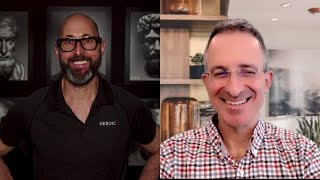
Tal Ben-Shahar talks about the arrival fallacy, why happiness requires both meaning and pleasure, and practical daily habits like body scans and cold plunges. He describes four happiness archetypes using a hamburger metaphor and explains why helping others shine is how you get into the light yourself.
Chapters
Foreign.
Heroes. It's 1:01pm Central Time, which can only mean one thing. It is day one. Welcome. Excited to welcome Tall Ben Shahar, one of my favorite teachers, one of my favorite guides, and consider you a dear friend now as well. Tall, I've been so inspired by you and I'm grateful to introduce you to our community in this context. And thanks for being here.
Thank you, Brian. I'm delighted to be here.
All right, life is good. I'm breathing slightly heavily, not just because I'm excited, but because I just got off the row where I did a nice little workout before today's time together. This is our fifth session, Heroic chats with masters. I very deliberately sequenced these with the individuals who have had the greatest impact on my life. So we started with Phil Stutz, who earned a place on my wall back there, spiritual godfather. And then John Mackey, my business mentor, as, you know, CEO of Whole Foods. Then we talked to William Damon and I kind of went with William in the third spot because he's William Damon, you know, just, just a heroic, just true national treasure. And then, you know, Cal Tall and Mark Devine are the next three kind of my. More my peers who have most influenced me. So we had Cal in last week. We'll have Mark in next week. Tal, Mark was kind of my mental toughness guy. Navy Seal. Cal, Deep work, deep living. And you have your influence on me is everywhere in my work in subtle and significant ways. But your work with obviously tolrote Happier. A great book that we've featured. We've actually let me do my little app here. We've got. If you search for Shahar, we will find 19 plus ones in which I reference Utah 77 philosopher's notes in which I reference you, including your book happier, choose the life you want and the pursuit of perfect, all of which are great. But the pursuit of perfect. Perfect. That book probably changed my life the most. If you have not checked out Happier and Pursuit of Perfect and Choose youe Life. Check. Choose the life you want. Check them out. But your distinction across the spectrum of perfectionism with the optimalist vis a vis the perfectionist and embracing the constraints of our realities like that, that was just absolutely formatively life changing for me. So bless you, you're a good one. I'm excited to have you here today. I will be celebrating you in my meditation in which we reflect on our fav. Favorite guides. But that's the prelude. Let's flip the switch. Enjoy a breath together or three. And then Tal and I will have Fun talking heroes, guides, Masterpiece days, big three number ones, etc. For now, enjoy connecting to your breath. Inviting the best, most heroic version of yourself to join us if they have not yet already joined. We are committed to being heroically wise, disciplined, loving, courageous, grateful, hopeful, curious and zesty as we activate our soul Force 2101 in service to something much bigger than ourselves. Energy Target swipe. Approaching a one minute meditation. Moving from energy to work. Think of one of your We've done guides in the past. If you want to do that, do that again. But perhaps your favorite author. Think of an author you may not have met personally who's most impacted your life. Appreciate the hard work they did to help you do what you do. Beam them some appreciation and connect their wisdom through you to one person you've served as a result of the wisdom you gained from that authority and that Guide. Target swipe. Connecting to those we serve. Creating a deeper sense of meaning and purpose by connecting to those who have helped us serve profoundly as well. Moving from work to love. Knowing there's no difference when we do it right. Think of someone in your life who made you smile over the last 24 hours. Little micro moment of awesome. Bring them to mind. Savor that experience. Beam them some love. Beam them a text for bonus points. Target Swipe. Appreciate someone our big three Energy, work and love. I am excited to chat toll. How are you?
I'm doing well, thank you. All things considered. You know, it's not, not perfect, never is, but things are going well. Thank you.
Give us, give us the quote. So before we were kind of having a few minutes together, I loved it. Can you share that with us?
Yeah. So very often when we were asked how how we're doing, people you know, say oh, I'm doing great, I'm doing amazing or terrific. And you know, a friend of mine says, well, the majority is good and the majority counts. So yeah, there are always things that are that are not going well. But fortunately there are also things that are going well. And the question is, what do we choose to focus on?
We're benefit finders. Let's go. And we're also optimalists, embracing the constraints of reality without the naivete to think that it should all be perfect all the time. Love it. Love your grounded pragmatism, which is another aspect or attribute of you that I so appreciate and admire. So stepping back and starting at the very kind of broadest and highest level, would love to know who your heroes are.
So you know, I'm a shameless hero worshiper I have many heroes. Heroes are my role models. In fact, and you may have heard me say this before, to me, the best self help books are not the, you know, the five Steps to Happiness, the, the Secret to the Good Life. They're not my books either. Rather they are biographies. Good, solid biographies because what they do is they present us role models, heroes and people we can and in many ways ought to follow if we are to be the best versions of ourselves. So my heroes, some are from books, others are from personal meaning. One of them is actually just right behind you, Viktor Frankl, who again, it's, it's unimaginable what he, what he was able to, to accomplish, the strength that he was able to, to extract from, from, from within. Very closely aligned with him is someone who was actually alongside Viktor Frankl at auschwitz in the 1940s. And that's none other than my grandmother who is an Auschwitz survivor. And I tell her story in greater length. I can point you to the video later on. But the bottom line is what she went through and lost her entire family, lost a number of children before having my mom as the only child she could ever or did have. And then telling me that life is beautiful and that we have so much to appreciate. So, you know, she's a big time hero of mine.
Absolutely beautiful. Yeah. Again, so many places we can go on that. But I want to step back to the biographies, the fact that those are the best self development books. Which biographies? So which specific biographies do you recommend? If you're going to give us a top three that comes to mind, what would that be?
Good. So one of them is Viktor Frankl's, which is, you know, is a partial autobiography, but it's a good one. The other one is Gandhi's My Experiments with Truth. And just the name, you know, to me says it all because he doesn't say My Finding Truth. He doesn't say my ultimate or the ultimate Truth. He said My Experiments with Truth. And his entire book is, is about his experimentations, trials and many errors. You know, in South Africa he failed miserably, but he wouldn't have been able to do what he did in India without that miserable failure. So, you know, it's an example of not someone who's perfect, someone who is extraordinary and therefore can be a great role model. Another one, and this is a book that I, that I teach in my, in fact I taught it a couple of weeks ago in our master's program, which is Anita Roddick's Business as Unusual. And Anita Roddick really changed the face of business in so many ways. So Ben and Jerry, you know, were influenced by, by her. You know, Your mentor John McKee was certainly influenced by her. And she, she gets, you know, what the role of a business is. Yeah, of course. It needs to make money. It needs to survive and thrive financially at the same time. It's about, about. About bringing about change, individual and societal change. Speaking of which, here is another hero of mine, and that's Warren Bennis, who, you know, so Warren Bennis was, was also my teacher. And Warren Bennis, if, If I could, Brian, I want to share an experience that I had with him, which for me was life changing. So Warren Bennis celebrated his 80th birthday and this was at Harvard. And people would come in from, you know, from all over the country, all over the world. So Al Gore was there because, you know, they had worked together and Tom Peters and Ken Blanchard and Stephen Covey was there, you know, the who and who of the, you know, the self help and self development field. And it was an amazing day that we had together. And Howard Gardner spoke and at night he had a more intimate party. Now I was his teaching assistant at the time, I was a graduate student, so invited me to the party, you know, to help and to, to be there with his, with, with his friends. And I, and I came early to help set up with Grace, his wife and him, and stayed till after they all left. And throughout the evening, I followed him and, you know, essentially stalking him because I just wanted to see, you know, how it is that he interacts with all the, you know, the luminaries, the heroes there, people whom I've read and have been so many of them were my heroes and guides. And what amazed me, as it always did with Warren Bennis, is how much light he brought to the room. You know, one of my favorite personal quotes is that if you want to be in the light, help those around you shine. If you want to be in the light, help those around you shine. Well, he was in the light because he made everyone around him shine. You know, whether it was, you know, the, the waiter serving the hors d' oeuvres or whether it was Tom Peters. And at the end, after everyone left, you know, I helped them, you know, get the house back to, to normal. And. And then it became already weird. It was too late. So I had to leave. And as, as I was about to, to leave, I said to, to Warren, can I ask you just one more question, please? And he said, sure. And I said, warren, how is it that you're this way. How is it that you're this way? And, you know. He paused for a few seconds, and then he said to me, tal, I wasn't always this way. Good night. Now, what I meant, of course, but how is it, you know, that you're so confident and strong and bring light to everyone and so on and so. And he said, I wasn't always this way. And such an important message to get from my hero for my teacher because he says it takes work, it takes time. It's a process. It's not a perfect straight line or certainly not a vertical line. It's. There are ups and downs. And if you do the work, if you put in the time and the effort, then again, he didn't say these words. But then you too, can become a hero, which is very much, Brian, the basic premise of everything that you're dedicating your life to.
So good. And I had a sense that Warren would show up either in the hero or the guide slot, knowing our conversations in the past. That's such a beautiful story. And I think of your guiding star from the pursuit of perfect. Can you. Can you give us that metaphor in that story that you talk about as well, that we're not heading toward a distant shore? A good life is becoming. It is not. You're not there. There's no destination. There's no there there. There's this guiding star. Can you frame that up for us? Because I. Goosebumps. Felt bad as you were describing that. Because that's the thing that most changed my life, that you helped me understand. Shoot. 10. I don't know, 10, approaching 12. I don't know how many years ago was now, but it was one of those clicks. Oh, yes. That's why I've been suffering so much. And this was a key that unlocked a lot of my own latent potential via deep acceptance, et cetera. But if you can reflect on that, that'd be wonderful.
You know, most people, certainly in the west, but not only fall into the trap. The trap which I've come to call the arrival fallacy. The arrival fallacy is the belief that when we get somewhere, that is when we'll be happy. So when I make that million bucks, or when I get this raise, or when I get into this college, or when I become. Or when I have this partner or prince or Princess Charming, then I'll be happy. And that's a fallacy because achieving arriving, yeah, that does lead to a temporary high, but it's just that, a temporary high. And when, for example, Viktor Frankl talks about his sense of meaning. He's not talking about something which is necessary. Okay, I have to write this book and then I'll be happy. He says we need to find a sense of meaning and purpose on an ongoing basis. And that sense of meaning and purpose can be a much more general meaning. Guiding stars, such as alleviating suffering. You know, alleviating suffering is not something that you arrive at. You're constantly doing that or contributing to, to people's happiness or spreading happiness, which is my personal mission, mission statement. This is not something that, okay, done check. Just like, you know, okay, so I got into this college check. Or you know, I made this money check. It's something that is a guiding star and that is the thing that motivates us, that inspires us, that helps us attain what Franklin before him, Nietzsche were talking about, that when we have a what for, we can overcome any anyhow.
Yeah. And then when we realize how becomes.
Possible, that's when we can, we can overcome difficulties and hardships. Having that guiding star, having that abstract sometimes vision, mission, goal that's so good.
And then the arrival fallacy is what we would describe via Phil Stutz's work of being exonerated that at some point you're going to get to a point where you no longer suffer, that you've got it all figured out, you're exonerated from all further pain, uncertainty and hard work, which the wisdom to see that that is never going to happen is oftentimes your ticket to truly enjoying every aspect of the journey. Right.
You know, Brian, it reminds me that so, you know, I have students at all ages, the youngest being, you know, in college, at least 18. And sometimes those 18 year olds. And it has happened to me a few times throughout my career. They have, they come to me and they say, tod, you know, we really like positive psychology. In fact, we're even thinking of majoring in psychology, focusing on positive psychology. And it's great. But. And then they put their, you know, very worried and concerned look on and they say, but what if we become so good at positive psychology, the science of happiness, that we will no longer experience hardships and difficulties and challenges? And you always say how important they are for personal growth and personal development. What if I become so good at this and no longer experience these challenges? And my response is always the same. It's always, don't worry, life will take care of you. Life always takes care of us. And it does, you know, whether you're, you're dedicating your life to, you know, the science of well being or whether you are, you know, a computer coder. We'll all experience these challenges and a good thing that we will, there are opportunities.
Absolutely. The heroic gods will continue to bless us is the metaphor use. Let's actually, let's step back for a moment and talk about another theoretical frame that's been so great for me. Your happiness archetype and the four different kind of pathways that one may find themselves on in different phases. And of course any, anyone can find themselves in different places throughout our lives. But can you give us the quick overview of that? Because that was another really powerful set of distinctions for me. Sure.
So the, you know, I've basically created or discussed four hamburger types that each of them captures a, a different life archetype. So the, the, the first hamburger would be the most common one in our world, which is the what, what I call the hedonic one, which is very tasty but is unhealthy for us. So it's good for now. Now I'm having a good time, but later, less I won't feel as vital and strong and energetic. So that's one archetype. It's about present benefits but no future benefit. Second archetype, also extremely common in our world is the healthy but untasty hamburger. I used to call it the vegetarian burger, but then I got attacked by many vegetarians who said they're amazing vegetari burgers. It's not a vegetarian.
We don't go there Tal. We don't go there.
Exactly, exactly. Pick your battles. And by the way, I have tasted many very healthy and tasty burgers. So a healthy but. But it doesn't taste good. This is all about future. I'll feel great, but right now I'm not really enjoying myself. Yes, sense of purpose, meaning for the future, but no present benefits. Second archetype, third archetype, the worst. Neither tasty nor healthy. We've all had those hamburgers. And that captures the learned helplessness archetype where I'm not experiencing positive emotions, pleasurable emotions right now. And I don't see any positive future ahead of me. I'm basically resigned to where I am. Depression is in this third archetype, when it's pervasive, when it lasts for a long time. And then the fourth archetype, that's the happiness archetype, that's the delicious hamburger that's also extremely healthy. That is where we have both present benefit and future benefit, where we're enjoying what we're doing and we're on the path to a meaningful, purposeful goal. Ideally, we want to spend as much time as possible on. In that archetype, future benefits and present benefits. Practically, it's not possible to be there all the time because sometimes we'll have to forego present pleasure for future good. For example, for many people, not all, but for many people, really pushing themselves when they're exercising is painful or lifting the weights, going till failure, if that's your thing, you know that that hurts, but you're doing it for, you know, future benefit. Even if you're not enjoying now and again, some people do, or other times, it's great, you know, to. To just, you know, enjoy a ice cream in moderation. Not necessarily a bad thing. In moderation. And then you experience, or whatever your guilty pleasures are, so to speak, in moderation, even though there is no future benefit. But. And sometimes we all fall again, life takes care of us. Sometimes we all fall into this, you know, third archetype where I'm not feeling it now and I'm. And I'm also despondent and pessimistic. The question is, how can we spend more time, not all of the time, but more time when we're doing something that is enjoyable and we're building something for the future. For example, if we're doing work that we enjoy and is meaningful to us, or when we're in a relationship where we overall enjoy our time together and it's a meaningful relationship to us. Present benefit, future benefit, pleasure and meaning.
That's beautiful. We call it hedonic eudaimonia. You know, where. What is. What is best for you, as Seneca says, you most enjoy. Like, can we get to that point where those two become the same? Any practical tips? You gave us a lot, implicitly with what you just described, but anything arise for you as they. And think about doing this in order to create more of that.
Yes. So you know one of the fields and I don't know, you know, Brian, I've read numerous plus ones of yours. I don't remember. Did you write any, if you wrote anything about appreciative inquiry.
Not yet, but I'm making notes here on future plus ones. I had heard the hamburger metaphor, so let's go. Give it to us.
Yes. So appreciative inquiry, this is introduced by David Cooperrider and others, is a technique and approach towards realizing our individual and organizational potential. How? It's very simple. The basic premise is. Draw on the best from the past to inspire the present so that you can create A better future. Draw on the best from the past to inspire the present so that you can create a better future. Now this approach is so powerful because what it does essentially is it appreciates what worked well in the past. For example, I can do it in, in my relationship, so you know, I cannot. So when did you know Tommy and I really have experienced our best period of time? I'm not talking about a single experience, but let's say our best month or six months. Drawing on the best from the past and draw and asking why? What did we do there? And when. Just when you even talk about that, it inspires the present, it brings up pleasurable positive emotions and then how can we apply it and create a better future? So ask yourself, when were you at that state that Seneca describes where you were doing something and you were emerged, you were experiencing flow and you were doing something that contributed to overall meaning and purpose in your life? So you were experiencing the hedonic experience and it was eudaimonic. When did I experience that? What can I learn from it? How can I have more of it or more similar experiences? Because, you know, in the past it may have been. For me it was when I was an athlete. You know, I'm not a professional athlete anymore, but there are still things that I can learn from what I did then to what I'm doing today as a teacher and writer.
That's so good. And I was thinking of you. Squash, right? National champion squash. I'm rowing and I'm like thinking of you and your energy and that mastery and just that you're playful. Look, I want to. I cannot be a world class athlete, work 16 hours a day and be a great husband and father. Shoot. Something's got to break and it can't be me. Let me embrace reality. But I love that we frame that often as thinking back to when you were at your best. Who were you? What virtues were you embodying? What actual things were you doing? And simplifying the whole process of can we identify those things? Can we make that prior best our new baseline and quit giving up those gains and really install those, you know, the happiness habits as you. I forget exactly the phrase you use, but those happiness habits that we use that keep us at our best and again simplifying it so we can move from theory to practice to mastery more consistently. I love that. It also reminds me, well, go ahead.
And Brian, just going back to one of my heroes and remembering that it's all about experimenting with truth. So it's okay to make a mistake. As long as we. We keep going, keep experimenting, because that's how we learn. We need that loop between reflection and action. What I call reflection. Reflection. Because if you only have reflection, you know, you'll come up with the detached theories. If you only have action, you're reactive. You will not grow. We need to con. Consistently go. You know, many people have the misunderstanding that maturity, growth comes from the Earth's revolutions around the sun. Yeah, it's. Of course, it's connected, it's correlated. But that's not the cause of maturity. The cause of maturities is a result of another revolution. Not of the Earth around the sun. You know, a year goes by, but rather the revolution around the loop between reflection and action. Reflection, that's how we grow. That's how we mature.
It's so good. And I'm seeing this spiraling up that Ray Dalio and Phil Stutz talk about where it's. And Phil likes to talk about, and we talk about in our community a lot. Speed is a force. The speed with which you can move through those evolutionary cycles and notice when you hit what he calls a glitch, you're disconnected. Perfect. What tool do I need to use right now in order to be reconnected? The action, the reflection, and then the new action with the new data. And then there are no. Ultimately, of course, there are mistakes, but from a true experimenter's mindset, it's all data. So I can look at it with a neutrality without the emotionality of shame and whatnot, shine a flashlight on it and then take that next step. And how do we speed through those revolutions in order to accelerate our evolution? I love that frame. And I'm genuinely giddy. I got a plus one like farm growing here on my notes. This is so good.
You know, Brian, I sign your plus ones in our programs, so I want as many of them as possible. That's why I'm introducing.
Let's go, baby. Well, again, we've already got. What do we got? I'm looking back down 19. I got another 19 getting queued up here. Bless you. Tall. So, heroes, we got Frankel, we have your beautiful grandmother. We have Warren Bennis. Any other intellectual or practical or moral guide who has affected you and what practical thing they taught you. And then we'll move on to your own practices.
Yes. So again, I have. I have many, but I do want to highlight one, and that is Marva Collins. Marva Collins. Is there a plus one?
No, but you turned me on. I don't know if I did. A note on her book. I read the book you recommended to me years ago. What a beautiful woman. I watched the documentary on her. Goosebumps again. She's a good one, but excited to hear.
Yeah. So Marva Collins was a school teacher in inner city Chicago. And again, I'm not going to go into too much depth here. I do recommend reading her book called the Marva Collins Way, Another incredible biography, autobiography. And there's a movie about her starring Cicely Tyson. And she, Marvel Collins passed away, I don't know, maybe five, seven years ago maybe. And she transformed hundreds of students lives. She taught in inner city Chicago in a place that was unfortunately a place that was drowning in. In hopelessness. And. And she brought hope to these, to these students. And she helped each and everyone, no exception, each and every one, thrive, flourish, become a hero. How? By teaching them about heroes. By reminding them that they have the potential for the heroic with. Within them. Reminding them that it takes hard work, effort, dedication. And it's. When I read about Marvel Collins, specifically the Marvel Collins Way, that book, that's the moment I decided that I'm going to be a teacher. Wow. Yeah. That was the moment for me because I realized that is meaningful. And in fact, right now, what I'm. What I'm. What I'm trying to do is to help create a school of education named after Marva Collins.
Wow.
Because it's. Because she can bring so much light to our system of education, to our schools and to our world. She was one extraordinary woman, truly heroic.
And I'm excited to go back and reread her book and feature her. She's such a beautiful human being. And before I forget, I didn't say this in the intro and I intended to, but TAHL has created an accredited master's program in Happiness Studies. We have a number of students who have gone through our coach program who are now part of your program. And anything Tal does is something that I encourage you to check out. So, Tal, can you just briefly tell us. I know it's masters now. I don't know if you're still or if you're in the works on the PhD, et cetera, but I'm so excited about everything you've done and how you're doing it. Can you share a little bit on that?
Sure. So the, the master's program, actually the world's first master's program in Happiness Studies was launched in October. So actually, just a couple of hours ago, we had our weekly webinar. We meet for, you know, 90 minutes on Thursdays which, you know, and I said it at the end of the webinar. I said, the only frustrating thing about this webinar is that it's so short because literally we were talking about. Actually, another interesting topic today. We're talking about humble inquiry and how do you ask questions. It's work by Edgar Schein that is really, really wonderful. And then we talked about Ekneth Iswaran.
Who, you know, I have done more notes on Exodus work than any other author. I wish that man was alive today. What a beautiful human.
And it's exactly what I said to him. I said, you know, he is, you know, there's. There's been so many programs and shows, especially on Netflix, about, you know, fallen heroes, about, you know, how they exploited their, you know, their. Their power, how they abused people. And then you have Eknath Iswaran, who's just so amazing and so genuine and humble and brilliant. Anyway, so he was our hero of the week in the master's program. So we have this master's program. It's going to be. It's two years long. And my goal is, and it looks like we are on target right now, is to launch the PhD as soon as our first master degree students graduate. So that will be fall of 2024.
Oh, I'm so excited. Studies that is so good, that Tall created heroically the first ever Master's and PhD. Tall also, as you know, if you follow my work, taught at the time the largest class in Harvard's history. Michael was actually there while Tall was teaching that class and then taught on leadership as well. But Tall, I'm genuinely just so excited for you and proud of you, you know, and just. Just for what you're doing and how you're doing it is so inspiring. So happinessstudies.org, where do we go? What's the URL again? Just so we say that out loud in this context.
So it's happiness studies, all one word with three S's. Dot Academy, HappinessStudies Academy.
I do not promote anything, and I am rare or whatever, very, very rarely. And that is something I encourage you to check out if you've considered that. I wish that existed when I was looking around, because I looked at, oh, I want to get to. Is it a PhD in philosophy? Is it in psychology? Is it in religious studies? I don't want the mba, is it? And there was nothing that existed. So we've tried to create our own version of that in an unaccredited fashion, you know, with the coaching program and all the work I've done, of course, but as a 22, 20, 21, 22 year old coming up before positive psychology and even now, where do you go for that sort of thing? So bless you for doing that and perfect. Let's talk about you. So let's talk about you and what you have done practically in order to be in a position to contribute the way that you have and continue to create. So we'll get to the energy work in love. But I just want to talk about your days. So when you think about your days and you think about getting yourself into a place through which you can express that eudaimonic best version of yourself, how do you think about your days? We like to think of them with an am kind of, you know, bookend, as we discussed in a PM bookend. How do you think about it and what key practices have you learned to help you move from theory to practice to mastery?
Yes. So, you know, in a similar way, and by the way, the ways that I start and end my days, they have changed over, over the years. Again, my experiments with truth. And also I'm different physiologically and certainly cognitively than I was 10 years ago and certainly 30 years ago. But right now what I do. So I start every morning with a. Again, I don't time myself. So it's anywhere between 10 minutes to 12 minutes, probably body scan meditation, where I breathe in focus and breathe out, relaxation. And I, and I go all the way, you know, from top of my head to the tip of my toes. That's how I start. And then I do the, the breath work, specifically the one that Wim Hof talks about. The, you know, so the 30 in and out and then holding my breath for. And again, it's, it's usually between two and three minutes and then doing it again three times. So that, that takes me about, you know, 20 minutes. And then very important part of my day. I read my reminders, you know, so what are my reminders? You know, I'm very big on reminders because, you know, a question that I, that I, that I often ask, you know, students is the following. Tell me, do you want to be grateful for the people you, you care about and who care about you in your life, or do you want to take them for granted? Do you want to be grateful for the good things in your life or do you want to take those for granted? And it's a rhetorical question, you know, who would say no, I want to take them for no one. And yet, and this is important and yet most people, most of the time, take the good things, the good people in their lives for granted. That's simply an empirical fact. Now, it's not because they're bad people. It's not because they're stupid. It's not because they don't care. No, they care and they're smart and they're good people. And yet we forget. Which is why we need reminders now. Unfortunately, sometimes reminder, for example, to be grateful come in the form of a tragedy. You know, suddenly someone we care about has passed or we are ill, and then we, oh, we should appreciate. But why do we need to wait? Why can't we remind ourselves consistently of the kind of person that I want to be, of the kind of life that I want to lead, of the best version of myself? And there are many ways of reminding. One way is to have picture of your heroes behind you or in front of you, that you look at them and they remind you. Another is, you know, I wear a bracelet that will remind you, for example, to be present or to be kind or to be appreciative. Another way of reminding ourselves is through an app, which is, you know, something that your app does, or it could be through a, you know, you know, a screen saver or whatever it is, a picture, it doesn't matter. Reminders. One form of reminders, and this is one that I use every day is every morning when I start, I have on my. I read my. About my five values. For example, give yourself the permission to be human. For example, be present. For example, give help, be generous. For example, I talk about the, the importance of slowing down because I tend to go at, you know, 200 miles an hour. Um, so I remind myself. And again, that has also changed over the years, but not much. The reminders are pretty similar on, on, on, on. On a daily basis. So these are the things that I remind myself in the morning. And then I always read based on. On Eknath Iswaran. I always read a passage. So right now I'm. The passage I'm reading is about the distinction between sensations and sensational that Osho talks about. And he just, he says, you know, that the more that we can sense, the less we need the sensational. It's really beautiful. And you know, as Eknath Isran points out, we become what we meditate on. We become what we read over and over again. So every morning and that takes like four minutes, not even just to read the remind daily reminders. And that single paragraph that changes over, that does change over time. And then I You know, I, I take my kids to school, I do, I do my work, but I have throughout the day what I call mvis. Now. What are mvis? You didn't write a plus one on that because it's not out yet.
Not yet. Let's go. I'll wait for you to officially publish it before I do the plus one on it, but let's go. Mvi.
So the mvis. Do you know that the, the acronym mvp? Not, not from sports, from, from startups. Minimum Viable product.
Yeah.
So you bring out a minimum, you know, you write an app. You know, you create an app. It's good enough to be out there. Minimum Viable product. Let's get it out, get feedback on it.
Well, very much, we very much know what that is. Tall. We got it. Let's go Iterate, baby, iterate. Let's go.
So MVI stands for paraphrasing mvp. MVI stands for minimum Viable intervention. Minimum Viable intervention. And that is, these are very short interventions. They can last for 30 seconds or up to a minute that when consistently applied, actually make a difference. So I'll give you an example of, you know, MVIs for me running on the spot for 30 seconds. So right here on my side, I have my trampoline. You know, I can, I, I'll be sitting down to write every, you know, hour, 90 minutes I get up and I, you know, run on the spot or you know, do my pull ups. Just one set. Not, you know, I don't go into, you know, sweaty and just, just do it. An MVI could be appreciation and it could be appreciation, which I do do, and I'll get to it in my PM end of the day. Or it could be, you know, right now. What, what, what is one thing that I can appreciate? An mvi, Minimum Viable intervention. Three deep breaths which I have through throughout the day. You know, an MVI could be a melting into a hug with my wife or my children. Just being there, being present. And again, it doesn't have to be now, you know, okay, we're going to spend three hours together. If, you know, we're all in the middle of something, just pause. An MVI. And these MVIs. And again, there are many of them. It could be, you know, one minute journaling. Again, I know you have that on your, on your app as well. You know, very short journaling that can go a long way. Small changes make a big difference if consistently applied. So I have those, you know, strewn throughout the day. I exercise every day, you know, for me, as, as, you know, for Me, you know, if you don't exercise, that's, you know, like, like taking a depressant. So, so I do that every day. And, and then at night, the, the end is I do my gratitudes every night religiously. I do the, the, the breath, but this time I do. And again, this is from Andrew Weil, you know, who talks about the, the 478 breath. And then I read. I always, you know, read. Not, you know, smartphone is out of the room, it doesn't even come close to me. But I have my, you know, my, my book or my Kindle, and I, and I read and fall asleep.
Beautiful. So good. Again, so many things to discuss there. Tactically, gratitude, how do you do it in the evening? You writing it down? Like, what are you doing? Are you just thinking of it?
The gratitudes? Yes. So for literally decades, because I've been doing this since 1999, I was writing it down. What I do now is I imagine it. So let's say, you know my daughter Shirelle. So, you know, I, I, I would say to me, and then I close my eyes and I see her in my mind's eye, or if, you know, if I write about something trivial, you know, a good hummus that I had for lunch, actually close my eyes and imagine what it is that. And this is because when we imagine this is research by Stephen Coslin, who was my teacher, you know, I took Psych 1 with him. He talks about how when we visualize, when it goes to our visual cortex, we are more likely to experience something like a child would. An adult can experience everything in the prefrontal cortex. That's why we're faster than children. Children, when they imagine something, it goes back to their visual cortex, which takes more time, but it's also fresher, it's also stronger. So visualizing is key when appreciating.
That's beautiful. And the savoring that's thrown into that just to kind of beautiful. So the book ending, I can feel your power and the power of that practice and yeah, so much. Again, we can talk about on that with the app too. And what we're doing to, you know, have that we call micro moments. You know, whether it's of connection with our loved ones or for me, it's the burpees that I'll do at a certain cadence and finding those little things where instead of oftentimes too there's that pull to go do things we know aren't great for us. And can we go from negative one to a plus one and the more by doing a positive habit in the moments we used to do the negative. But by doing what you're talking about, we have the structural discipline, as we would say, to be able to respond to life's challenges more powerfully. Longer chat will say big three. So one of my playful jokes, with respect, is bless Freud. Don't agree with him on a lot of things, but I do think he got it right when he said a good life comes down to ultimately our work and our love. To which I say, yes. And if we're not exercising, we're taking that depressant. If we're not eating, moving, sleeping, breathing and focusing our minds, well, we won't have the energy to show up powerfully in our work or our love. Therefore, the big three for us are energy, work, and love. So we'd love to hear from you, and you may have discussed some of these ideas in our conversation so far, but when you think of that and you think of our community, many of whom are coaches, all of whom are leaders in their own way, how have you changed your life in your energy, in your work, in your love, we'd love to hear what arises for you.
Good. Yes. So let me go to. To love, because I didn't talk much about that. And of course, it's, you know, number one predictor of happiness is quality time we spend with people we care about and who care about us. The most important thing, and this is the most important thing today in our world, is to dedicate ourselves to love. Because so often, you know, we see it, you know, people sitting in a restaurant and they're texting, sometimes one another, but they're texting or, you know, friends, you know, sitting in a circle. And each one is on, you know, his. Her smartphone, and we're paying a price for it. In fact, Jean Twenge, who teaches in San Diego, did research and this is. She inherited this research from. From other psychologists where basically every five years we look at the mental health levels of our teens, we look at the mental health levels of our teens, and every five years over decades, it went up 1%, down 1%, but generally pretty stable until now. And again, when I say now, I mean pre Covid, after Covid, the data is not out yet, but it's worse pre Covid, the five years before COVID compared to just before COVID levels of depression among the youth. And this is in North America, unfortunately, also reflected around the world. But in North America, levels of depression among teens went up by over 30%. We had never seen anything like it numbers of suicides went up by over 30% in those five years. Never seen anything like this again. It used to be up and down 1%. Suddenly this spike and it's getting worse because Covid certainly didn't help. And when Jean Twenge looked at the data and she mined the data to look for the cause, why now? What's different these five years? The answer was, and I quote, the ascendance of the smartphone. The ascendance of the smartphone. Now, don't get me wrong, I'm not against technology. I love technology. We're here talking, interacting thanks to technology. However, we need to learn to use it in moderation and we need to learn to control it rather than have it be control us. And right now we are control we. I say most of us are controlled by technology. So. And the first thing that goes, the first thing that goes are relationships. And that's why it has such a dire impact on our well being because relationships are the number one predictor of happiness. And 1,000 friends on social media are no substitute for that one BFF or that one, you know, hour long interaction where we're just with each other, you know, playing in the same sandbox playing that's so critical for happiness. So I have these times when we.
Call.
Islands of sanity which are without the phone, where we're just together hang out. These are so important in my relationships.
So I'm going to share that and echo that. And if you all have not added so tall. This is our app. We haven't really talked much about it since we launched it. Tull is a investor in heroic supporter of heroic feel blessed and honored to have your support Tall. Of course the app as our community knows, but you set your identity in your energy, work and love. Who are you at your best? So for me it's joyful Soulmate. I think about being married to my wife for 51 years and being best friends with my adult kids. And we'll talk tomorrow team about how I've already changed my identity again. But every morning I recommit to being married to my wife just for like literally two seconds. I'm like, we're married 51 years. I want to be worthy of that. And I'm best friends with my adult kids and I'm their papa. That's what this means for me. I recommit to that every single morning. But then I have. Where do I have the phone away? I just moved everything around but phone away when with the family. So this is, this is that opportunity to Create that micro moment of awesome as Barbara Fredrickson describes it. You know, I've hit that. Well, I hit it once a day. So basically I just. If I hit it once a day, then I target swipe it. But our community's hit that 50,000 times so far. Phone free connection is how we framed it. I tweaked it a bit, but if you haven't added that target to your love protocol, it's game changing to create even a minute or two again. Kids and spouses spell love, T, I, M, e. And if you have your smartphone tethered to you like I have it tethered to my computer now so I can share the screen, you're eroding your relationships in significant ways, constantly paper cutting those dynamics. And the simple act of putting our phones away for love, as we've discussed so many times, but as Tal just said, is huge. It shows people we care. We're present. Of course it affects our productivity. And even tall the research on the iPhone effect, I forget who did that research, but just simply having a phone out on a dinner table or on a restaurant table, even if it's not your phone, is going to diminish the quality of the connection because part of your attention and consciousness isn't there. And so that phone away in airplane mode, out of sight and out of touch, even in your pocket, you've got this seductive pull to it. So I really appreciate you starting there with the love and with a very simple practice, by the way. I mean, this is theory to practice that allows for that mastery and the depth of connection that you highlighted as being so important.
You know, a few birthdays ago, my kids asked me, what do you want for your birthday? And I asked for a box. I said, a nice box, and they got me a box. And that box is outside in the common area. And before we go to bed, we put our phones there because it also harms the quality of our sleep.
Ah, this is so good. The heroic box. Let's go, baby. The happiness box. Let's go. That is so good. I have a place dark in the recesses of my closet in the office.
I respect technology. You know, I put it in a nice box.
Yeah, this is good. Yeah, yeah. And again, our whole vision is heroic technology. So we worked with one of the best product development companies in the world. Make it beautiful, make it elegant. You know, my home screen. And again, I've shared this with our community, but I'll do it again. Every time that I pick up my phone, I want it to be A trigger to play the ultimate game well, which is to embody virtue. So that's my home screen on my phone. Now of course I'm using my phone. I have nothing against technology as Tol's talking about. Cal did his class. I have my class on conquering digital addiction. That's all I got. I want something more perfect. I got the next level which is also non interruptive and then I got the next level which is more productive. And then okay, there's my inputs but I got to go deep to get there. Then boom, I got the game I want to play right there in our vision talk is to make the phone a trigger or a cue or a prompt for virtue. And again, yeah, longer chat. So bless you on that. And I will also say check out the narcissism epidemic notes guys and gals by Gene in which we talk about entitlement preceding the smartphone, you know, horror stats, but just taking everything for granted and all those different things that have come with the last generation. But love target swipe as we like to say. Beautiful. Thank you. Energy and work. What arises for you as your top life changing practical applications.
Yeah, so, so let me. So energy. You know, I've always, you know, exercised a lot. Right now what I, what I've added to, to the mix is more weight work. So you know, I do lift usually body weights but I, I do lift weights. I do every day I do a yoga session and you know, just by myself, 30 to 45 minutes. You know, go through some, some asanas, you know, whether it's a younger yoga, which is what, what I studied or go through, you know, vinyasas, more flow yoga. But I find that that just centers me emotionally, physically. It's, it's, it's wonderful. Also high intensity interval training. I found that that really, really works, really works for me. And this is in addition to those MVIs.
Yep.
You know, I have a dedicated session and it could be playing squash with my, my son who, who picked it up and makes his dad run or, or whether it's actually you know, going on the, on the stationary bike. But I do have a, a hit session and that's, it's not every day, but it's a five days a week.
You and John Mackey by the way, have a lot in common. If you look at John's AM and your am, there are a lot of parallels from the breath work, the meditation, the gratitude, the. He's into pickleball, that's his big thing now. But yoga, you know, the reading you're your AMs are almost identical, actually. And then Wim Hof the breath. Are you also doing the cold?
I am. So that's one of my mvis, you know, so I actually just bought a plunge bath.
What'd we get? The cold plunge.
Yeah.
Okay. So my recovery after these sessions is a minute and one second to a minute, 43 seconds at 50 degrees, which makes my day go one way or the other. 50, 50, right. Get in there. But literally, that is a target that I have that I will be hitting shortly after we get off. But that's fantastic. That's. It's fun, isn't it?
And this is especially important, you know, so I didn't have it until now. And during the winters here, the. The water is cold enough in the shower. During the summers, you know, it's not. It's not. Not that cold. But. Yeah, but I'm a big fan of the cold experience.
Yeah. Tell us why. I'd love to hear from your analytical why. And also I want to know your protocol. What are you doing with the cold plunge and when?
Sure. So here is the thing, you know, so why it works. I mean, you know, so the theory behind it is quite obvious. We have if you sit at home and do nothing, you're sedentary, your muscles will. Will wither. You know, you use it or you lose it in the same. And then. And that's why we need to, you know, to. To go to the gym or that's why we need to, you know, to go for that run to. To stress our muscles. Because it's through stress that we grow. That's obvious. Now we have become very spoiled when it comes to dealing with different temperatures because we have air conditioning and we have, you know, great heating when we need it. So our bodies are losing their flexibility, their ability to deal with changes. And one very important change is changing temperature. And we used to be much better at it before we had the luxuries of modern life, just like we used to be stronger and fitter when we had to hunt and gather. So what that cold plunge does is it puts our body into stress. That's good stress because we learn. Our bodies learn how to deal with it. So what I do, you know, I love a warm bath or a shower and I enjoy it and I savor it. But then at the end, turn it all the way to cold.
Let's go, baby.
And like you and you know, closer to two minutes. And this is something very important that, you know, Wim Hof his, I think his great contribution is his, you know, three part theory which is the first is, you know, the cold. Second it's the breath and third it's the mind. Now if I go into the, to the, you know, into the bath or under the very cold shower and I can breathe deeply and slowly and really relax my body even though what I want to do is tense up, but actually just relax, that contributes in a significant way to my ability to create calm also in difficult situations. So it's not just going into the cold water, it's going into the cold water and breathing deeply and trying to relax my body. Very similar to the way I relax my body in the morning when I do my body scan routine.
So good and so much there. So perfect. What time of the day? Just weeds.
It's usually when I, when I wake up because that's when I would or you know, after when, when I shower. But if I shower twice a day, I do it twice a day. You know, I play squash in the afternoon. I shower after I'm not allowed into bed.
So target swipe. I'm so that's so good. So we gotta get Wim Hof on here. The woman who's co writing his new book is a heroic coach who's actually my editor for the book that I'm finishing and really excited. So we'll get him in. Check out the notes crew on the Wim Hof method that we've done and the comfort crisis in which we talk about a lot of the themes that Tal just explored. Brilliant. Awesome. Love, energy. How about work?
So work. I'm very much a follower of the work by. Schwartz and Lore on energy.
Let's go, let's bang out one of our 11. Let's do one of our little things. If you want to. I'll go bang out 11 burpees right now. Let's go. Powerful engagement, Jim. I think that's. I found them through you, which is another big impact. But go on.
Tim Lohr and Tony Schwartz again, one of, for me, one of the, you know, life changing books, the Power of Full Engagement and they talk about there about the, you know, the 90 minute sprints. So when it comes to work that's, that's what I do. And I have at least two 90 minute sprints a day, usually three. So after, you know, I'm in charge of you know, the morning routine with the kids, you know, I drop them off at, you know, at school and then I come back home and I, you know, jump into my, my morning routine and 90 minutes and that's where I focus on the things that are pleasurable to me and meaningful to me as much as possible. So that's when I would write, that's when I would prepare curriculum, you know, for the, for the master's degree or for the, for our certificate program. That's when I engage in things that, that, that are really deeply important to me. 90 minutes after that, 90 minutes, then I take my first eating break. And you know, that's part of my daily routine. And I must say I really look forward to it because I start every day, I follow the 16, 8.
I was just gonna ask you what your eating window is. Yeah, so eight hour eating windows. Sixteen exactly.
So my last meal during the day is, I finish it by 6 and then I eat again at 10 or 10:30 after my first 90 minute session. And by the way, important for me to say that if my wife and I are going out with friends, I will eat with them in the restaurant and then I will just eat at noon or 1 o' clock the following day because eating is also. I was just contacted by one of my students who talks about how eating or food in general is connected to happiness. And it is because it's a time to socialize, not to mention what we eat, that, that's important for happiness. But anyway, so, so I have my, I have my shake. That's how I start the day. And my shake has. I don't know, maybe this is tmi.
But let's go baby, you're going there.
So this is my secret recipe. So in the shake I put whatever, you know, the fruits of the, of the, of the season are, you know, a few fruits and then a few vegetables, you know, always, you know, greens, always, you know, a carrot and, and I put them to it. And then I put nuts in and all the kinds of nuts. So I put, you know, if a few cashews, walnuts, you know, six of them, two Brazilian nuts, you know, six almonds, pine nuts. And you know, and I put it on chia seeds. I put it all together and then we have this incredible, incredible. Oh, I love that machine. Incredible mixer.
I'm feeling the sensory pleasure. Just.
No, I, you know, it's something I look forward to every morning because by that time I'm also hungry.
Hungry. Yeah.
And, and it's the ideal hamburger, so to speak.
That's great.
It's very healthy and it's very tasty.
That's so good. And twinsies yet again. He makes this huge shake and then he nurses it through the day. That's so good. I love it. Sorry, you're going to say something else.
Yeah. And very important, I do put in one or two dates because this really. I have a sweet tooth, so.
Plus, you're Israeli, so we got to get a date or two in there. Let's go. Right.
I know because when I was younger, I really, you know, I had an issue with. With that, with so. So I need the sweets. And that certainly, you know, does.
Does the job. That's so good.
You know, my wife. My wife always says to me, she says, when you're no longer teaching, when you retire, you're going to open a smoothie stand. And I think she's right. You know, I think so, too.
Although I don't know if you're ever going to retire. I can't see you retiring. I see you. That's true. Too past Warren there, just continuing to be your thing and helping us all shine. One other thing I want to highlight that I got from your work on productivity was you made the distinction in one of the books that you're a writer, and yet there are days in which, not infrequently, you don't feel like writing. And that five minute on ramp is something I've taught a lot and I've practiced a lot. And it's gotten to a point for me now where. And you said this, you know, when you introduced me to the idea forever ago. But, you know, some of my best writing days come on days I just didn't have it. Whereas before it would be, oh, whatever, I didn't. Wasn't in the mood. So I'm not going to do it versus, no, I'm a professional. Give it the five minutes. And then there's something about being the type of person that does that and having enough instances in which, you know, surprise myself as I put some very bad stuff into the keyboard and then the words kept on going. But anyway, I really like that as a practice.
Yeah, no, I think that is so, so important. And again, the main difference. There are many different. But the main difference between procrastinators and non procrastinators is that procrastinators believe that inspiration precedes action, that we first need to be inspired by something, that we first really want to do something and be motivated and then we do it. Whereas people who don't procrastinate say action precedes inspiration. Let me just do it. Let me just take these five minutes and start writing. Or let me start, you know, doing. Exercising for five minutes. And then inspiration Comes often, not always, but often comes after. And if it doesn't, another five minutes, that's okay. So what?
Perfect. Beautiful. Knowing that we covered a lot and yet still just scratched the surface. But also, coming up on our time, Tal does have some more time. If you have a question. I should have framed it before that. We were going to be able to go a little bit later, longer today. If you have a question, please raise your hand. But Tal, again, knowing we could talk for a weekend, is there anything that we haven't discussed that you think would be a. You'd like to share?
Well, I, I was just seeing that, you know, Lara asked, and this is a very important question. If I add any yogurt or water to my shake, you have to answer this, Brian. This is about my recipe. We have to get this right. Is. No, I do not. But I always put in fruits that have liquids in them. So it could either be an orange or a, or a tangerine or, you know, this morning I put in a watermelon and a little bit and cantaloupe. So this gives it enough water so that it's watery. Very important question, Lara. Thank you for asking that.
Very important. My mouth is watering imagining the enjoyment of that. That is so good. Love it. Anything else?
No, sorry. So I was focusing on Lara's question.
Did you have a question? Is there anything else that you wanted to share before we move to the question?
No, just really thank you so much, Brian, for what you're doing, what your community is doing. Because many of my students, as you know, are members of your community and they bring this energy and passion and knowledge because they've been exposed to so much and they bring it to the, you know, to the class, to our interactions and really raise the level intellectually, emotionally, energetically. And, you know, the amount of times that I've, that I've thanked you and your community are infinite.
Wow. Well, we may be arm wrestling on that because the number of times that I've mentioned you and thanked you, infinite as well. So, yeah, as Jim Collins says, a good relationship is one in which the other person feels like they're getting the better part of the deal. I definitely feel so much from you and our friendship and your mentorship virtually, and now, you know, like this. So beautiful. Bless you. Thank you. We have some time for some questions. I see that Michael has his hand up. Shelly does as well. Let's see if we can get both. We have a. Tal was generous enough to say you can go up to 90 minutes, but let's look at that, we got 19. So it's called, you know, whatever, 10, 15 minutes. If you can frame up the question nice and compactly, as we strive to do, Michael, that'd be fantastic. Eager to hear Tal's thoughts.
Hello to you both. Lovely to hear your conversation. Very privileged to be here. My question is regarding the effects of the mobile phones, smartphones on young people. I used to work in a field study centre teaching kids outdoors and there was no phone signals at all where I worked. It was in Scotland. And by the end of the week the kids were very different. And I used to ask them what did they like the most about it and they would say it was having been away from the phone and playing cards, running around, talking with one another and having a laugh. And they were bowled over by how good the connection was. And I thought that was beautiful because I did notice a change over the last 10 years in students. How do you see that changing in light of COVID and the statistics that you've talked about? Yeah, that is my question.
Yeah, Michael, I think, I think that, you know, first of all it's great that you did that. And yeah, kids respond to it. You know, if you create this, these conditions for them and what's important for us to do is exactly that, create the condition for them where they can forge these relationships, where they can, you know, play cards, where they can look at each other, where they can, you know, play in the same sandbox. The situation since COVID has unfortunately gotten worse. So levels of stress and anxiety around the world are at an all time high, at least since we started measuring it reliably, which is decades ago. And one of the main reasons is because we do not interact enough. And the best we can do and what we need to do for our children is again not tell them to interact, not tell them to be calm, but rather to create the conditions that will allow for those interactions, that will allow for that calm. Because you know, when kids are together and you give them the phone, they'll play on the phone. But when they're together and you don't give them the phone, they'll find things to do, they'll become creative. One of my dear friends, Shirley Yuvalya here, she's a child psychologist, my go to person whenever I have questions about children, whenever her kids get, when they're off the phone because they have no phone times and they say to her, mommy, I'm bored, she says to them the following. She says, that's okay sweetheart, just be bored with dignity. And if we Allow our kids to be bored with dignity. They'll find interesting things. And later, as was the case with you, Michael, they'll thank us for cultivating much deeper, much healthier relationships, creating the conditions.
Beautiful. Beautiful. And happiness boxes in the houses, apparently. Let's go. Wonderful. And again, great to see you, Michael. Thank you for the wonderful question and the important one work. Shelley would love to hear from you. And I see Ronna has her hand up as well. I know Ronna is doing some great work in education as well. So I'd love it if we can, to have Shelly frame your question and then let's see if we have time for Ronna as well.
Okay, thank you.
Good to see you.
My question. Good to see you guys. My question was about the arrival fallacy. I was wondering, because this is something I've struggled with for at least the last 10 years. How do you like, get rid of this idea that once you get to there, once you achieve whatever you're supposed to achieve, then you'll be happy, even if you know that intellectually you won't. How do you actually make yourself believe that? So how do you actually eradicate the arrival fallacy in your brain? Yeah, yeah, that's the question.
So first of all, the arrival fallacy is pervasive. If there was. If it wasn't a fallacy, then the happiest people in the world would be the wealthiest people in the world, the ones who go to the top universities, or the ones who are. Who have made it on Hollywood or the, you know, the best athletes in the world. They would be the happiest people. Professional athletes, they would be the happiest people in the world because they have it all seemingly, at least by our standards of success, they're not the happiest. We actually see. Disproportional number of them on alcohol, drugs, suicides are extremely high. You know, think the 27 Club and other. And many other examples. And the reason why we see so many of these phenomena in these individuals is specifically because they made it there and then they realized that there is no there there. So they look for the answer outside of reality because reality couldn't provide them the answer to their yearnings. And what's outside of reality, outside of reality? Drugs, alcohol, or the ultimate exit, suicide. So we need to remind ourselves that that is not the answer, that reaching our goal is not. Now, that doesn't mean that we can't enjoy, you know, again, in my context, would be a publication of a book or, or, or, or a project that, that I was given, that's fine. To enjoy it and celebrate it, appreciate by all means at the same time. Remember that that's not the answer. If our question is how do I lead a full and fulfilling life, what's the answer? There are two schools of thought out there that don't meet and should. The one school of thought, mostly western, is about when you achieve, then you'll be happy. If you get into this school, if you make this money, if you conquer this mountain, then you'll be happy. School number two, forget about the future, let's all focus on the present. Just learn to be mindful, learn to appreciate this very moment, focus on sensations and then your life will become sensational. It's all about the here and now. Because look at the other school, it just doesn't work. Look at the miserable people who are achieving day in and day out and are not happy. So but you know what that second school, everything is in the, in the present. That's an incomplete picture also because part of human nature is to be future focused, oriented. And the question is, how do we merge the two? And the way we merge the two is as follows, is that is what has worked for me and empirically this is what, what, what, what we know works for most people. Have a goal, have an inspiring, challenging, meaningful goal that you want to achieve, find it, identify it, focus on it and then let it go. So for instance, I can say, you know, I really want my book to be out, let's say by July 1, 2024, and I'm really going to work hard for it and I'm going to wake up every morning and Write for those two 90 minute sessions. But once I have that goal, I'm letting go of it. But the fact that I have it allows me to enjoy the journey a lot more because it frees me to focus on, on the here and now. So the goal of goals, the ultimate purpose of having a purpose is actually to liberate us, to enjoy the present moment. Because if I wake up in the morning and I don't really have a goal and I don't know where I'm going, well, then I'll meander and I'm less likely to enjoy my day to day. But if I have a clear goal and I work on it and I focus on it, then I can enjoy the journey. The journey on the way to a meaningful destination. The pleasurable journey on the way to a meaningful destination. That's how you combine the two. Have goals, but then once you have them and they guide you Let go of them. You get their wonderful. Celebrate, enjoy. But they're not the answer to your question of happiness.
Like you thought deeply on these ideas, Tal.
Once or twice, but the important thing is once again, experiments with truth. Try fall down, get up again, play around with them. That's how we learn and grow.
And then that speed through which we turn it around, shall we? You know, when we find ourselves in that confused, overwhelmed, burned out, stressed, this isn't working nihilistic state. Then it's what tool can I use right now to remember and have the wisdom and the discipline and the love for myself and for my life and the courage and the gratitude and the hope and the curiosity and the zest to go, get to work. And that spiraling up that we talked about a while ago. But tall. Absolutely love it. Again, that's a weekend long chat right there that we could continue for months and years and decades in lifetime. But great to see you, Shelly.
Thank you.
Yeah. I'm thinking of the goal that we had in LA where the Spartan race and getting to that starting line and having that vision and teamwork makes the dream work. Let's go. Shelly started and finished a Spartan race with us in LA that she didn't think she could do with the support of. How many was it? Six?
It was seven.
Seven total.
I guess seven is counting me. Yes.
Yeah, yeah, yeah. So it was just. It was one of the most heroic events of the heroic weekend, you know. And bless you. Longer. Longer conversation, but bless you. Great to see you, Tall. Thank you. And I'm not sure if Rana dropped. Rana, if you are still here and would like to connect, please raise your hand again. If not, then we will celebrate our time together. And Tal, if you would be open. I actually hesitated, and then I put John Mackey on the spot because he was so into meditation, you know, that we do a little bookend. Oh, Ronna's here. Rana, let's frame it up real quick because we got Tal, who's already gone long, but great to see you. Can you help us frame your question and then we can hear Tal's perspective? Yes. Thank you. I'm so honored to be in your presence tonight.
Thank you.
So, as an educator, I'm very curious about not just the reformation of our traditional education, but a transformation. So when you mentioned Marva Collins and then you said that you were eager to create a school of education, I was just curious, what if you could just expand on that. Thank you.
Thank you for asking. Sure. So the master's degree that we're Offering right now is done in conjunction with Centenary University because the Happiness Studies Academy joined forces with an existing university. That's Centenary. And we're offering both our masters soon, the PhD. And what I've already suggested and offered to Centenary University is to create a school of education where we'll give, you know, a platform. First of all, Marva Collins. The school will be named after her as the role model and incorporate other ideas of, you know, great educators like Maria Montessori, like, you know, Steiner and others like Janusz Korczak, who talked about reforming and transforming education as you did. So, you know, bringing these, you know, great ideas to live together, to exist in one one school of education. And hopefully that will become a beacon to other schools of education that will incorporate Marvel Collins idea. Because, you know, the thing about, in today's world, the problem is not that we don't have enough ideas. We have enough ideas. We know what we need to do, but knowing is not enough. We need to, first of all, disseminate this knowledge. And we need to create processes that will put this knowledge in place in the classroom, physically, in people's lives, in organizations. And that's what I hope this Marva Collins School of Education will do. Following her lead, because that's exactly what she did in her throughout her life. Transforming lives of, you know, one person at a time, one classroom, one school at a time.
Wonderful. Thank you. Thank you, Rana. We got to move from theory to practice to mastery together. We got to do that today. Toll, would you be open to bookending our time together? I had that little meditation in the beginning. We like to end our time together reconnecting to our best selves. Would you be open to just a quick, you know, 30, 60, whatever. It winds up being second meditation?
With pleasure, of course. All right, so just take a deep breath, you can through your nose, all the way down to your belly. And then breathe out gently, slowly, quietly, and breathe in and out at your own pace. At this moment, you have nowhere to go, nowhere to be. You have everything that you want right here and right now. This moment is complete. It's whole. And throughout the day, whenever you can, just take 30 seconds, taking three deep breaths and experience the whole wholeness, the completeness that you are. Breathe in wholeness and spread wholeness. This is the foundation of whole person well being. This is the foundation of whole being. One final, full, complete whole breath in. And as you breathe out, spread gratitude to all those who are present right here and right now with us. Thank you.
Bless you, Tal. I appreciate you deeply. Thank you, everyone. Yeah, have a great rest of your day. Tal. We may break people up if they wanted to stay even longer. Tall, so good to see you. Thank you.
Thank you, Brian, and thank you all. Take good care. Bye Bye.
That is how it is done. Bless Tall. Bless all of you. Great to see you. Diane, just popping up. I didn't get to say hi to you all. Kimmy, Sarah, Ryan, Robin, Svatlvana, Joe. So good. If you want to continue hanging on. We've gone long, obviously, but we can separate you into groups. I'm not sure, Yana, is. Is Nat still here to help with that? Okay, cool. It's way, way outside of my scope of expertise here. Teamwork makes the dream work. But if you're up for it and would like to stay, please do. If not, we will see you tomorrow at 1:01pm I will be on the road. We're going to a little chess tournament this weekend. So I'm actually going to be on the road, which will be a fun mobile office. But Nat, if you can take over, that'd be great.
Absolutely. So thank you everyone who joined us today. Let's move to our mastermind, part of our connection. I'll stop the recording.
More from Brian

Heroic +1: What’s THE Most Creative Act in the Universe?: Turning Around Glitches (#2024)









