Heroic Chat with William Damon: From Passion to Purpose
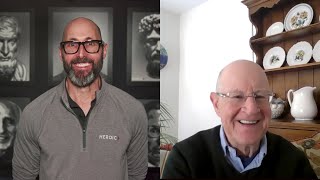
William Damon, a Stanford psychologist, explains why purpose differs from passion: it's an enduring commitment to something beyond yourself that you own and act on. He describes how people discover purpose through trial and error, reflection, and watching exemplars like Mr. Rogers and Eleanor Roosevelt.
Chapters
Foreign. Heroes, it is 1:01pm Central Time, which means today is officially day one. Good to see you. Today I have a special guest, a dear guide of mine, Professor William Damon. Welcome, Bill. Thrilled to have you here today.
Hello, Brian. I am just delighted to talk talk with you.
And as always, well, fantastic. This is our third session, the heroic chats with Masters. The first session was with my dear coach, Phil Stutz, who I've actually got back there. And then John Mackey, the CEO of Whole Foods, joined us. And you are our third guide to join us. And you have been. And I deliberately reached out to you and asked you if you could join us in one of those first three sessions because you may not know just how deep of an impact you have had on my life. But who you are and the work that you've done studying moral development and how to help us create purpose and the wisdom that you shared with me when I reached out to you shortly after starting heroic has deeply impacted me in my journey. So I'm just really honored to have you here today. Just feel super blessed to be able to share you with our community. You're one of my favorite people in the world. And just bless you for being here and for spending decades doing what you do.
Well, thanks so much. I'm actually feeling very humbled to hear all that, Brian, because as you know, I'm a big fan of the way you present everything to the public and all the dynamic interpretations that you do of great, great works all over the place. So I am so, so humbled to be a guest on your. On your show.
Well, thank you and bless you. And I am so excited to be able to celebrate you some more with our community. We like to begin these sessions, each of these sessions actually, with a brief meditation. So, heroes, let me actually check you out. Usually I say hello. I didn't say hello to you today. Let me say hello. Alex, Carlene, Kimmy, Jonathan, Vinny, Damiano, Michael, Doris, Glenn. Great to see you all. Thanks for being with us today. Let's flip the switch and invite the best, most heroic version of ourselves to join us. Remembering silence, stillness, our breath is one of the best ways to connect to our inner daimon, our inner guides. Finding your center, Committing to embodying wisdom, self mastery, love, courage, gratitude, hope, curiosity and zest. We optimize our energy so we can have strength for 2. Live a life of deep purpose and meaning in service to something bigger than ourselves. Think of a guide, a mentor, a living hero of yours who has most deeply impacted your life and helped you give your gifts to the world. Imagine one person. Feel their presence. Think of one piece of wisdom they've given to you, or one quality they've embodied that's most deeply inspired. You. See how that wisdom has helped you show up more powerfully and more purposefully in your work. Target swipe Energy and work moving from work to love. And as we like to say, knowing that when we do it right, there is no difference between our work and our love. Beam that guide deep, deep appreciation and love and gratitude. Bonus points. Send them a text, write them an email. Write them a letter. Let them know that you do not take them for granted, but as a beautiful gift to you in your heroic quest. As we do our best to activate our soul force to help create a world in which 51% of humanity is flourishing by 2051, I will send my gratitude to one of my beloved guides now, Professor Damon. And those of you who do not know Professor Damon and his work, go to the Heroic app and I'm going to share with you right now. Use our beautiful search feature. We got Koch and Bernardo from our tech team on today. At least those two. Thank you all for doing what you do. But search Damon and what you will find are a number of plus ones and philosopher's notes on some of his great books. Professor Damon is a professor at Stanford, one of the world's leading scholars on moral development, how to discover and live a life of deep purpose and meaning. I have goosebumps. I say that his work has deeply, deeply inspired me. As I've said, check out the notes on the power of ideals which he wrote with his wife, which I think is so cool. A round of golf with my father. His most recent book, which is phenomenal, the Path to Purpose on how to discover our purpose and to help our children and next generation discover their purpose and noble purpose as well. Each of those is fantastic. I highly recommend you check those out. We will discuss some of those themes today. And in addition to the work that you've done, Bill Slash, I like to call you Professor Damon. It's such a. I just like honoring you and who you are and the role that you played for me and the professor, you know, growing out my beard to embody that guide role in addition to your intellectual rigor and the deep work you've done, you know, research wise and otherwise, to establish how to cultivate a moral compass and purpose. When I reached out to you, when I found it heroic, I reached out to a few of my mentors and we had a great Chat. And at the end of it, I said, what's the number one thing that you want me to have in mind as I embark on this heroic quest? And it was a beautiful moment for me because you paused and you were very thoughtful. And he came back and he said two things. One, all of my best ideas met the most resistance. I had to have the courage to move through the resistance, but it was worth it. And then you said in two, it's not going to be easy. It's going to be a lot harder than you think. And this was so, you know, at the time, of course, it's a new idea. You've got the big vision and you're feeling great about it, and I've got enough gray whiskers to know it will be hard. But when it really got hard, your voice was in my head and was just a really beautiful compass for me throughout. But bless you. Appreciate you and excited to connect your ideas with our community today. Yeah. I'll pause there for a moment.
Great. Well, when you reminded me that I said those things, it's true. I still believe that that one sign of that I've found out over the years, one sign that I'm actually onto something, is when some of my dearest friends even kind of advise me, don't go there. Of course, that doesn't mean every time they say, don't go there, I actually should go there, because a lot of times they're right. But it is to me, a sign that maybe I'm onto something a little different that's worth exploring. And as I said, these things, important things, don't come easy. That's the other lesson I've learned, is that anything worth doing takes a lot of work and persistence because you don't always get it right right away. And so that's another sign. Just because there are obstacles all of a sudden doesn't mean, geez, in the wrong territory here. It means maybe I just have to keep plowing through the obstacles.
That's great. One of the metaphors we like to use is when you're on your hero's journey, you face dragons, you're not sidestepping lizards. You're supposed to be facing those dragons. And your story that it should be easy is often the thing that gets most in the way.
Now, luckily, I will say the converse happens too, which is sometimes things that seem to be, oh, my God, this is really frightening. I can never do this turn out to be a lot easier than you expected. So that happens too, in life. Life gives you some Breaks every now and then.
Yep, I love it. And I want to step back for a moment and talk about purpose. Then I want to drill into some of the instances in your life in which you did the very things you just described. But let's step back and frame purpose. What is purpose? And then follow on. Question would be, how do we discover our purpose at any age? And then of course, how do we help others discover theirs? But how should we be think about what it means to live a purpose driven life?
Great. Yeah, I'm really glad you asked that because purpose is a word. Especially lately that's become a bit of a buzzword. In fact, in the 20 years that I've been doing studies of purpose, the popularity of the concept has just skyrocketed. And as with all things, when that happens, it gets used in lots of different ways that actually are not very helpful. So you often hear people talk about purpose interchangeably with passion. Oh, you know, I really want my child to find purpose and everything my child does will be passionate. And no, that's not exactly right because a lot of times purpose is kind of a quiet, determined, almost serene, but certainly not passionate endeavor. Sometimes it's passionate, but not always. So these are different concepts. And meaning, that's another one people always talk about. I want to have a life of meaning and purpose. And that's great. Both meaning and purpose are really important, but they're not the same thing. If they were the same thing, you wouldn't need two words for them. Each word captures its own special part of life. And the special part of life that purpose captures is the idea that, number one, it's a long term, kind of enduring commitment. So it's not a one shot deal. And we're talking about heroic acts here. I will say that there are a lot of heroic acts that are actually not purpose. They're wonderful. If I jump into a river to save a drowning child, that is a heroic act. But that's not really my purpose in life because I'm not hanging out around rivers looking for kids to jump in them. It's a one time heroic act. A purpose is an enduring commitment that you stick with over time. And it has two landmark qualities. One is it does need to be meaningful to the self. You have to embrace it, you own it, so nobody can order you to do a purpose. And again, there are a lot of things in life that people or eager to do and you need to do some of them. You need to stop at red lights when you're driving a car. If you're a child, I think you ought to do your homework if a teacher tells you to do it. But you wouldn't say it's a purpose because you're doing it because somebody told you to do it. And a purpose is something you voluntarily bring yourself to. And secondly, it's something that is intended to be of consequence to the world. You're making a difference in the world. You're contributing something to the world and something beyond the self. It's not all about you. And in fact, that's one of the great lines of Rick Warren's book Purpose Driven Life, which he wrote before I started my work on purpose. That's a theology book. My work is secular. But he has one of the great first lines in books, which is it's not about you. That is a characteristic of purpose that brings purpose beyond simple meaning. Again, it's wonderful to do meaningful things, to read a poem, to go to a movie that struck you as real and gave you some sense of truth. But going to a movie is not a purpose. It could be very meaningful. A purpose is something that you're doing that is attempting to accomplish something that makes a difference to the world beyond the self. The idea of purpose captures all the things I mentioned. It's enduring long term, it's a commitment, it's meaningful. And it's an attempt to make a contribution beyond the self. Because of that, because of all those qualities of purpose. Purpose brings enormous benefits to the world and to the self. But it's because it has those features.
That's amazing. And you talk about the difference between the heroic and the noble purpose in noble purpose. And what I've tried to do is translate kind of transcendent, include the heroic in the way that we think about it, which tends to be a one off acute moment of crisis in which an individual comes in and does something quote, heroic. But we've tried to do is redefine the idea of what it means to be a hero based on the ancient Greek etymology in which the word meant protector and by its very definition meant it was about more than you. But then to make it a moment to moment to moment experience where your purpose is at the ultimate level to be your best self in service to something bigger than yourself. And the moment you do that, the way I like to say it looking at my two tattoos, the moment you live with Arete, and you are that best version of yourself living with virtue and excellence, you are heroic in that very moment. And to have that as the ultimate game or purpose is what we're trying to create, you know, a culture of, in our community and love the differentiation between what is usually considered heroic and the truly noble purpose driven life as you articulate it.
Yeah, that's lovely, Brian. I think that really what you're talking about is a person that actually becomes capable of doing heroic actions continuously over a life period, and maybe even learns to do more and more of that or learns to sustain that. And doing a single heroic act might actually start that ball rolling. It could well be that all of a sudden you find yourself in a situation where you really do need to sacrifice and step out beyond your usual comfort zone. And that may be an unusual experience for you. I mean, I know this has happened to me where, gee, all of a sudden I did something amazing and that might give you a message about yourself that brings you to exactly the realization that you talked about, which is, well, what kind of a person do I want to be? This feels pretty good. I'm going to look for other opportunities to do that. And at that point it does become a purpose. It becomes a long term commitment to do something. So I think the single heroic act can very well trigger a lifelong quest for a life of noble purpose. So. And we should get into a conversation about what heroic means as well. It's sounding to me that you, of course, you've thought a lot more about this than I have the concept of heroic, but. But it sounds to me like you have a very forward looking view of that and so we should. I would love to discuss that with you.
Yeah. I mean, what I've tried to do in my own life is to make the mundane the most important. I mean the sublime. You know, the quote, heroic comes from the most mundane basic things. And even one of the examples that, you know, you had used in terms of a noble versus heroic purpose is a mother taking care of her child like, well, to me that is heroic. My wife, you're not going to hear much about her. She doesn't get the praise that I get because I'm out here in front of our community. But goosebumps behind the scenes, she's the one who's been getting up at night and doing this and doing that. And to me that is heroic. And you're never going to get any global praise for it. But to really embrace the beauty in the mundane. And again, it's a redefinition clearly of what one typically thinks of as heroic. But when we have strength for two, when we do those hard things, when we sit down and do our meditation or choose to eat a certain way so we have more energy to be of more service. To me, each of those small acts is in and of itself a moment of personal heroism and everyday heroism. And we're, you know, we're having fun redefining and also figuring out how to bring that to life. But the reality is that's when the joy exists. Eudaimonia, the summum bonum, is experienced moment to moment, to moment, to moment, to moment. It's not an abstract. Let me wait for the moment. It's this moment. Can I show up with wisdom and discipline and love and courage and gratitude and all the other virtues? So that's how we're playing with our definition. I'd love to hear your thoughts on that.
Yeah. Well, I love that the idea of the heroic can be ordinary is a wonderful idea, and it kind of cuts against the kind of Hollywood version which is heroic has to always be larger than life and somebody with a suit of armor on that does slay dragons and that kind of thing. Heroic in the sense that you're talking about is very noble and admirable and not easy. But it's not people who are necessarily celebrated or winning awards or larger than life. I think of the nurse at our local health care service who shows up every day through thicker thin, starting early in the morning, deals with people under terrible conditions, and she's reliable, she's there, she's wonderful, she puts a smile on your face. And I'm not sure she would be recognized as heroic by a Hollywood filmmaker, but, boy, she certainly is heroic by my definition and sounds like your definition.
And this is it. And to me, this is the culture we need to create. And anything that goes against Hollywood's climactic, unending, it's all supposed to be great, the better. And that intrinsic motivation where she's also not doing it for the money, she's not doing it for the prestige and for the fame and all the Instagram likes. She's doing it because it's the right thing to do. And she has found a way to do what she loves to do, using her gifts in service to the world. And if that isn't heroic in the most fundamental, ancient sense, then I really don't know what is. And this whole vice and virtue and trying to make these things cool and beautiful and attractive in our modern world is a big part of my life's purpose and my life's mission. And it's fun to go back and forth with you on the ideas because it's so important to get It. Right. And then to be able to articulate it with substance.
Yeah, yeah. It's important to think carefully about the words we use and make sure they really capture exactly what we are intending. And the. And I'm so glad that you're doing that, to be intentional about that. It makes everything clear. And in terms of our practice, what we do with our lives, it gives us much better direction. I always make a big fuss about people defining purpose the right way and really using it to mean exactly one thing. And I always use a medical metaphor because I think what I do, psychology is both a science and a practice, the way medicine is. And I say, you know, if medicine, if your doctor used the word, the words kidney and spleen interchangeably, let's say, it would be kind of a harrowing experience to go into intestinal surgery with this fellow because you want to be sure that each of those concepts means exactly one thing and one thing only. And it's the same with concepts like purpose and hero and all of that. So I am so glad that you started our dialogue with. With paying attention to this, and I'm.
So glad I celebrated you and your intellectual rigor and just the discipline with which you approach these things. And you talk about it in the power of ideals as well, of how, you know, the modern. Some of the neuroscientific approach has gotten just too deterministic and loss of the agency of. No, no. This is an. An opportunity for our humanity to be shown. The precision with which you shine a light on that debate I found to be really, really insightful as well. That's in the power of ideals. So thank you and bless you for that. Is there something you want to say on that before I ask you more about how to move from the theory to the practice on purpose?
No, we'll just leave it at that. I do think that it's always a struggle whenever you write about human nature from a scientific point of view or any other way. It's always a struggle to avoid simplistic statements to explain things. And the media, I hate to say, are culprits in this, maybe because they have a limited amount of time to talk about things, and so they always try to explain behavior by either, oh, it's all in the genes or it's in the culture. This is why somebody did something, and what always ends up happening is they take the agency out of the person. They try to explain it by forces that are driving us. Of course, the person did this because he or she had a genetic heritage to be Courageous, let's say, or because his or her culture demanded it. Well, no, people make choices. I mean, that's what the power of ideals was about. We make choices that determine our destinies. And the choices aren't absolute. Often we are influenced by culture, by our genetic heritage, but in the end, it's up to us to make the right choice. And that's the idea of agency.
Oh, goosebumps. And the power of ideals. If you have not read the note on that and go deeper into the book, because that book is just so fantastic and the exemplars that you feature, and again, the intellectual rigor with which you shine a light on that and the importance of agency. We've been talking about a lot. We get together at 1:01pm every day now, seven days a week. You know, we're just two, three weeks in now. But agency has been a consistent theme, you know, and just that. That do not give that up. You always have that choice, stepping in between the stimulus, the response, choosing the more noble response, etc. So the agency that one has to make the choices that lead to a more purposeful life. How do we create so that 1 and 2? I get the idea that the theory, to roughly paraphrase it, it needs to be intrinsically meaningful and it needs to be something about something more than just yourself over a longer period of time, et cetera. There's a couple ways I could frame it. How have you, you defined and created and defined your purpose, perhaps as a story that can help us get clarity on how we can do that in our lives?
Yeah, well, it happens in very small ways, at least in my life. And I would say stumbling ways, one step at a time. I'll tell you, I recently wrote about this in my latest book, A Round of Golf with My Father. I'll explain the title at some point, if we have time, but the occasion that started me off on the path that I eventually spent my life doing, and that path is doing research, writing about it, having students, as you said, I am a professor. I try to find out things in the world that people don't know about and that are valuable and give people the information that helps them make choices in their lives. And that's what I consider my quest as a researcher and communicate it in a way that will move people and they'll understand. Well, how did I start doing this? It wasn't a very noble endeavor. It was actually when I was in the ninth grade and I started a new school and I was a very mediocre student. I was able to pass the tests and not get in trouble, but I really couldn't care less about my. I grew up in a kind of a non intellectual community. I had a bad attitude about school and everything else. But there was one thing I did enjoy. I liked sports. And I was in the ninth grade, not able to make any of the athletic teams in my school. But I was able to get an assignment writing for the school newspaper to cover sports. To cover school sports. Because I was such a poor writer at that point, they assigned me to the least interesting, lowest status sports that the school possibly had, which at that time was JV junior varsity soccer. Because, you know, all the good athletes played football. And this was in the days before Americans even knew much about soccer. So I went and I covered again a very low level game of our JV team playing against a group of Eastern European immigrants, kids that had just come over from Hungary. And the kids were amazingly good soccer players, much better than our team because Americans didn't play soccer in those days. And they absolutely wiped us out. And I got interested in that and I hung around afterwards to talk to these kids. The kids had nothing materially. They were very poor. I still remember their moms packed them for lunch, bacon fat and green pepper sandwiches. And I was feeling sorry for them and their clothes were almost in tatters. Turned out these kids were. Talk about zest, they were having a blast. They were so full of joy and happiness. And I talked to them about that and they said, we're in America, it's unbelievable and we're going to get rich. We're going to have great all of a sudden. And our parents aren't worried about the police anymore. And they were just full of joy and being thrilled about being in America, which I had never thought about. I was 14 years old at the time. I'd taken everything for granted. I wrote that paper. That was the story I wrote for my school newspaper. Not about the soccer game. And my classmates read it and they said, wow, we never. This is so enlightening. We always took this for granted. You know, our freedoms are. And at that moment that got such a good response, I guess you would say it went viral. This is long before the days of that anything went viral. But if it were an Internet story, it would have been that everyone passed it around. And that left such an impression on me that I then started paying attention in my English class to how to write. And I said, I'm going to learn how to actually be a good writer and do more of Kind of stuff. And that one event triggered a whole series of efforts. And every time I made a further effort, I got more gratification out of it. I would write more stories. And eventually I did not become a journalist, I became a psychological researcher. But doing the same kind of thing, exploring the world, finding out about things, sharing what I found to people. And people like you tell me that it has some value. So that gives me the feedback I need to decide that I actually am putting my grain of sand on the pile in my life doing something that is worthwhile and valuable to people. And that's been my purpose, my vocational purpose. I will also say, of course I have family purpose, raising children, faith. I mean, there are other purposes I have. But as far as my vocational purpose goes, that's where it began with that very odd effort to write about a soccer game by school newspaper in ninth grade.
Yeah, that's amazing. So many stories come to mind. Even my son, we went to the park and there's guys playing chess and one was kind enough to clear off a and then to put the pieces there and to really engage with my then nine year old son. And it sparked what is currently a passion. We'll see if it becomes a more, you know, purpose driven thing. But just beautiful to see that moment. And then as a father, the etymology of parenting I love as well. It means to bring forth so to see his joy and his excellence, you know, being cultivated in that domain from that one little spark that is similar to what you described and then to see the cascading sparks that are being formed and, and to use it as a context to teach mastery in these ideas has been really, really beautiful for me as still a young father to see coming to life.
It's great that you recognize that because important things start small and sometimes parents get a little discouraged or they figure, oh, not much has happened here, but small steps, that's the ball game is getting us all our children and ourselves to take small steps in the right direction.
Let's go into the individual today who are points in their life journey from young high school to those more and all that good stuff. How do we get more clarity on our purpose? What would you recommend as perhaps the top one or two things to consider as we look to get more clarity?
I think being active, I think that's the number one thing. I mean a lot of especially younger people have dreams and that's great. You ought to have dreams and aspirations. That's part of youth. Aristotle wrote about that as a characteristic of youth. And that's wonderful. But activity, I think, is really what gets things going. So trying things out and trying things out that you may not succeed at and being willing to take failure and keeping going. You know, every, I mean, every high school has dozens of young people who are. Who have dreams of being everything from a filmmaker to a scientist to whatever. And all that's great, but a lot of them haven't actually tried to do any of it. And so they read about it, they admire people, they talk about it. But I think that finding a way to actually do something, even something small in that direction, and then the clarity, and you use the word clarity. The clarity you get is, number one, you find out whether it's interesting to you, whether you enjoy doing it. In order to develop a purpose, you need. You need three things, really. You need to be interested enough that you'll be drawn to the activity. If you hate math, let's say, and you just don't like it, you wouldn't really want to become a computer programmer or any of the things you do something else. So you need to be interested. You need to have some talent or some capacity to do it in some way that will give you a future in it. If you're 5 foot 5 inches tall, you're not going to aspire to be a center for the Golden State Warriors. So you have to be realistic. And the world has to, in some sense need or at least want what you're doing. There has to be some market or some reason that what you're doing will add value to the world. The only way you're going to find these things out, whether you're interested, whether you're talented, whether there is a need for it, is by trying, by giving it a shot. And then you'll get feedback on it. Well, this is boring. I'm not interested enough or. Well, you know, I'm not that good at doing this. I'm not that visual or I'm a little tone deaf. So I'm not going to be a great musician. So I'll try something else or I'm doing something, but there's really no reason out there in the world to do it. As you learn more about the world, the only way you're going to figure any of that out with clarity is by trying it out and expect that there'll be a long road ahead of trial, error, failure. And then keep trying, keep moving, that's great.
And then check the box if it isn't it, and be good with that. And then go through those cycles to get More clarity and get. Eliminate a lot of choices too. I found that to be so helpful for me. I've. Nope, tried that. I don't need to wonder if I would like that. I've done it. Not it. And then of course, the successful. Ooh, that. That feels closer. That feels closer. And it feels. It's just a fun, iterative process at the end of the day. And that echoes what we said too. My coach, Phil Stutz, likes to say that action drives creativity. You can sit here and think all you want, but until you actually take action, you don't have those feedback loops that you mentioned that allows you to get the clarity that you need. So moving out of the theory into the practice, out of the abstract, into the concrete, I can feel the power of that.
Yeah, yeah. And keep reflecting. I mean, the action doesn't stand alone because then you bring your reflection to it and check it out against what your dreams are and whether again, the two sink and one promotes the other. But I think the action, to me, in my observation, that's the gap that has to be filled if people want to move forward.
Yep. Let me actually use my son as an example for other people's kids and just I'm genuinely curious to hear your thoughts of how you would frame his current passion for chess. So we hired a coach recently and he's really into it. We homeschool him and so he has the autonomy to do what he wants to do. And he's gotten really into it. And I had an intuition that he was. Had a natural talent and ability to gain skill quickly. And he loves it. So he's working hard and he's gained proficiency quickly. His coaches affirm that he's actually more, quote, talented than even I had imagined. And now, you know, the hard work and all these things. So he's excited and he's doing all that work. How do we take that from a passion and truly have that purpose driven nature? And I can see the mastery opportunities, etc. But I'd love to hear you frame that nascent passion, which I can see potential for purpose in which he's contributing beyond just his own game. But how would you encourage me to think about that as a father and other parents whose kids might be into two different ideas?
Okay, Brian. Well, you know, I'm going to warn you, I always hesitate to give parenting advice to people that they may that. Well, anyway, take.
Let me frame it differently. Let me frame it differently. If his aspiration is, and it currently is, to become a master and potentially even international Master and even potentially a gram, that kind of thing. And he's 10, so we take this always, he's a 10 year old. But I'm looking at this and saying, oh, interesting. But if we wanted to take that aspiration to excel in sport or in something like chess, or in something like art, or in something like medicine, for that, for that purpose. So there's a specific of my son, but more just curious of how purpose is cultivated. And please do be candid because I'm virtue of curiosity. Let's go.
I was winding myself up to be candid because I'm not sure you're going to want to hear what I'm going to say.
Yeah, yeah.
But what I'm going to say is that there's limits to what a parent can do. And so at some point the parents do need to step back because purpose is self created. It's when a person makes their own choices and there's no way that a parent can write the script of life for a child ever. And there's a lot that parents can do and you've obviously done already a lot of those things, which is to provide opportunities, give the child the resources, the encouragement, that's really important. All of the purposeful young people we see are getting support and encouragement from their parents and give them opportunities. But when it comes down to actually making the choice of whether to pursue something long term and make the commitment to it, my view is that not only is there not a lot that a parent can do to make that happen, but sometimes parents try so hard to do that that it actually is counterproductive 100%. And I'll tell you something interesting that I've observed in some of the cases that, that we've studied or that we've come out of our research is that. And I'm not suggesting you do this either, but it gives you the same message, which is that sometimes when parents actually put up a little bit of resistance to what the child wants to do, I'll give you an example of that. That's what gets the kid going. So I'll give you an example of that. A couple of high powered engineers had given their son every possible incentive and they assumed that these were already high powered engineers and they assumed the sun would go on and create the next Google or the next whatever. And so they set the kid up with every possible education and they just pounded on the kid to do it over and over again. Turned out what the boy wanted to do was become a chef in a restaurant and he got really interested in sauces. And what he really wanted to do was go up to Napa Valley and intern with a French sauce chef. This horrified the parents and it was exactly. They didn't get it at all and they resisted it. The more they resisted it, the more the kid wanted to do it. And finally they actually came around and the young man is highly motivated to. Part of that motivation, I think was finding himself in relation to the opposition of the parents. So what I'm saying to you, and I don't know how welcome this advice is, but you know, sometimes you have to let go and let the child do it and figure it out and not just say, well, I'm going to encourage you to do it and keep going. Yeah.
And just to be. Yeah. And just. I appreciate the candid feedback and to be explicit and candid back. That's a given. Like, of course I'm not pressuring him to do anything. What my wife and I have been doing is, you know, looking for the moment in which he has a spark of excitement, you know, and he's delayed and he was delayed in reading and this. He knew how to make a fire before he knew how to read. Like, we've been very, very open to allowing him to, you know, find his rhythms and his joys. So when we saw this passion, it became an interesting thing and of course allow it to go. So if I were the parent in the story you told first, I wouldn't be the overbearing engineering one and I'd be really excited when the sauces idea came up. My question is more to take that solitary activity if he decides to pursue it beyond his six month love affair that he has currently and to make it about something more than just him and to have the purpose that's not just. I love it. Which again is a given to me. Of course he's got to love it. It's got to be intrinsic. I heard you, I'm a good student number one. It's got to be intrinsic. Then my question is more how do we take those things that could be a narcissistic. This is all about me and make it the. No, no, no. But this is a gift that you can give to the world, you know, and cultivate that from a. Hands off. I'm a bit of a ninja, you know, I'm not an overbearing. And trust me, he's oppositional, by the way. So if I want him to do anything, I tell him not to do it.
I'm clearly preaching to the converted on that issue. Of not pushing your child. And of course I could have realized that knowing you. But you're asking a really good question about how to make this activity, as you say, this passion, purposeful. And I think you're again right on the right track, which is there's a bunch of ways that you could encourage your son to share this one thing. He could, he could teach. He could teach a younger or a friend of his how to play chess. That would be exactly a sharing, other oriented way of, of providing a contribution, of making this activity into a contribution to the world beyond the self. And there are ways that he's maybe a bit young. If he's 10, he's a bit young for this. But eventually when he gets to be 12, 14, 15 or something like that, he could be thinking about the whole world of chess and ways that chess could become a, an educational tool for people or ways that chess could become maybe more ethical. I mean, there's a lot of ways that the activity, that the industry of chess could be improved. He's a little young for that, but maybe at this level it would be more sharing it with peers or younger sisters.
Awesome. That was exactly what I was hoping for, just closing that loop. So it goes from just the one to the two. Perfect. Bless you. Thank you for your candor. Please. Always candor is a good thing. We strive to embody the virtue of curiosity and humility. Perfect. Thank you. Bless you. And who are your favorite heroes? When you think of individuals that most inspire you, who comes to mind?
Yeah, well, there are some that are kind of world famous and I'll share those with you. And I'll give you a couple of 20th century ones. You never know about living people, what's going to happen with them. But two people from the 20th century that inspire me. One is Winston Churchill, who really stood tall against terrible pressures in World War II. And he was early in recognizing both the dangers of fascism and of communism and against a lot of opposition, including in his own country, fought the good fight. And then when it looked like the war was turning against England, he was the one that gave his speeches still give me chills. We will fight them on the streets. We shall never surrender. So he's a great hero to me. And to share another 20th century woman, Eleanor Roosevelt, who especially at the time when she helped create the Universal Declaration of Human Rights, which I wrote about in the Power of Ideals, in which Marianne Glendon has a wonderful book, it's one of my favorite books called Eleanor Roosevelt and the Declaration of Human Rights. And she Improbably got every country in the United nations, countries that were fighting each other like crazy and that didn't even, you know, the Israelis and the Arab countries and the communists and the capitalists, countries that were at each other's throats. She got them all to agree on this 29 article declaration of what every human has a right to. And it was the apotheosis, I think, of moral progress in the world. And that was because of her own Eleanor Roosevelt's own grace and open mindedness and just the wonderful human person she was. She was also deeply religious and had a Christian prayer that she read every night at three in the morning when she finally got to bed in Paris after months and months of wrangling with these tough people. And her persistence created this doctrine. So those are, those are two of my, of my kind of world famous heroes. And as I said earlier, I have a lot of ordinary heroes ranging from the nurse to teachers that I've met to my wife to people. And so there are lots of people that are not world famous. But those are two that people would, would recognize and know about.
That's beautiful. And as it turns out. And I'm going to see, I've never done this, but I'm going to see if I can share my. Does that work? Look at this. Okay, cool. So I got Eleanor Roosevelt up there. I got my heroes on the wall, so they're staring at me. So we named our daughter after Eleanor Roosevelt and our son after Emerson. And then I've got Churchill right above me. You can't see, but he's right above. So I like you. I'm sorry. Inspired by Churchill and Eleanor, the Mr. Rogers there reminded me to be a good man as a husband and father.
Oh, Mr. Rogers would be another. I'm right up there with Mr. Rogers too.
You're right up there with Mr. Rogers, by the way, in my mind, just so you know, you have that same humility and that same beautiful grace that I see in him. So we share him as both a hero. And you both strike me as kindred spirit. The other thing I love about Churchill is his emotionality and his authenticity and his willingness to weep when he's moved, you know, and that, that he was such a passionate human being who was so connected to something bigger than himself, to use our language today, and so fiercely committed to being that literal protector of the free world and of England and of course of democracy and humanity. So I'm not surprised that we share some heroes in common and moved by both of them. You profile Eleanor in the Power of Ideals, right?
That's right, yes. Yeah. Especially in this effort to create this document that nobody would have put a bet on as to whether it would actually get support. And. And everybody signed off on it, which was just.
That's so good. So, community. Check out not only the notes on the Power of Ideals, that's a book worth reading to get an idea of how guides can inspire you. Moral exemplars, et cetera. All right. You're incredibly prolific. You've done some very, very important work. How? What is the number one thing that you have done creatively in your work that you think has allowed you to create at such a high level for such a long period of time?
Well, can I say two things? Because I think there are two things that get me moving. One is when I really feel that there's a shared view around that's kind of trendy, that's wrong, and that actually gets me angry. I won't say foaming at the mouth angry, but it gets my spirits going. Maybe anger is not exactly the right way word, but it gets me moving. And I've had a number of these in my career where, for example, when I started doing work on what has now been called positive youth development, there was really the sense that young people in this country are problems. And when I fact. When I moved into my new office, when they brought me out at Stanford, they had decorated it for me, the set of offices in my center that I took over. And there were posters that said, oh, one poster said, do you know this year 40,000 teenagers will kill somebody? And the next poster said, you know, 80,000 will get hooked on drugs, and the next one, they'll commit suicide. You know, one thing after another. This was the problem of youth. That was the big thing back in the 90s. And I had just done some work after college, social work with young people from very disadvantaged backgrounds. And I was amazed at how talented they were and how much they had to offer. And so I really was kind of angry that young people were seen as a problem, not an asset, not something that had a lot to contribute to society. So that's what started me writing a whole bunch of books on youth development, greater expectations. I wrote the Youth Charter, and I think that was so. And the other thing. And the second thing, and this led to the work I did on purpose, was that I became determined that one of the great books that inspired me on this was Viktor Frankl's great book, which has been translated in English as Man's Search to Meaning, Man's search for meaning. That was actually a mistranslation. The book's real title, original title, was nevertheless say yes to Life, which I think is a better title. But that book was very inspiring to me, and inspiring because it gave me the sense that what really drives us is not these sort of childhood traumas that Freud wrote about or things that shaped us, but rather our own hopes and aspirations for the future and that we can determine our own future even in the most horrendous circumstances, which is what Frankl wrote about, which of course, was being interned in a concentration camp. And the idea that, nevertheless, whatever life throws at you, you can say yes to it. And the reason I started working on purpose is because. So what got me motivated was that everybody around me, and this is what you were saying before, everybody around me was saying, you can't study purpose in the scientific way. You know, be a theologian, you know, go into the ministry if you want to do this, or be a philosopher. But, you know, scientific studies of purpose, it's too ethereal, it's too abstract. It's too. And that kind of got me a little bit angry too, because I thought, gee, psychology, this is an important part of psychology. It may be the most important part. It's what Frankl understood. This should be the future of psychology. And so I said, well, if there's this herd mentality that you can't go there, no, I'm going to go there. So I think I had that little bit of anger and that curiosity about how you could do it. And now I will say without, I hope, giving myself, well, I won't be. I'll avoid false modesty. You know, 15 years later, the journals, the psychological journals, the scientific journals, are full of studies of purpose. Now everybody goes there. It's one of the most popular topics in developmental science in my field. So that turned out to be, I think, the right quest, the right direction. And what got me started was the sense that, you know, there's this shared misconception, this myths going around, this wrong idea, just as there was about positive youth development and how young people are a problem. There's a sense that you can't study purpose or you can't think about it in a scientific way, which, by the way, also leads to educational practice, because once you can understand something scientifically, you can actually do something in practice, just like medicine does, to promote it. And now there's educational endeavors all over the place in high school and college that actually are meant to encourage young people to become Purposeful.
That's great. And that's another great example of your own heroic quest in which you were willing to go up against the trend of, you know, what was accepted and what was a good idea at the time. And I appreciate your, I guess Aristotle would talk about that as magnanimity. You know, that great soul, it's not right to be falsely modest. You want to be appropriately embracing of what happened. And I do appreciate the courage you had there. Practically speaking, how have you shown up? Is there a practical thing that you've done over the last X decades that's allowed you, I know that, you know, you allowed a bit of healthy rage, if you will, at what you didn't see as right, you know, to fuel your, your passion. But on a day to day basis, is there anything that you did that you think would be instructive for us?
Well, my realm of operation, of course, is with students, and that's my everyday life. I'm a teacher, I'm a professor, and so practically I try to help my students in any way possible. First of all, share whatever truth that I have been able to understand in the world. So I try to share that with them and, and I try to help them in their own quest to build upon whatever truth I have to go in their own direction and exceed what I can do. And I think that is the sign of a good teacher, is that your students end up getting further than you. And I have a number of students that I'm very proud of that have done that, and I work every day on trying to accomplish that. So I think that's the realm of my practical operation is with students. And of course I also go around and give talks. I, I write books, I do what I'm doing now. I do a lot of podcasts with people. So I try to share, share the message that way as well.
Yep. And then again, to reflect back to you, it's the fact that you've embodied these ideals that is most resonant with me. And why I admire you so much is you're not only talking about them. When I read your books. There's the intellectual rigor with the humility, with the humanity that you are what I would describe as a radiant exemplar. You are one of those purpose exemplars. And I think that's the greatest impact in the ultimate practice. So then, energy, work and love are our big three. So Freud, one of the few things I agree with him on is that work and love are very important. You get those right, you're doing well, I like to say that, yeah. But if your energy isn't where it needs be to to be, you're going to have a tough time showing up in your work and love. So we distilled that into our big three energy, work, and love. So we just talked about the work. I would love to hear from you on the love side, as you've strived to embody more of the virtue of love in your life. Is there a particular practice that you have found to be the most impactful that you think we would benefit from?
I think the practice that I find most useful in that is the practice of trying to be optimistic and have hope, especially for people you've kind of given up on or you've been discouraged and you're tempted to give up on. I think you should never give up on anybody. But that's a belief I have that's easier said than done because a lot of people do disappoint. And if I can, if I have time to just share a. A wonderful interaction I had with one of the true masters of the world, the Dalai Lama. And I was privileged to do a dialogue with him where there's a formality, where I make a presentation, and then he asks you a question, and then you get to ask him a question. And I did this up in Vancouver on the founding of his Dalai Lama North America American Center. And the problem, the question I asked him was exactly about something that I had kind of gotten discouraged about, which is what do you do in any study of any population? You always find a certain number of people at any age, whether it's. We've studied older people with looking for purpose, ages 50 to 90, and of course, our work with adolescents and young adults, you always find maybe 20, 25% of them who aren't even looking or given up, or goals are not part of their lives. Either they're discouraged, they are depressed, or maybe they're just having too good a time. They think and they're being hedonistic and the college student is drinking his or her way through college and the fraternity not paying attention to anything. And you can't talk to them about goals because they don't want them, they're not looking, they're not interested, or they've given up on them. So that was the question I asked the Dalai Lama. I said, well, you know, what do you do about these people? Because the other folks we have educational programs for people that have dreams but not enough action, or people that have action but don't understand what they're doing, we can do things, but somebody that doesn't even want goals or says, leave me alone. I want to drift through life. Leave me alone. And the Dalai Lama said, oh, yes, there's something you can do about it. And again, hearing the master say that. And then he said, basically, you need to do two things at once. You need to portray in a graphic way to this person how possible it is to have a meaningful life and how joyful it is, and portray in a graphic way how barren and meaningless it is not to have any kind of purpose. And he suggested ways to do it. And it's not so much that he gave me a recipe or the answer in the sense that I could then go out and do this, but he gave me hope that this could be done. And that energized me a lot. Because as I said, in your life, both in your personal life and your professional life, you run into problems or people that you just think, well, gee, I'm never going to get anywhere with this person. And we all know you can read the newspapers and read about people that look like they're hopeless in a lot of ways. But having that hope, not being hopeless, having that hope, I think, is what gives me energy to have, and that is what enables me to love rather than to just give up. Because the absence of. Because the opposite of love is actually not hate. The opposite of love is not caring, is being indifferent, is just giving up. It's not hating someone, it's actually acting like they're not even a person worth having an emotion about. That, to me, is the absence of the opposite of love. And so in order to be loving, you have to again, embrace the person. You can get very angry at the person, but then you care about the person, person enough to work on having that good, loving relationship.
Ah, goosebumps. That's beautiful. And I should point to our dear mutual friend Aristotle again. So, you know, courage, he says, is the virtue that vitalizes, or I paraphrase, the virtue that vitalizes all the virtues and perhaps the most important virtue, courage. So then we talk about, well, then encouragement to inject one with courage to see their better future and help them see that when they can't see that, to have the hope that they can in fact become their best selves and to encourage them would be the most loving thing you can do. So I love the way you framed that. That's super inspiring.
Well, thank you.
Yeah, I love it. We're at the 2:00' clock. Boy time. My joke in these is time Flies when having fun with friends.
This is true.
Do you have a few minutes beyond our scheduled time if our community had any questions? It looks like we have a hand that just went up.
Absolutely.
Okay, great. Nat, if you can help navigate. Vlad, I see that your hand is up. I believe that's for a question.
We actually have Laura, Christine, and Robin.
Who submitted questions previously.
Okay.
If you have time.
Okay, great. Let's. That is awesome. Vlad, do you have a. Well, shoot. Nat, would you like me to go to the scheduled ones out of honor for the RSVP ship?
We can. I mean, it's your.
It's your call if you want to go with Vlad.
That's perfect.
Okay, cool. Let's see what we can do. Vlad.
Thank you very much for an incredible, incredible evening. I have one question about the hero's journey, because heroes must learn progress in both kind and wicked learning environments. Kind learning environments are the ones like chess and golf, where you have immediate feedback and you have deliberate training that will. With a coach that will ensure progress. But wicked environments are complex challenges like the ones Churchill or Viktor Frankl had to face during the Second World War in different roles. So what would you advise us to learn and make progress in these challenging environments where there is no, you know, book knowledge that you cannot do?
Out.
Thank you.
Yes. And I'd love to hear Brian on this too, because, you know, I think I've gotten enough sense of the way he's talking about the heroic progress that I have a feeling he will have a good answer to this. But I would say that in order to learn in that kind of environment that is not very well programmed for you, in other words, it's not structured in a way that there are lessons that somebody can give you or anything like that. The number one step, which is maybe very difficult because there may be a lot of pressure going on, but the number one step is really being observant and listening without jumping too quickly about what to do. In other words, to. It's almost an initial orientation of not being active, of being passive in the sense of trying to absorb everything that's going on. So you're not missing something because these are very emotional conditions. And it would be easy to jump in a way that you actually started going down the wrong path because it is so complicated. And it's almost like. I mean, meditation, of course, is kind of a new concept that I don't think. I'm not sure existed back in Winston Churchill day, in Winston Churchill's day. But I think the. What he did Was, you know, he would go out into the streets and just kind of walk through the streets and hear people and hear people get a sense of what the British public was going through. And I think he had that ability to kind of sit back and take it in. And then when he acted, he acted very decisively. So that's what I would say, is you need to be a very good listener and a very good observer for a period of time and maybe resist that impulse to jump too quickly. But then eventually, of course, you're building up. You do absolutely want to jump, but hopefully at that point, you'll be able to jump in the right direction. But, Brian, I'd love to hear you on this because.
Because I appreciate that. And I. As I was listening to Vlad, my. I wasn't even thinking of what I would say when I was, oh, I'm really excited to hear what Bill has to say about this. I love everything you said. And then I. When I think of Churchill, I think of him painting. I think of him laying bricks. I think of him oscillating. So he was on when he was on and he worked so hard, but when he was off, he was unapologetically off. He was taking his naps. He was, you know, laying the bricks and painting and finding ways to keep his coffee consciousness open, but also plugged into something bigger than himself. Although he wouldn't use these words, I don't think. And then Eleanor I thought of as well, because, of course, she was FDR's channel to the people, right? And being really connected to the suffering of humanity and helping him see what he otherwise may not have seen. And for me, it always comes back to your soul force, which is a phrase I got from Gandhi, who's right next to Churchill, by the way. I have Churchill and Gandhi up there, and I love having them up there because they're opposites. One is. He never stops talking. One is frail and rarely, you know, would go days without talking. And they didn't even like each other, is my joke. You got him showing up in a loincloth at the palace, you know, who is this guy? Churchill says, disrespecting the institution. I love that about the fact that our heroes can be so different. Different, yet they were both themselves fully expressed in service to something bigger than themselves. But Confucius over there, of course, ancient Chinese philosophy was about cultivating virtue such that they can effortlessly do the right thing. Wu Wei. And this is the Chinese idea of soul force. That was satyagraha, Gandhi's idea that MLK talked about. About. So these calls are at 1:01pm Central Time because our kind of playful thing is get your soul force to 101. Not even 100%, but 101. Something more than you that's divinely inspired. And so the greater the challenge, Vlad, from my vantage point, the greater the need for us to focus on the things within our control that allow us to plug into something bigger than ourselves through the meditation, but also the eating, the moving, the sleeping, the breathing, the focusing of our minds, reducing inputs. You know, Gandhi and Churchill, if they were alive today, they're not blowing their brains up with nonstop Instagram feeds and these other things that clutter the mind. They have that silence we talk about in lead yourself first. So I love how you framed it. And I think the means by which we allow for that spaciousness is to take a step back, practice our philosophy, and try to get our energy focused on what's important now consistently such that there's an intelligence bigger than us that's coming through in service to something bigger than ourselves.
Good.
Great question, Vlad.
Thank you very much.
Yeah, bless you, Laura.
Okay. Hi. A little embarrassed about how I look because I didn't plan on being on camera and asking.
You are great today, Laura. Great to see you. We see your soul shining through.
Thank you. Thank you. Thank you, Professor Damon and Matt and the team for Brian, for letting me ask this question. So today I am at a crossroads. I recently finished part of a coaching program that has me certified. I formed an llc. I'm starting my business. I'm working on me. I've been. Was laid off six months ago from my job. No more unemployment. And I've got an offer for a job in my old shadow career at a much lower than salary than what I was used to. But it's money and I'm. I'm struggling with the courage to move forward in the direction of my dream and my purpose. Showing up for myself and for others, while, you know, also knowing I only have so much money left in my bank account, but I could probably make it a couple months and that might be enough. So my question for you is, what question would you like have me ask myself to make this decision about what to do about this offer that would either very slow down or maybe derail me from my purpose.
Okay, well, I hope this is helpful, but I'm kind of thinking about. I'm thinking about a golf analogy, which often, you know, sometimes for whatever reason, you know, your golf ball lands in the rough and it's not the ideal place to be. In fact, it's exactly where you don't want to be. But you kind of have to play it where lays. I mean, that's rule number one of golf. You play it. You play it where it lays. And the challenge is not to think about, oh, where would I be if I hadn't ended up in the rough? Gee, you know, I'm going to beat myself up or I'm going to feel really bad, or I'm going to think that somehow the game is over because all of a sudden I'm in the rough. The challenge is just to make the best shot you can to get back on the fairway. And as we know from watching, you know, golf, masters like Tigers Wood, sometimes they actually make an amazing shot, a better shot than they would have made even if they had had a better approach shot. But whether or not that happens, I think the point is always try to make the best of wherever you are and not take that as a statement about you or your game. In other words, not to say, oh, this is, you know, this is all going downhill, but rather to say, well, now that I have a plan, I'm going to get out of the rough. I'm going to do what I need to do. In your case, you know, you need some dollars, you have to eat. So how is that plan, even though it's not the ideal. If I had to make up an ideal life for myself, I wouldn't be starting from this position. But I am. I'm in the rough. So how can I then make a plan that will then get me to eventually in the direction that I want to go, given that I have to take this suboptimal shot right now, because I don't have a choice, this is the best I can do. So, you know, you kind of play it as it lays. Be optimistic. I was talking about that earlier. And take it kind of one step at a time in your mind to how this is going to lead you back into the purposeful path that you really, really want to go. But if it's necessary to take, take a shot right now that isn't under the greatest conditions, so be it. And the other thing you can take some satisfaction at is that virtually everybody, all of us, have been in the same situation one way or another. Even the greatest heroes of the world have always been. They always end up in that condition sometime in their lives. Life is long. You can't avoid. You can't avoid that eventually happening.
That's so good. And then if I can piggyback on that. Churchill again. Churchill. I mean, he's so prolific because he was so extravagant in his spend. So he had to keep on working and writing. And again, his weakness became his genius. And it all goes together. I mean, he was at the risk of losing some very important material thanks to him, constantly throughout his life. I love the metaphor of playing from the rough again. Goosebumps. And this is. This is stoicism 101. You know, we accept what. What we've been given, you know, and we're loving what is. We radically accept it, as Phil would say, and then what do I want? So we want to balance courage with wisdom, because an excess of courage is no longer virtuous. That's rash. So if you need to make money and you have two months to spend, perfect, you're in the rough, go make money. And it's not wise or disciplined or frankly, loving or courageous to think you're going to create a business from scratch in two months that's going to suddenly make what you used to make. And that's fine. That just is what it is. But then we want to, I believe, use this constraint to our advantage, use it as fuel for our growth. Practice your philosophy more than you've ever practiced it. Eating, moving, sleeping, breathing, focusing, controlling the controllables. And then to go into the hope that Professor Damon's been talking about so much, the three aspects of hope we talk about know what you'd like to see in your future, that ideal vision, and know you can create an agency and then create the pathways. And so, frankly, I would look at it and go, all right, I got an offer. Cool. It's not quite what I want. I've got a coaching business. It's not quite where I want to take be yet. I'd consider getting other options. Are there other pathways? Can you go get two or three or four or five other job offers that pay you a little bit more or a little bit more aligned? And then one thing that I think is important, Bill, that I'd actually like to hear your reflections on, is how do you make the thing that may not be the perfect thing purposeful? And so the job that you're going to go take, Laura, there's a scenario in which not only does it help pay the immediate bills, can you bring the coaching aspect of it, however implicitly, but make it explicit in your own practice that no, no, you're embodying these virtues, you're helping your team, and you're, quote, building your coaching business. It's not only not Derailing you. It's the catalyst and the scaffolding you need for the next steps in your heroic journey. But. And I gotta refer to you as Professor Damon. How can we bring purpose to activities that may not feel particularly purposeful? Because of course we can. But how would you encourage us to do that?
Yeah, well, that's kind of. We didn't have time for me to talk about the book that I wrote recently, which has a lot to do with. I mean, what you're really talking about is redemption. How do you redeem things that are not optimal and in just one sentence? The book I wrote had to do with my finding out about a father that I had never met and that it turned out he had abandoned us, my mother and me. I didn't even know that. And I had a bunch of resentments and thoughts about what would my life have been like if I had grown up with a father and so on. And for reasons. The book is called A Round of Golf with My Father. I didn't have the round of golf, and I didn't have a father. But I go into this. But anyway, the point of the book and what I write about addresses exactly this question, which is you're in a situation that you. That you certainly wouldn't have created for yourself if you had the power of control, of creating life outcomes for yourself. You know, it wasn't great for me to grow up with a single mother in very disadvantaged circumstances and not have a father to learn from or to teach me golf, which was what that was about. However, and this is the point, that there actually were things that I did that I discovered to compensate for that that turned out to be strengths, virtues that I would not have had otherwise. And not only that, then when I went back and reconstructed his life and my life and all of that, I learned more. So that I actually came away with new insights, new purposes that came out of exactly the unfortunate condition that I was in and recognizing that condition. And again, life is full of those opportunities. One of my favorite examples from music is. I don't know how familiar people are with jazz guitar or any of that, but there was a wonderful jazz guitarist named Django Reinhardt who had a horrible accident early in his life that disfigured his fingers. And you would think, you know, well, that's it for his guitar playing. He actually found ways to build a whole style of guitar music based on disfigured fingers that move the music forward in ways that were unimaginable. But this was his way of not only Compensating and making up, but actually making a strength and a creative virtue out of a terrible incident in his life. So just knowing that this is possible and then being creative and finding ways of doing it. And I write about this pretty. That's what the point of my book is, if anybody's interested in that, is how to do these redemptive acts to redeem things that otherwise you would regret and feel just. That were just catastrophes and so on.
Yeah, it's so good. And then my own parallel on that. I got so much out of reading your book with your father. My father struggled with alco alcohol and we had a very limited relationship. His father struggled with alcohol, ended his own life. I have had my own emotional challenges. And directly tied to my joke is I lost apparently, both the genetic and the environmental lottery on that one. But it's my greatest gift. My own suffering has become my greatest gift because I can the redemptive story there. If I know what it feels like to feel like that, I know what it feels like to feel like this. And I also know roughly what I did. And so this is by far my greatest gift. So again, this is our anti fertility we talk about all the time. Easier said than done. Easier for us to say it in an abstract level. And this is what you've trained for. The heroic gods have blessed you with an opportunity to show us what you got. And the reality is that you navigating this is going to make you a better coach. When you cultivate the strength, you become more energized, more productive, more connected than you've ever been. And that's what people are going to pay for. There's no greater thing you can do right now than to build your consciousness. And God, as Epictetus would say, just gave you a real strong young wrestler to see what you got. Go grapple. Look at it and have that joy, have that hope, and give us all you got. And then bring that purpose, that meaning to each of those days. And let's join. If you want to chat some more, we can talk in another one of these one on ones and go deeper. Bless you. Thank you for being here and asking such a great question.
Thank you. Thank you both.
We're stretching our time. You got time for one more?
Sure.
You're wonderful, Robin.
Great.
Well, Brian, you might be able to weigh in on this. Also in self mastery, we have structural discipline, reactive discipline, and expansive discipline. And I wanted to look at the link, ask you guys about the link between expansive discipline and cultivating purpose and Inspiring goal, which is part of hope.
Perfect. Let me frame that for Professor Damon. So I talk about the virtue of self mastery, and I've broken it down via an adaptation of my coach Phil's work, which is you have structural discipline, which is you have certain things you do on a daily basis. You go to bed at a certain time, you get up at a certain level, time you move your body, et cetera. Reactive discipline, which is Viktor Frankl over there. Stimulus, response. Can you step into the gap and choose the best response? And then. And that's a discipline. And then expansive discipline, which is basically courage. And you realize that you need to expand into life's challenges. So, Robin, with that frame, your question is how do we connect expansive discipline, courage, essentially with hope and purpose?
Yeah. So if you're, if you look at the if hope, if you cultivate an inspiring goal with agency and pathways, how do you cultivate that expansive discipline? I guess it's that getting outside your comfort zone day by day and expanding what that is. But if you're going for a moonshot, you know, a short, intermediate and long term goal, an inspiring goal or a purpose or a mission, how do you cultivate that expansive discipline? And maybe, professor, there were moments when you felt that resistance and you pushed through. And then ultimately you found sort of that North Star that led to a greater purpose for you.
Yeah, well, you're right. I mean, during my better moments, that's exactly what's happened. Pretend that. I mean, I won't pretend that I've always succeeded in doing that. I think some of the things we're talking about are really right up there with the kind of. The kind of challenges that push us to our total limits. And I think, I mean, the reason some people are just so admirable is that they really do seem to have a habit of being able to, I mean, like Nelson Mandela or somebody like that. But there's nothing about me that is anywhere near that level. But I have had moments that I've been able to do that. And I would say that what those moments have in common is that I've been able to focus my mind. And this is almost a stoic kind of exercise. I've been able to focus my mind so completely on my goal, on the purpose that the expansive question doesn't really come up because it feels natural. And this is something that we found in our research that when my wife and I wrote the book Some Do Care, we got to know 23 moral exemplars who had incredibly courageous lives. But one of the astonishing things we found was that when every one of them denied that they needed courage to do what they did, even though they were risking their lives or risking their livelihoods and everything, but they felt it was so necessary that it was just part of who they were to, to fight the good fight against racism or against war or whatever it was that they didn't. It wasn't a Hamlet like thing where they were wrestling. They weren't wrestling, they were just doing it naturally because they were so focused on their purpose. And I have had those times in life when it's come naturally for me to do things that other people said, wow, you must have had a lot of courage to do that. And it's not because I steeled my courage to the sticking point or whatever that Shakespearean phrase is, it's that I didn't even think about it. I just did it. I won't pretend that I do that every day. I'm not out there gallantly conquering all the evils of the world at all. But I have had moments and that's. And those moments have that characteristic of just the focus on what you're doing. So you're not really worrying. And I just say one more sentence about this. I mean, we talked about the definition of purpose and the whole idea of purpose bringing you beyond yourself that prevents you from being self absorbed. By definition, you're not thinking about yourself. You're thinking about this, this thing that you're trying to accomplish or these other people that you're trying to serve. And the more you can avoid being self absorbed, the less you worry and the less you fear and the less you need courage. And so I would say that's the. If you can develop a habit of really focusing on what you're trying to accomplish and what you believe in, the more you can develop that habit in a mind regulating sense, the less you will worry about, the less you'll need to have that courage. And you know, and when you do, maybe you'll be able to push yourself over the, over the line.
That is so beautiful to remove that self consciousness and to capitalize it with the big S self and be committed to something bigger than ourselves. I always think of the Dalai Lama. I used to get, you know, kind of self conscious and terrified before I do anything, period, you know, talking or whatever publicly the Dalai Lama, my understanding is before he gives a talk, he sips a cup of tea and he takes the focus off of himself and imagines one person benefiting from what he's going to Share hoping that they would. And it's that transference from this self absorption to no, no, I'm doing this for something bigger than myself. And I love the story and some do care about that. It becomes almost choiceless at some point. We're so deeply committed to something outside of ourselves that again, goosebumps. What else are we going to do? And then it's that, that focus on, well now what needs to get done, as we would say, Robin, you know, with the constructive living ideas we talk about a lot and even peak performance, you know, athletic coaches and athletes. It's task oriented focus. Now it needs to get done. Now it needs to get done. Now it needs to get done. And when we combine that with something bigger than ourselves, there's a potency to it that is transformative in those. I love your humility. In those moments in which we remember the truth of this wisdom and then practice it with self mastery and with the love and the courage and the gratitude and the hope and the curiosity and the zest, we have that eudaimonic joy of knowing we're doing what we're here to do.
Right.
Well, this has been phenomenal, Bill. Thank you so much. I deeply appreciate you and all you've done and all you continue to do. If there's anything we can ever do to serve you, please let us know. And appreciate you taking so much time to be with us today.
Really greatly appreciate it on my end. Brian, it's truly a joy to have these conversations with you and, and thank you for all you do. Really.
Fantastic. All right, we will talk soon. Have a great rest of your day.
Okay, bye. See you.
Bye. Professor Damon is a treasure. I definitely wanted to go deeper into his theoretical scholarly framework because he is literally the best in the world at purpose, moral development and just his humility and his, from my vantage point, embodiment of the ideas that we're talking about. Beautiful, inspiring. We have a ton of you still here. If you would like to connect with one another, we would love to help you do so. Let's enjoy a breath together celebrating Professor Damon, celebrating guides you have had in your life. Celebrating our commitment to living on purpose. And then I will let Nat help facilitate the next phase. Soul Force activated 101. I appreciate being here with you today. Have a great rest of the day.
More from Brian

Heroic +1: What’s THE Most Creative Act in the Universe?: Turning Around Glitches (#2024)









