Meditation 101: How to Meditate without Moving to the Himalayas
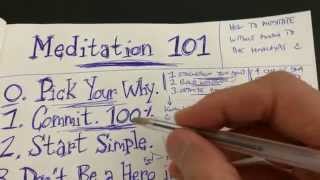
Brian Johnson explains how to start meditating without extreme commitment. He frames meditation as a low-cost pill for attention and willpower, then walks through the basics: pick your why, start small, use steady posture and breath, let your mind wander without judgment, and meditate at the same time each morning.
Chapters
Hi guys, this is Brian. I'm sitting here preparing for my next class, Meditation 101, how to Meditate Without Moving to the Himalayas. Smiley face. And I thought I'd do another one of these videos. Top 10 or so favorite Big Ideas on How to Develop a Meditation Practice. We're going to unpack these ideas in about a 75, 90 minute class. Part of our membership dealio. If you haven't joined that yet, what are you waiting for? 10 bucks a month get access to 250 philosopher's notes, plus five new philosopher's notes every month, PDF, MP3, and one of these classes every month. So we've done optimal living 101 a reboot class habits 101, getting stuff done 101, confidence 101, and we'd love to have you join us. Either way, I want to share some ideas here. Then my intention is at least one person is going to get at least one idea that will significantly change your life. So let's jump in. The first thing I want to do, actually, I want to read a quote to you. This is Jonathan Haidt. See how we can make that easy to read? Jonathan Haidt, the Happiness Hypothesis. He's a leading scientist out of NYU these days. He tells us, suppose you read about a pill that you could take once a day to reduce anxiety and increase your contentment. Would you take it? Suppose further that the pill has a great variety of side effects, all of them good, increased self esteem, empathy and trust. It even improves memory. Suppose finally that the pill is all natural and costs nothing. Now, would you take it? The pill exists. It's called meditation. I love that quote for a lot of reasons. We're going to share a number of other great thoughts in the class, but this is the first zero, if you will, reason and big idea for meditating. We've got to pick our why with anything we want to do. We need to know why we want to do it. So Jonathan gives us a bunch of ideas. My top five reasons why we want to meditate. Number one, we want to strengthen our mind. All great researchers tell us that our ability to put our attention where we want, when we want, is critical to our overall well being. And meditation is one of the top ways to do it. It's literally like strength training for your brain, for your mind, which is a good thing. The second thing, why I love meditating and advocate for it is we build our willpower. At the same time that you strengthen your mind, you actually build the gray matter that's gonna help you cultivate willpower. Another good thing. We'll go into detail on this in the class. Third thing, you build your immune system. So science is unequivocal about that. You induce what Herbert Benson calls the relaxation response. He also tells us that we change our DNA. Epigenetics research has shown that meditating for as what it was, 12 to 15 minutes a day for as eight weeks, you change your DNA, your genetic expression. That's exciting. And then of course, fifth reason, you connect to something bigger than you, which ultimately leads you to become a better, more creative, healthy, happy, loving human being. All good reasons. But what's your why? We need to start there. As with anything that we want to add to our life. Now, the first big idea, once we have our why, is we need to commit and we need to make 100% commitment. I come back to this theme again and again and again with all of our habits we want to build because this is the cornerstone on which all habits are built, a 100% commitment. And that again demands that we know what our why is. Once we know our why, we go all in. We don't go kind of, sort of, almost kind of, sort of almost in. 90% commitment is very different than 93%, which is very different than 95, 6, 95.6%. These are actually very similar. 99%. Right. We want 100% non negotiable commitment. That little whiny voice that's going to come on the airwaves and tell you, no, no, no, no. Today's the day you should take a day off. You need to remove that voice from your head, period. And one way to do that is the second big idea. Start simple. Consistency over intensity. It's much better to meditate for one minute a day than to bust out 60 minutes once a week. You want to create a daily habit, which we talk about a lot in the Habits 101 class. I'm going to go into a little bit of detail in the class, but not right now. But don't miss a day. Much easier to do something every day. Do it for one minute. Get micro wins under your belt. Build some momentum. This is what I did with my burpees habit. I did 136 burpees this morning. I started out with one burpee 136 days ago. I added one per day. I got a bunch of little micro wins. Now. It's easy to do that many and I'm excited about it and I'm marching toward 300. I'm doing the same thing right now with pull ups, I'm just starting at one and I'm going to build that up, see how far we can go. But the idea here is that you want to plan for the finish line, not the starting line. Right. If you go for 60 minutes out the gate, you're not meditating at all right now. You're likely to crash. And then you're going to be a hero in the beginning. Eknath Eswaron tells us, don't be a hero in the beginning. These are the people who, when they start a habit, you and I are among these people. We all do this at times. You start a habit and there's trumpets and fanfare and celebration. Yeah, I'm going to do this. I'm going to change my life. And then your enthusiasm wanes and Eswaron says, you tiptoe out the back door. It's because you started at the finish line. You were trying to do way too much. Plan for the starting line, know that you'll build to the finish line and just do it. And again, look at it over horticultural time. Too many of us want to results immediately. When we don't get it immediately, we give up. Another variable to think about here that we'll talk about in the classes. It doesn't matter what you feel like you said you're going to do it. You made 100% commitment. You made it easy with a one minute a day minimum commitment. Then you just do it. You do it again, and you do it again, and you do it again. We're going to talk about that at the end here as well. Okay? So that's some high level stuff, practically speaking. Let's explore some ideas. People always ask, how do I sit? Well, Jon Kabat Zinn has the best advice I've heard here. He says, sit with dignity. Even as I read that, I fixed my posture a little bit. So think about that when I ask you to sit with dignity. And you ask yourself, hey, let me sit with some dignity here. See, if you don't adjust your posture and know that your posture affects your mind and vice versa. So if you want to get into a good, nice, noble mind state, get into a noble posture. Sit with dignity. Really cool idea. In the class, we're going to talk about something called strong determination that Sn Gwanka introduced me to. The idea is you don't open your eyes, your hands or your legs during your entire meditation session. And you got to recognize the fact that your fidgets and your itches that you want to go after are more mental than physical. We're going to talk about that in some more detail. But, yeah, there's some pain that you want to pay attention to, but also all of your little fidgets and your little itches. That says more about your mind not settling down than anything. We want to discipline that. The fifth big idea is to breathe and drop in. Breathe and drop in. I like to start every one of my meditations with five nice, deep breaths. We're going to talk about some different ways to do that, but the basic idea is we want to go from beta brain waves to an alpha brain state. And one of the best ways to do that is. Is via our breath. So we'll talk about the induction phase of our meditation. This is related to our posture. You want to slow down, sit up nice with dignity, and then breathe nice and deeply. That will slow your mind down some really powerful ways. The sixth big idea here. Excuse me. Is to pick an anchor. Okay, so we've picked our. Why? We've committed 100%. We're starting simply. We're not going to be here in the beginning. We're in this for the long run. We're sitting with nice dignity. We're breathing deeply. Then what do we do with our mind? Then we pick an anchor. Different traditions recommend different anchors. Anything from a mantra or a prayer is a great way to meditate. Eknath Eskaron talks about that. Your breath, of course, is great. You can count your breaths whatever you do. Pick an anchor and think about it like this. Sailors, when they're out on the open sea, they want to reduce their drifting. What do they do? They throw an anchor overboard. It lodges them into one location. You want to have an anchor so you can fix your attention on one point and reduce drifting. You want to know that the smaller the area of your focus, the greater your attention, not just to meditation, but everything in your life. So we'll talk about finding an anchor, but know that that's hugely important. The seventh big idea. Your mind is going to drift. A lot of new meditators think that they need to turn their brain off. And if they can't turn their brain off, something's wrong. It's not about turning your brain off. Your mind will wander, period. Doesn't matter how long you meditate, it will wander. You might have longer spaces between the time it wanders. But just bring it back. Don't make it a big deal. Just bring it back. Think of it like strength training. You have an anchor. You want to focus on a mantra or a prayer or counting or Your breath and, and then your mind slips. You know it's going to slip. You don't make it a big deal. You say to yourself, oh, well. And you passively, neutrally bring yourself back to your anchor again and again and again. You do that and it's like doing reps for your mind. You're strengthening your ability to bring your attention back to where you want, which is what I said was the number one reason why I meditate. That's our seventh big idea. The eighth big idea is to brush your brain. It's related to the ol. Herbert Benson shared both of these ideas with me. He's out of Harvard, one of the leading scientists studying meditation. He says, look, when you brush your teeth, are you judging your meditation, your tooth brushing? No, you just brush your teeth. You're not saying, oh, did I really get that back molar? Well, I'm not sure. Let me go back there and do it again. You just brush your teeth. Well, guess what? Meditation doesn't need to be any more complicated. Just brush your brain. And remember rule number one, don't judge your meditation just because your brain is going nuts and you can't turn it off and you think it's your worst meditation. You got to know that that actually might be your best meditation. If you hadn't have meditated that day, you might have been even more toxic when you headed out in the world. So don't judge your meditation. Just brush your brain, sit down, show up and do the work and let it take care of itself and get the benefits over the long run. The ninth big idea here is to reduce the variability of your timing, which means be consistent in when you do it. Remember we've talked about in the different habits that it's easier to structure your days in the a.m. in the p.m. you have more control over these times. A lot of teachers and I highly recommend, do this first thing in the morning. Do your meditation first thing in the morning. It's easy. You get up, you do your little morning routine and you meditate for a minute, 2, 5, 10, whatever or whatever works best for you if it isn't that time. But be consistent and remember these bookends. It's easier to get things you're going to do every day first thing in the morning or at the end of the day when you have more control over your schedule. But again, reduce the variability and try not to miss a day. The 10th big idea is work diligently, patiently and persistently. Sn Gwenka, who's one of the leading vipassana teachers. I did a 10 day silent meditation with him back in the day. And he said again and again and again, work diligently, diligently, work patiently and persistently. Patiently and persistently and you're bound to be successful. Bound to be successful. I literally heard that, certainly dozens of times, if not hundreds of times in this beautiful, lyrical Burmese accent. And it's stuck in my head. Everything in life, we just need to work diligently, patiently, persistently. We're bound to be successful. But the problem is most of us don't approach life or meditation or anything with a sense of mastery. We want one climax after another. We want to feel immediate benefits and just have our lives be amazing always. George Leonard tells us we need to learn to love the plateau. You have a gain and then you got a plateau, little gain, plateau, big gain, plateau. But we all want this huge nonstop orgasmic experience. And George Leonard says we need to learn to love the plateau, make our life one big practice and just show up little by little, get a little bit better, and know that again, we're measuring our benefits via horticultural time, not clock time. We don't expect to sit down, do one meditation, and feel enlightened. Just like you don't bust out one set of 50 pushups and expect to be ripped. You got to put in the time, work diligently, patiently, persistently. But if you do that, over the long run, you will be successful. 11th big idea. We gotta remember all life is meditation. We're not meditating so we can levitate off of our cushions. It's not about what we experience during the meditation, it's about who we are the rest of the day. And as Jonathan Haidt tells us, we become better human beings with a stronger mind, better willpower, immune system that's rocking DNA that's expressing most powerfully. And we're connected to something bigger than ourselves, which allows us to shine with a radiant enthusiasm that we're all looking for. So there you go. Meditation 101. Some of my favorite big ideas. I hope that you got something great out of this and I'm looking forward to sharing this with all of you who are signed up. I appreciate you. Blessed to have thousands already signed up and just so stoked to continue to share some of my favorite big ideas. Appreciate your support. Let's do this. Have another awesome day. See ya.
More from Brian

Heroic +1: What’s THE Most Creative Act in the Universe?: Turning Around Glitches (#2024)









