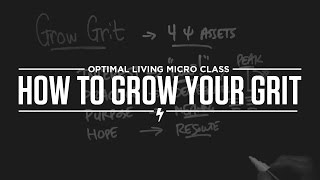
A short YouTube micro-class by Brian Johnson (inspired by Angela Duckworth) explaining how to grow grit. Presents four psychological assets—interest, deliberate practice, purpose, and hope—to counter four common reasons people quit (boredom; effort not worth it; lack of importance; hopelessness). The chunk also includes a promotional segment describing Philosopher's Notes and an optimized membership offering.
Chapters
Hi, this is Brian. Welcome back to another micro class. This one's on Grow Grit, inspired by, you guessed it, Angela Duckworth's grit. How do we grow grit? It's the whole point, right? So we know that grit is a function of passion and perseverance. But how do you grow it? Well, Angela tells us there are four psychological assets that we want to build, and she says there are four common reasons people quit, which is the opposite of having grit. She says sometimes we say to ourselves, I'm bored, right? Or the effort isn't worth it, or maybe this isn't important to me. Or how about, I can't do this, so I might as well give up. Those four complaints, she says, need to have these four psychological assets to combat them so you don't quit. Here. Here they are. One interest. If you're feeling bored, you need to check in and say, do I really love what I'm doing? She says all the grit paragons she studied basically say, I love what I do. I don't kind of sort of like it. I certainly don't hate it. I love what I do. When you have that level of intense interest and passion, you don't tend to get bored. Second psychological asset to deal with. The effort isn't worth it. Oh, man. The effort isn't worth it. I'm just going to quit. Well, the gritty among us have the asset, the psychological asset of practicing deliberately. Right? They want to get better so they're not sitting there saying, oh, this is too hard. They realize with the growth mindset that it requires hard. You have to stretch out of your comfort zone. Boop. Get out of it. If you want to grow. Right?
Think of peak.
Go check that out if you haven't yet Anders Ericsson's work. You have to get out of your comfort zone in order to get better. Simple homeostatic response is how we develop our skills. That's how you deal with boredom. Then people may say, this just isn't important to me. I started it, you know, but it's just not important to me. Well, the psychological asset that counters that is purpose. You've got a meaning that's bigger than you. All of the mature grit paragons that Angela studied say that what they do, yes, they love it. They absolutely love it. But that love is met with a love for other people as well. They love doing what they do, but they also love serving other people. Their work means something beyond just themselves. That purpose helps us navigate the this isn't important to me. Well, you know what when you have a clear purpose, and we all have a clear purpose, but when we have a clear purpose, we are inspired and fired up by that. To move beyond that obstacle of this just isn't important. Well, you know, this is why it's important. Be clear on that. What is the meaning behind what you do? And then the final thing was, I can't do this, so I might as well give up. Well, that's hopelessness. You deal with that with hope and not the passive wishing, oh, wouldn't that be cool if my life got better, I hope I get lucky. But the rigorous resolute knowing that your life is going to improve not by luck, but because you're going to do what it takes to make it happen. Angela jokes that if she was going to get a tattoo, it would be the Japanese saying, fall down seven times, rise eight, get up eight times, have that resolute commitment to making your life better and exerting that level of active, engaged hope, which is what we've talked about a ton of times. Check out making hope happen. You've got a brighter future. You know that you have the agency to make it happen. And you're willing to take all these different pathways when you have that resolution, that hope and that purpose, and a willingness to practice, to get better, and an absolute love for what you do. You've got the four psychological assets that help you grow. Grit. How are you strong? What are you really strong at here? And what needs work? Get clear. Go rocket. Have an awesome day.
Isn't it a bit odd that we went from math to science to history, but somehow missed the class on how to live? For some wacky reason, optimal living 101 never made the schedule. Of course, it's too late to go back and change that and you're too busy to read full time to catch up.
Yet.
If you're like us, you're all about optimizing your life and actualizing your potential. So imagine this. Imagine having someone read the best books on optimal living and pulling out the big ideas that can truly change your life. You know those sections you asterisk and underline and mark all up. Then imagine that guy me connecting those.
Ideas to other great books in helping.
You apply them to your life today. Well, that's what I do with something we call Philosopher's Notes, where I break down each great book into a simple 6 page PDF, 20 minute MP3 and 10 minute Philosopher's Notes TV episode. Then imagine me taking the absolute best big ideas from those great books and sharing them with you. In fun, inspiring, super practical, optimal living 101, classes on stuff like purpose 101, confidence 101, business 101, meditation 101, that sort of thing. You got a personal trainer? I'm kind of like your personal philosopher. Ancient wisdom plus modern science plus common sense plus virtue plus mastery plus fun. That's what our optimized membership program is all about. We'd love to have you join us.