Module II: Hero-ology (Part 2)
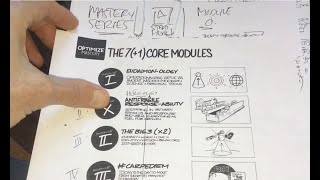
Brian Johnson presents Module II Part 2 of a mastery series ("Hero-ology") focused on operationalizing the Hero's Journey into day-to-day practice. He outlines a multi-part toolkit for developing antifragile confidence, heroic courage, and responsibility — including perspective exercises, a core-virtues compass, self-compassion as a healing balm, an acceptance-based "hero pill," techniques to reframe setbacks (alchemy/magic wand), a 1-2-3 debrief method to build momentum, iterative "pearl" practice, a hope map (goal + agency + pathways), and dietary metaphors (hero sandwich/bars) — and closes with a promo for the Optimize platform.
Chapters
Hey guys, what's up? This is Brian getting ready to head into the studio post trail. Module 2, Part 2, Hero Ology, the study of a good hero. We're going to continue our discussion on antifragile confidence, heroic courage and responsibility. We've got our mastery series core modules, module zero introduction. Module one, Eudaimonology, the study of a good soul. We went into module two here, Hero ology, where we talked about the rules of the game. Antifragile confidence, heroic courage, responsibility, all of which were defined. We challenge you to make your choice, flip the switch, develop some heroic stamina and eat a hero sandwich. This week we're going to continue our exploration of how to create anti fragile confidence, heroic courage and responsibility. Basically trying to operationalize the wisdom from Joseph Campbell's Hero's Journey, etc. So we got to train like heroic warrior philosopher monks. Whatever metaphor you want to use, we need to move from theory to practice to mastery today. That's the big idea. Number one, we're going to focus on stocking up our arsenals, our armamentarium of tools, weapons and provisions. We need to have them ready at hand so we can use them when we face our inevitable challenges. That's our first idea. Practice your philosophy, emphasis on your what are your highest ideals? Rock them. Then we're going to step back and kind of approach this like a hero's training basic training camp. First we're going to get some basic orienteering skills under our belts. We're going to get perspective, time and space. And realize, you know what, none of this is that big of a deal. Really fun exercise on time and space. Looking at the earth relative to the sun relative to the Milky Way relative to thousands, millions trillions of Milky Ways. Crazy. Get perspective. Third idea is going to be how to make a compass. The points of our compass will be our core. Thank you. I owe some burpees. Our core virtues. Wisdom, self mastery, courage and love. Then we've got our ancillary top five virtues encompassing that compass as well. But the real theme here is going to be look, we need to make a distinction between being a perfectionist and being an optimalist. We need to have our ideals become guiding stars rather than have them as distant shores keep the high standards. Science says Tal Ben Shahar tells us, but embrace reality. That's how you make a compass. That'll be fun. And then we're going to talk about how to make going to go from basic orienteering to suffering well and also healing any potential wounds we may have as we get the Right. Orientation and face inevitable obstacles. How to make a healing balm. Well, first we need to remember there are no perfect human beings. Thank you, Abraham Maslow. And you and I won't be the first. We talk about it a lot. Self compassion is our healing balm. Here we're going to look at the science of self compassion. Number one, two and three. Common humanity. You're not alone. Kindness. Be nice to yourself. And three, mindfulness. We're going to read that Mr. Rogers little blurb on his challenges creating. We had a coaching session with Cal Newport who joined and mentored our coaches. See if I can grab that. And for those who were there, you may have noticed in the background he had a framed Mr. Rogers thing that we sent to him. I sent to him Mr. Rogers. Am I kidding myself that I'm able to write a script again? Am I really just whistling Dixie? I wonder. If I don't get down to it, I'll never really know. Why can't I trust myself? Mr. Rogers says, really? That's what it's all about. That not wanting to go through the agony of creation after all these years. He says it's just as bad as ever. You notice that? All caps. I wonder if every creative artist goes through the tortures of the day. I'm trying to create. Oh well, the hour cometh and now is when I've got to do it. Get to it, Fred. Get to it. All caps. But don't let anybody ever tell you, tell anybody else that it was easy. It wasn't. April 1979. He was almost 50 years old. He'd been doing this for over a decade. And here he is, still challenging. Then he says, hey, it wasn't easy, but it was great. This I must remember. Powerful stuff. Joe and I talked about that sent him. He liked it. Sent him the framed version of that. The point here is common humanity. You're not alone. You're struggling, you're suffering. Well, come on. That's a reverse indicator. You're on the path. Have self compassion for yourself by recognizing nothing's wrong with you per se. It's the common human experience. Then be nice to yourself, be mindful, etc. Healing Balm. Then we're going to learn how to make a hero pill, AKA an aspirin, suffer. Well, we're gonna talk about the importance of accepting our current reality. If suffering equals pain times resistance, which is another Kristin Neff idea who brought us the science of self compassion or in fact suffering equals pain to the resistance. Power. It's an exponential not A multiplicative thing, Right? The more you resist what's happening in your life, the more you suffer. Right? Well, if that's the case, then E equals O. That's the mathematical symbol for eating. P plus one to the infinity. We're going to talk about this equation. Eudaimonia equals optimus. Eating. Whatever pain you are experiencing plus one, you take action. Four abs. As Joseph Campbell says, the demon you swallow gives you its power. You got to accept what is, love what is. Then use it all as fuel. That's going to be our hero pill concoction. Then, number six, we're going to have fun making a secret weapon, a magic wand. Hermes, the ancient mythical God Epictetus talked about, he had a magical wand. A lot of people said that it could turn anything into gold. Epictetus says, no, no, no. It can turn anything into awesome. You need to learn. We need to learn how to alchemize versus catastrophize. We use whatever life gives us again as fuel for our growth. We need to see everything as a challenge versus a threat. This is a big idea. We'll talk more about next week. Yeah. And we'll talk about some Harry Potter wisdom. This Hermes magical wand is similar to the Philosopher's Stone, which is said to be able to turn a base metal into gold. But really what the Philosopher's Stone did was turn anything into a positive, right? When you have the right mindset, you can use anything for fuel. Harry Potter and the Sorcerer's Stone is what they called it, but it was really the Philosopher's Stone. We'll talk about that seventh big idea. How to make a hero fire. You go out on this heroic quest. Here are some tools you need, right? You want to have your armamentarium properly stocked. You got the perspective. You got a compass. You got a healing bomb. You got a hero pill. You got your weapon. And then you need to get some fire. How do you start a fire? Well, we're going to talk about the 1, 2, 3 process, inspired by a number of teachers, including Lanny Basham, with winning in mind, Olympic gold medalist, who will be joining us at Optimize 2020, which is pretty fun. 1, 2, 3. What was awesome? When something goes wrong, you ask yourself, what was awesome? You don't start with the problem, what was awesome? Then you say, what needs a little work? Then you say, how will we optimize? It's almost like, this is the match. What was awesome? Then you've got the wood, the fuel that you're going to use, which is what Needs work. And then you strike that match on something gritty, which we're going to talk about next week as well. The science of grit. How will we optimize? What will we do differently? That's how you use it all as fuel and create a hero fire. Let there be light. We win or we learn. Seventh, big idea. Eighth, how to make pearls. Actually already buried my pearl away so I can take it to the office. But I carry a pearl around to remind myself that everything, you know, that we want in life. You look at this gem. It's such a perfect metaphor, right? Step one, irritant to making a pearl. Step two, you apply what they call nacre. Use a tool on your irritant to get a little bit better. You do that over and over and over and over and over again. What do you get? You get luminescence. Then you use these pearls to trade for supplies on your heroic quest. The ninth idea is how to make a hope map. So you want a map of the terrain? Well, there are three steps, according to science. You need to have a goal, you need to have a sense of agency, and you need to have pathways. We're going to keep on coming back to this idea again and again and again. Just did another note on the science of virtue. Happy people are hopeful. Hopeful people are happy. It's really that simple. We're going to add a zero. You got to accept and love and be grateful for whatever's going on in your life right now. Then you walk through this process. Then you take action infinitely. What's important now? What's important now? But we're going to focus on the best selves diary here. Get a vision for who you are and who you are aspiring to be. We're actually going to call this our V1 Hope map in the next session. Next week, we're going to make this a v2 hope map by applying some whoop to it. But we'll start here and build some confidence by doing what's important. Now then, the tenth idea. We ended our last session making a hero sandwich. You got to eat your virtues. Well, this time we're going to learn how to make hero bars and quit eating idiot bars. Basic idea here is we're going to look at our top three things we're most proud of in our lives. Right. But we're going to see that all of those things we're most proud of came with a ton of challenges we had to overcome. Challenges oopses became yeses. We're going to talk about changing our scars into metals we're going to talk about one of my prior investors and mentors a billionaire who I'll tell you how he introduced me to a group of potential investors in Aspen back in the day we're going to think about that we're going to make some hero bars Quit eating the idiot bars as we continue our study of a good hero in her ology cultivate our antifragile confidence heroic courage response ability training like warriors philosophers monks and stocking up our arsenals or if you prefer the optimize depot of tools weapons provisions for our hero's quests look forward to seeing you there as always this is part of our mastery series go to optimize me and you can sign up for the two week free trial etc etc etc get access to this series year long course basically the philosopher's notes over 500 of them 50 other classes we have optimal living 101 classes and a bunch of optimized plus 1s there you go let's do this.
More from Brian

Heroic +1: What’s THE Most Creative Act in the Universe?: Turning Around Glitches (#2024)









