My Top 3 NUTRITION Books of All Time (+ a Life-Changing Idea From Each!)
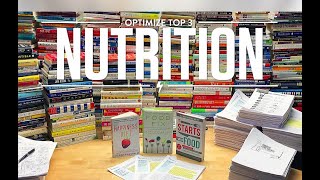
Brian Johnson presents his top three nutrition books and one life‑changing idea drawn from each: (1) Food Fix (Mark Hyman) — stop drinking sugar/sugar‑sweetened beverages as the single biggest change for health; (2) The Happiness Diet (Tyler Graham & Drew Ramsey) — ultra‑processed foods ("carbage") strongly increase depression risk (~60% cited) while whole‑food diets reduce it (~26% cited); (3) It Starts with Food (Dallas & Melissa Hartwig) — a paleo/low‑grain experiment that resolved the speaker's migraines. He synthesizes these into three "Optimized Food Rules": don't drink sugar, eat real (not factory) food, and maintain at least a 13‑hour overnight fast (eating sunset). The video also promotes deeper resources (philosopher's notes, Optimize Mastery classes, and coaching).
Chapters
Hey guys, what's up? This is Bry. Welcome back to the Optimized Top three Books of All Time series. Today we've got my top three favorite books on nutrition. We've covered some ground so far. We've talked about my top three favorite books of all time. Then Ancient Wisdom, Modern Science Habits and now nutrition. We've got in the number one slot Food Fix by Mark Hyman, MD, one of the world's leading functional medicine doctors. We're going to talk about why. And the number one tip from that, we also have the Happiness Diet by Tyler Graham and Drew Ramsey, M.D. great book on the connection between our diets and our emotional and psychological well being. And then we've got It Starts with Food by Dallas Hartwig and Melissa Hardwig. A life changing book for me. We're going to talk about why that was the case. Of course we've got philosopher's notes on each of these great books. And on all of these books, 600 philosopher's notes. Big old stack there. Six page PDF, 20 minute MP3 where I pull out what I call my favorite big ideas. Those sections you asterisks and underline mark all up that can literally change your life. So I connect them to other books and then give you a playful kick in the butt to help you go out and live your greatest life. And I haven't mentioned it much yet, but we also have Optimal Living 101 Master Series classes on each of these top threes. So here's our top 10 big ideas. I take all the ideas from dozens of. Those are three of my favorite books. But nutrition is one of my favorite subjects. I would say probably modern science, positive psychology, all those books right there and nutrition, all those books right there are among my favorite subjects. That and stoicism, right? Eating is huge. To get our energy right, we've got notes on Food Rules by Michael Pollan and a couple of other or at least one other his books. Eat, Move, Sleep, Great Book by Tom Rath, clean gut by Dr. Alejandro Junger, fat for fuel by Dr. Mercola, some other books on keto. I've experimented with basically everything over the years. Vegan, Paleo, Keto, etc. Continue to experiment and today we're going to talk about these three books. My favorite idea from each and also the Optimized Food rules which I talk about in depth in our Optimize Mastery series. So we take all of these books, we distill them into philosopher's notes, then we have 101 classes, all of which you can get for free as part of our two week trial at Optimize Me. Then I boil it down into our Optimize Mastery series, which is the cornerstone of our Optimize Coach program. That's at Optimize Me Coach. All right, without further ado, let's get to work. I'm going to keep our food prescription pad, Fundamental prescription Pad out as well in case we need it. Okay, top three favorite books. Food Fix number one, the reason why Food Fix is my number one nutrition book of all time. There are a lot of reasons, actually. Mark Hyman, I trust the guy. He's experimented with everything. Vegan, paleo. He even has a pegan approach where he combines the best of both. He's not dogmatic. He approaches things from a systemic level. He's a functional medicine doctor. If I ever needed a doctor, I would go to a functional, functional medicine doctor. They're not treating symptoms, they're treating systems. They don't want to spray paint the brown leaves on your tree green, right? And deal with the symptoms. They want to figure out what the root cause is of your issues. And in this book, Mark breaks down for us the fact that our food system is in trouble. And if we want to save our health, our economy, our communities, and our planet one bite at a time, we need to figure out how we fix our food system. So this is a systemic, global societal issues book. And it's also a very personal book. So you get to learn some great tips on how to optimize your own wellbeing while doing so in the service to our greater world. Now, the number one tip from this is the number one rule from the book which we have in here, which is, where did I put it? Quit drinking sugar. Stop drinking sugary beverages. Mark says, see if we can find it. Stop drinking sugary beverages. If you've gotten this far, then my next recommendation probably goes without saying, but I'll say it anyway. Don't drink sugar. The best way to reform the food system is to make sugar laden foods less profitable, right? And then he says here, cutting sugar sweetened beverages from your diet is the, and I quote, single biggest thing you can do to improve your health. When authors like Dr. Hyman say things like, the single biggest thing you can do to improve your health, I like, sit up straight. The number one thing I want you to know, which is what a lot of authors say in these books. I sit up straight, I underline that, I asterisk that, and I pull it out in a big idea. And I say, look, the number one Thing they said we need to know is this. So the number one thing that you can do, the single biggest thing you can do to improve your health health, is to quit drinking sugar sweetened beverages. Now that's not just the obvious things like your Coke or your Pepsi. Fruit juices are not health drinks either. He says this fruit juice is loaded with sugar and is just as harmful as soda. He means that literally. Fruit juice is loaded with sugar and is just as harmful as soda. Avoid buying it and certainly don't give it to your children parents. Are you still giving your kids fruit juice thinking it's a healthy drink? It's not. John Ratey, Harvard psychiatrist, says this is actually probably the number one mistake otherwise great parents make giving their kids fruit juice. It's toxic. Sugar does not belong in our diets at the levels that we consume it, period. That is why in our optimized food rules, it's the number one rule, don't drink sugar. So my question to you is, are you drinking sugar number one thing you can do? Thank you, Mark Hyman. Appreciate your decades of work. You rock. Next favorite book, the Happiness Diet, A Nutritional Prescription for a Sharp Brain, Balanced Mood and Lean Energized Body by Tyler Graham. Drew Ramsey. Now, it was tough to pick the top three here because I've got a lot of favorite books and nutrition is such a complex nuanced thing that people tend to get a little evangelical about whatever belief system they follow. I, I love this book because it's written by an MD and psychiatrist and they make the connection between our minds and our bodies and the fact that what you eat affects your emotional well being. Now I love their tone. It's playful. In this book, you may know that the modern American diet is called mad or the standard American diet is sad, right? So you can call it mad or sad. And they say, look, you want to get mad or sad, angry or depressed, just eat what most people eat. Then I love this phrase. They come up with carbage, carbidge, ultra processed, fast acting carbs need to go throw the carbage out. That's my number one favorite big idea from this. And I should say just to make it very explicit. Well, I'll just see what they got to say here. A large study recently published in the British Journal of Psychiatry found that eating processed foods such as refined carbohydrates, sweets and processed meats increased the risk of depression by about 60%. I'm going to repeat that. Journal of Psychiatry, the British Journal of Psychiatry found that eating processed foods such as refined carbohydrates, sweets and processed meats. Do you eat any of that? Most Americans in Western people, in Western society do increase the risk of depression by about 60%. That's crazy. Eating a whole food diet, on the other hand, decreased the risk of disease, of that disease by about 26%. So you can go down 26%, Whole Foods, you can go up 60%. That's actually, that's a pretty big difference there, folks, which is why we have our optimized fundamentals prescription pad that we give to our optimized coaches, and we give it to our coaches and we say, you write your own prescription, right? We have our coaches give it to their clients and they write their own prescription. They're not patients, they're conquerors. A patient submits, a conqueror seeks successfully. So I ask you, what's the number one prescription you need to write to yourself? And Mark Hyman tells us there's actually been research done. Another reason why I love this book, there's been research done where doctors, instead of writing drug prescriptions, or in addition to in some studies, they write food prescriptions and then they actually pay for the healthy food. And even after they pay for the healthy food, the savings in health care costs, in the increase in well being are astounding. We need to write food prescriptions because food can fix a lot of our problems. Again, longer chat, check out the note for more. Check out the book for more. But for now, what's the number one thing you can write to yourself? Right? Think about that. That leads us to again, the number one idea I got out of happiness diet is throw out the carbage and then the connection between depression and your nutrition. Most psychiatrists should have a pad like that and they should get your brain hygiene right is how. Dan Siegel, a Harvard MD psychiatrist, friend and optimized coach, guest faculty luminary member, A luminary in our program says, make sure you get your eating. You're moving, you're sleeping. Right? I don't know if he writes prescriptions for it, but that's the basic idea. That leads us to the second optimized food rule, eat real food, which is a play on Michael Pollan's food rules. Right? His food rules. Eat food not too much. Mostly plants. Eat food not too much. I like that. We've adapted our food rules to these three. Don't drink sugar, then eat real food. And I say throw out the factory food. Throw out the factory food. If you could just rewind time and not eat food. That's Made in the factory. Three types of food from the factory. We want to throw out ultra processed food, factory farmed animals. This is the garbage by the way. And then factory fats, vegetable oils that disrupt our omega 3 and 6 balances. Olive oil's been around forever. Way before the industrial revolution, Socrates was hammering olive oil in ancient Greece. It's been around for 5,000 years. Canola oil, safflower oil, soybean oil, corn oil, these things did not exist 100 plus years ago. We required factories to press oil out of those guys that are not healthy. They sound good. Vegetables are not. That's our second food rule. Don't drink sugar, eat real food. Throw out the factory food. The third of my top three is it starts with food by Dallas Hardwick. Now, I was a low fat vegan for a decade and it worked until it didn't work longer. Chat nuanced. I used to be vegan. Jellicoe So I get vegans that are getting all upset even as I start talking about this right now. And I respect all approaches and I try to have these food rules that's agnostic to what you do, but when you do it, do it within the context of these rules. And I like these rules, the optimized food rules, because they apply to every single approach you want to follow. Now for me, when I followed the low fat, high grain vegan diet, I wasn't doing too great after a while. In fact, I had migraines occasionally and actually more often than I liked, which is anytime, once, twice a month. But I didn't know what day I'd have migraine headache. I read this book and I reluctantly tried it because I was so vegan. Jelica the idea of even going toward paleo was absurd to me. But Alexandra had some skin issues. We were having our first kid about eight years ago and I was willing to experiment. After she started and had some gains, I did this. My migraines went away immediately. I had skin issues that resolved themselves within days. Grains didn't work for me and removing them from my diet changed my life radically. So this approach is paleo in nature and it's fascinating. Dallas Hardwig. Melissa Hardwig. Powerful stuff. And again, everyone needs to experiment, test their own things. But this experiment worked for me. Again, life changing. I reduced grains and I got rid of the migraines. Good equation for me. Now again, we could have talked about a lot of different books in here. David Perlmutter could have easily made the cut. His grain Brain Brain Maker is amazing. Susan Peirce Thompson we have notes on her Bright Line Eating and Bright Line Eating Cookbook. She's also part of our visiting faculty. Robert Lustig, Fat Chance. Mark Hyman's other book, Eat Fat, Get Thin, David Ludwig's Always Hungry, Gary Taubes, the Case Against Sugar and why We Get Fat. I'm actually going to talk about those books in our next or in one of our future top threes on weight loss. This is just general nutrition, what we just did, but I'm going to share my top three on weight loss as well. Which leads us back to our optimized food rules. Again, whatever you do, do it to the best of your ability. And I would encourage you to follow these three rules. Don't drink your sugar. Eat real food throughout the factory food, ultra processed carbage, factory farmed animals and factory fats. The third rule is have an eating sunset. Have a window of time at least 13 hours long between your last meal and your next meal the next day. At least 13 hours. The research on this as it relates to cancer and other issues is profound. So when did you eat your last meal last night? When did you eat your first meal? Get clarity on that. And if you can't go 13 hours easily, which you should be able to do, then we need to deal with your metabolic flexibility. We're going to talk about that more in the weight loss thing, which is really optimize your metabolism. Your insulin's out of whack if you can't go that long without not eating. And then just follow the food rules. Drink less sugar, don't drink any sugar, and then stop eating so much carbage. You'll find it easier to go a longer period of time. Again, we talk about that in depth in actually, we talk about it in depth in optimal nutrition 101. And then we go even more in depth in optimal Weight Metabolism 101. How to optimize our metabolism to easily sculpt our ideal bodies while energizing and actualizing. And then we hold our coaches to a standard of 0.5, waist to height, your waist to height circumference ratio. Longer chat, but it's your number one predictor of morbidity. If it isn't less than 0.5, we need to get it to 0.5. We challenge our coaches to do that. We spend a ton of time on our fundamentals. Eating is the first one we discuss. That's all I got. That's a lot. All right, so again, we've got 600 philosopher's notes. You can get access to all of these notes for free as part of our two week trial. And you get access to 50 optim 101 masterclasses and a thousand optimized plus ones. I can get another stack of a thousand plus ones that I've written. And then of course, you get these three nutrition books and then a couple dozen other nutrition books, whatever we've got now. And most importantly, what's the number one thing you know you could do that you could change your life today if you actually wrote yourself a prescription to change this part of your nutritional approach? What is it? Get on that. Make today another awesome day. Follow all of the Optimize top 3s at Optimize Me. Top 3 get that free trial at Optimize Me. Learn more about the Optimize Coach program at Optimize Me. Coach Coach. Let's go.
More from Brian

Heroic +1: What’s THE Most Creative Act in the Universe?: Turning Around Glitches (#2024)









