My Top 3 POSITIVE PSYCHOLOGY Books of All Time (+ a Life-Changing Idea From Each!)
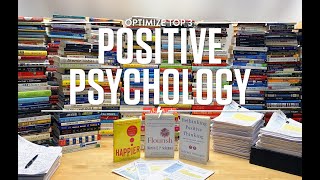
YouTube transcript of Brian Johnson's 'Top three' video recommending his three favorite modern positive psychology books—Flourish (Martin Seligman), Happier (Tal Ben-Shahar), and Rethinking Positive Thinking (Gabriele Oettingen). Johnson summarizes core ideas (Seligman's PERMA and 'what went well' exercise; Oettingen's WOOP process—Wish, Outcome, Obstacle, Plan; Ben-Shahar's happiness archetypes and balancing present/future), mentions many other positive-psychology titles, and promotes his Optimize/Optimize Coach program and access to 600 Philosopher's Notes.
Chapters
Hey guys, this is Bry. Welcome back to the Optimized Philosopher's Notes Top three series. Today we've got Modern Science. This just might be my favorite subject. We did the top three of all time. Then we did top three Ancient Wisdom. Today it's all about the top three modern science positive psychology books. You'll notice that in the center here we've got 500 books we're hanging out with today, 600 philosopher's notes in which I distill the very best life changing ideas from those books. But the first books I set up here in this stack are dozens and dozens of positive psychology books. We've got nearly all the best ones, all the new ones that are coming out in the collection. These are my three all time favorites. We're going to talk about why and we're going to share one big idea from each of them. Happier? Well, actually number one is Flourish by Martin Seligman, the founder of the positive psychology movement. Kind of a must you got at least know what he thinks. We talk about it, of course, in the Philosopher's Note. Happier by Tal Ben Shahar. Tal taught the largest class in Harvard's history. Martin Seligman wrote the blurb at the top, the backbone of the most popular course at Harvard. Tal has become a dear friend. He is a luminary in our Optimized Coach program and he's actually an optimizer. I was pleasantly surprised to hear that he starts every single day with our optimized Plus1s, which is pretty awesome. Love you tall. And then we've got Rethinking Positive Thinking. Gabriel Oettingen, another one of my favorite human beings on the planet. This book is fantastic. We've got to understand that you can't just think about positive things. You got to rub it up against reality. We'll talk about that. Gabrielle Oettingen is also one of the luminaries in our Optimized Coach program. You can learn more about that by the way, where we integrate ancient wisdom, modern science and practical tools to help you master your life and coach others to do the same at Optimize Me Coach. And as always, you can get instant access to all 600 philosopher's notes, 6 page PDFs, 20 minute MP3s on the site, on the app, et cetera. As part of our free two week trial at Optimize Me and then follow along at Optimize Me top three where we've got 30 top three videos like this on the range of domains that I think we need to be aware of. If we want to optimize and actualize our potential. So before we jump in top three, I got a stack of like amazing books that didn't make the cut. And again, if you look at at the stack behind that, you'll see, you know, we've got Anders Ericsson peak, God bless him, passed away. We were looking forward to having him at our event in 2020 and in our luminary, you know, guest faculty, but just brilliant guy on the 10,000 hour rule. Malcolm Gladwell extended his research on that wasn't quite the way Anders would like to have it described. A basic idea. Grit by Angela Duckworth. The Psychology of Hope. Super Important by Rick Snyder. Self Compassion. Kristin Neff. We just talked about, or we will talk about rather. The Joy of movement by Kelly McGonigal. The science of exercise. The courage quotient. Robert Be Zoie's Diener. Did you know there's a science to courage? Yep. Abraham Maslow's Future Visions. Iconoclast. One of the world's leading neuroscientists tells us how to be an iconoclast. Mihaly Csikszentmihalyi, who co founded the Positive Psychology movement with Martin Seligman, wrote a great book on creativity. That's so good. He also wrote Flow, which we feature. There's Jonathan Haidt. I always get it confused. Is it Hayter Height? The Happiness Hypothesis. Sony Lybomerski, the How of Happiness. Emotional Intelligence. Again. Robert Bisoit's Diener and his dad, Ed Diener. Happiness. The Power of Agency. Unbelievably good book. Martin Seligman's Authentic Happiness. Maslow's Motivation and Personality. We've got some. The Science of. Where did that one go? What doesn't kill us? The Science of Post Traumatic Growth. Powerful stuff. Character strengths matter. Yes, they do. The Upward Spiral. How to Get Rid of Depression. Carol Dweck. Mindset again, super important. Look at that. We got flow in there twice. That's like me. Oh, geez. We've got some good books in there. And then we have all the notes, of course. Presence. Amy Cuddy. This is such a good book. So there's a ton of books that didn't make the cut. Check them out. Without further ado, our top three. So Martin Seligman is the founder of the Positive Psychology movement and he wrote Learned Optimism, which is up there somewhere. Then he wrote Authentic Happiness, which is right here. Then he realized, oh, wait, wait, wait, wait. The real science we want to study is the science of well being. And if you recall in our discussion on ancient wisdom, I said, look, Aristotle, if you asked him what the summum bonum of life is with the highest good, he would tell you it's eudaimonia via arete. In our optimized coach program in the Mastery Series Module 1 on Eudaimonology, I playfully say, look, if you invited Aristotle as a proxy for ancient wisdom and Martin Seligman as a proxy for modern science into the party right now, and he said, hey, guys, what's the ultimate purpose of life? Aristotle would tell you, eudaimonia via arete flourish by putting your virtues in action. And guess what? Flourish is the English translation of Eudaimonia. And guess what? Martin Seligman started the positive psychology movement by studying virtue. And he says it forms the underpinning of a good life. It's the basis of his entire philosophy. Well, being theory is what he calls it. Now, under that he has what he calls perma, right? P, E, R, M, A. We talk about it in the note, of course. See if we can flip to that briefly. Perma. And notice that I. I personally review my philosopher's notes. So this is me rereading my philosopher's notes. Why? Because I write these notes thinking about what I want to remember. So I'm reading the book and I'm asterisking and I'm underlining and I'm finding these passages I personally want to remember. And then I'll go back to it months or years later and I learn from my own notes, which frankly, is how I know that they're effective, because I love them and they work for me. And again, thankfully, we've had tens of thousands of people echo that. But anyway, Seligman boils down his well being philosophy to perma. You need to have positive emotions. You need to have engagement in life. You need to have strong relationships, meaning and achievement. Can we talk about all that? Then we talk about the strengths and virtues and kind of unpack some practical ways to go about doing that. But this is just a seminal book. What went well? This is one of the most powerful interventions in positive psychology. What went well today? Write down three things that went well today and why they went well. You do that for a week or two, or three or four or five. Actually for one week. One week and your well being will go up dramatically. So again, in these notes, we're sharing practical tools to move from theory to practice to mastery. He talks about Anders Ericsson and the 10,000 hours here. Tons of wisdom in there. I'll leave it at that. That's flourish. Thank you very much. Then we have Rethinking Positive Thinking. Gabrielle Oettingen. Again, this is. You've probably never heard of this book, which is a shame because it's astonishingly powerful. We come back to this wisdom again and again and again throughout our work with our Optimize Coach program. And I'm certain that operationalizing this wisdom is one of the reasons we get such huge results in our program. So the basic idea here is rethinking positive thinking. Gabrielle Oettingen tells us that you can't just think, quote, positively. Yes, you need to start with a vision of what you want, but then you need to rub it up against reality. And that creates what's called a necessity to act right. Otherwise you just dream and you look at your vision board and you watch the Secret for the hundredth time and you forget that you actually need to take action. But if you whoop it, you come up with a wish. If you could wave a wand, I like to say, and create your ideal reality, what would you have? That's your wish. Then your outcome. Why? What benefits will you get from that wish? Outcome. That's where most positive thinking stops. Then we need to rub it up against reality and ask ourselves, okay, I want that. And that's the benefit. What obstacles might get in the way? Super important. Again, she's done research on this. She talks about in the book, we talk about in the note that people who actually do this process achieve more, whether it's getting a job or a relationship or whatever success you want to have in your life. Losing weight, etc. Most people ignore reality. Not a good idea. Rub up against reality, your vision, then you make a plan. Oh, okay, well if I face that obstacle, then I will do this. Her husband actually came up with something called Implementation Intentions. Peter Golwitzer. If this happens, then I'll do that. That is one of the most robust ways to boost your well being that we know of scientifically. Wish outcome, obstacle, plan, whoop. Life changing. That's why I love this book the most. One thing I didn't mention in our top three all time books, we had Happy Together by Susie and James Pawelski. So James co founded the Master of Applied Positive Psychology at the University of Pennsylvania with Seligman. So this one is another one of my favorite science ones but we already covered it so we don't need to cover it again in this context. Number three, all time favorite, happier Tal Ben Shahar. Tal is probably in my all time favorite people on the planet list as well. He's just such a good guy, humble, brilliant. I love him. And he says this really well. He says, I see at the role of positive psychology is to bridge the ivory tower in Main street. The rigor of academia and the fun of the self help movement. That too is the purpose of this book. That's why his class was the most popular in Harvard's history. Now, what I love most about this book, and there are a lot of things I love about this book, is his four archetypes. And again, he tells us the ultimate currency in life is to flourish. Happiness. It's why we do everything. But he gives us this archetype happiness archetype, and then three other archetypes. And he tells us to think about how we relate to the present moment, now and the future. If we have a negative relationship to the present and we have a negative relationship to the future, we're nihilists. We're just not doing great right now. If you have a positive relationship to the now present, but a negative relationship to the future, you're a hedonist. You're just enjoying life, not thinking about tomorrow. Okay, good luck with that. Then you can have a negative relationship to the present moment and a positive relationship to the future. And you're a rat racer. You're never happy, you're never satisfied. This is the treadmill that I used to find myself on. That you may find yourself on. We all do at different times, right? Kind of all bounce around different, different areas of this quadrant here. But what we want to do. So you have goals that really inspire you, but you're not enjoying the process. If you're a rat racer. Then he says what you need to do is really enjoy the moment while having a future that inspires you. And he uses a metaphor of having a goal that fires you up. It's like having a peak on a mountain you want to climb up and enjoying the process and enjoying the journey. Then you've got the happiness archetype. Then you're flourishing. You're going after your best self and you're enjoying the process of becoming that best version of yourself. That's why I love one of the reasons I love happier so much, Flourish, Rethinking happier. Then we've got grit. The science of ultra resilience. We'll find a way to integrate that in a different top three. We've got peak Anders Ericsson again, the 10,000 hour rule. His number one point in that book is we, we all have the, quote, gift, the gift of Changing our lives. The gift of becoming the next best version of ourselves. Now, all of us won't be destined to be chess players or Olympic athletes, but we can all hit the peak. And again, his image on the COVID of his book is a mountain peak. Right. I'm gonna knock some stuff over to go get that. I gotta find that it's worth it. Sorry. Other books. Oh, he just has a little flag, right? It's hitting the mountain peak and enjoying the process of getting there. Presence again. Amy Cuddy's work is so powerful. Striking a power pose. Changing your overall well being simply by holding yourself in a powerful posture. Again, there's nuance to the science. The Power of Agency is another great book you may not have heard of, but it's fantastic. Paul Knapper and Anthony Rao are also part of our faculty, as is Gabriel Oettingen. As I mentioned, we got to invite Amy and Angela. The Psychology of Hope. I wish Rick Schneider could be on our faculty. He's passed away. We'll cover him in the top three on hope. No sweat. Michelle Seager. Another great book. Hiding out in there somewhere. Where are you? No sweat. There it is down there. Fantastic book on the science of healthy behaviors. Short story there is don't approach your eating and your moving and your sleeping as chores. Approach them as gifts that you're giving to yourself. Gifts versus chores. That's a big idea. She's part of our faculty as well. Sonia Lie Beomirsky. The how of Happiness and the Myths of Happiness. It was tough not to include her in the top three. She and these ones kind of are neck and neck right there. They're both great introductions to the subject. Sonia is on our faculty and Sonya conducted research with us on the efficacy of our optimized coach program. I wish I had the data in front of me right here. Check that out at Optimize Me Coach Science. We'll put a link to it around here somewhere. But Sonia and her top PhD student helped us establish the fact that we're really good at helping people express the best version of themselves. Something like 29% of our optimizers when they started our program felt connected to the best version of themselves. And over 90, like 3% after 300 days could say the same. It was astonishing. And their confidence went up, their hope went up, their overall well being relationships, their weight, their confidence in their nutritional plan, their sleep, etc, etc. Etc. Their work productivity, blah, blah, blah. All right, there you go. More than enough. As always. Get access to all of these notes on positive psychology, ancient wisdom, eating, moving, sleeping, everything else that we cover as part of our free two week trial at Optimize Me. Follow us in the top three series at Optimize Me Top three and get three free notes there. If that's all you want to do right now, then of course, Optimize Coach. At Optimize Me. Coach. I love modern science. We want to have empirically proven, evidence based, practical tools we can apply to our lives today. That, more than anything is what Optimize is all about.
More from Brian

Heroic +1: What’s THE Most Creative Act in the Universe?: Turning Around Glitches (#2024)









