My Top 3 WEIGHT LOSS Books of All Time (+ a Life-Changing Idea From Each!)
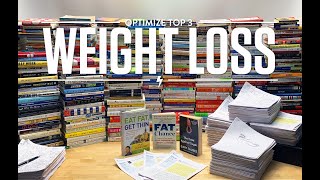
Brian Johnson picks three weight loss books and the core idea from each: optimize your metabolism, not just calories. Sugar and fast carbs spike insulin and leptin. His rules: cut sugar drinks, skip ultra-processed food, eat within an 11-hour window, keep your waist-to-height ratio under 0.5.
Chapters
Hey guys, what's up? This is Bry back with the Optimized top three favorite books All Time series. Today we're going to talk about my favorite books on weight loss. So in our last edition we focused on my favorite books on nutrition. I think we still got those hiding back there. Food Fix it starts with Food Happiness Diet. We've got some other near top threes. Always Hungry by David Ludwig, why We Get Fat by Gary Taubs, etc. But today I want to talk about weight loss books. Now these are slightly different. Nutrition is just kind of a general concept. But if you are carrying more than the optimal amount of weight, then what we need to do is optimize your metabolism such that your optimal weight is a natural byproduct of those mechanics getting in place. So that's how I approach this. We've got these three favorite books of mine, the Philosopher's Notes and of course I just not of course. But I do also distill this into a 101 where I take my 10 favorite big ideas and then share them in the context of an optimal living 101 masterclass hour long. Got this worksheet Optimal it's not even weight 101. It's optimal metabolism 101. How to optimize our metabolism to easily sculpture ideal bodies while energizing and actualizing that scale says ideal weight. Let's do this again. 10 ideas in the 101. You can get instant access to that in everything. All the Philosopher's notes, all the Optimal Living 101. All 50 of these classes at Optimize Me as part of that free two week trial, et cetera. Of course. For now, top three favorite books on optimizing our metabolism are Fat Chance by Robert Lustig, who's one of the world's leading endocrinologists at UC San Francisco. Beating the odds against sugar, processed food, obesity and disease. I'll talk to you about why that is on the top three list and the number one idea I got from it that we talk about in the philosopher's note number two, eat fat, get thin. Mark Hyman, M.D. we covered his food fix in my favorite nutrition book. I trust Mark Hyman. He's a functional medicine doctor. He's tried everything, vegan, paleo, everything in between. And I just really trust his approach. He's not dogmatic. A lot of people who are in any given camp tend to get dogmatic and cherry pick data. Again, it's impossible not to at some level. But I really, really, really respect Mark's perspective. In this book, we'll talk about why it made the top two. His perspective as a functional medicine doctor deeply influences me. And then the third of our top three is the case against sugar by Gary Taubes. Again, you want to get your metabolism right, you need to eliminate sugar and fast acting carbs. That's the short story and that's what each of these three books describes to us. So with that, let's take a look at my favorite ideas. I'm going to grab my notes over here. Top three, weight loss. Oh, yeah. And then we've got the coach program where we take all of that and distill it into an eating module that you might enjoy as well. Optimize me coach. It's actually astonishing to me how many of our coaches lose more weight than they ever thought possible. And now easily, inevitably, we did a scientific project on this, asking them before and after how easy it was for them to follow their nutritional philosophy and maintain their ideal weight. The numbers are astonishing. And we challenged them to get to the less than 0.5 waist to height ratio, which is actually the number one thing I got out of fat chance. So reading this book, Robert Lustig tells us that tells us a lot of stuff. But the surprising truth about fast acting carbs, Sugar. Oops, wrong book. And sugar, the Darth Vader of the food empire world. Then we gotta understand our insulin and our leptin. How our insulin, which stores fat and our leptin, which controls hunger, get disrupted when we eat too much sugar. Then he talks about fat. Big butt, not such a big deal. Big belly, very big deal. Your visceral fat. And this is the number one idea from this book for me. Your visceral fat is the greatest predictor of your morbidity. Now, one way to measure that is your waist to height ratio. You want that to be less than 0.5. Dr. Lustig actually talks about a simpler measure of just your waist circumference. But we use a little bit more nuanced approach with our optimized coach program. What we encourage our optimizers to follow, which is less than 0.5, is what you want your waist to height ratio to be. So I'm 72 inches tall. As a six foot tall guy, my waist can be 36. It's closer to 31. All right, perfect. I'm fine. So what's your waist circumference? What's your height in inches? Divide it and see. Where are you? Less than 0.5 or greater than 0.5. Know that that's the cutoff. You want optimized visceral fat less than 0.5. That's a really, really big idea. Again, if we want to optimize our lives and be the best version of ourselves and serve heroically and all that, we got to be alive. And that's going to be the number one predictor. And again, we've got to know that that is being driven that unhealthy insulin and leptin hormonal responses being driven by the Darth Vader of the food empire, sugar and then also fast acting carbs. Now moving on to Eat Fat Get Thin by Mark Hyman. So now why I chose this book as the number two slot is Mark does a brilliant job of juxtaposing what's called the metabolic theory and the energy balance theory. This is part of a much, much longer conversation, but and we talk about it as well in our notes on Always Hungry by David Ludwig. Gary Taubes talks about this a lot in the case against sugar and then also why we get fat. Good fat calories, good calories, bad calories, etc. Long story short, most of the nutrition world and all of the junk food industry wants us to believe that it's about energy balance. Calories in, calories out. Of course that plays a role, but it is not the determining factor in whether or not our insulin is optimized. The determining factor is whether a metabolism is optimized. And that says unequivocally that a calorie is not a calorie. Right? Mark says in Food Fix, any third grader can tell you that a thousand calories from Coke is different. Coca Cola is different than a thousand calories from broccoli. A calorie is not a calorie. Different calories, whether it's sugar or ultra processed carbage, fast acting carbs affect your body differently than proteins and fats or even a slow metabolized carbohydrate. This is just, that's just common sense. Like you think about it for two seconds. Of course it doesn't, it isn't the same. But we're convinced with unbelievable amount of money spent by the junk food industry on junk science and junk scientific research that no, no, no, you don't need to worry about the junk food. That's not the problem. You're just not exercising enough. It's an energy balance issue. And again, I talk about this a lot more in optimal weight metabolism one on one. And of course we go off on it in our Mastery series. For now, I'm going to leave it at that. Metabolic theory versus Energy balance. Check out the note for more on it and then check out all the notes on the subject if you're inspired to learn more. Moving on to our third in the top three, Gary Taubes. So I love this book, the Case Against Sugar. Taubes is a journalist out of UC Berkeley, across the bay from Robert Lustig. I dropped out of law School at UC Berkeley, Bolt Class of 2000. So when I think of Berkeley, I have fond memories. Anyway, Gary Taubes, the Case Against Sugar. He basically says, look, let's look at what's driving chronic disease, right? And he basically sets it up as the case against sugar as if this were a criminal case and you were looking for the prime suspect. That's the trigger for all of the chronically sick people in our society. The two thirds who are overweight, almost one in seven is diabetic. One in four to five will die of cancer. Yet the prime suspects for the dietary trigger of these conditions have been, until the last decade, treated as little worse than a harmless pleasure. That would be sugar, he says. If this were a criminal case, the case against sugar would be the argument for the prosecution. This is a really compelling book. Again, sugars are the cause of disease. As the cause of disease, the prime suspect. Is sugar a drug or is it a food? Interesting conversation. Susan Peirce Thompson has the same conversation in Bright Line Eating, which is another great book that almost made the cut. I highly recommend everything. Susan does Bright Line Eating in the Bright Line Eating Cookbook. Check those out. She also is a luminary in our Optimized Coach program. And then again, he talks about the energy balance versus metabolic theory and toxins, acute versus chronic. Now look, if sugar made you sick instantly, just killed you, of course that would be an acute toxin. We wouldn't eat it. Unfortunately, it's chronic. It accumulates over time. And guess what? Sugar is often described as candy for cancer cells. Stop feeding your cancer. That's the case against sugar and why I love it so much. This has deeply influenced our work. In fact, it's one of our top three optimized food rules that we talked about in the Top three on nutrition. Check out the Top three episode on nutrition for more. In terms of the other books that are great, but definitely check out the notes on David Ludwig's Always Hungry why We Get Fat. Susan Peirce Thompson, as I mentioned Bright Line Eating and her cookbook briefly, the optimized food rules are these three plus one. Number one, stop drinking sugar. That's sodas and fruit juices. This is Mark Hyman's number one tip from Food Fix. I see you back there, Food Fix. Of course Gary Topps talks about it, Robert Lessig talks about it a ton and Mark talks about same ideas. Neat fat, get thin. That's rule number one. Stop drinking your sugar. Parents fruit juice is not a health food. 2. Throw out the factory food. Eat real food. Throw out the factory food, ultra processed carbs, the factory farmed animals, and the factory fats. Again, a longer chat, but those three fall into the second rule. The third rule is have an eating sunset. Stop eating, give yourself the night off and have 13 hours between your last meal and your first meal the next day. Again, research has shown that that decreases recurrence of cancer, et cetera. 13 hours between your last meal and your first meal. Can you do that? If you can't, you probably have metabolic issues. Perfect. Read the notes, get clarity, get your insulin dialed in, your leptin dialed in. It'll be easier for you to go an extended period of time. Let your body do the autophagy and overall cleanup it needs to do at a cellular level that it can't do if you're eating all day every day. So again, want to optimize your weight, optimize your metabolism? Check out these notes. I hope they're helpful. I hope the class is helpful. We've gotten a ton of feedback on all of it. And then again, we've got the optimal nutrition 101 as well. That's all I got. Hope you enjoyed. Goodbye books again as always, for those who may not have heard me say this before, optimize me for the free trial. Two weeks free. Join a ton of people, hope you enjoy and then Optimize me. Top three if you want to follow along with the series of top three books, all of our fundamentals eating, which we just did before this one, weight loss, moving, sleeping, breathing, focusing, celebrating life, prospering habits, books, ancient wisdom, modern science, etc. All right, that's all I got for now. Have a great day. See you.
More from Brian

Heroic +1: What’s THE Most Creative Act in the Universe?: Turning Around Glitches (#2024)









