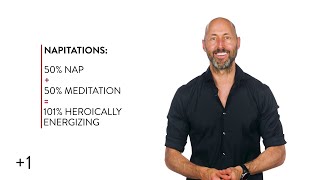
A short YouTube episode (Brian Johnson, Heroic +1) introducing the concept of “napitations” — a blend of napping and meditation — and summarizing scientific and historical support for daytime naps. The speaker cites Sarah Mednick’s book and historical practices (Roman sexta/siesta) and lists multiple health and cognitive benefits attributed to napping.
Chapters
Hi, this is Brian. Welcome back to another heroic plus one. Today I want to talk about napitations.
Napitations? Yes, napitations.
50% nap, 50% meditation, 101% heroically energizing. We actually talked about this forever ago in plus one number 326. Here's the deal. In short, science says naps are powerful. In fact, Sarah Mednick wrote a whole book about the power of naps. It's called take a nap, change your life. Check out those notes. Did you know that every animal species but humans takes a nap during the day?
Yep.
Every other animal is multiphasic, meaning that they have many phases of sleep. Homo sapiens are modern industrialized variety. Anyway, Dr. Mednick tells us, stand alone in attempting to satisfy the need for sleep in one phase. As a Roger E. Kirk, one of the few historians to study sleep, put it, napping is a tool as old as time itself. Did you know that the Romans set up their masterpiece days to include a time for naps?
Yep.
I quote again.
By the first century B.C. the Romans had divided their day into periods designated for specific activities such as prayer, meals and rest. Midday became known as sexta, as in the sixth hour, noon by their way of counting, a time when everyone would go to bed. The word has survived in the familiar term siesta. And did you know that there are at least 20 good reasons to take a nap? Yep. According to Dr. Mednick, you should nap.
If you want to.
And I quote again, increase your alertness, make better decisions, preserve your youthful looks, lose weight, reduce your risk of heart attack and stroke, improve your stamina, elevate your mood, boost your creativity, reduce stress, reduce dependence on drugs and alcohol, alleviate migraines, ulcers and other problems with psychological components. Improve the ease and quality of your nocturnal sleep.
And she says, because it feels good.
And that's a quick take on the why. Here's the quick take on the how for napitations. Or at least how I do it first, decide it's worth the experiment, then go all in. I personally go into the old bedroom, put in the earplugs, put on the noise canceling headphones to make it quiet. Then I pull the blackout curtain shut to make it dark. Then I hop in bed, pull the covers out up and act like I mean business as I put on my eye mask, little thing. Then I clear my mind as I do my go to breath count and completely relax my body. I breathe in through my nose, down into my belly to a count of six. I hold for one and I exhale back out through my nose for a count of eight. Ah. Repeat thoughts arise. Perfect back to our breath count, completely relaxing our body and boom. Science says that a nap as short as 6 minutes can have incredibly positive benefits. I find that after 7, 11 or 15 minutes I am surprisingly re energized and ready to go dominate the rest of the day Napitations. They do a hero good. Try one today.