PhilosophersNotes TV Episode #1
Brian Johnson launches Philosopher's Notes TV, a daily YouTube series distilling 3-5 big ideas from books like Marcus Aurelius, Emerson, and Tal Ben-Shahar into 10-minute episodes. He'll cover 25 books spanning classic philosophy to modern self-help, with occasional queued episodes and community discussion.
Chapters
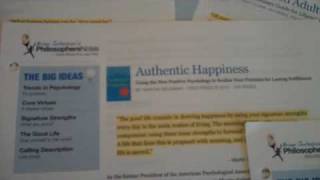
Foreign. Hey guys, this is Brian with my lovely goddess Alexandra, who's making some yummy tea and food. Thank you, darling. So this is Philosopher's Notes TV episode number one, take three. I've done a couple of first ones. They didn't quite come out the way I wanted to. Let's say hi to Alexander through there. Hi, darling. But what we have here in the dining room, I have all 100 of my first 100 philosopher's notes. And what I'm going to do with Philosopher's Notes TV is I'm going to record 10 minute. None of the shows will be longer than 10 minutes, but 10 minute episodes on each of my notes. And what I'm going to do is I'm going to pull out three to five of my favorite big ideas. So as you know, if you're familiar with the notes, each of the notes has about 10 big ideas in it. So I pull out some of my favorite big ideas from these great books. So this one, for example, is the Success Principles by Jack Canfield. Awesome book. And it's seriously just one long quote and a bunch of big ideas. But I pulled out 10 of my favorite ones and we'll go through a handful of those in 10 minutes. So it usually takes me 20 minutes to record this as an MP3. This six page PDF. We're going to bust through it in 10 minutes and see what we can do. So as you know, I have top 10 old school classics. I have 20th century, 20 20th century classics like Joseph Campbell, Osho, Krishnamurti, etc. Old school guys. And then we've got like 45 modern classics from Tolle Dyer, Deepak, Paulo Coelho, etc. Dan Millman, etc. Then we've got some positive psychology books that I love, the Science of Happiness and then some abundance books. Now I was sitting here and they were all neatly organized about five minutes ago and I was looking into and feeling into which ones do I want to do first? And it was really hard for me to decide because I love all of them. But here's a quick look at the 25 of them that I'm going to do first. We're going to start old school style. Actually, I probably won't go in this order, but I love Ralph Waldo Emerson, classic transcendental philosopher who really in many ways is kind of the grandfather of the personal development movement. 19th century rock star Ralph Waldo Emerson. We will kick butt with him. Meditations by Marcus Aurelius. He's that old guy in the movie Gladiator. He's the old emperor, Roman emperor, Stoic philosopher. One of my favorite guys. I actually studied his stuff in the Danube of Hungary where he wrote this book, Meditations. Really cool. How about how to Stop Worrying and Start Living by Dale Carnegie, the guy who wrote how to Win Friends and Influence People. This is a really cool book. We've got some fun ideas if you have any worrying in your life. I've definitely mastered the art of worrying, so this book was really helpful for me. How about the Fountainhead by Ayn Rand? How about the dishes going on over there in the kitchen? How about the Fountainhead by Ayn Rand? This is awesome. 700 page book. We will break it down in 10 minutes. It'll be a lot of fun. She's powerful. Love her stuff. How about the Magic of Thinking Big? Really fun. We'll explore some of the big ideas there. He's got some funny stuff like excusitis and stickability and all these other words that I just love. We'll rock that one. How about Mastery by George Leonard? Really cool book. All about the idea that it takes diligence and making our life a practice. Right? And actually putting in the effort to achieve the level of happiness we want, which all these great teachers talk about. And I'm not about anything quickly for me you can have a nice experience. But then we need to do the work to really make sure that our lives are, you know, optimize whatever you want. So mastery is all about that. We'll talk about Spiritual Liberation by Reverend Michael Bernard Beckwith, the guy from the Secret who has a church out here in LA called Agape. He's awesome. This note is really cool. We're gonna have fun with the TV show on it. The Success Principles. Jack Canfield's a rock star. Chicken Soup for the Soul. The book is amazing. We're gonna have fun going through some of my favorites there. The Power of Full Engagement. Another great book. They looked at athletes and the top performing athletes have a certain way of showing up that's different than the next tier. And they apply these ideas to life. Really good stuff. How about the Pursuit of Perfect? I'm a huge fan of positive psychology. Tal Ben Shahar, the author of this book is probably my favorite teacher right now. He wrote another book called Happier which is right here. We're going to do. These are two of my favorite books. We're going to look at the Science of Happiness applied in a really fun way. So we'll have fun with those. The Six Pillars of Self Esteem by Nathaniel Brandon. This guy was in a relationship with Ayn Rand since he was an incredibly young guy, maybe like 18, 19, 20 years old. And Ayn Rand viewed him as, in a lot of ways, the quintessential hero of her novels. He embodied those ideals, which is pretty impressive. And the guy is incredibly articulate. So we're going to look at his six pillars of self esteem. Those are fantastic. We're going to do the Secrets of the Millionaire Mind. It's a really fun book by T. Harv Eker. He's got some great big ideas. I've got a lot of them in this one. We'll cover a handful of them. Getting our wealth on in challenging economic times. Then we'll look at spiritual economics. Great book that totally transformed my relationship around money. We'll look at Think and Grow Rich, the classic super fun book. Lots of big ideas in there. We'll go over the seven Spiritual Laws of Success by Deepak. This book totally changed my life. His seventh spiritual law of success, the Law of Dharma, is the reason why I'm doing Philosopher's notes in many ways. So we'll look at that. We will look at the Science of getting rich. This book was the inspiration for the movie the Secret. And we'll look at the Science of getting rich. It's actually really cool. Wallace D. Wattles is a great guy and we will have fun with that. We'll look at Authentic Happiness by Martin Seligman. I thought I was going to give myself a PhD in psychology for a while and if I would have, I would have wanted to study with him. And I actually did a, I don't know, six or ten week course with him shortly after this book came out. And we'll go over some of the big ideas in this one. The Science of Happiness. I understanding your signature strengths. That's going to be a really cool episode. Motivation and Personality by Abraham Maslow. He's kind of my spiritual great grandfather and I love the guy. He in a lot of ways is the grandfather of the positive psychology movement. Really good dude. Happier by Tal Ben Shahar. We already talked about how about the Seven Habits of Highly Effective People. This was probably the first book I read while I was still at UCLA as an undergraduate. Was introduced to this book and just amazing stuff. So we'll look at the seven Habits. We'll look at a few of my favorite ones and how we can apply it to our lives. How about the Four Agreements? We'll go over the four Agreements. That's a really powerful book. Totally transformed my life as well. How about integrative nutrition? My goddess Alexandra is studying with this guy Joshua Rosenthal right now. And this is a really, really, really good book on integrative nutrition. So all the ideas that go into healthy living, essentially, he talks about the importance of primary foods, right? So before we even consume our food, we need to look at our spirituality, we need to look at our relationships, we need to look at our professional creativity. We need to look at our movement and exercise. He calls those primary foods. We'll talk about that. That's going to be fun. How about how to Think Like Leonardo da Vinci by Michael Gelb. This book is another huge inspiration for me. I read it shortly after I sold my first business. Totally transformed my life. We've got an exercise in here called 100 Questions that We're going to go over. That's awesome. I recently met Michael Gelb at a conscious capitalism retreat and let him know that this book changed my life. And he said, well, that made my day. And I said, well, you know, you made my life, helped make my life. So it's a pretty good trade. So that's exciting. We're going to do that episode, and I'm also going to be interviewing him and all these other authors who are still alive and talking about their big ideas, too. But that's a separate thing we'll be doing soon. And then finally, out of the top 25 notes, I'm excited to do Happy for no Reason by Marci Schaimoff. She's awesome. This book is great. A really fun kind of chicken soup for the soul meats positive psychology. Look at how to integrate these scientific truths into our lives. So that's a whirlwind tour of 25 of my favorite notes. And I have a hundred of favorite notes, really, but those are 25 that I'm really fired up to bring to you on Philosopher's Notes tv. This will be the first episode. I will be doing these daily. So excited about that. I might queue up some on occasion if I'm going to be out of town or whatever, but that's the basic idea. I'm also going to do PNTV Philosopher's Notes TV episodes on just big ideas that inspire me. So whenever I have an idea that I really want to share from a book I'm reading or a distinction I make, I'm just going to turn on this flip cam and share with you what's inspiring me. So that's the basic idea. I plan to do a lot of these over the next several years, and I really hope you enjoy. I also want to encourage comments and discussions and really build just a vibrant community around these ideas. And let's go out and rock our greatest lives. So there you go. Hope you enjoyed and so excited to share. Have an awesome day. See ya.
More from Brian

Heroic +1: What’s THE Most Creative Act in the Universe?: Turning Around Glitches (#2024)









