PNTV: 10-Minute Toughness by Jason Selk (#173)
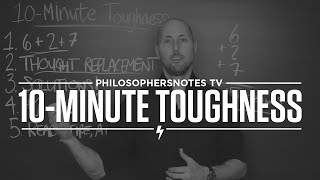
A short PNTV (Philosopher's Notes TV) video by Brian Johnson summarizing five core ideas from Jason Selk’s book "10 Minute Toughness": a 15-second breathing pattern (6-2-7), thought replacement, relentless solution-focus, the "plus one" process game, and a 'ready, fire, aim' action bias. The video is a practical guide to brief daily mental-training practices for athletes and professionals to regulate physiology, replace unhelpful thoughts, and favor action and small wins over endless planning.
Chapters
Hi, this is Brian. Welcome back to Philosopher's Notes TV. Today, another great book, 10 Minute Toughness by Jason Selk. 10 Minute Toughness. Great book on mental training. We've been doing a lot of great notes on these great books. Mental training. We've got Mind the Art of Mental Training With Winning in Mind Attainment. Now this book and a bunch of other ones. Jason Selk is the consultant, the sports psychology consultant for the St. Louis Cardinals. And he trains a ton of professional athletes and all that good stuff, business executives on how to get their minds right. What makes this book great is that a lot of the other books talk about the general kind of what he says. And he says how use this 10 minute practice that he encourages us to, to rock and integrate into our lives in order to get your minds right in a systematic way. Check out the book. I talk about it a little bit more in the notes here. But today we're going to look at five of my favorite big ideas, starting with the first one. Six plus two plus seven. Six plus two plus seven. First, let's do the math. Six plus two plus seven. If my math is right, that equals 15. 15 what? 15 seconds is how long we want to breathe. So the first step toward getting our minds right in this plan and in every other mental training plan, whether it's a sports psychologist or a peak performing coach or a cognitive therapist or a willpower scientist or a Buddhist meditation teacher, what they're going to teach us is if you want to control your mind, you need to start by controlling your physiology. And the best possible way to do that is to control your breathing patterns. It's within our direct control. And his little pattern here is great. We've done a lot of inhaling to four, exhaling to six, which is fantastic. I really like this. Inhale to six, hold for two and then exhale for seven. I like it for several reasons. One, it's a nice deep breath. He says if you get to 15 seconds, you officially took a deep centering breath. And I also like the fact that it forces us to count by forcing us to count and doing the 1, 2, 3, 4, 5, 6 on the inhale, 1, 2 on the hold, and then 7 out. We're putting our mind's attention on the counting, which is a great way to take it off of whatever might be stressing us out. Really cool idea. So let's do it right now. Inhale to 6, hold for 2, exhale to 7, Hold for two, exhale for seven. Inhaling to 6, Holding for two, exhaling for seven. I love doing these breathing exercises. And as I say in my classes, we do these breathing exercises often throughout the classes, practice this. Practice this breathing technique. Not just when you need it, when you're stressed out. If that's the only time you try to do this, you won't do it. Then you got to practice it throughout your day in the most mundane environments. You're in your car, in traffic, don't complain, turn off the radio and breathe. You're in line at the grocery store, take an opportunity to breathe. And if you do this type of actual 10 minute practice, this is how it starts with a centering breath. And then it's how it ends with a centering breath. Big, big idea. Get your breathing on. That's the first big idea. Now as we get our breathing right, we obviously need to get our minds right. He's got a great big idea. Thought replacement. Basic idea here is you can't have two thoughts in your mind at the same exact time. Not possible. So when you find yourself having stressful, anxious, not so helpful thoughts creeping up, as we always, we often do at different times, right? Notice that. And then discipline yourself to quickly, powerfully replace that thought with something aligned with your goal, something more positive. He has a bunch of different ways that we can do that. But just understand this fact that your thoughts cannot. Two negative thoughts, two thoughts that are opposite of one another cannot coexist at the same time. You can't have two thoughts at the same time. You can't have two feelings at the same time. If you're feeling super tight and stressed, you can't simultaneously do the breathing we just did and feel that tension. You just can't. I forgot to mention in the first idea, if you can't get yourself to breathe for 15 full seconds, then you really need to breathe for 15 full seconds. And he does this with his athletes. They're in a pressure situation. He shares a story about watching one of his pitchers, Major League Baseball pitcher on tv. And the young pitcher is having a tough time and he's sitting there watching him saying, breathe, breathe, come on, breathe. And he didn't do it. He wound up, you know, having a really tough inning, got yanked and he talked to him afterwards and the pitcher thought that he took a deep breath, but he didn't. So if you don't, if you aren't able to get all the way that 15 second breath in, then you really need it. Keep that in mind. And again, remember, you cannot have two thoughts simultaneously in your mind. He shares a story about A pink elephant. If I tell you right now, don't think of a pink elephant, most of the time that little guy creeps into our mind and it's kind of hard to get him out. But the reality is that's actually a really easy game to win. If you want to get the pink elephant out of your mind, all you have to do is intensely think about something else, anything else. Think about the blue sky or a black elephant for that matter, or a huge ocean or whatever inspires you. Think intensely about something other than other than the pink elephant and he'll or she'll get right out of your head. It's the same thing with negative thoughts. When you think a positive thought, a way you want to feel about yourself or something you're excited about in terms of a goal you're pursuing, it will naturally kick out the negative thought. It's a really big idea. Again, all great teachers talk about this. That's the second big idea. The third one is solutions. He says if you want to be mentally tough, you need to quit focusing on problems. And relentlessly. He uses this word relentlessly. Relentlessly. Relentlessly. Focus on solutions. Always. All the time, focus on solutions. Most of us, unfortunately, most of the time are talking about problems, criticizing, we're gossiping, we're blaming, we're whatever, complaining. We're thinking about the problem, what's not right in our lives. We need to relentlessly focus on what we want. Think about what you want. And when you have a problem or a challenge, ask yourself one very simple, powerful question that Jason recommends we think about. What is one thing I could do that could help this situation, that could improve this situation? One thing you don't need to do 122 things. One thing, you don't need to be perfect. Just do one little thing. Always have a solution on the board. He says, always. And never say in response to that question of what is one thing you could do to improve the situation? Never say I don't know. He has this game called the I don't know game. You can't play it. You cannot say, I don't know. That's the game. Can't say I don't know. Imagine that. It's a great way to build your decision making muscles and your solution making muscles. Find a solution. Next big idea is related the plus one game. He talks about the fact that we need to make process primary. All these teachers do. If you're obsessing about the outcome and not putting enough time into what you need to do in order to Achieve the outcome. You will both stress yourself out and not achieve that which you want to achieve. That's just a fact. Now he says play the plus one game. He calls it the plus one concept. I like to call it the plus one game. So what's a little thing you can do right now to move yourself in the direction of your dreams? How do you set up little wins? Knock over those dominoes we talk about. Don't obsess about the huge one. Know that your greatness, your excellence, your ultimate potential is only going to come as a function of you knocking over smaller goals. Then all you need to do is focus on the next one plus one. That's the game you want to play. The final big idea here is Ready, fire, aim. Most of the time, people obsess on this part of it. Aim, aim, aim. Oh, let me get it right. I want to make sure it's perfect. Aim, aim. Endless aim. They never shoot. He quotes Lanny Basham, who we featured with winning in mind. Phenomenal book gold medalist shooter who says, look, most people focus on the aiming all the time. You need to shoot. Only when you shoot can you see how close you are to the target. You don't need to get a bullseye on your first shot. You won't. Oh, well, I'm a little off or I'm a lot off. Let me correct. Oh, well, I'm still off, but no big deal. I'm a little closer where I learned a little bit more. And you keep on doing that and calibrating, not in seconds and minutes, but in days and more likely weeks and months and years. You're going to hit the target more and more consistently. If you're willing to give yourself decades, you'll be surprised how quickly you'll get really good by being willing to Ready, fire, aim. In the note, I share a story. John Mackey, the CEO of Whole Foods, became a friend and mentor and investor my last business years ago. And I learned this idea from him. Ready, fire, aim. He created Whole Foods, one of my most the companies that has inspired me, the most conscious capitalism, etc. And he built it on a lot of principles. But one of them was this. Just get out there and do it. And I interviewed him. I'll share a link to that below. And I asked him about this. I said, hey, you know, as a recovering perfectionist, I really got a lot out of your ready, fire, aim thing. And he laughed and he said, I actually prefer fire, ready, aim. Just go for it. Yeah, there are some things in your life that you don't want to do that with like a pilot taking off or a surgeon. You want to go through certain steps in the process. But for most of us, most of the time, we can afford to be in action more often and earlier. When you're in action, you can learn. And when you have a growth mindset, that's all you want to do. You don't care about looking good and always being perfect. You want to get better. The only way to get better is to be willing to shoot again and again and again. So there you go. Five quick, big ideas. Ready, fire, Aim. Just go for it. Put yourself out there. Learn a little bit. Get a little better. Play the plus one game. Know that you're going to progressively get better into excellence and let your goals be a byproduct of that commitment. Solutions. Obsess about solutions. Be persistently and relentlessly solution focused, not problem focused. Quickest way to move from a victim to a creator is to shift from complaining to saying, what do I want? What do I want right now? And then how can I take a baby step toward it? Thought replacement, Negative thought. Bump it out with a positive thought. Big idea. And then six plus two plus seven. Let's wrap it up with one more deep breath. 15 seconds. Inhale to six. Hold for two. Exhale for seven. That feels good. All right. Hope you enjoyed. Look forward to sharing more with you soon. Have another awesome day. See you.
More from Brian

Heroic +1: What’s THE Most Creative Act in the Universe?: Turning Around Glitches (#2024)









