PNTV: 100 Ways to Motivate Yourself by Steve Chandler (#101)
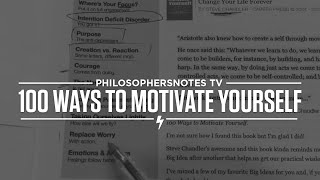
Brian Johnson breaks down Steve Chandler's motivational lessons, including the idea that courage comes from doing, not from feeling brave first. Chandler argues purpose works like an antidepressant and that most people suffer from intention deficit disorder, treating worry as something to replace with action.
Chapters
Hey guys, what's up? This is Brian. We've got a Philosopher's Notes TV episode on 100 Ways to Motivate Yourself and change your life forever by guy named Steve Chandler. I'm not sure how I got introduced to his work, but I'm glad I did. He's a super funny guy, super wise, passionate. I dig him. He wrote this book 100 ways to motivate yourself. Another one called time warrior and another one called wealth warrior and some other ones that are great. Another I have notes or will have notes on all those books. For now, let's take a quick look at this great fun little book and check it out. I think you'll really dig it. You can check him out@stevechandler.com 100 Ways to Motivate Yourself. Here are a few of my favorites. Intention deficit disorder. That's a good one. Purpose is an antidepressant. That's pretty awesome. Creation versus reaction. Same letters, different order and different mojo. The fact that courage comes from doing that's good. The news. It's not news, it's bad news. Look at that. Prove the pessimist wrong. We've got to have attorneys and bouncers in our head. That's pretty cool. Taking ourselves lightly in order to fly. That's a good one. We want to replace worry with action. What needs to get done? Go do it. And then emotions and actions. Feelings follow behavior. Oops. Finger. Important to know. So let's cruise through here. We're going to skip. Where's your focus? It's a really good idea, but we don't have time for it in this 10 minutes. Procrastination. It's a big idea on procrastination. I'm going to come back to that. We'll do a whole other video just on procrastination for now. Intention deficit disorder. Such a great idea. He says once we get the picture of who we want to be, definitely planned work is the next step on the path. Definitely planned work inspires the energy of purpose. Without it, we suffer from a weird kind of intention deficit disorder. We're short on intention. We don't know where we're going or what we're up to. Intention deficit disorder. Just love that idea. If we don't know what's important to us, we don't have a clear intention. We're going to suffer from intention deficit disorder. Not a good place to play. The antidote is again, finding intention, having a clear sense of what we want to do and a clear, definitely planned work path. And then our Deeper purpose, which is really an antidepressant, as Chandler says and all the great teachers say. He says it is impossible to work with a definite sense of purpose and be depressed at the same time. Carefully planned work will motivate you to do more and worry less. So I challenge you, go work with a definite sense of purpose and try to be depressed at the same time. It's impossible. It's an antidepressant. Get on that next one is creation versus reaction. Never knew this, but those words, creation versus reaction or end reaction, Same exact letters. They're an anagram of one another. Reaction, creation. Very, very different, though. Are you reacting? Are you constantly responding habitually to your life circumstances? Or are you choosing your most empowered response? Being proactive, coming from a creation, a creative mindset. Huge distinction. We talk about this all the time. Pay attention to choose the most creative, empowered response. Good stuff. Courage comes from doing. Emerson once said, the greater part of courage is having done it before. And that soon became true of my speaking in public. Chandler says, fear of doing it can only be cured by doing it. And soon my confidence was built by doing it again and again. This is awesome. We think we need to wait until we have it all figured out, but the reality is we need to do it, and we figure it out by doing it. And we get our confidence and our courage through the action of moving through our fears and trying again and again and again. We've got some great Emerson quotes in here. God will not have his work made manifest by cowards. That's a big one. Always, always, always, always, always do what you're afraid to do. Do the thing you fear. And the death of fear is certain, at least of that particular fear. We have a whole video on how to conquer your fear in 30 seconds. Check that one out. In the optimal living 101 series. The fact is, we're going to have different fears, but we need to move through them and develop new fears, new edges that we're playing on really powerful stuff. So remember, the fear of doing it can only be cured by doing it. You don't get confident before and then do it. You do it and then you get confident. The news is not the news. The news is not the news. It's the bad news. It's deliberate shock. Chandler worked as a journalist for a while and he talks about just how terrible the whole industry is and how they're literally hooking us with the worst stuff you can possibly imagine, because that's what keeps our attention. That's what sells horrible. Don't plant that seed and those seeds in your mind. He says we pay more attention to what we put into our car than we do in what we put into our minds. So get some high octane fuel. Quit watching the news. It's terrible. Next big idea. Prove the pessimist wrong. He says we need to start to argue against your first line of reasoning. He says. Pretend you're an attorney whose job is to prove the pessimist and you wrong. Start off on building your case for what's possible. Too often we look at things and we think that there's only one perspective. Well, let's choose the most empowered perspective. I talk about some ideas here from Alan Cohen. Imagine you have two lawyers in a courtroom inside your head. One's arguing for the worst case, one's arguing for the best case. Guess who's going to win? Who will win that battle? The lawyer whom you pay the most. But the way you pay these lawyers is not with money. It's with your attention. So where are you putting your attention? Put it on the good stuff. Empower the lawyer who you want to win. Empower the optimistic, most empowered perspective you can in your mind. This is really cool. Prove the pessimist wrong. Alan Cohen has another idea. Act like you have a bouncer in your head who's responsible for kicking out the negative thoughts. It's not about being unrealistic, but it's unrealistic to focus on the negative. Life is extraordinary and we always have the opportunity to choose the most empowered response. Have a bouncer in there kicking out the useless thoughts. The two lawyers pay the one who you want to win really, really well with your attention. Next big idea. Take ourselves lightly. Taking ourselves likely lightly. Chesterton says, after all, it's because God's angels take themselves so lightly that they are able to fly. Love that. I go to my whiteboard often here. It's all a game. Don't take yourself so seriously. I tell a story in this note about a great. Where is it from, this idea? From the Art of possibility. Rule number six, really funny short story is don't take yourself so seriously. Life isn't that big of a deal. Here we go. Replace worry with action. Replace worry with action. Don't worry. Or rather, don't just worry. Let worry change into action. Worry to action. Worry to action. If you want to stress yourself out, think about what's going wrong again and again and again and again and again. Get your worry muscle all worked up and you will create exos. Move that worry into action. Do the most constructive thing you can and what you'll find when you do that is that your energy, your emotions will actually follow your actions. A lot of times we think we need to be happy before we take action. Once I'm confident, then I'll do it. It's not the way it works. You get confident by doing it, as we just discussed. And you get happy by doing the things you know you're here to do. He quotes Chandler, quotes William James who says, we do not sing because we are happy. We are happy because we sing. That's amazing. Most of us confuse it. We get it in the wrong order. Action leads to emotion, not the other way around. Action leads to emotion. We talk about some other great ideas here. Constructive Living is another great book. I'll do a. No, I already have a video on that. Check it out. He says behavior wags the tail of feelings. We do. Then we feel. It's an amazing distinction. Behavior wags the tail of feelings. We do. Then we feel. We do not sing because we are happy. We are happy because we sing. So what do you need to be singing that's going to make you happy? Go out and do it and you will find that your emotions follow your action. Super, super cool stuff. I know that when I record these videos I just have such great days and it's amazing. It's hard to have a bad day when you're recording a couple of these videos a day. Action creates emotional states. Really cool stuff. What do you need to do as you figure that out? Think about your intention deficit disorder and how you're going to solve that purpose. As the antidepressant. Change the order of reaction, you get creation. We want to lean into that. The good news is not good news. It's not even news. It's bad news. Courage comes from doing. Prove the pessimists in your head wrong with the bouncer and the attorneys. Take yourself lightly and replace worry with action. Then your emotions that you want to experience will flow. There you go. Hundred ways to motivate yourself. Less than 10 minutes. Some of my favorite big ideas. Hope you dug it. Check out Steve Chandler. He's got some good stuff. Alright, have an awesome day. Look forward to sharing more with you soon. See ya.
More from Brian

Heroic +1: What’s THE Most Creative Act in the Universe?: Turning Around Glitches (#2024)









