PNTV: 12 Rules For Life by Jordan B. Peterson (#372)
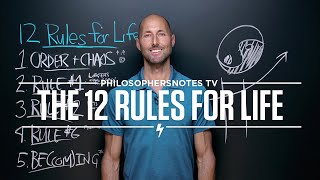
Brian Johnson breaks down Jordan Peterson's 12 Rules for Life, which centers on balancing order and chaos through responsibility. Stand up straight, treat yourself like someone you care for, compare yourself only to your past self, and fix your own house before criticizing the world. The core idea: being is becoming, a constant process of self-improvement.
Chapters
Hi, this is Brian. Welcome back to another episode of Philosopher's Notes tv. It's been a while. I'm excited to be back with a great book. 12 Rules for Life by Jordan B. Peterson. 12 Rules for Life subtitle and Antidote to Chaos Jordan B. Peterson, as you may know, is one of the world's leading intellectuals. He is a clinical psychologist and professor at the University of Toronto, used to be at Harvard. Brilliant, brilliant guy. His style reminds me of Yuval, Noah Harari and Ray Dalio, two great thinkers we will be featuring soon. And this book is all about how we can shoulder more responsibility and give ourselves heroically to the world. It's phenomenal. We've got five big ideas we will take a look at, of course, philosopher's note, etc. Let's start with order and chaos. Why do we need rules? Because if you haven't noticed, there's a lot of chaos in the world. Peterson says throughout the book, rule number one of life is there's a lot of suffering. From Buddhism, Christianity, to all the great wisdom traditions, we learn suffering is an inherent part of life. That chaos in life when requires us to show up powerfully and counterbalance it with order. He uses and then the rules that help us do that. He uses the symbol, the yin and Yang symbol to bring the point home. And quick overview here. Our yin and Yang symbol has light and it has dark, right? So the light is symbolic of order in this take on it. And the dark is symbolic of chaos. Within the light, there's a little bit of dark, within the dark, there's a little bit of light. Order and chaos are constantly flowing in our lives and we want to become masters at essentially using that energy wisely and having, as Peterson says, one foot in order and then one foot in chaos. Constantly going from who we are to who we can become and not getting swamped by the chaos and also not getting stuck in a rigid sense of who we are today. In the note, I talk about Dan Siegel and I liken it to his model that a healthy individual flows like a river of flexibility. So you can imagine a river of flexibility. On one side, the way Dan Siegel puts it is you have structure. On the other side, you have spontaneity. Structure and spontaneity. If you flood one side too much, the structure turns into rigidity. If you go too far on the other side, the spontaneity turns into chaos. So again, same idea. Order, chaos, it's always playing on itself. And we've talked about this a lot in the membership lately. But this idea of emotional stamina, the fact is, the more chaos you have in your life, the more of this darkness that you feel, the more you need to have order in your life, the more you need to establish a protocol, a set of rules that you know can keep you in the game, keep you plugged in. My coach, Phil Stutz, calls that cultivating emotional stamina. The worse you feel, the harder life is, the more committed you are to your protocol. That's not easy to do, but it's absolutely essential. That's order and chaos. That's why rules are so important. And that's the basic essence of the book, is getting really, really good at dancing with that dynamic. So having said that, rule number one. What's rule number one? Rule number one is to stand up straight with your shoulders back. Out of all the rules Peterson could come up with to help us optimize such that we can actualize our potential in service, in heroic service to the world, he constantly comes back to shoulder more responsibility. The life of meaning isn't one where you're trying to create happiness all the time. It's where you're committed to giving yourself to the world and, and shouldering more responsibility. So rule number one, he says, is stand up straight, shoulders back. And Peterson is an evolutionary psychologist, and he brings the point home with a story about lobsters. Right? So he tells us that lobsters are 350 million years old. 350 million years old. Nearly half a billion years. Lobsters have been around to put it in perspective. Dinosaurs have been around for 65 million years. They're like newcomers on the block relative to lobsters. And even then, over hundreds of millions of years, lobsters had what Peterson calls dominance hierarchies. There were more or less powerful lobsters. And one of the things. Check out the book for the full in depth overview of that. But what we want to know is powerful lobsters have better posture than, than weaker lobsters. And we want to be, and we need to be, and we need you to be powerful. We need you to have a sense of dominance in your environment. And the way to do that, one of the ways to do that, the easiest way to do that, rule number one on creating more order is to stand up straight, put your shoulders back, have good posture. That releases in lobsters and in us. The serotonin that calms our nervous system helps us deal with that chaos more effectively. So stand up straight, put your shoulders back. Think about that more. Today, it's Amy Cuddy's presence, the power Poses. In our work with the membership, the Optimizers, we talk about imagining a thread through your head, pulling you up, lengthening and widening your spine, right? Eric Goodman, who is one of the leading biomechanic experts in the world, Thor. Chris Helmsworth. Thor wrote the forward to this guy's book, Eric Goodman's book. His number one tip is chest up, chin down. Chest up, chin down or shoulders back. Stand up straight, shoulders back. Get your posture right. Quit going through life hunched over. Be strong. Think, Peterson says, be inspired by a victorious lobster. Rule number two is to take care of yourself better. He makes the point that if you look at the data, imagine someone's not feeling well, right? They go to the doctor, they get prescribed medication, they actually think it's medication they should take. But so many people don't actually do it. Whereas those same people, if they went to the veterinarian and their pet needed medication, they would do a better job at administering the medication to their pet than they do to themselves. It's a stunning thing when you think about it. And again, Professor Peterson walks us through some of the reasons why and the shame that we have and the lack of respect we have for ourselves. And he says, you need to treat yourself rule number two, as if you're taking care of yourself like you're taking care of someone for whom you're responsible, right? Treat yourself better than you treat your pet. And if you need to, imagine that you're taking care of someone you love when you take care of yourself, it's a super powerful, simple idea. That's rule number two. You're standing up straight, and then you're taking care of yourself as if you're taking care of yourself, taking care of someone for whom you're responsible. Remember that. Medication and pets, that's crazy. Rule number six is what? Rule number six, as we jump forward, is. Quit criticizing the world. It's really, really easy to criticize other people. It always has been, right? He says, quit doing that. Quit criticizing the world, and quit thinking that you're going to save the world. Get on that. As soon as your life, your house is in perfect order, says, go take care of your own stuff. Make yourself perfect, right? And then you can talk about giving yourself to the world. Put your house in perfect order. And one of the tips here is, he says, you need to start stopping the things you do that you know aren't good for you. Start super small. Think about what you can do today such that at the end of the day today, you're a little bit better. Than you were at the beginning of the day? Can you do that? Can you find one little thing? Can you organize some papers on your desk? Or can you clean up the mess in that part of your room or in your kitchen or whatever? Can you make your life just a little bit more organized, a little more perfect today? Not absolutely perfect, but just a little bit more perfect today than it was at the beginning of the day? And then can you do that tomorrow and can you do that the day after that and the day after that? Get your house in order, get your life in order? He says you do that day in and day out, over three years, you won't even recognize who you are today. The power of compounding is real, he says. It's what we talk about all the time with our optimized plus ones. Little by little, you aggregate and compound these tiny little micro games, and over an extended period of time, that's magic. So if you find yourself, or the next time you find yourself complaining or criticizing the world or someone in the world, look at yourself and think about what you can do to make yourself a little better. That's rule number six. And our final big idea that we're going to talk about today is that being is becoming. Becoming is being. Peterson talks a lot about being this state of the world and this beautiful ineffable power of the world that is this combination of order and chaos. Being that we have this sense of being in the midst of this greater being. And he says that our ultimate being is only realized in a state of becoming. There's no such thing as a static. Let me pull this out and just capture it in time. This little dynamic flow of order and chaos is constant. It's never ending. Our being is in our becoming. And when we recognize that, we want to get excited about being honest about where we are, what needs work, see our future, see what we're capable of doing, see our limitations, and then have fun closing that gap, realizing it's never going to be over. We're never going to reach that point of, okay, check the box, I'm done. And then we can celebrate that, realize we're never going to be exonerated, and get back to work. As part of that, he says, we realize rule number four. Rule number four is quit comparing yourself to other people. You don't want to compare yourself to where other people are today. You want to compare yourself to where you were yesterday. So if the version of you today is better than the version of you yesterday, you're winning. End of discussion. Don't look outside yourself at what other people are doing. It's irrelevant. We want to focus on ourselves, get our own house in order and know that if we do that over time, we're going to go to amazing places and, and that our being is in our becoming again. We're never going to be exonerated. That is again, as my coach says, that's the fundamental thing. This idea, fundamental problem, this idea that we should already be perfect. We should already have figured it out. The chaos should just go away once and for all. He says that idea of being exonerated from all future work is actually the most pernicious thing, thing we can have floating through our minds. Let go of that. Get to work. Moment to moment to moment. Your being is in your becoming. We are going to create perfect order in our lives. What little tiny thing can you do today to get just a little bit better? Quit criticizing. Get to work on making yourself a little better. Remember pets and the fact that most people take better care of their pets than they do themselves? What would your life look like? Peterson asks, if you actually took care of yourself, what could you do if you actually did the things that you know you could do to give yourself the energy and the vitality and the power that you could have? Think about that. Then get to work on it. Remember our lobsters. 350 million years lobsters have had serotonin going through their brains and little brains and little bodies. And the victorious, the most powerful among them, have the best posture. So stand up straight, shoulders back. Get your posture going all day, every day. Stand and walk like the powerful person that you are. Give yourself to the world and master this process of order and chaos. And remember, the more challenges you have in your life, the more you need order, the more you need rules, the more you need algorithms as we've been talking a lot about and we'll talk about more as we get into some Yuval Noah Harari work in future PNTVs order and chaos. Mastering that dynamic is what it's all about. 12 rules for life highly recommend it. I'm excited to be back and sharing wisdom in this context again. Hope you enjoyed what was the idea that jumped out and landed? How can you make it a more practical, applied, integrated part of your life today? Get on that and make today another awesome day. See you soon.
More from Brian

Heroic +1: What’s THE Most Creative Act in the Universe?: Turning Around Glitches (#2024)









