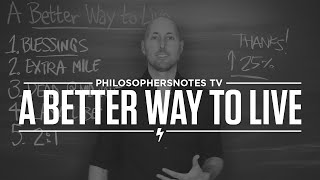
Brian Johnson presents a spoken summary of Og Mandino's A Better Way to Live (Philosopher's Notes TV episode). He frames Mandino's life (early addiction and later success) and emphasizes that the book codifies 17 rules for living. In this segment Johnson highlights five major ideas: (1) count your blessings (gratitude increases happiness), (2) go the extra mile (strive to give your best), (3) treat each person as if they might die at midnight (be kinder/fully present), (4) be a craftsman (do small unseen details well — Statue of Liberty/Steve Jobs examples), and (5) accept failure as paired with success (Hank Aaron struck out far more than he homered). Johnson references Mandino's commercial success and uses stories and analogies to make the rules practical.
Questions this video answers
March 14, 2015.
Hit 710 home runs; struck out 1,262 times.
1866.
About 25 million copies.
14 or 15 books.
Chapters
Hi, this is Brian. Welcome back to Philosopher's Notes tv. Today, another great book, A Better Way to Live by Og Mandino. Og Mandino, first book of his that I've read, and one of the last that he wrote. Ogg was one of the most popular inspirational writers of his era in the 70s and 80s. But what's fascinating is that at 35 years old, OG Mandino was essentially, in his own words, a drunk derelict who was essentially homeless, driving around the country, finding work, had lost his first wife and his family at the end of his rope. He had like 20 or 40 bucks left to his name and was contemplating buying a gun to end his life. That's where Og Mandino was. And then he figured out how to create a better way to live. And this book documents his 17 rules of life. It's a fascinating story. He picked himself up. He got inspired by W. Clement Stone in Napoleon Hill's book Success through a positive mental attitude. He wound up working for W. Clement Stone as an insurance guy in one of his companies. And then he wound up publishing and running Stone and Napoleon Hill's magazine, Success Unlimited, and then wrote the Greatest Salesman in the World, which We're Going to Do tomorrow, which sold millions of copies. He went on to sell something like 25 million copies of his books. 14 or 15 books in his lifetime. Extraordinary story. So this book is all about his 17 rules. We've got the Philosopher's Note with a bunch of ideas. And we have my five favorite ones now and a new piece of chalk. Exciting. First rule. 17 rules of life. What's the first rule? The first rule is count your blessings. Count your blessings. All the great teachers talk about all the same things. We did the Science of Gratitude the other day. Right? Thanks. By Robert Emmons. What did he teach us? That if you keep a gratitude journal, you can increase your happiness by as much as 25% once a week. Capture five things for which you're grateful. You can boost your happiness by 25%. That's truly astounding. And that's why it's rule number one. Ogg has some great stories about how to really identify what you're. So, what you have going on in your life, what are your assets? He says, no matter how broke you are, you're extraordinarily wealthy. And he challenges us with some great questions. He says, look, what's your freedom worth? Most of us live in a free nation. What's that worth to you to have the freedom to watch something like this, to do what you do during your day and not be overly controlled by a despotic government. What's that worth to you? Is it a million? Is it 2 million? Is it 5 million? Is it 10 million? What about your hands? What would you sell your hands for? What are those worth to you? How about your feet? How many millions of dollars would you sell your feet for? You wouldn't. What about your eyes? Your heart? You wouldn't sell these things, yet they're extraordinarily valuable. We need to count our blessings. No matter how down and out we may feel, we have a ton to be grateful for, and we boost our happiness by this 25%. How does that work? That's what we talked about yesterday. When you think about new things and you do new things, you prune old neural pathways. Literally, you get rid of them. They don't become likely to show up again. When you train yourself to look for what's good in your life, which is what you do when you keep a gratitude journal, you sprout new neural pathways that are much more healthy, and you get a huge boost in your happiness. That's our first big idea. Count your blessings. And it's the first rule of creating a better life. The second rule. Go the extra mile. Go the extra mile. You want to depress yourself? See how little you can do in a given day. Just stay in bed, pull the covers over your head, don't even go an inch, let alone the first mile, let alone an extra mile. Fantastic recipe to feel miserable. If you want to feel great, change from what's the least I can do today to what's the most I can do today to serve the people I have in my life, whether that's my employer or my partners or my colleagues or my clients or my family. What's the most you can do? Everything always comes back to this one word. Arete. How do you express the highest version of yourself more and more consistently today? Going the extra mile. That's what that's. This is all about. You're capable of giving yourself in a certain degree. To the extent you do that, you will feel great. So think about that. Are you asking yourself the question, what's the least I can do? Or what's the most you could do? In the note, I talk about that Olympic athlete that Matthew Kelly refers to. Think of the Olympic athlete who's asking herself, what's the least I can do to win a gold medal? It's nonsense. No Olympic athlete who actually aspires to and winds up receiving a gold medal says what's the least I can do to get a gold medal. They think, what's the most I can do? I'm so excited about this. I'm so committed to this. I'm going to give my life to it. How can I get a little bit better today and give as much as I can? That's the extra mile. That's the second rule. The third rule. Not the third rule, but the third big idea. I'm not sure what number rule this is, but it's this. Imagine that the next person you meet today is going to be dead at midnight. At midnight, their life is going to end. Imagine that the next person you're going to interact with and the person after that and the person after that. Every person you're going to meet today. How would you treat them? What would you be like with them if you knew that? If you knew that you were going to be one of the last people with whom they interacted? OG asks us this question and he says, you know how you'd be? You'd be more kind and tender and loving than you've ever been. So be that. Now he shares some amazing stories. He's a great storyteller. You can see why he was so successful and has sold so many books. Let's make people feel important. Let's be present in people's lives and treat them with the same kindness and tenderness and love that we would if we knew they would be dead at midnight. And then think about how you would act if you knew you were going to be dead at midnight. How would you show up? A lot of the petty stuff. Well, hopefully all the petty stuff, the nonsense, the BS goes away with that lens. That's the place from which we want to live more and more consistently. That's our third big idea. Fourth big idea. This Statue of Liberty. We want to talk about her hairdo. So this is a artistic rendering of the Statue of Liberty? Yep, that's it right there. Get this. 1866. 1866 is when France, thank you again, gave the US the Statue of Liberty. Grover Cleveland was President of the United States. Now, the Statue of Liberty is something like 350ft tall. Now, in 1866, we didn't have any airplanes, we didn't have any helicopters. So there was no way that anyone was ever going to see the Statue of Liberty's hairdo. The top of her head just wasn't going to see it. But the craftsman who actually created the Statue of Liberty and I'm going to figure out his name so we can Celebrate him properly. Auguste Bartholdi, who designed the Statue of Liberty, made sure that every single hair on her head was perfect. Was perfect. It took him weeks and weeks and weeks longer to make sure the top of her head was perfect. And he didn't need to do that. No one was going to see the top of her head except for him and his team and the people that assembled the Statue of Liberty. But he did his best anyway. He did it right. He's a craftsman. He showed up and he made the tiniest detail right. And now we can fly and we can look at that, we can admire that. So if you happen to be above the Statue of Liberty one day, appreciate that looking down. Steve Jobs, craftsman, did the same thing. He had his engineers sign the inside of a computer. You're never going to see that, but it was designed beautifully. Every single part of your Apple experience is designed beautifully. Craftsman. Very similar to going the extra mile. Think about how you can do your best. Quit cutting corners and show up and make sure your Statue of Liberty's hair looks great. That's our fourth big idea. The fifth big idea. Two to one, two to one. What's that? Well, Mandino tells a great story. It's 1974, which happens to be the year I was born, but it also happens to be the year that Hank Aaron was chasing Babe Ruth for the home run record. Alright? Now, Mandino was curious, how many strikeouts did Hank Aaron have at that time? So he called up the Atlanta Braves and he said, hey, you know, I'm curious, how many times has Hank Aaron struck out? And the little young PR guy said, strike out? Well, I have no idea. He's like, well, can you check for me? And the guy puts him on hold, goes and checks, comes back and says, well, Hank Aaron has hit 710 home runs. And Ogg says, yeah, I know that. And he says he struck out 1262 times. 1262 times Hank Aaron struck out, hit home runs 710 times. He struck out nearly twice as often as he hit home runs. That's an amazing thing. We talk about this all the time. You cannot succeed, whether it's hitting home runs in whatever aspect, metaphorically of your life, whatever, without having a certain number of strikeouts. And in this case, the greatest home run hitter ever arguably struck out twice as often as he succeeded. Hitting a home run, that's an extraordinary thing. Keep that in mind. We know that success goes with failure. Home runs goes with strikeouts. Alan Watts said that some things are so connected that you can say it goes with one word, not two words goes with success. Goes with failure. Home runs goes with strikeouts. Night goes with day. Right? Light goes with dark. Whatever you want to throw in there goes with you can't separate one from the other. And if you want to succeed, you need to be willing to fail. Thomas Watson, IBM. You want to double your rate of success. Will double your rate of failure. The greatest in any field are the ones who have failed the most. Broken record. We talk about this all the time. But you need to and we need to reorient our relationship to failure. Mistakes are just mistakes. No big deal. Get back up. Get clear on what you want. Learn a little bit. Get a little bit better and go hit it. Literally and figuratively. Two to one strikeouts to homers. Lady Liberty's hairdos. Perfect. That's kind of cool. Craftsman. How would you treat people if you knew they were going to be dead at midnight? How would you live if you knew you were going to be dead at midnight? We're not guaranteed any moment. Show up and be your best moment to moment to moment. The extra mile time to go on that trip. Do your best. What's the most you can do? And then blessings rule number one for a better way to live. Count your blessings. You have a ton of them. Paying attention to them. Boost your happiness. There you go. I appreciate you and all your kind words and support. I count my blessings daily to have the opportunity to do this and I appreciate you making that possible. Hope you enjoyed. Look forward to sharing with you soon. Have another awesome day. See you.