PNTV: Be Quick -- But Don't Hurry by Andrew Hill with John Wooden (#255)
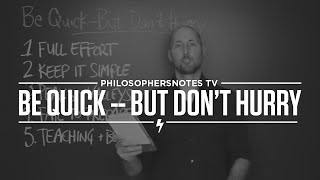
Andrew Hill recounts lessons from John Wooden on operating at full speed without panic. Wooden's core idea: be quick but don't hurry. He emphasizes fundamentals, meticulous preparation, and steady effort over emotional swings, teaching through example rather than lectures.
Questions this video answers
Finding Success in the Teachings of a Lifetime
Andy (Andy) Hill with John Wooden
Second season
Chapters
Hi, this is Brian. Welcome back to Philosopher's Notes TV Today, another great book, Be Quick But Don't Hurry. Be Quick But Don't Hurry by Andy Hill with John Wooden. Subtitle Finding Success in the Teachings of a Lifetime so this book is part autobiography, part leadership manual. And Andy Hill played for Coach Wooden back in the day during the UCLA dynasty. And he actually sat on the bench. He was a high school standout, was great freshman year on the kind of the JV team back in the day. They could only play three years on varsity. And then he rarely got into the games during his stint on varsity at UCLA in. And he was actually kind of bitter about that. He was ambivalent about his experience playing with Coach Wooden, even though he won three NCAA championships, one of only 12 athletes to do that in basketball, which is pretty remarkable. But it wasn't until later in his life that he realized all the success that he had in life. He was the head of CBS.
Studios.
For example, and done some other great things. All this success came from the lessons that he learned from Coach Wooden. And later in his life he went back and created a deep relationship with Coach. And they wrote this book together after he spent time unpacking all the wisdom. It's a great, fun book. If you're into sports and leadership, I think you'll enjoy it. We've got the Philosopher's Note with a bunch of big ideas. Five of my favorites here. Let's start with what it means to go quick, to be quick, but don't hurry. Andy says it was impossible to play for UCLA and not have that phrase just drilled into your consciousness. Coach would stop practice, Be quick, but don't hurry. Be quick but don't hurry. Said it so much it almost became a joke. But they got what it meant and the basic idea. Even Coach Wooden couldn't articulate it perfectly, but he said you could just feel it. You knew when you were being quick but not hurrying, where you're right at the edge of your ability, right there at the edge, yet you're still centered. And Coach would say, you need to be quick if you want to do things in life, but you also need to find that centeredness at your edge. It's kind of like what we talked about in the Little Book of Talent, the last PNTV episode that we featured, where if you want to grow and deliberately practice, you need to find your sweet spot, which was right at the edge of your ability, not in your comfort zone, but not so far that you're in your survival zone. That's the basic idea of being quick but not hurrying. So the question for you is, and he described it as a razor's edge, it's not easy and you're going to make mistakes when you're trying to be quick but not hurrying. But that's okay. You want to find that balance point. And the question for you is, are you not quick enough or do you go so quickly that you wind up rushing? How can you optimize that? Wherever you are, do you need to speed up a little bit or do you need to find your center a little more consistently? Whatever that is, have fun getting a little bit better. That's a prelude kind of big idea number zero here. The first big idea is full effort. So Coach Wooden, espn, as I've mentioned in a number of these episodes, voted Coach Wooden the coach of the century. He's arguably the greatest coach ever. His Bruins Go Bruins won a ton of championships, but he never focused on winning per se. Andy says he was smart enough to know that winning was a byproduct of full effort. And coach said full, full effort is success. If you do your best in this practice, today, in this game, that's success. You have peace of mind knowing that you did your absolute best, which is all you have control over. Anything that comes from that success, Coach says is a byproduct of true success. The fame that you might get, the championships, the fortune, whatever byproducts of true success. And that you gave full effort. It's a powerful thing to say, especially when you're a guy who won as.
Much as he did.
And Andy said it's not that he wasn't competitive, he wanted to win, but he was just smart enough to know that the way to get there was to ruthlessly focus on the process and showing up and creating masterpiece practices and days in the process. Second big idea is to keep it simple. So coach was a huge advocate of simplicity. Andy said that in their heyday when they were winning all those championships, they had one defense, man to man, they had one primary offense. For 40 years, they ran the exact same offense, with exceptions, for six years when they had the two best centers ever, Bill Walton and Kareem Abdul Jabbar, right, Lu Alcindor, back in the day. Other than those guys, they built an offense around them. They ran the exact same offense every single year, right? Same offense, one offense, one out of bounds play, super simple structure. Coach kept things simple. And what he wanted to do was to run those very simple plays and styles to perfection, to come as close to perfection as he possibly could. He said, hey look, you introduce complexity into that, you're not going to do it as well. And Andy said that strategically it was pointless to scout ucla. You knew what they were going to do and UCLA didn't worry about their opponents. They spent all their time mastering what they knew they wanted to do. They got really, really, really good at that. And people couldn't stop them. How awesome is that? So think simplicity, which is tied to fundamentals as well, which we're going to talk about more in a moment. But think about your life and, and if you've made it unnecessarily complex, rather than have one thing, do you have 2, 3, 4, 5, 10, 20, 30 things? Well, you try to do that many things well, you're not going to do any of them well. Simplify, bring it down to can you focus on one thing and do that as well as you possibly can. I reference Bruce Lee and Georges St. Pierre, that those guys aren't nervous about the martial artist who's practiced a thousand moves once. Bruce Lee was nervous about the guy that practice one move 10,000 times. So that's how they train, mastering whatever it is that they got into. Second big idea. The third big idea is a fun one, Peaks and valleys. So coach was not a manic guy. He was passionate, but he was grounded. And he wasn't driven by emotion. He was driven by these basic fundamentals. And he says, look, you don't want to have peaks and valleys. You don't want to be super high and emotional because when you do that, you're going to be super down and in the valley you want to even those out and just show up consistently with a rational, committed, practicing mind. Right. Now when I read this, I kind of laugh because that made me think of 15 years ago. 15 years over 15 years ago now when I was running my very first business. Young entrepreneur, 25 years old or so, we had won UCLA's business plan competition and we hired a guy out of UCLA who just graduated with his JD and his mba. And before that he was an Army Ranger, military intelligence officer who went to West Point. Amazing human being named Kelly Perdue. He became our head of business development and basically my right hand guy. And we went on to raise $5 million or another $4 million together and wound up selling our business.
But we shared an office, Westwood, right.
And as any good startup this is in the first dot com boom days we had our ping pong table and we had the dartboard in the office and all this stuff but we'd be going through the day. And if you've built a business, well, if you're alive, you know that some days are better than other days, right? And even some hours are better than other hours when you're really in it and pushing the edge from a startup perspective. Anyway, Kelly and I would, you know, shared a whiteboard, maybe we had a couple of them, but we'd after a call, right, we'd walk up to the whiteboard and we'd go, yeah, all right. That was a good one. We had a good call, right? Because it was so up and down. And then if it wasn't a good call, you'd get a sad face, right? And then this would happen so much that it just became an up arrow or a down arrow. You knew the mood for that moment. And Kelly had a phrase that. That stuck in my mind then. And since he said, look, nothing is ever as good as it seems or as bad as it seems, which is.
A great way to avoid these peaks.
And valleys, find some balance, and hopefully that right as you realize that nothing's ever as good as it seems or as bad as it seems. Now, it was a joy working with Kelly. And then a few years later, he actually wound up winning the Apprentice, the second season of the Apprentice. So check him out. Kelly Perdue. Great guy. Thanks for all your support. Kelly then and now.
Appreciate you.
That's our third big idea. Fourth big idea. Fail to prepare and you are preparing to fail, Right? So if you fail to prepare, you are preparing to fail. We've heard that before, but apparently Andy tells us this was another one of those phrases that Coach Wooden said. All the time he was prepared, he'd show up and in every single practice, he'd have a little 3 by 5 note card that he spent hours working on to figure out what he was going to drill his team on that day. He put all of his energy into full effort. Can we create a masterpiece practice today? And he expected his team to be fully prepared and so well prepared that his goal was to never call a timeout. Team was prepared. Let them execute during the game. And then in this idea as well, in the note, I talk about one of the ways that coach prepared. So I love this story and I've shared it before. But two weeks before they actually got onto the court, right, their first all team meeting, Coach Wooden, who worked with the best athletes of the era, would teach them how to put on their socks. He wanted them to be prepared at the most basic level. And literally he taught them he'd personally demonstrate how to properly put on a sock. You got to roll it over the toes a certain way. You got to pull it tight around the heel, then pull it up, and you got no wrinkles in it. That's the level of preparation that he had. He was committed to the fundamentals because he knew the fundamentals were how you actually architect. Big, long term, consistent success. I was interviewing Tom Morris the other day, the modern, practical public philosopher who was a professor at Notre Dame for years, and we were talking about his great books, True Success and others. He literally wrote the book Philosophy for Dummies, right? And he used this comparison. We were talking about exactly this, of fundamentals and doing the little things well. And he said, look, if you want to build a tent, where's some space? If you want to build a tent.
Hello, little tent, right?
No big deal. You don't need to dig a foundation. All you need to do is drill in a stake, drill in another stake, maybe sweep off the area, right? And boom, you've got a tent. Not a big deal. But if you want to build a tower, a skyscraper that you're really proud of, right? There it is. Wow. That's your tower. That is your life. If you just want a tent life, no big deal. You don't need fundamentals. You can just go through life and pick it up and move it around, whatever. But if you want to build a tower in your life, you need to dig an incredibly deep foundation. And as I've often said, if you want to see how tall a building is going to be, look at how deeply they're digging the foundation. It's the same thing with our lives. If you want to create a great life, then how deeply are you digging your foundation? How committed are you to preparing to have masterpiece days?
You don't need to if this is.
All you want, but if you want the tower, you need to commit. So that's our preparation idea. The final big idea is teaching and being so Coach Wooden didn't consider himself a coach. Primarily, he considered himself a teacher. He says, when I taught basketball, not when I coached it, when I taught it. And he describes the fact. Andy describes the fact that Coach was all about embodying this wisdom. He said, you can't. He's got a great poem that Coach would recite that I share in the note. But you can't just tell people what to do. It's who you are. That's going to be the greatest lesson. I love a quote from Emerson that I share in the note. Emerson says what you do speaks so loudly that I cannot hear what you say. What you do speaks so loudly I can't hear what you say. So you can tell me all the things you think I need to do, or we can tell our kids or our colleagues or our spouse or our friends or whatever or what we think they should do, but they're going to do what we're doing. It's particularly amazing to see this as we have our Emerson is turning three, our little guy Emerson is turning three in a week and he does everything we do. It's surreal and it's exciting to realize that's how we're teaching him. It's not hey do this, it's this is what I do. You're learning on a subconscious level. So we want to embody this. If we want to inspire and empower people in our lives, we need to be the change we want to see. It's a truism, but we need to step back and realize just how true it is and then live consistently with it. So that's a quick look at Be quick but don't hurry. Embody what it is you want to teach, prepare, dig a deep foundation. If you aspire to have a great life. If you don't, awesome, that's fine too. But if you do want to create a great life, then you got to be honest about what it takes and, and the foundation. The fundamentals are what it's all about. Certainly the key aspect of what we build on peaks and valleys, Happy face, sad face, up arrow, down arrow. Nothing is as good as it seems or as bad as it seems. Thank you. Kelly Perdue. Second big idea that we went through was the keeping it simple. UCLA ran one offense, one defense, one out of bounds play to perfection. How do you simplify your life? How do you remove unnecessary complexity? And remember, full effort is true success. Everything else is a byproduct of that success. Be quick, but don't hurry. Be at the edge of your ability while still being centered and enjoy the process. I hope you enjoyed what was the big idea that jumped out the most, what question that I asked, resonated. Take the time to think about it and then figure out how you're going to make that a part of your day to day life again. That's the whole point of this, is to plant these seeds and tend the ones that really resonate as we optimize and actualize. Hope you enjoyed. Share more soon. Have another awesome day. See you.
Hi, this is Brian. I hope you enjoyed that PNTV episode.
A lot of people don't know all.
The stuff I do beyond these free videos I share on YouTube. So I thought I'd do a quick video to give you an overview of our membership program that you can get access to and get a ton of other stuff. So here's a quick look. 10 bucks a month Join the Optimal Living Membership program. You get Instant Access to 250 Philosopher's Notes on some of the best Optimal living books out there. Old school classics, positive psychology, modern stuff, Mindfulness, Peak Performance, purpose, neuroscience, wealth, etc.
And what you may not know is.
That in addition to the PNTV episodes, I create PDFs on all these great books. So six page PDFs. Let's take a look at one of them. Joseph Campbell, you want to figure out how to live your hero's journey? Well, this is a great place to start. I basically pull out my favorite big ideas, riff on them, connect them to other books and other ideas and help you apply this wisdom to your life today. That's what the PDF looks like. Again, we have 250 of these on all these different great books and and then I record those PDFs as an MP3 so you can listen to that MP3 while you're on a walk or working out or doing some errands or whatever that is. Philosopher's Notes. A lot going on there. And then in addition to Philosopher's Notes, you get access to Optimal Living classes. Optimal Living 101 idea here is that all those great teachers come back to the same big ideas again and again and again. I distill those ideas into classes. Super practical, fun, inspiring classes ranging from Habits 101, Confidence 101, Getting Stuff Done 101, Meditation 101, instant access to all those classes. And then Future classes include Relationships 101, Energy 101, Purpose 101 business goals, etc. Those are our full length classes. And then I create micro classes. Two to three to five minute little bursts of wisdom on my favorite great ideas from these great books across the domain that you want to optimize in your life. So we have dozens of these so far. I create 50 new micro classes every month and 10 new philosopher's notes every month for 10 bucks a month. So we're blessed to have thousands of members who are enjoying the program and sharing some incredibly kind words with us. And super simple $10 a month cancel anytime. Would be honored to be a bigger part of your life and I appreciate your support. And here's to optimizing and actualizing.
More from Brian

Heroic +1: What’s THE Most Creative Act in the Universe?: Turning Around Glitches (#2024)









