PNTV: Born for This by Chris Guillebeau (#290)
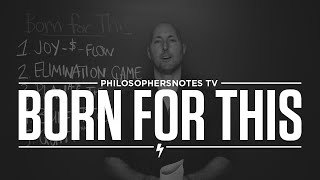
Chris Guillebeau's framework for finding work you love: the intersection of joy, money, and flow. Use the elimination game to narrow down, test ideas with Plan A through Z, apply the Buffett goals test (write 25, pick 5), and quit projects while staying committed to your bigger vision.
Chapters
Hi, this is Brian.
Welcome back to Philosopher's Notes tv. Today we've got another great book, Born for this by Chris Guillebeau. Born for this subtitle how to find the work you were meant to do. How to find the work you were meant to do. I interviewed Kris already. Check out that interview. This is a great book. If you're looking for tools and tips and strategies to figure out what you're here to do, your job with a capital J. I think you'll like this book. Kris has also written a number of other great books. The Art of nonconformity, the $100 startup, and I need to cover those. And I've also covered the Happiness of Pursuit. Awesome book. He created something called the World Domination Summit, which has to be the best.
Name for a conference ever.
We've got a bunch of big ideas here and I'm excited to share five of my favorites now. So we'll start with the first big idea is Joy Money Flow. He says that the people who have really figured it out, who have figured out what they're born to do, have figured out these three things. These are the kind of numbers on the winning career lottery ticket. It's the nexus point. These three circles, Joy, Money and Flow. Now this is very similar to. Well, let's walk through it, then I'll talk about the similarities. So, Joy, what do you love to do? What do you truly love to do? I like to say that you love it so much that you would pay to do it. What gives you joy when you do it? And then the second facet in Kris model is what can you get paid to do? What does the world need? How are you going to meet those needs? Otherwise, it's just a hobby. We're not talking about a hobby with this book. We're talking about getting paid to do what you were born to do. It's an important distinction. Life is very short, you may have noticed, and we don't want to spend most of our time doing stuff to pay the bills. That isn't something that we truly love to do. At least I don't. I think if you're watching this, you fall into that category as well. Then the third circle is when are you in flow?
Right.
When you're just doing your best work. It's when your strengths are engaged.
Right.
So, Joy Money Flow. Now, this is very similar to a number of different frames we've used in these notes, particularly Jim Collins from Good to great. He says great businesses and great individuals follow something very similar. Rather than Joy he says love. They do stuff they truly love to do. And his second thing is what they're great at, what they can truly be great at. The best in the world at, right? When their strengths are engaged and they can truly be extraordinary. And then, of course, there's the money and meeting needs. He calls it the economic engine. If you don't have all three of those, joy, money flow, you do not win the career lottery. Create your own ticket by figuring that out, right? Joy, money flow. Now, the second big idea is to help us unpack that. So, as you'd expect, Kris has a bunch of exercises to help drill into with more clarity what this looks like for you. Then, how you engage in your life, right? Depending on what you're doing now to find that ideal path. He's got a bunch of fun ways, strategies, and tips to engage in. But he has something called the elimination game. And imagine this. Imagine if you wrote down all of the things that you could possibly do so you could continue doing exactly what you're doing right now. You can do this, you can do that, you can do this, you can do that, that, that, that, that. Figure out all the different things you could do in theory, right?
Get that list created and then go through.
And the first thing you want to do is you want to eliminate everything that doesn't give you joy. When you think about it, you're like, nah, I can't imagine doing that. Yeah, I could do that. That doesn't fire me up. That doesn't give me joy. I don't love the idea of doing that. He says eliminate those first. Again, life is short. Too short to be doing things that we don't feel pretty excited about. The second thing you want to do is eliminate the things you can't. You don't think you can figure out how to get paid to do it. Again, we're not talking about a hobby. We're talking about finding and creating a meaningful career where you're getting paid to meet needs and pay the rent. And then the third thing is.
So you eliminate things that don't give.
You joy, you eliminate things that don't give you money, and then you eliminate things that just don't line up with what you're truly could be great at, right? Where you can get into flow more and more consistently. That's a cool exercise. And if you're looking to create more purpose and meaning and mojo and get paid to do what you love to do in service to the world, that's a helpful exercise to do. And again, we want to move from theory to practice. I've done the Jim Collins hedgehog thing dozens and dozens and dozens of times. What do I love to do? What can I be truly great at? And what does the world need? It's a different answer in different days and certainly in different weeks and months and years. Come back to it and get a little bit more clarity. Right. We talked about David Data has a great model. He says, look, what you're really doing in your life is you're penetrating concentric circles of meaning and purpose. You start out maybe kind of wandering around here, then you get a little bit more clear, and you're doing this now. You feel a little bit more on purpose, and then you realize that's not quite it. Then you get a little bit deeper. Then you get a little bit deeper, a little bit deeper, and you get in. And frankly, that's an infinite looping pattern. Right. You're always refining getting a little bit more close to your truest dharma. And then that continues to evolve. But anyway, exercise. Try it. Check out the book for a lot more. Like that third big idea, plan A to Z. And then I've got a little T plus E here. Trial and error. That's what we're talking about. Too often we get this idea that that person just knew. They just knew they were kind of born, and they were born for this, and they knew shortly after they were born that this is what they were here to do. And there might be some people that stumbled into that good fortune, but those are rare scenarios, if they exist at all. More people, myself included, discover it via trial and error. So you want to get rid of the myth that you're somehow, if you don't have it figured out, you're never going to figure it out. You need to try things. And he makes the fun and great comparison. We're going to talk about more in the next episode on the Science of Hope that if you try plan A, let's say you do this and you're like, hey, you know what? This is it. I'm going to go for this. And it doesn't work. Okay, awesome. Welcome to the game. Trial and error. What did you learn? And remember, if you tried plan A and it didn't work, you've got plans B through z. You've got 25 more letters at your disposal. Then you can go AA, AB. You can work it. Infinite number of pathways equals an antifragile sense of confidence and trust in yourself. You can figure it out. You just need to keep on trying things, right? And he says in the past, he used to say, look, plan A, there is no plan B. And now he's like, well, yeah, when you start something, you want to have a plan B. If that doesn't work, then what are you going to do? Nassim Taleb talks about that in Antifragile and calls it optionality. If you only have one option, you're fragile. If you have two, you're a little bit more robust. Three, you're a little bit more robust. But if you have infinite options, optionality, you're anti fragile. This one doesn't work. Cool. Assimilate the lessons, go to the next one. Same thing. Assimilate the lessons, go to the next one. Get a little bit smarter each time out. Remember plan A through Z, Trial and error. Fourth big idea was actually only a sidebar little comment that he had, but I thought it was awesome. So here we go. It's what's called the Buffett goals test. So apparently back in the day, Warren Buffet, one of his friends came up to him and said, hey, you know, I'm struggling to figure out what I want to do. Warren Buffett said, okay, write down 25 life goals. Not like bucket list, like, oh, I want to go visit this and that, or whatever, right? But things you really want to do with your life that are important to you, that have true, deep meaning. Life goals, what are they? Come up with 25 of them. Warren Buffett recommended to his friend. He said, okay, once you got 25, pick five of them and throw away the other 20. Literally throw them away. You're going to get to them at some point. No, these five are what you're going to dedicate your life to. Be willing to make a decision day seer, cut off all these other options and say, that's what's important to me. I'm going to shape my life around these top five priorities. I love that. 25. Find your five, throw away the other 20. Our fifth big idea is to quit. Final chapter in the book. I think Kris says that, look, winners quit all the time. We have this myth that you can never quit, that if quitting is for losers. And he's like, really? Well, there are a lot of different ways to look at all the different stories around persistence. And the way that I like to frame this idea is you can quit on an individual project basis, right? Your plan A may or may not work, and you need to have the courage and the confidence and the clarity to say it's not working, right? So I'm going to quit. That and I'm going to take the lessons learned and go over here. And if that works or doesn't work, I'm going to go continue on my Alphabet soup plans. Right? So you can quit on an individual project. What we don't want to do is on a micro level. What we don't want to do is quit on a macro level. You got to know that this is how it works. Have that growth mindset and be willing to persist on the highest level. You're not going to give up until you get a little bit more clarity and a lot more clarity. And ideally get to the place where you figured out what you're born to do. Quit in the little things. Hold that deep persistence and and willingness to try again and again and again on the highest level. But remember, winners quit all the time. He says, look, it's true that you miss every shot you don't take, right? But if you miss every shot you do take, it's time to try a different strategy. Be willing to quit and move into something that makes more sense. Keep in mind your 25 goals reduced to your 5. What's really important to you. And do that exercise again. Just like that. Plan A to Z. Trial and error. It's not about waving a magic wand and figuring it out. And if you don't have it figured out, you're in the wrong category. It's trial and error. Try things. I have tried so many things. One of the key reasons why I feel blessed to do what I do now is I've tried a ton of things, most of which didn't work. Cool. What can I learn? How do I get more depth in clarity in what I really want to do? Elimination game. Write down all the things you could do. Eliminate the things that don't give you joy that you don't think you can make money on and that you don't think will give you flow. And. And that brings us back to our joy. Money flow. What really fires you up? How can you get paid to serve other people with that? And then how does that intersect with where you can be in flow, what you can be truly great at, your native strengths, etc. That is a quick look at Born for this. I hope you enjoyed and I look forward to sharing more soon. Have another awesome day. See you.
You. Hi, this is Brian. I hope you enjoyed that PNTV episode. A lot of people don't know all the stuff I do beyond these free videos I share on YouTube. So I thought I'd do a quick video to give you an overview of our membership program that you can get access to and get a ton of other stuff. So here's a quick look. 10 bucks a month Join the Optimal Living Membership program. You get Instant Access to 250 free Philosopher's Notes on some of the best optimal living books out there. Old school classics, positive psychology, Modern stuff, Mindfulness, Peak Performance, purpose, neuroscience, wealth, etc. What you may not know is that in addition to the PNTV episodes, I create PDFs on all these great books. So six page PDFs. Let's take a look at one of them. Joseph Campbell.
You want to figure out how to.
Live your hero's journey? Well, this is a great place to start. I basically pull out my favorite big ideas, riff on them, connect them to other books and other ideas and help you apply this wisdom to your life today. That's what the PDF looks like again, we have 250 of these on all these different great books. And then I record those PDFs as an MP3 so you can listen to that MP3 while you're on a walk or working out or doing some errands or whatever that is. Philosopher's Notes. A lot going on there. And then in addition to Philosopher's Notes, you get access to optimal living classes. Optimal Living 101 idea here is that all those great teachers come back to the same big ideas again and again and again. I distill those ideas into classes. Super practical, fun, inspiring classes ranging from Habits101, Confidence101, Getting Stuff Done101 Meditation101, instant access to all those classes and then Future classes include Relationships 101 Energy 101 Purpose 101 business goals, etc. Those are our full length classes. And then I create micro classes. Two to three to five minute little bursts of wisdom on my favorite great ideas from these great books across the domain that you want to optimize in your life. So we have dozens of these so far. I create 50 new micro classes every month. 10 new philosopher's notes every month for 10 bucks a month. So we're blessed to have thousands of members who are enjoying the program and sharing some incredibly kind words with us. And super simple. 10 bucks a month. Cancel anytime. Would be honored to be a bigger.
Part of your life and I appreciate your support.
And here's to optimizing and actualizing.
More from Brian

Heroic +1: What’s THE Most Creative Act in the Universe?: Turning Around Glitches (#2024)









